Capabilities
Data Engineering Services for Reliable Business Pipelines
A dashboard is a symptom, not a system. Most of the reporting problems blamed on a BI tool are pipeline problems: nobody agreed what correct data looked like before it was moved. Our data engineering services focus on the layer underneath the chart, where records are moved, validated and transformed into inputs that analytics and AI work can actually rely on.
Start with contracts, not connectors
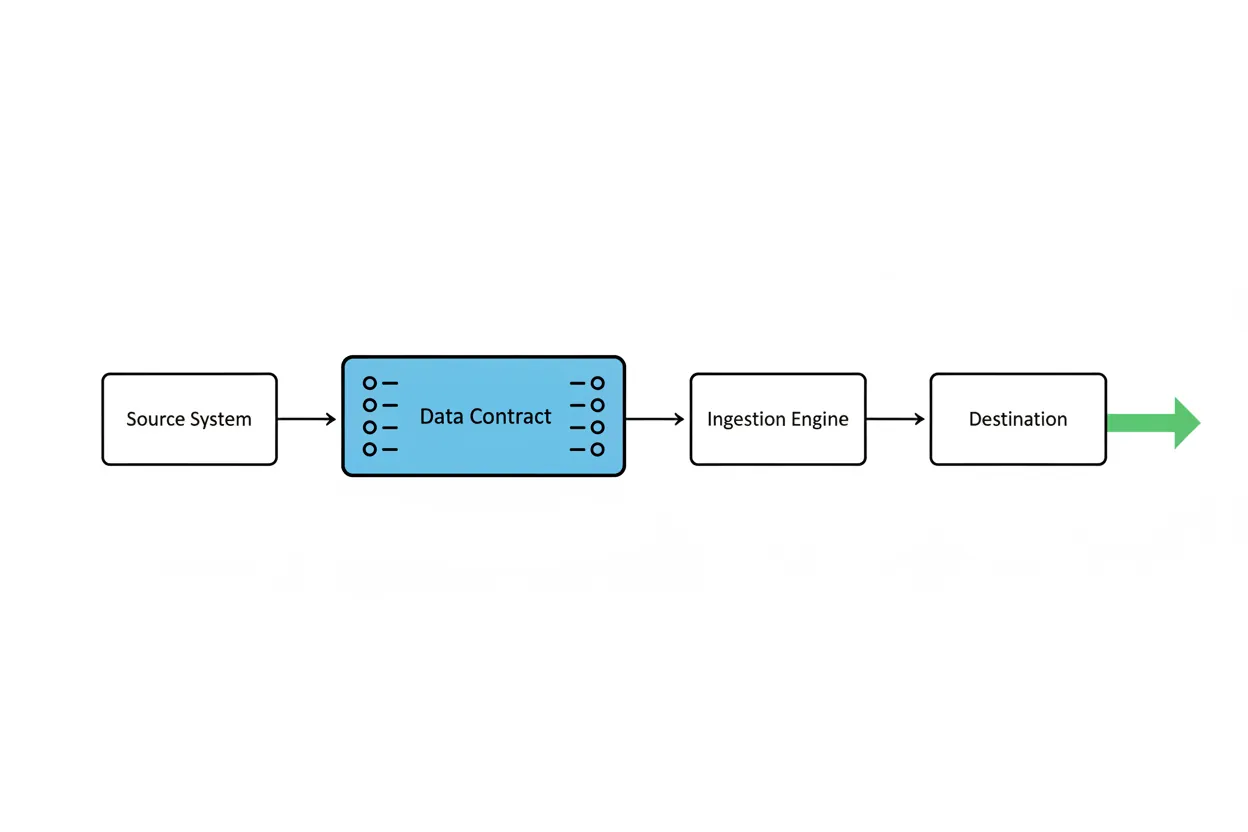
Before any code is written, the work starts with a written agreement between the source system owner, the person who consumes the output, and the engineer in the middle.
That document names the tables and fields in scope, the data type and business key for each field, how often the destination needs to refresh, the expected row volumes at normal and peak load, who grants access and through which method, and how long records are retained at the destination.
Vendors and consultancies describe this territory broadly as integration, quality and modernization work spanning platforms and processes, as Thoughtworks frames it. The contract turns that abstraction into something testable. If a field cannot be defined, it does not belong in the first release.
Choose an ingestion pattern that matches decision latency
Pattern selection is a business decision disguised as a technical one. Ask what decision changes if the data is four hours old. If nothing changes, a scheduled batch load is cheaper to run and simpler to debug.
If an operational decision genuinely depends on sub-hour information, event-driven ingestion or change data capture is worth the added complexity; Qlik describes log-based change data capture as reading the database transaction log directly to deliver inserts, updates and deletes downstream. The same page distinguishes ETL, which transforms before loading, from ELT, which lands raw data and transforms inside the destination. Both patterns are legitimate.
Website and app event capture is a separate discipline, handled in workflow integration and tracking.
Build validation into delivery, not a later cleanup project
Quality checks belong inside the pipeline run, not in a quarterly audit. Practical checks include schema assertions that fail the run when a column type changes, duplicate detection on the agreed business key, null and range thresholds on fields that drive reporting, and source-to-target reconciliation that compares record counts and control totals for each load window.
Failed records go to a quarantine table with the reason attached rather than silently disappearing or silently landing. Rejection thresholds are agreed in advance, so the pipeline stops before a bad load reaches a report. For a sector-specific view of how records move between systems, see a healthcare CRM integration example.
Free Audit
Want a straight read on where your budget is leaking?
Plan for change and failure before go-live
Sources change without notice. A vendor renames a column, an API deprecates a version, a nightly export arrives empty, a network call times out halfway through a write. Durable data pipeline development assumes all of this. Writes are made idempotent so a rerun produces one correct row rather than a duplicate.
Transient failures retry with backoff, and persistent failures stop the run instead of partially loading. Backfills are a documented procedure with a defined date range, not an improvised script. Schema evolution rules state which changes are additive and safe, and which require review. Where this feeds measurement work, those rules connect to healthcare attribution implementation.
Make pipeline operations observable and owned
An unmonitored pipeline fails quietly, and the first person to notice is usually an executive reading a wrong number. Observability means four things are visible without opening code: freshness, meaning when each destination table last updated successfully; completeness, meaning records loaded against records expected; failure state, including which step failed and why; and ownership, meaning a named person or rotation receives the alert.
Alerts route to a channel people actually read, and every run writes a history record that can be inspected later. The same discipline underpins credible reporting downstream, including marketing attribution services.

Document and hand over work your team can maintain
Handover is part of the engineering, not an afterthought. The engagement produces pipeline code in a repository your organization controls, a dependency list with versions, an explicit statement of where credentials live and which boundaries govern access to them, and a runbook covering routine operation, backfill steps, reconciliation procedure and recovery from common failures.
Secrets are referenced, never embedded in code or documentation. Transformation logic is documented in business terms alongside the SQL or Python, so an analyst can explain why a number is what it is. The test is simple: a competent engineer who did not build the pipeline should be able to operate it.
Email Us
Prefer to send the context directly?
What your organization owns at the end
The difference between a maintained asset and a rented dependency is specific and inspectable. A rented dependency lives in someone else's account, uses undocumented transformation logic, and cannot be exported without a rebuild.
An owned asset is code in your repository, a schema you defined, credentials you control, and documentation your team can read. That distinction is the practical form of data sovereignty and business control.
It is also what makes everything built on top of the pipeline defensible, from decision-focused marketing dashboards to tracking records from source to outcome. Ownership, hosting location, retention and approved data flows are documented during scoping rather than assumed.
Private or on-premises deployment is a control decision, and it does not by itself establish security or legal compliance.
Questions buyers ask before scoping
Do we need real-time data for every source?
Rarely. Real-time patterns earn their cost when a decision genuinely depends on sub-hour latency, such as operational routing or intake response. Most reporting, financial reconciliation and AI training workloads are well served by scheduled loads. Each source gets its own refresh decision based on how the data is used.
What happens when a source changes its fields?
Additive changes, such as a new optional column, should pass through without breaking anything. Breaking changes, such as a renamed key or changed data type, should fail the run loudly and alert the owner rather than loading corrupted values. The schema contract defines which category a change falls into, and the runbook describes the review and backfill path.
Will we own the pipeline code and documentation?
Yes. Code, configuration, transformation logic and the runbook are written to be handed over and maintained by your team or another engineer. Ownership terms, repository location and access are confirmed in writing at the start of the engagement.
What information and access are needed to scope this work?
A list of source systems and the data owner for each, sample schemas or exports, your intended destination, the reporting or AI use case the data serves, current refresh expectations, and any regulatory or contractual restriction on where the data may be stored or processed. Read-only sandbox access is usually enough for scoping.
What can we export at the end?
The destination tables, the pipeline code and configuration, the test suite, the reconciliation logs and the documentation. Export paths are defined before build, not negotiated at the end.
More Services
Ready to see where your marketing can improve?
Request a free audit of your paid media, landing pages, attribution, and measurement setup. You'll get a straight assessment of where the opportunities are.
or email us at info@marketingpowered.ai