AI Edge
Leverage AI for Social Media Marketing Effectiveness
AI-native infrastructure meets operator-level behavioral health expertise to build social presence that actually converts.
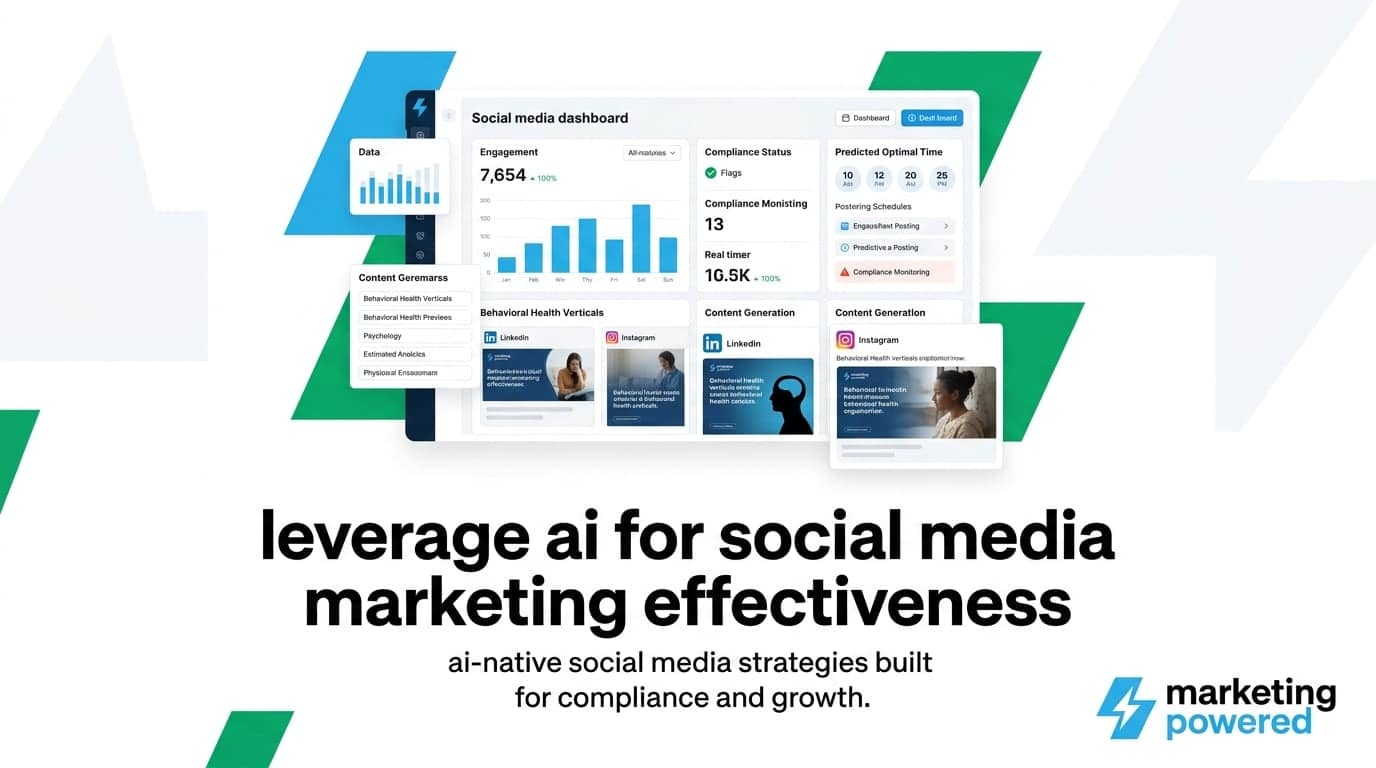
Understanding AI's role in social media
AI social media marketing is not a novelty feature or a checkbox on an agency's capabilities deck. It is a fundamental shift in how behavioral health organizations can reach, engage, and convert their audiences without burning through budget on guesswork.
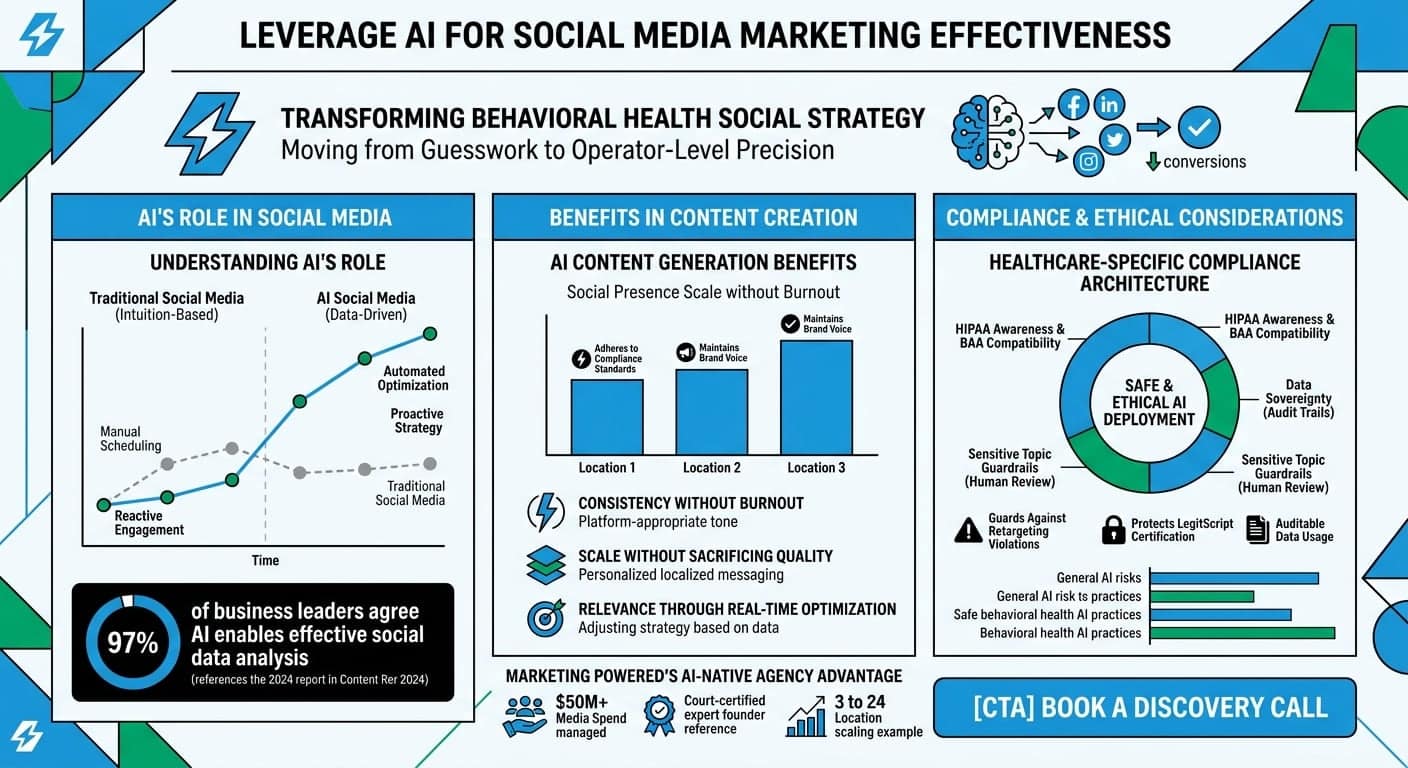
Traditional social media management relies on manual scheduling, reactive engagement, and content calendars built on intuition. AI changes the equation. Machine learning models analyze audience behavior patterns, predict optimal posting windows, and identify which content formats generate meaningful engagement versus vanity metrics. For behavioral health marketers operating under strict compliance requirements, this precision matters.
The data tells a clear story. According to a 2024 Sprout Social report, 97% of business leaders agree AI and machine learning will enable companies to analyze social data more effectively. For treatment centers and mental health practices, effective analysis means understanding which messages resonate with families in crisis, which platforms deliver qualified inquiries, and which content builds the trust necessary for someone to pick up the phone.
Marketing Powered has operated as an AI-native agency since 2022, building infrastructure specifically designed for healthcare verticals. Our approach to AI social media content is not about generating more posts. It is about generating the right posts, distributed through the right channels, measured against admission-focused outcomes rather than likes and shares.
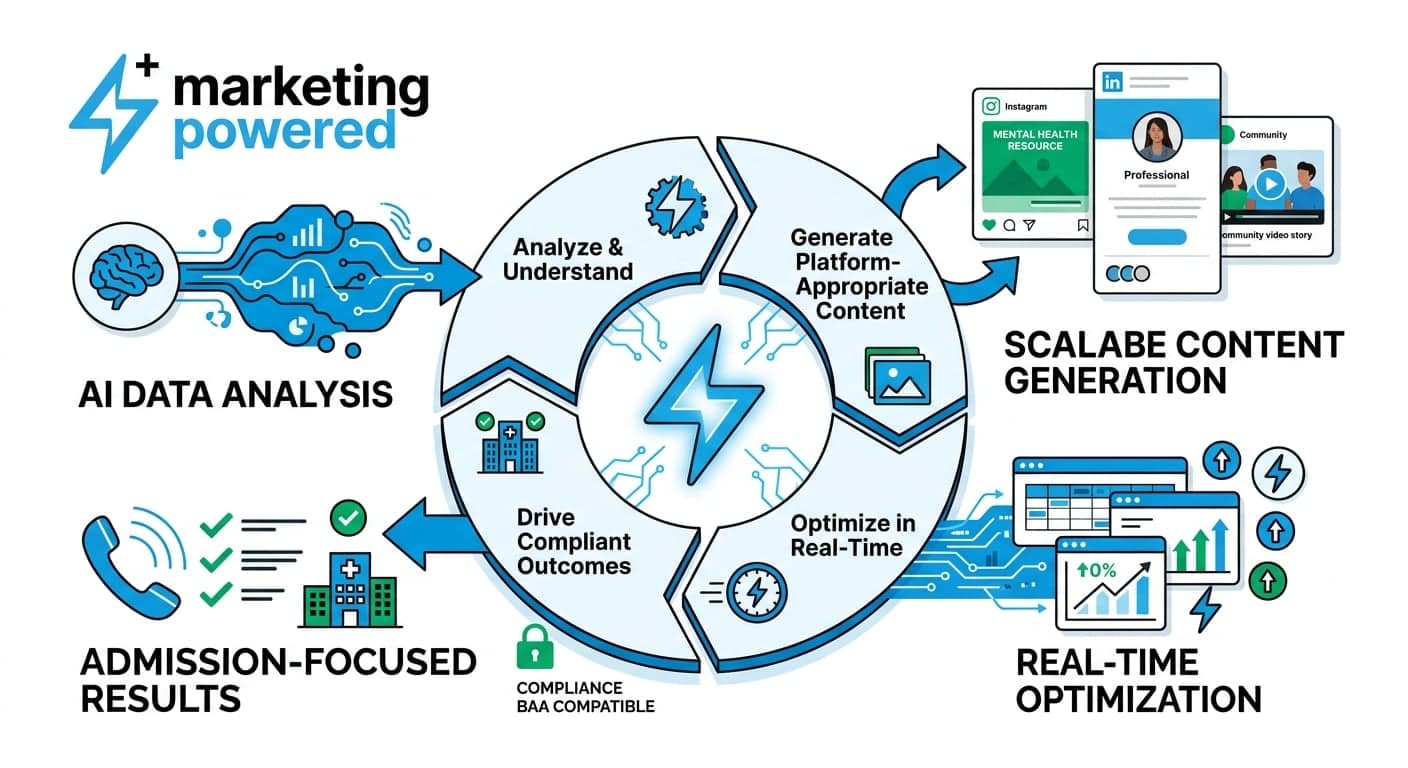
Benefits of AI in social media content creation
AI content generation solves three persistent problems for behavioral health marketing teams: consistency, scale, and relevance. When your clinical staff is focused on patient care and your marketing team is stretched thin, maintaining a steady social presence becomes a resource drain. AI systems change that calculus.
Consistency without burnout. AI tools can maintain posting schedules across platforms while adapting tone and format to each channel's requirements. A LinkedIn post addressing referral partners requires different framing than an Instagram story reaching family members. AI models trained on your brand voice can produce platform-appropriate variations from a single content brief.
Scale without sacrificing quality. For organizations operating multiple locations or service lines, AI content generation enables personalized messaging at scale. Each facility can maintain its local presence while adhering to centralized compliance standards and brand guidelines.
Relevance through real-time optimization. AI systems monitor engagement patterns and adjust content strategy based on actual performance data. When a particular topic or format outperforms expectations, the system can generate more content in that direction. When something falls flat, resources shift automatically.
The practical applications extend beyond post creation. AI-powered social listening identifies emerging conversations relevant to your services. Sentiment analysis flags potential reputation issues before they escalate. Automated A/B testing reveals which headlines, images, and calls-to-action generate qualified engagement versus noise.
Marketing Powered's paid media services integrate with our social strategy to ensure content performance data flows into paid amplification decisions. When organic content demonstrates strong engagement with your target audience, paid distribution can extend that reach to similar profiles across platforms.
Compliance and ethical considerations
Behavioral health marketing operates under scrutiny that most industries never face. Google's healthcare advertising policies restrict retargeting for addiction treatment. Meta's health-related advertising policies impose additional limitations. LegitScript certification requirements govern what claims you can make and how you can make them.
AI tools amplify both the opportunity and the risk. An AI system trained on generic marketing data will generate content that violates healthcare advertising standards. It will suggest retargeting strategies prohibited in your vertical. It will produce claims that put your LegitScript certification at risk.
This is where operator experience separates qualified partners from vendors selling AI as a feature. Marketing Powered has managed $50M+ in behavioral health and mental health media spend. We understand the compliance landscape because we have operated within it at scale.
Our AI infrastructure is built with HIPAA awareness from the foundation. Data sovereignty is not an afterthought. Patient information never enters commercial AI systems. Content generation happens within controlled environments designed for healthcare applications.
The ethical dimension extends beyond regulatory compliance. AI-generated content must be transparent. Audiences deserve to know when they are interacting with automated systems. Mental health content requires particular sensitivity around topics like suicide prevention, self-harm, and crisis intervention. Our AI systems include guardrails that flag high-risk content for human review before publication.
Free Audit
Want a straight read on where your budget is leaking?
Choosing the right AI tools for your needs
Not every AI tool belongs in a behavioral health marketing stack. The selection criteria for healthcare verticals differ significantly from general marketing applications.
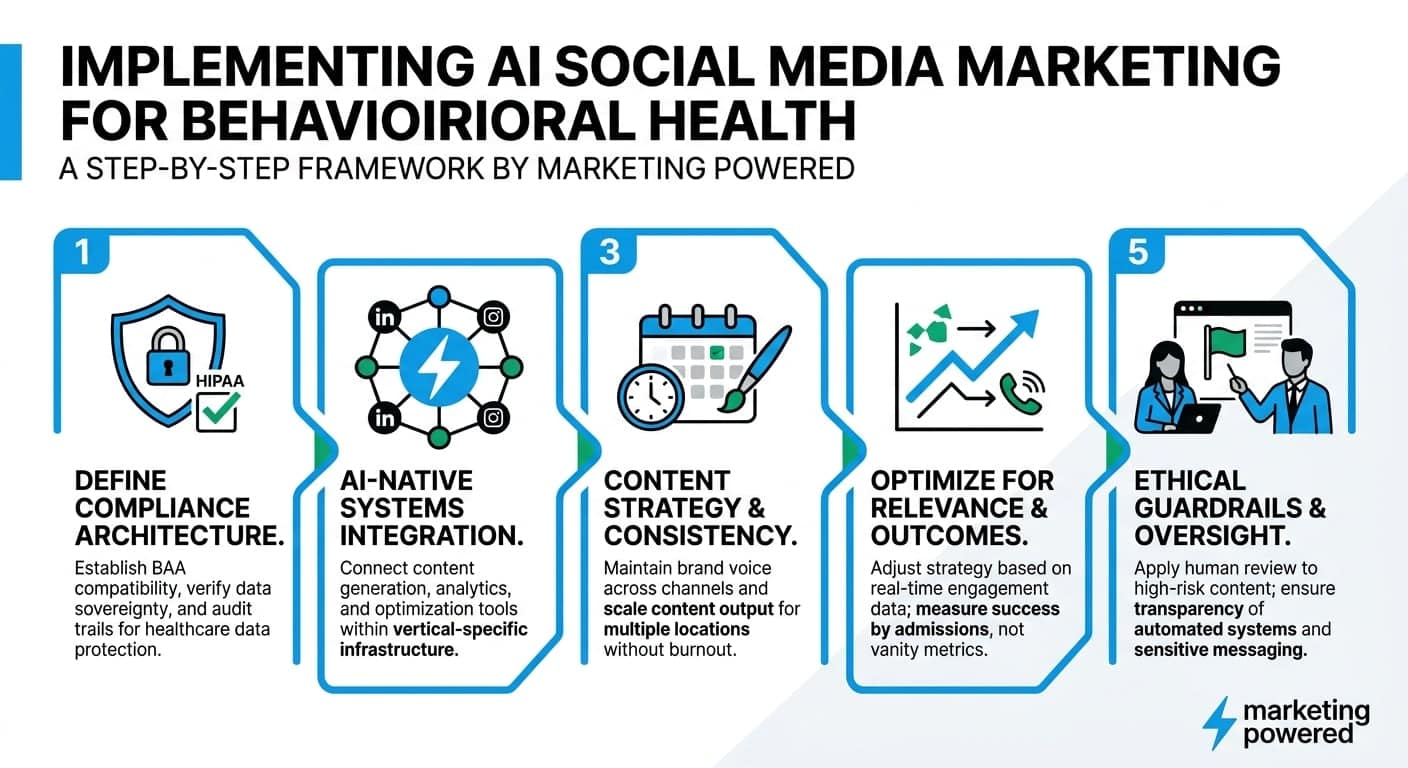
Start with compliance architecture. Before evaluating features, understand where your data goes. Does the tool send content through commercial APIs that may retain training data? Does it offer BAA (Business Associate Agreement) compatibility for HIPAA-covered entities? Can you audit what information enters and exits the system? If the vendor cannot answer these questions clearly, the tool is not ready for healthcare.
Evaluate vertical understanding. General-purpose AI tools produce general-purpose output. For behavioral health, you need systems that understand the difference between addiction treatment and mental health services, the regulatory distinctions between PHP and IOP programs, and the compliance requirements specific to your state and accreditation body.
Consider integration depth. Standalone AI tools create data silos. The most effective implementations connect content generation to analytics, analytics to optimization, and optimization back to strategy. Marketing Powered's infrastructure links social performance data to web development decisions and paid media allocation.
Assess the human layer. AI tools without strategic oversight produce volume without value.
The right implementation pairs automated capabilities with experienced judgment. Our team has scaled organizations through multi-market growth, managed $1.5M to $2M monthly in Google Ads, and tracked attribution through to admission. That operator experience shapes how we deploy AI, not the other way around.
- Compliance architecture: BAA compatibility, data sovereignty, audit trails
- Vertical understanding: Healthcare-specific training and guardrails
- Integration depth: Connected systems from content to conversion
- Human oversight: Operator experience guiding AI deployment
Case study: Successful AI integration in behavioral health
When a multi-location behavioral health organization needed to scale through a multi-location expansion, the marketing infrastructure had to grow without proportional headcount increases. Traditional agency approaches would have required expanding the content team, adding more account managers, and accepting longer turnaround times. AI-native operations offered a different path.
The challenge was significant. Each new location required localized content, market-specific messaging, and compliance review across multiple platforms. Manual processes would have created bottlenecks at every stage.
Our AI systems enabled a consistent brand voice across all locations while adapting content for local audiences. Automated compliance checks flagged potential issues before content reached approval queues. Performance data from each market fed into optimization models that improved targeting across the network.
The results are tracked to business outcomes, not vanity metrics. We measure success through admission attribution, not engagement rates. Our court-certified expert witness founder brings the same rigor to marketing measurement that holds up under legal scrutiny.
For behavioral health organizations considering AI integration, the operator-side example illustrates what is possible when AI infrastructure is built for the vertical rather than adapted from general marketing tools. Scale does not require proportional complexity when systems are designed correctly from the start.
You can explore more examples in our case studies, which detail outcomes across multiple behavioral health and mental health clients.
Ready to discuss an AI-driven social media strategy?
Book a discovery call to talk through your compliance requirements, lead quality goals, and how AI-native infrastructure can support your social media presence without the risks of general-purpose tools.
Questions, Answered.
AI social media marketing applies machine learning and automation to social media strategy, content creation, and optimization. Unlike traditional methods that rely on manual scheduling and intuition-based decisions, AI systems analyze audience behavior, predict optimal timing, and adapt content based on performance data. For behavioral health organizations, this means more precise targeting, consistent compliance, and measurement tied to admission outcomes rather than surface-level engagement metrics.
AI streamlines content creation by generating platform-appropriate variations from single content briefs, maintaining consistent brand voice across channels, and scaling output without proportional team expansion. The technology monitors engagement patterns and adjusts content strategy based on actual performance. For multi-location behavioral health organizations, this enables personalized local content while maintaining centralized compliance standards.
Key ethical considerations include transparency about AI-generated content, data privacy and protection, and appropriate sensitivity around mental health topics. Behavioral health content requires particular care with crisis-related subjects. AI systems should include guardrails that flag high-risk content for human review. Regulatory compliance adds another layer, as healthcare advertising restrictions require AI tools built with vertical-specific limitations rather than adapted from general marketing applications.
Evaluate AI tools on four criteria for healthcare applications: compliance architecture (BAA compatibility, data sovereignty, audit capabilities), vertical understanding (healthcare-specific training and guardrails), integration depth (connection to analytics and optimization systems), and human oversight (experienced operators guiding deployment). Avoid tools that cannot clearly explain where your data goes or that lack healthcare-specific compliance features.
Marketing Powered combines AI-native infrastructure with operator-level behavioral health experience. We have managed $50M+ in BH/MH media spend, scaled organizations through multi-market growth, and tracked attribution through to admission. Our founder holds court-certified expert witness credentials in advertising strategy. We built our AI systems for healthcare compliance from the foundation, with LegitScript awareness and HIPAA-conscious data handling, not as afterthoughts added to general marketing tools.
Ready to see what AI-native marketing can do for your treatment center?
Request a free audit of your paid media, landing pages, attribution, and compliance posture. You'll get a straight assessment of where the opportunities are.
or email us at info@marketingpowered.ai