Capabilities
Analytics and Attribution That Measure What Happens After the Inquiry
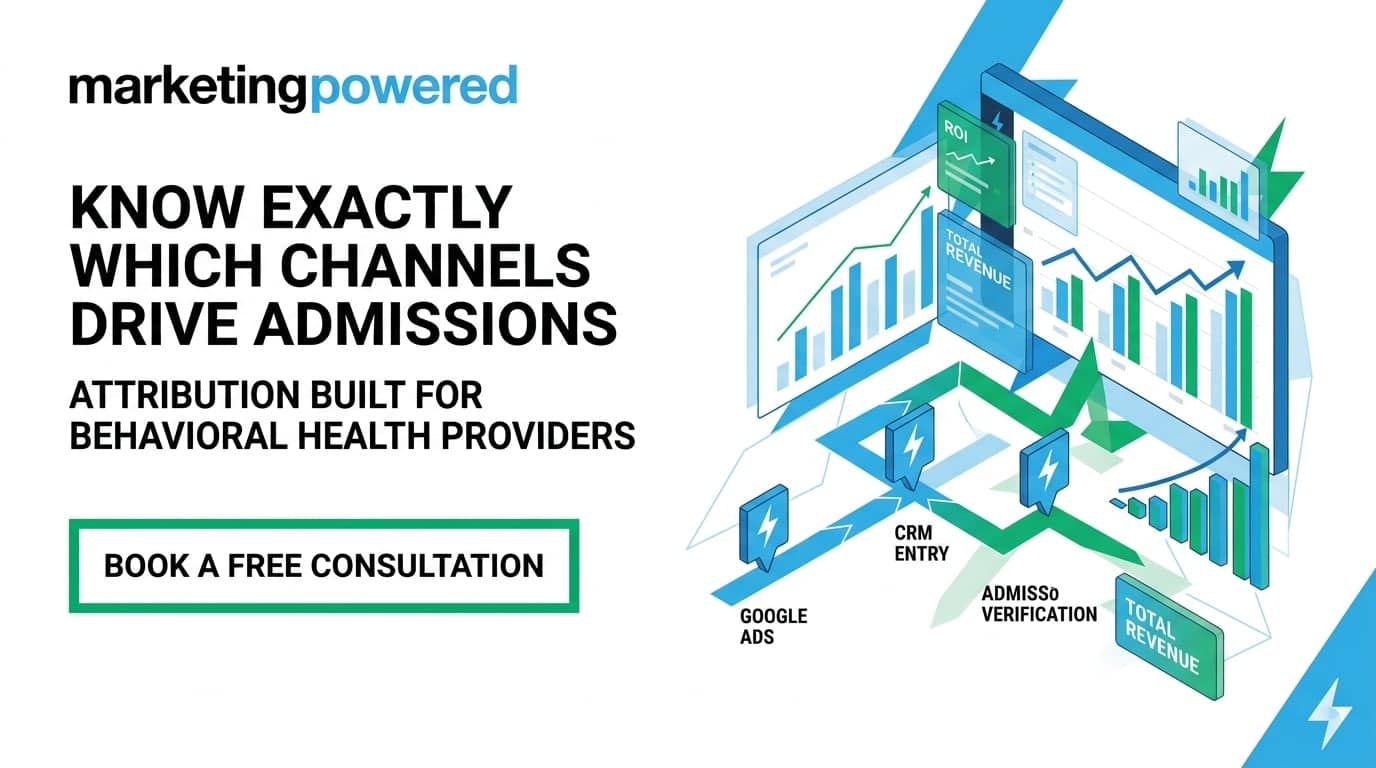
We connect campaign data, call tracking, and CRM records so you can see which investments produce qualified opportunities, admissions, or appointments, and where the available data stops short.
Why Attribution Has to Reach Past the Lead
A lead report tells you that someone filled out a form or placed a call. It does not tell you whether that person was a fit, whether anyone followed up, or whether the inquiry became an admission, an appointment, or revenue. Budget decisions made on lead counts alone reward the campaigns that generate the most activity, not the ones that generate the most value.
Marketing attribution, as we practice it, connects investment to the outcomes your organization counts. For a hospital or health system that may be scheduled appointments by service line. For a behavioral health provider it is usually admissions. For a multi-location organization it is often qualified opportunities that a local team can act on. We define the outcome with you before we measure anything.
This page describes the measurement service. The homepage summarizes it under measure what happens after the inquiry. If your current reports no longer match reality, start with fixing marketing attribution and come back here for how we run it on an ongoing basis.
What We Connect
Attribution is a data-integration problem before it is a reporting problem. Three sources have to agree on what happened.
Call tracking and CRM integration
Campaign platforms know which ad or keyword produced a click. Call tracking knows which number was dialed and which session that number was assigned to. The CRM knows what happened next. We connect the three so that a call or form submission carries its source into the CRM record, and the CRM status flows back into reporting. Our call tracking and intake attribution service covers the call side in detail, and our workflow integrations service covers the connections.
Identifier handling
We match records with identifiers that are built for the job: platform click IDs, analytics session IDs, dynamically assigned tracking numbers, and CRM record IDs. Analytics events carry those identifiers and nothing else. Names, phone numbers, email addresses, form text, and any health information stay in the systems designed to hold them. We do not place them in analytics parameters.
Deduplication
The same person often calls, submits a form, and starts a chat within a day. Without a deduplication rule, that one inquiry becomes three conversions and the cost per conversion looks better than it is. We agree on the matching window and the matching keys with you, document them, and apply them consistently so that the counts in the executive review are counts of people, not of events.
Conversion Definitions and Conversion Value Per Cost
Every engagement starts with a written set of conversion definitions. A typical set has four levels: an inquiry, a qualified opportunity, a scheduled appointment or admission, and revenue where the data supports it. Each level has a source of truth, usually the CRM or the practice or admissions system, and an owner who can confirm a disputed record.
With definitions in place, we report conversion value per cost, where higher is better. That metric puts the value of the outcomes a campaign produced over what it cost, instead of putting cost over a count of leads. It makes a campaign that produces fewer but better inquiries visible, and it makes a campaign that produces volume without value visible too.
We also keep the simpler metrics in view: cost per qualified opportunity, qualification rate by source, and time from inquiry to decision. Leadership needs the whole picture, not one number.
Free Audit
Want a straight read on where your budget is leaking?
Measured Versus Modeled Data
Some of what you will see in a report is observed: a click with a known ID, a call that connected, a CRM record with a status change. Some of it is modeled: a platform's estimate of conversions it could not observe, an attribution model's split of credit across several touchpoints, or a projection built from a partial month.
We label the two kinds of data differently in every report and we do not blend them in the same total. Modeled numbers are useful for direction. Observed numbers are what you make decisions on. When a platform reports more conversions than your CRM can confirm, we show both figures and explain the gap rather than picking the larger one.
Reporting Cadence and the Decisions It Supports
We propose weekly operating checks and a monthly executive review, with the cadence defined in your engagement. The weekly check covers spend pacing, qualification rate by source, tracking health, and anything that broke. The monthly review covers conversion value per cost by channel and location, what changed, what we recommend, and the decisions that need an owner.
Reports are built around decisions: where to move budget, which location or service line needs attention, which handoff is losing inquiries, and which data gap is worth closing. If a number does not change a decision, it does not need a slide.
Limitations We Document Up Front
No attribution setup sees everything. We write down the known gaps at the start of an engagement and update the list as they change.
- Consent and blocked tags: visitors who decline tracking or use blockers are measured only on the server side, if at all, so observed conversion counts are a floor, not a total.
- Offline steps: a referral conversation, a walk-in, or an insurance call that happens outside any tracked channel will not carry a marketing source unless the intake team records one.
- Partial CRM data: a status that is not updated, a duplicate record, or a field that was never mapped leaves an inquiry unresolved in the report.
- Platform estimates: advertising platforms model conversions they cannot observe, and those estimates change as the platform's methods change.
- Long decision windows: an inquiry that converts months later may fall outside the comparison period and show up as unattributed.
Each limitation has a mitigation, and each mitigation has a cost. We recommend the ones that are worth it for your decisions and leave the rest documented.
Email Us
Prefer to send the context directly?
Data Handling in Analytics
Healthcare organizations carry obligations about what tracking technologies may collect on their websites. The HHS guidance on online tracking technologies is the framework your privacy and compliance owners work within, and your counsel decides what applies to your organization. Our job is to design measurement that fits inside those decisions: no identifying or health information in analytics parameters, consent behavior preserved, and every outside platform that receives data named in the configuration. Our data sovereignty page explains how we document storage, processing, access, and outside providers for the data we handle.
That design supports your obligations. It does not replace your review, and we do not present a configuration as a compliance assurance.
How We Present Evidence
We do not publish percentages without a case behind them. When we describe a result, it comes with the work owner, the dates, the baseline, the metric definition, the comparison period, the scope, and the limitations. Results from our founder's prior executive role are labeled as prior experience, not agency work. Our client results page explains that standard and lists approved cases as they become available.
Experience Behind the Method
Before founding Marketing Powered, Mike Hulick led marketing as CMO of a multi-state behavioral health operator. During his tenure, the organization expanded from 3 to 24 locations across 9 states. He managed about $1.5 million to $2 million per month in Google Ads spend. Reporting at that scale had to connect spend to admissions by location, reconcile with the CRM, and hold up in a finance review, which is where this approach to attribution was formed.
That is prior executive experience, not agency client work. It informs how we define conversions, how we treat modeled data, and what we expect a report to do for a leadership team.
Strategy
Want to start with a quick message?
Start With an Audit of Your Current Tracking
If your current analytics cannot answer which marketing efforts produce qualified opportunities, admissions, or appointments at what cost, you are making budget decisions without the information you need. We start with an audit of your tracking, call routing, CRM fields, and conversion definitions, then show you what connecting them would look like.
Questions, Answered.
Marketing attribution connects marketing activity to business outcomes by matching the source of an inquiry to what happened afterward: qualification, an appointment or admission, and revenue where the data supports it. It depends on agreed conversion definitions, consistent identifiers across advertising platforms, call tracking, and the CRM, and clear labeling of observed versus modeled data.
Platform reports count conversions the platform observed or estimated, and they stop at the point of inquiry. We reconcile those counts with your CRM, remove duplicates, and report on the outcomes your organization defines, with conversion value per cost as the headline measure. Where the platform and the CRM disagree, both numbers are shown and the gap is explained.
Access to the advertising and analytics accounts, the call tracking platform, and the CRM or admissions system, plus an owner who can confirm conversion definitions and resolve disputed records. We work with the systems you already operate. We do not need, and do not want, patient details in analytics data.
We propose weekly operating checks and a monthly executive review, with the cadence set in your engagement. The weekly check keeps spend and tracking healthy; the monthly review is built around budget and operating decisions.
No. Consent choices, blocked tags, offline steps, and incomplete CRM records leave gaps. We document the known gaps, mitigate the ones worth the cost, and treat observed conversions as a floor rather than presenting partial tracking as certainty.
Ready to see where your marketing can improve?
Request a free audit of your paid media, landing pages, attribution, and measurement setup. You'll get a straight assessment of where the opportunities are.
or email us at info@marketingpowered.ai