AI Edge
Understanding the Benefits of Owned AI Systems
Move beyond API wrappers and third-party dependencies. Build AI infrastructure you actually control.
What Are Owned AI Systems?
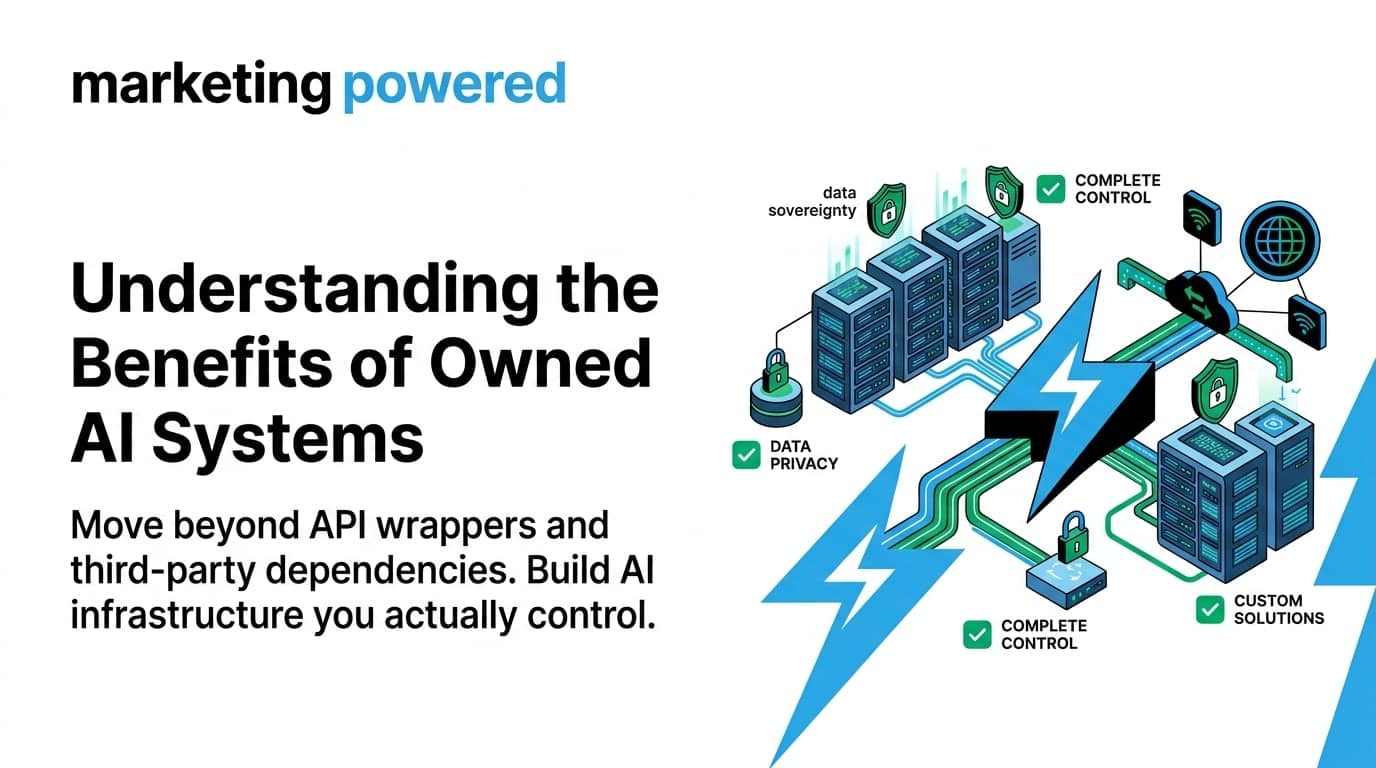
Owned AI systems are artificial intelligence infrastructures that an organization builds, hosts, and controls entirely within its own environment. Unlike third-party AI solutions, where you rent access to someone else's models through commercial APIs, owned AI systems run on hardware you control, process data within your security perimeter, and evolve according to your specifications.
The distinction matters for organizations handling sensitive data or operating in regulated industries. When you use a commercial AI API, your queries, your data, and your competitive intelligence flow through external servers. You accept the provider's terms, their pricing changes, and their model updates on their schedule. Owned AI systems invert that dependency.
Self-hosted AI infrastructure typically includes local inference hardware (GPU clusters or optimized CPU systems), vector databases for retrieval-augmented generation, and model weights you've either trained, fine-tuned, or selected from open-source AI models. The result is an AI capability that operates without external API calls for core functions.
Marketing Powered runs its AI operations on a Mac Studio M3 Ultra cluster with TerraMaster NAS storage and static IP business internet, purpose-built for HIPAA-compliant local inference. This is not a wrapper on OpenAI or Anthropic. It's owned infrastructure that keeps client data within a controlled environment. We've operated this way since 2022, before most agencies understood why it mattered.
Advantages of Proprietary AI Marketing
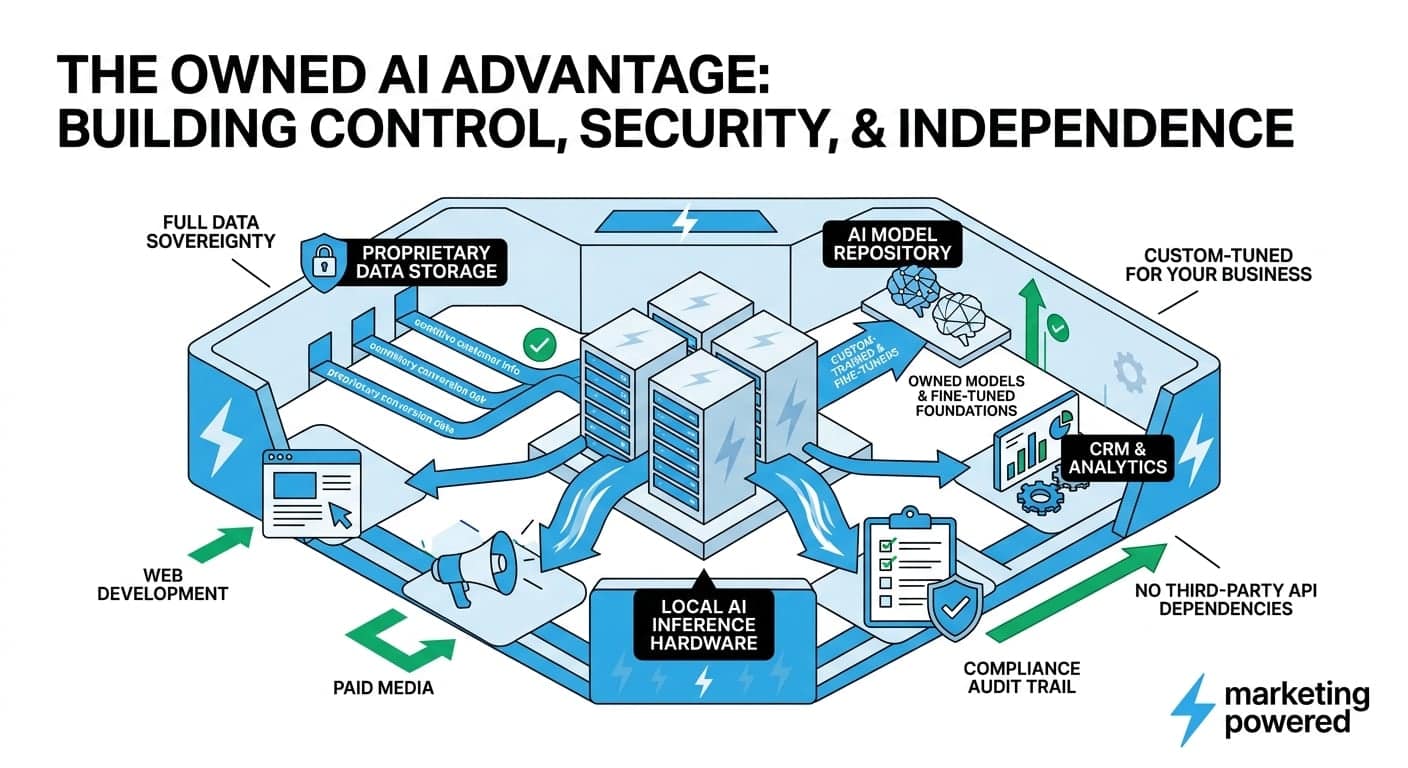
Proprietary AI marketing shifts the competitive equation. Instead of using the same AI tools as every competitor (with the same capabilities and the same limitations), you build systems tuned to your specific data, your customer segments, and your operational requirements.
Data privacy sits at the center of this advantage. When AI processing happens on your infrastructure, sensitive customer information never leaves your control. For healthcare organizations, financial services firms, and any business handling regulated data, this isn't a nice-to-have feature. It's a compliance requirement. Marketing Powered maintains HIPAA-aware practices throughout our AI stack specifically because the behavioral health marketing and mental health marketing verticals we serve cannot tolerate data exposure.
Custom AI systems also enable marketing approaches that commercial APIs cannot support.
You can train models on your proprietary conversion data, your intake call transcripts (with appropriate consent), and your historical campaign performance. The resulting system understands your business context in ways a general-purpose model never will.
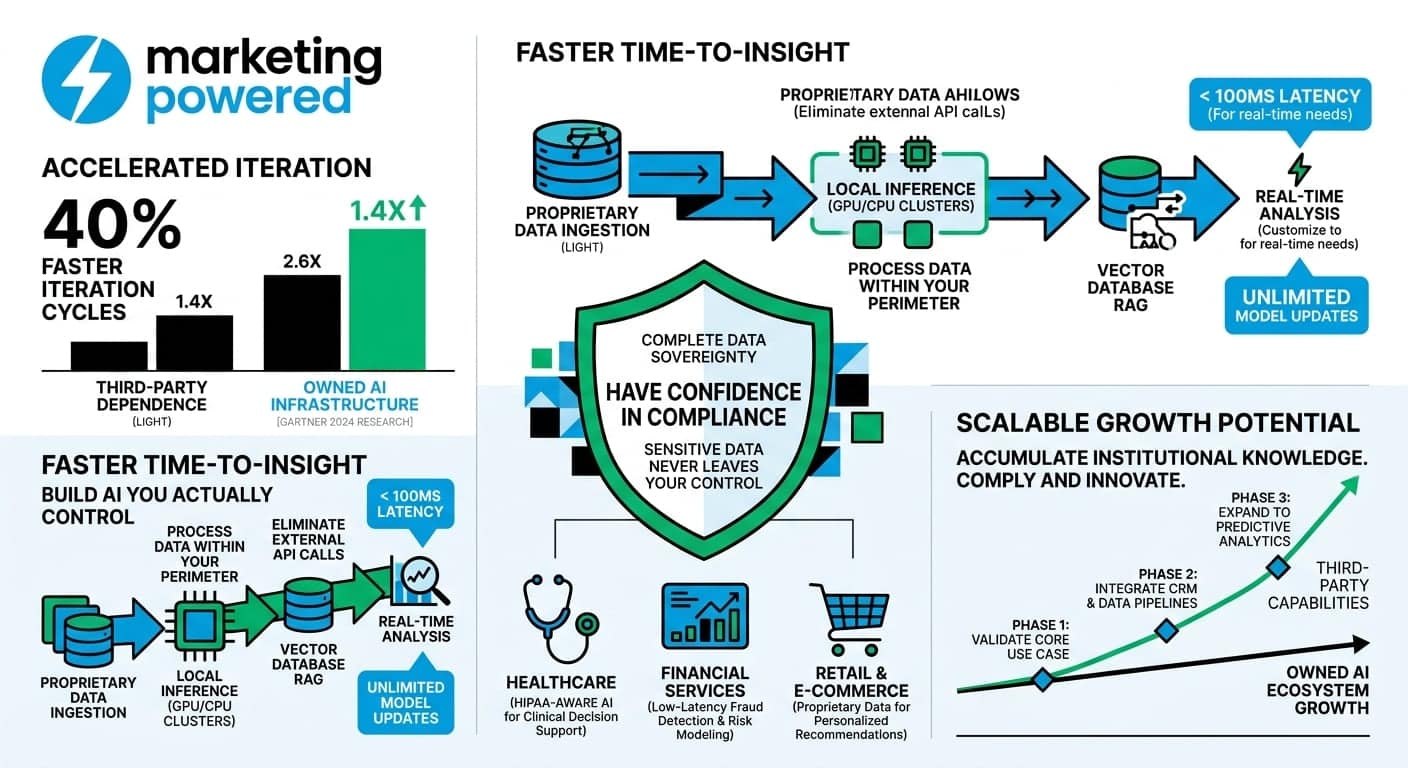
According to Gartner's 2024 AI deployment research, organizations with proprietary AI infrastructure report 40% faster iteration cycles compared to those dependent on third-party AI services. The speed advantage compounds over time as your systems accumulate institutional knowledge.
Implementing Custom AI Systems in Your Enterprise
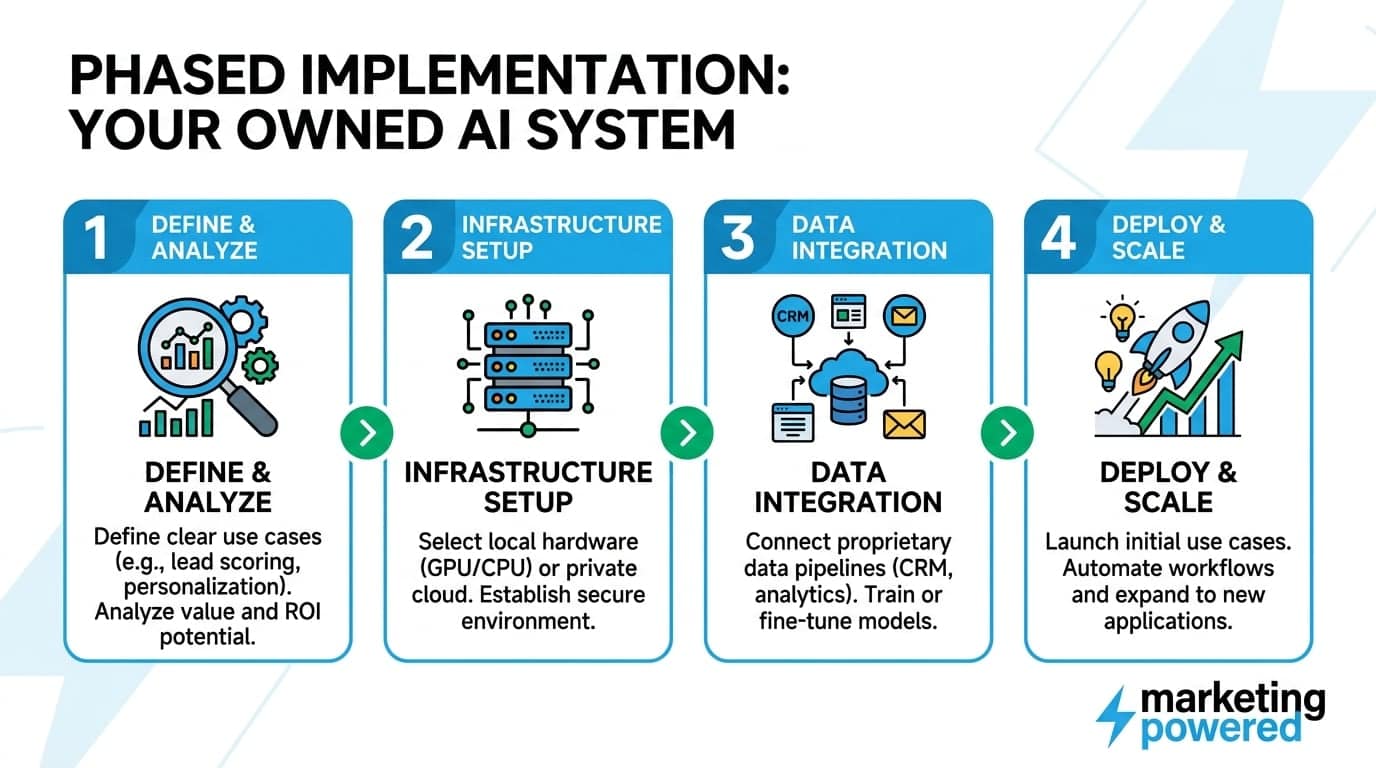
Implementation requires an honest assessment of your current state before any technology decisions. Start by mapping where AI could generate measurable value: lead scoring, content generation, predictive analytics, customer service automation, or attribution modeling. Not every use case justifies owned infrastructure. Some do.
The infrastructure decision follows the use case analysis. Options range from on-premise GPU clusters to private cloud deployments to hybrid configurations. Hardware selection depends on inference volume, latency requirements, and budget constraints. A system handling 10,000 daily inferences has different needs than one processing 10 million.
Integration with existing systems typically proceeds in phases. Phase one establishes the core inference infrastructure and validates it against a single use case. Phase two connects the AI system to your data pipelines, CRM, marketing automation, and analytics stack. Phase three expands to additional use cases once the foundation proves stable.
Consider these integration factors before committing:
Your advanced web development infrastructure needs API endpoints to communicate with AI systems. Your AI-powered paid media campaigns need real-time data flows. And your compliance team needs audit trails showing how data moves through the system. Planning these connections upfront prevents expensive retrofitting later.
- Data governance: Where does training data originate? Who approves its use? How long is it retained?
- Model selection: Open-source foundations (Llama, Mistral) vs. licensed models vs. custom training
- Security architecture: Network segmentation, encryption at rest and in transit, access controls
- Staffing: Do you have ML engineers in-house, or will you partner with a specialized firm?
- Maintenance: Models require monitoring, retraining, and version management over time
Free Audit
Want a straight read on where your budget is leaking?
Real-World Applications of Self-Hosted AI
Healthcare organizations face the clearest case for owned AI systems. Patient data cannot flow through external APIs without extensive compliance review and business associate agreements. Self-hosted AI enables clinical decision support, intake optimization, and patient communication automation while keeping protected health information within HIPAA-compliant boundaries. Marketing Powered has managed over $50M in behavioral health and mental health media spend, and our owned AI infrastructure is specifically designed for this compliance posture.
Financial services firms use on-premise AI for fraud detection, risk modeling, and customer segmentation. The latency requirements for real-time fraud detection often preclude external API calls. The data sensitivity of financial records demands infrastructure you control. NIST's AI Risk Management Framework guides the deployment of AI in regulated financial contexts.
Retail and e-commerce operations deploy owned AI for inventory prediction, personalized recommendations, and dynamic pricing. The competitive advantage lies in training models on proprietary sales data that competitors cannot access. When your AI understands your specific customer base and product catalog, it outperforms generic solutions.
For deeper analysis of case studies showing how AI infrastructure decisions affect business outcomes, we document specific implementations across these verticals.
Choosing the Right AI Solution Provider
Evaluate providers on three dimensions: technical depth, vertical expertise, and infrastructure philosophy.
Technical depth means understanding whether the provider builds systems or resells them. Many agencies now claim AI capabilities but simply connect commercial APIs without understanding the underlying architecture. Ask about their inference infrastructure, their model selection rationale, and their approach to fine-tuning. If the answers sound vague, you're talking to a reseller.
Vertical expertise determines whether the provider understands your compliance requirements and operational context. Marketing Powered operates exclusively in behavioral health and mental health marketing, where we've managed $1.5M to $2M monthly in Google Ads across 11+ accounts and helped scale operations for multi-location behavioral health organizations. That depth of vertical experience translates into AI systems designed for specific regulatory environments, not generic solutions adapted after the fact.
Infrastructure philosophy reveals long-term alignment. Some providers optimize for speed-to-market using commercial APIs, accepting the dependency risks. Others invest in owned infrastructure that takes longer to build but delivers data sovereignty and operational independence. Neither approach is universally correct, but you should understand which philosophy guides your provider.
Marketing Powered has operated as an AI-native agency since 2022, building local inference capabilities before most agencies understood the category. Our founder holds court-certified expert witness credentials in advertising strategy, bringing a level of accountability that typical agency relationships lack. To learn more about AI Edge and how owned infrastructure creates competitive advantage, explore our approach in detail.
Ready to Explore Owned AI Systems?
The conversation starts with understanding your current infrastructure, your compliance requirements, and where AI can generate measurable returns. We'll discuss strategy, lead quality, channel mix, and whether owned AI systems fit your operational context.
Questions, Answered.
Owned AI systems provide complete control over your data, eliminating the security and privacy risks inherent in third-party API dependencies. You gain the ability to customize AI models to your specific business requirements, train on proprietary data that competitors cannot access, and operate without external service disruptions or pricing changes affecting your capabilities. For regulated industries, owned infrastructure also simplifies compliance by keeping sensitive data within your security perimeter.
Integration typically proceeds in phases. Initial deployment establishes core inference infrastructure and validates against a single use case. Subsequent phases connect the AI system to existing data pipelines, CRM platforms, marketing automation tools, and analytics infrastructure through API endpoints. Compatibility assessment should happen before hardware selection, evaluating your current tech stack, data governance policies, and staffing capacity to maintain AI systems over time.
Healthcare, financial services, and retail see the clearest advantages. Healthcare organizations require a HIPAA-compliant infrastructure where patient data never leaves controlled environments. Financial services firms need low-latency, high-security AI for fraud detection and risk modeling. Retail operations benefit from training models on proprietary sales and customer data to build competitive advantages that generic AI solutions cannot replicate.
Proprietary AI marketing uses custom-built AI systems trained on your specific conversion data, customer segments, and campaign performance history. Unlike commercial AI tools that every competitor can access with identical capabilities, proprietary AI marketing systems understand your business context and can execute strategies tuned to your exact requirements. This approach also enables privacy-focused marketing where sensitive customer data never flows through external APIs.
Ready to see what AI-native marketing can do for your treatment center?
Request a free audit of your paid media, landing pages, attribution, and compliance posture. You'll get a straight assessment of where the opportunities are.
or email us at info@marketingpowered.ai