Who We Help
Effective Mental Health Marketing Strategies
Specialized strategies for psychiatric practices, therapy groups, and outpatient mental health centers from an agency that has managed $50M+ in behavioral health and mental health media.
Understanding Mental Health Marketing Needs
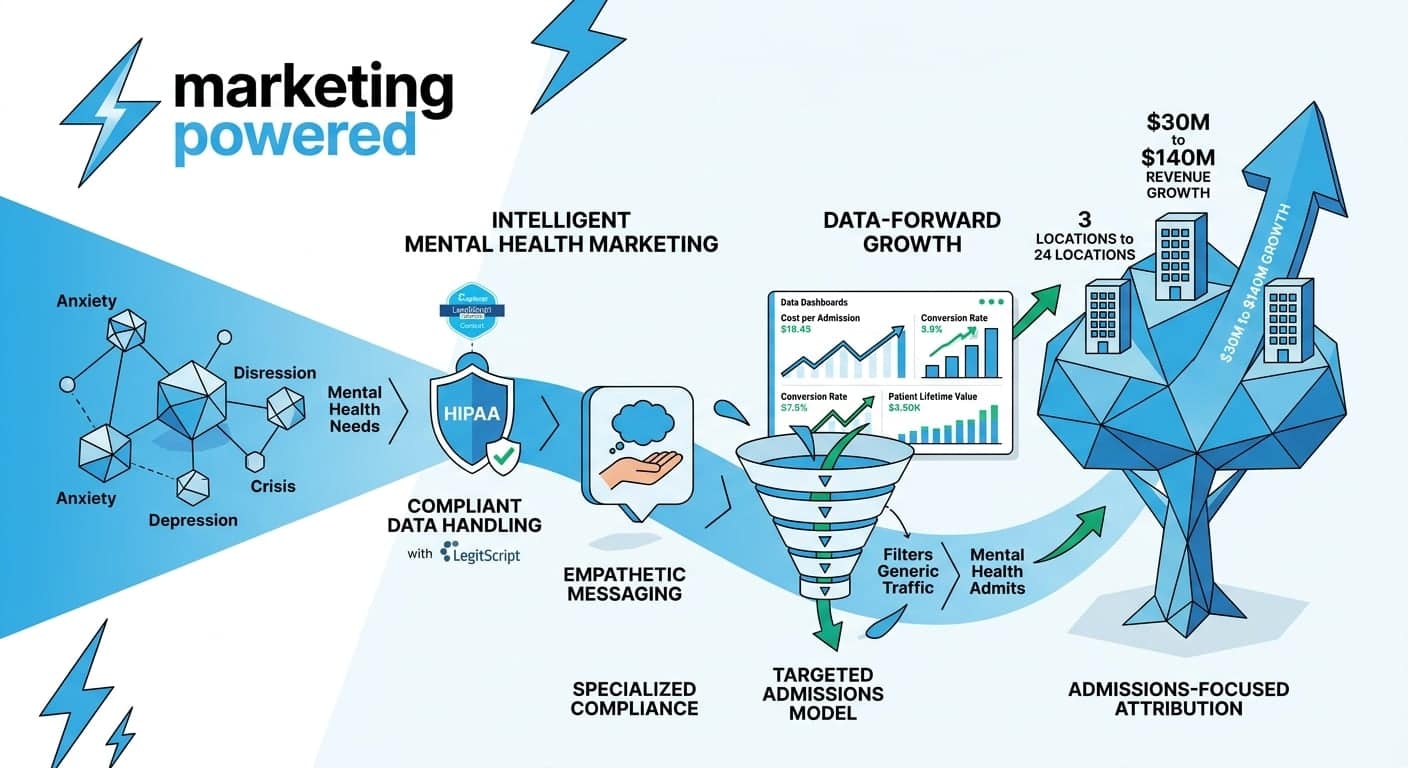
Most marketing agencies treat mental health the same way they treat HVAC or personal injury law: run ads, generate leads, and send a report. That approach fails in this category. Mental health marketing requires a fundamentally different posture because you are reaching people at vulnerable moments, operating under strict privacy regulations, and navigating advertising platforms that classify your services as sensitive.
The gap between general agency knowledge and operator-level understanding shows up fast. A generalist agency might build a campaign that generates form fills but violates HIPAA requirements in how it handles that data. They might write ad copy that triggers a Google Ads disapproval or, worse, gets your account suspended under [Google's healthcare and medicines
policy](https://support.google.com/adspolicy/answer/176031). They might optimize for lead volume when what you actually need is qualified admissions.
Mental health providers face challenges that do not exist in other verticals. Patient privacy is not just a best practice; it is a legal requirement with real penalties. The topics you address (depression, anxiety, trauma, suicidal ideation) require messaging that is both accurate and sensitive. Your prospective patients are often in crisis, which means your marketing must meet them with empathy, not aggressive sales tactics.
These constraints are not obstacles to effective marketing. They are the operating environment. An agency that understands mental health marketing builds a strategy around these realities from day one, not as an afterthought when something goes wrong.
Why Choose a Specialized Mental Health Marketing Agency
Specialization matters because the cost of getting it wrong is high. A suspended Google Ads account can take weeks to reinstate. A HIPAA violation can result in fines ranging from $100 to $50,000 per incident. A poorly targeted campaign burns budget on leads your intake team cannot convert. These are not hypothetical risks; they are the daily reality of marketing in a regulated healthcare vertical.
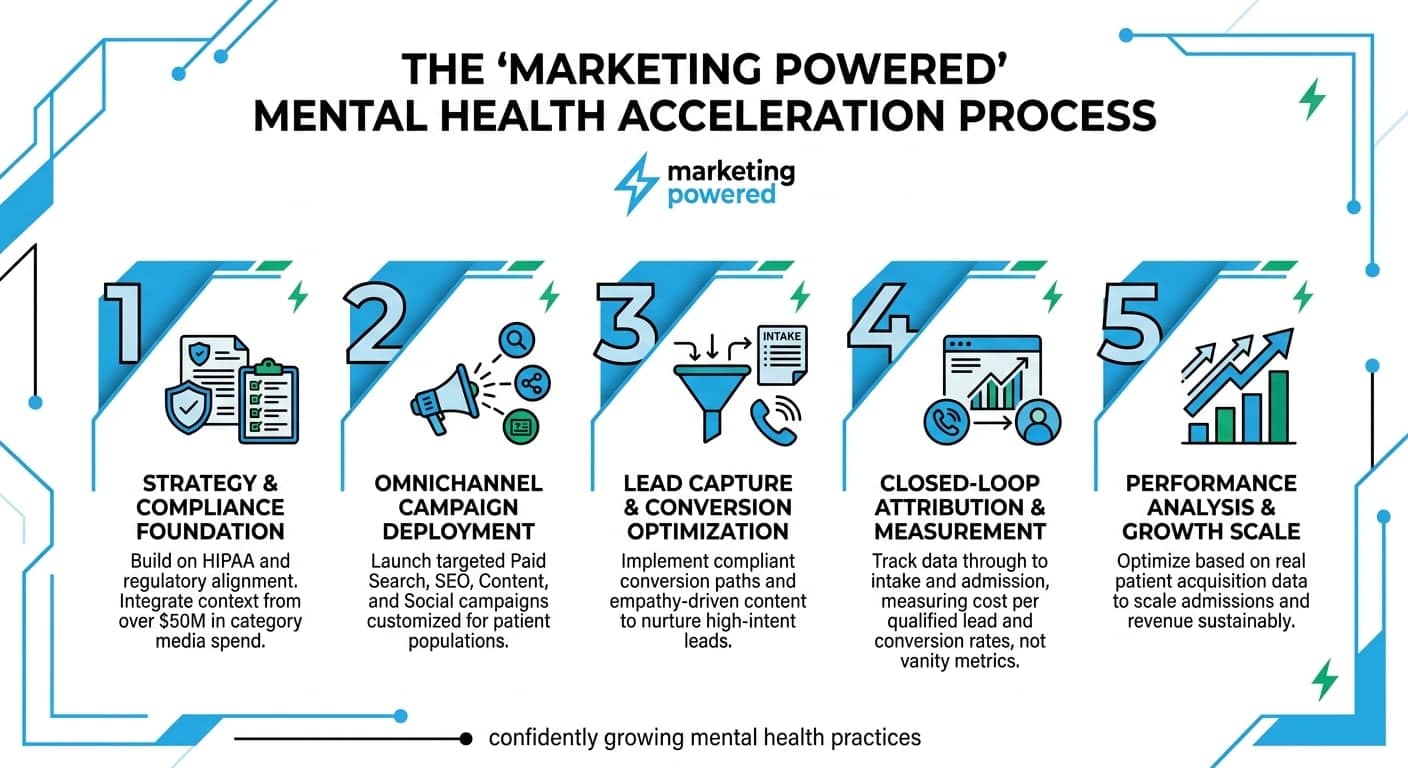
A mental health marketing agency that has operated in this space brings pattern recognition a generalist cannot match. We have managed over $50M in behavioral health and mental health media spend. That experience means we have seen what triggers platform disapprovals, what messaging resonates with different patient populations, and what attribution models actually connect marketing dollars to admissions.
Compliance knowledge is table stakes. LegitScript certification context matters for any paid advertising in treatment services. HIPAA awareness must be built into every touchpoint where patient information could be collected. Google Ads classifies mental health services as a sensitive category, which means no retargeting is allowed. An agency that does not understand these constraints will either get you in trouble or leave performance on the table.
Customized strategy is the other half of the equation. Psychiatric practice marketing is different from therapy practice marketing. An outpatient clinic has different patient acquisition economics than a residential program. A telehealth platform competes on different factors than a brick-and-mortar group practice. A specialized agency builds campaigns around your specific model, not a template they used for the last ten clients.
Digital Marketing Strategies for Mental Health Providers
Effective digital marketing for mental health providers balances reach, compliance, and conversion quality. The channels are familiar (paid search, SEO, content, social), but the execution requires vertical-specific expertise.
- Paid search remains the highest-intent channel for mental health services. When someone searches 'psychiatrist near me' or 'anxiety treatment options,' they are actively seeking help. Google Ads in this category requires approved advertiser certification for some ad types, careful keyword selection to avoid policy violations, and landing pages that meet both conversion best practices and compliance requirements. Our team has managed $1.5M to $2M monthly in Google Ads across behavioral health and mental health accounts, with campaigns structured to maximize qualified leads while maintaining platform compliance.
- SEO builds long-term patient acquisition at a lower marginal cost than paid media. For psychiatric practices and therapy groups, this means creating content that addresses the questions prospective patients actually ask, building local search presence for geographic terms, and earning authority through legitimate backlinks. The SAMHSA treatment locator and similar directories also play a role in how patients find providers.
- Content marketing serves dual purposes: it supports SEO, and it builds trust with prospective patients before they ever contact your intake team. Mental health content must balance clinical accuracy with accessibility. It should educate without diagnosing, empathize without being manipulative, and guide readers toward appropriate next steps. This is where sensitivity to the category matters most.
- Web development for mental health providers require HIPAA-conscious form handling, fast load times (especially on mobile, where many crisis searches happen), and conversion paths that respect where the visitor is in their decision process. A first-time visitor researching symptoms needs different content than someone ready to schedule an intake call.
Free Audit
Want a straight read on where your budget is leaking?
Measuring the Impact of Your Marketing Efforts
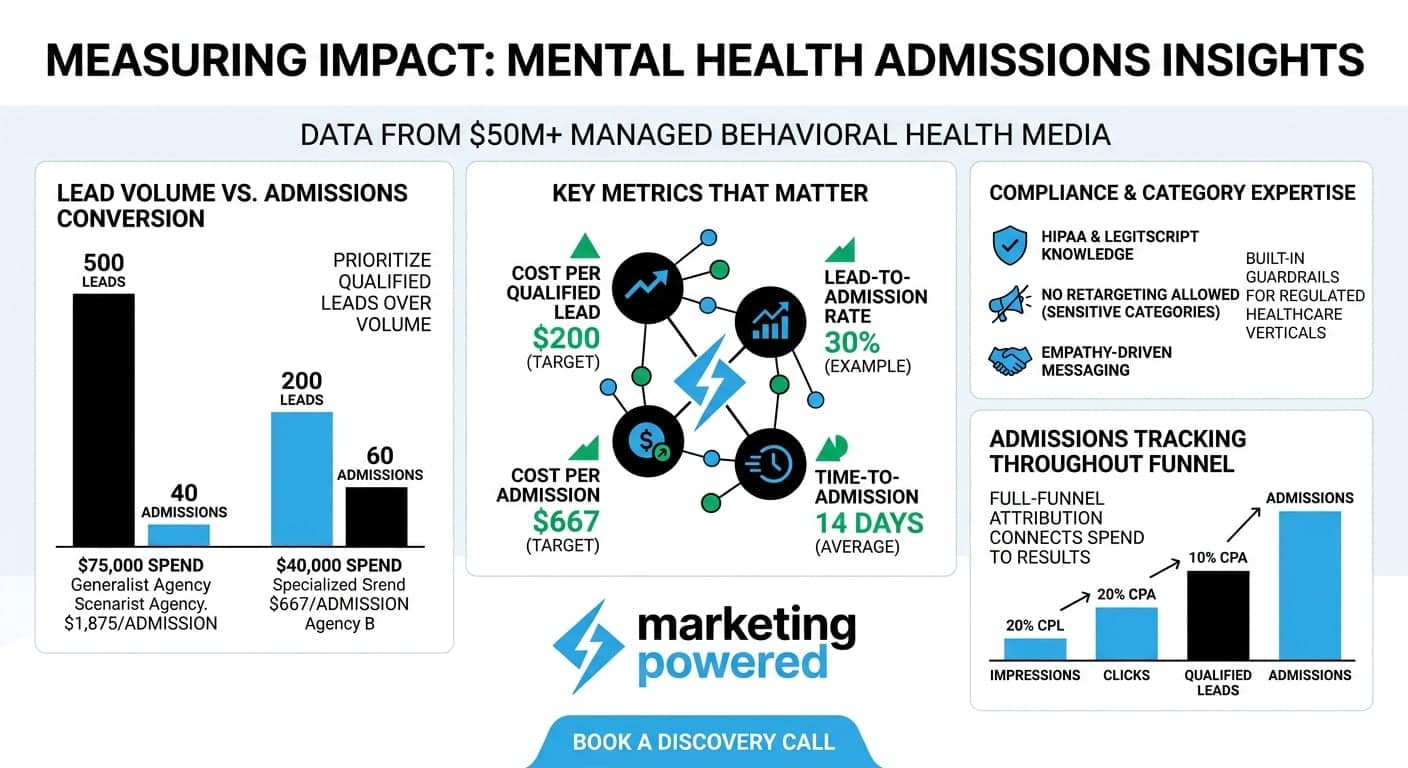
Lead volume is not the metric that matters. Admissions are. The gap between those two numbers is where most mental health marketing programs fail.
A campaign that generates 500 leads per month looks successful on a dashboard. But if only 40 of those leads convert to admissions, and your cost per lead was $150, you spent $75,000 to acquire 40 patients at $1,875 per admission. If a competing campaign generates 200 leads at $200 per lead but 60 convert to admissions, you spent $40,000 to acquire 60 patients at $667 per admission. The second campaign is objectively better, even though it generated fewer leads at a higher cost per lead.
This is why attribution discipline matters. We track attribution through to admission, not just to form fill or phone call. That requires integration between your marketing platforms, your CRM, and your intake workflow. It requires consistent tracking across channels. And it requires an agency that understands your business well enough to know which metrics actually indicate success.
The metrics that matter for mental health marketing include cost per qualified lead (not just cost per lead), lead-to-admission conversion rate, cost per admission, patient lifetime value by acquisition channel, and time-to-admission by source. Paid media services should be measured against these outcomes, not vanity metrics like impressions or click-through rate.
Case Studies: Success in Mental Health Marketing
Results speak louder than promises. Our case studies document the outcomes we have achieved for mental health and behavioral health clients across multiple verticals and scales.
One example: A multi-location behavioral health organization expanded across multiple markets during our engagement. That growth required marketing infrastructure that could scale with the organization, attribution systems that connected spend to admissions across multiple facilities, and campaign management that maintained compliance as the footprint expanded. That work reinforced the importance of full-funnel reporting during growth periods.
Another pattern we see repeatedly: mental health practices come to us after a bad experience with a generalist agency. The previous agency generated leads, but the leads were of low quality. The previous agency ran campaigns, but the campaigns got disapproved. The previous agency sent reports, but the reports did not connect to the metrics that actually drove the business. We rebuild from a foundation of category knowledge and compliance awareness, and the results follow.
Our founder's credibility in this space includes status as a court-certified expert witness in advertising strategy. That level of accountability, where your methodology must withstand legal scrutiny, shapes how we approach every campaign. We build systems that can be defended, not just marketed.
Start a Conversation About Your Mental Health Marketing
If your current marketing is generating leads but not admissions, or if you are concerned about compliance in a regulated vertical, we should talk. We bring $50M+ in managed behavioral health and mental health media experience, attribution systems that track through to admission, and AI-native infrastructure built for this category.
Questions, Answered.
Effective mental health marketing combines paid search for high-intent patient acquisition, SEO for long-term organic visibility, content marketing that builds trust, and a compliant web infrastructure that converts visitors to intake calls. The specific mix depends on your practice model, geography, and patient population. What separates successful strategies from unsuccessful ones is attribution that tracks through to admissions, not just leads, and campaign execution that respects the compliance constraints of the healthcare vertical.
Compliance starts with understanding the regulatory environment: HIPAA requirements for any patient data handling, Google Ads and Meta policies for healthcare advertising (including the prohibition on retargeting for sensitive categories), and LegitScript certification context for treatment advertising. Working with a mental health marketing agency that has operated in this space for years means these guardrails are built into strategy from day one, not discovered after a violation.
Psychiatric practice marketing carries unique sensitivities around medication, diagnosis, and patient privacy. The prospective patients you reach are often vulnerable, and the regulatory requirements are strict. A generalist agency learning on your account can result in disapproved campaigns, compliance violations, and wasted budget on leads your intake team cannot convert. Specialization means pattern recognition for what works and what triggers problems in this category.
Content serves two functions in therapy practice marketing: it supports SEO by targeting the questions prospective patients search, and it builds trust by demonstrating your expertise before a patient ever contacts you. Effective content is clinically accurate, emotionally appropriate, and actionable without being manipulative. It guides readers toward help without making claims that would violate advertising regulations or clinical ethics.
Ready to see what AI-native marketing can do for your treatment center?
Request a free audit of your paid media, landing pages, attribution, and compliance posture. You'll get a straight assessment of where the opportunities are.
or email us at info@marketingpowered.ai