Who We Help
Effective Telehealth Marketing Strategies for Mental Health
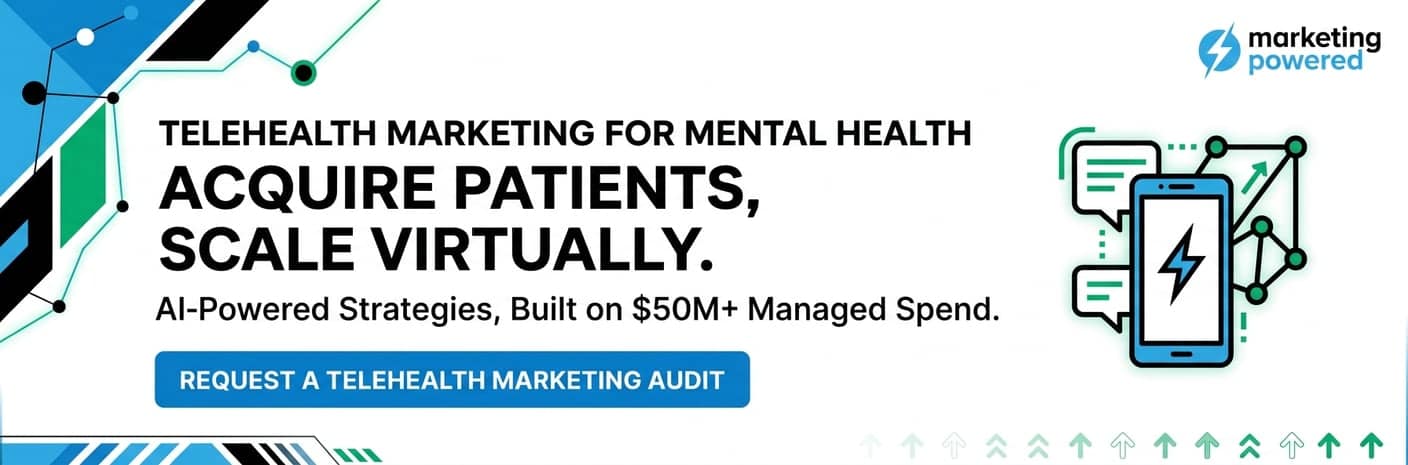
AI-powered patient acquisition for virtual mental health providers, built on $50M+ in managed behavioral health and mental health media spend.
Understanding Telehealth Opportunities
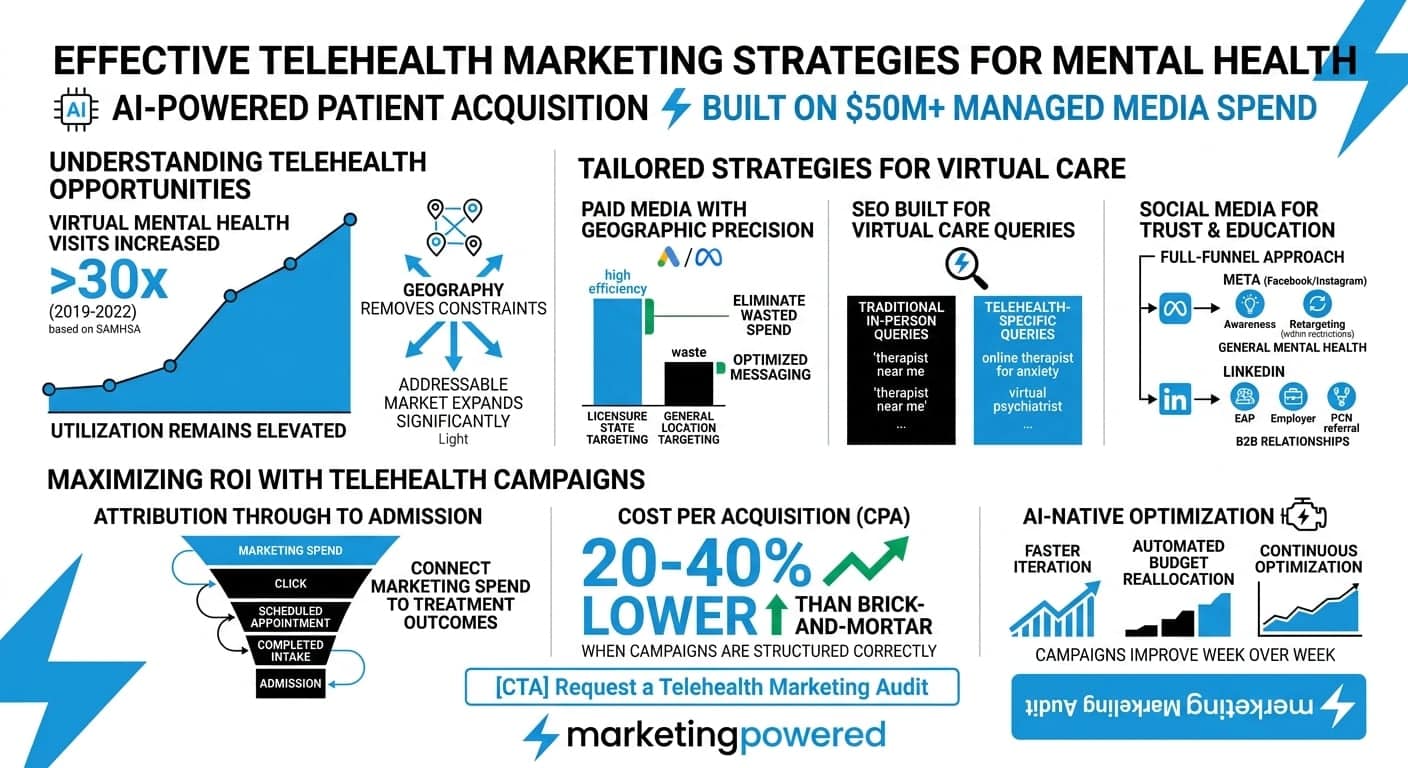
Virtual mental health services have shifted from a pandemic workaround to a permanent growth channel. According to a 2023 SAMHSA report on telehealth expansion, telehealth visits for mental health services increased by more than 30x between 2019 and 2022, and utilization has remained elevated. For mental health providers, this creates a patient acquisition opportunity that did not exist five years ago.
Telehealth removes geography as a constraint. A practice in Phoenix can serve patients across Arizona. A group practice in Austin can expand into rural Texas markets without leasing new office space. This geographic flexibility means your addressable market expands significantly, but so does your competition. Every other virtual provider is now competing for the same search queries, the same social feeds, and the same referral networks.
The providers winning in tele-mental health are not the ones with the largest budgets. They are the ones with the tightest targeting, the cleanest attribution, and marketing partners who understand how virtual therapy marketing differs from traditional in-person patient acquisition. Cost per acquisition in telehealth can run 20-40% lower than brick-and-mortar when campaigns are structured correctly, but poorly targeted campaigns waste budget on patients outside your licensure footprint or outside your clinical scope.
Marketing Powered has managed $50M+ in lifetime media spend across behavioral health and mental health. We have tracked attribution through to admission for treatment centers and outpatient practices across both in-person and virtual delivery models. That experience shapes how we approach telehealth marketing: with discipline around compliance, precision in targeting, and clear measurement from click to scheduled appointment.
Tailored Marketing Strategies for Telehealth
Telehealth marketing requires channel-specific tactics that account for how patients search for and evaluate virtual care. A strategy built for in-person practice marketing will underperform when applied to telehealth without modification.
Paid media with geographic precision
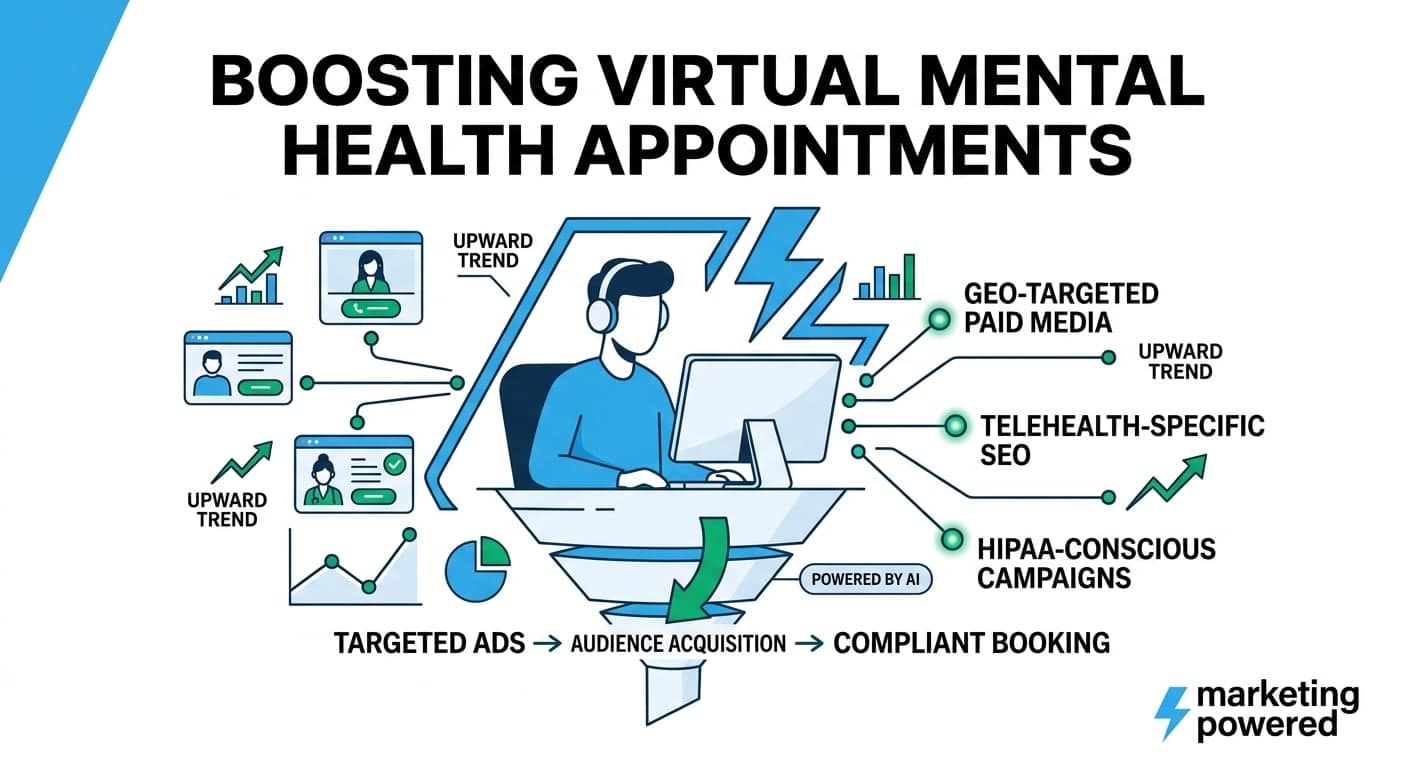
Google Ads and Meta remain the primary paid channels for virtual therapy marketing, but campaign structure matters. Telehealth campaigns need location targeting matched to your licensure states, not just your office address. We build campaigns that serve ads only to patients in states where your clinicians are licensed to practice, eliminating wasted spend on unserviceable leads.
Our paid media services include multi-variant optimization across ad creative, landing pages, and audience segments. For telehealth providers, this means testing messaging around convenience, privacy, and accessibility to find what resonates with your specific patient population.
Free Audit
Want a straight read on where your budget is leaking?
SEO built for virtual care queries
Patients searching for online therapy marketing terms use different query patterns than those searching for local providers. 'Therapist near me' becomes 'online therapist for anxiety' or 'virtual psychiatrist accepting new patients.' We build content strategies around these telehealth-specific search patterns, targeting the commercial and informational queries that drive qualified traffic.
Your web presence needs to communicate telehealth availability clearly, with state-specific landing pages where licensure allows multi-state practice.
Social media for trust and education
Meta and LinkedIn serve different functions in telehealth mental health marketing. Meta excels at awareness and retargeting for general mental health services (within Google Ads healthcare vertical restrictions that prohibit behavioral health retargeting). LinkedIn works for B2B referral relationships with EAPs, employers, and primary care networks that refer to virtual mental health providers.
The combination of paid, organic, and social creates a full-funnel approach that meets patients where they are researching care options.
Compliance and Regulatory Considerations
Telehealth marketing operates under the same compliance constraints as in-person healthcare marketing, with additional complexity around interstate licensure and platform-specific advertising policies.
HIPAA applies to your marketing stack, not just your EHR. If your CRM, email platform, or analytics tools touch patient data, they need to be configured with HIPAA requirements in mind. Marketing Powered builds campaigns with HIPAA-conscious infrastructure from the start, not as an afterthought.
Google Ads classifies mental health services as a sensitive healthcare vertical. This means no remarketing to users based on their engagement with your mental health content. We structure campaigns to work within these restrictions, using contextual and demographic targeting rather than behavioral retargeting that would violate platform policy.
For providers also offering addiction treatment or medication-assisted treatment through telehealth, LegitScript certification becomes relevant for running Google Ads. Our team has operated in LegitScript-certified environments and understands the documentation and compliance posture required to maintain certification.
Marketing Powered brings court-certified marketing expert witness credentials to these compliance conversations. We do not just follow the rules; we understand why they exist and how to build effective campaigns within them.
Email Us
Prefer to send the context directly?
Maximizing ROI with Telehealth Campaigns
Return on investment in telehealth marketing depends on tracking the right metrics through to the outcomes that matter: scheduled appointments, completed intakes, and retained patients.
Many providers track cost per lead without understanding cost per scheduled appointment or cost per completed intake. The gap between these metrics reveals where patients drop off in your funnel. Is it a lead quality problem (marketing)? A scheduling friction problem (operations)? A no-show problem (patient communication)? Attribution that stops at the lead level cannot answer these questions.
Attribution through to admission
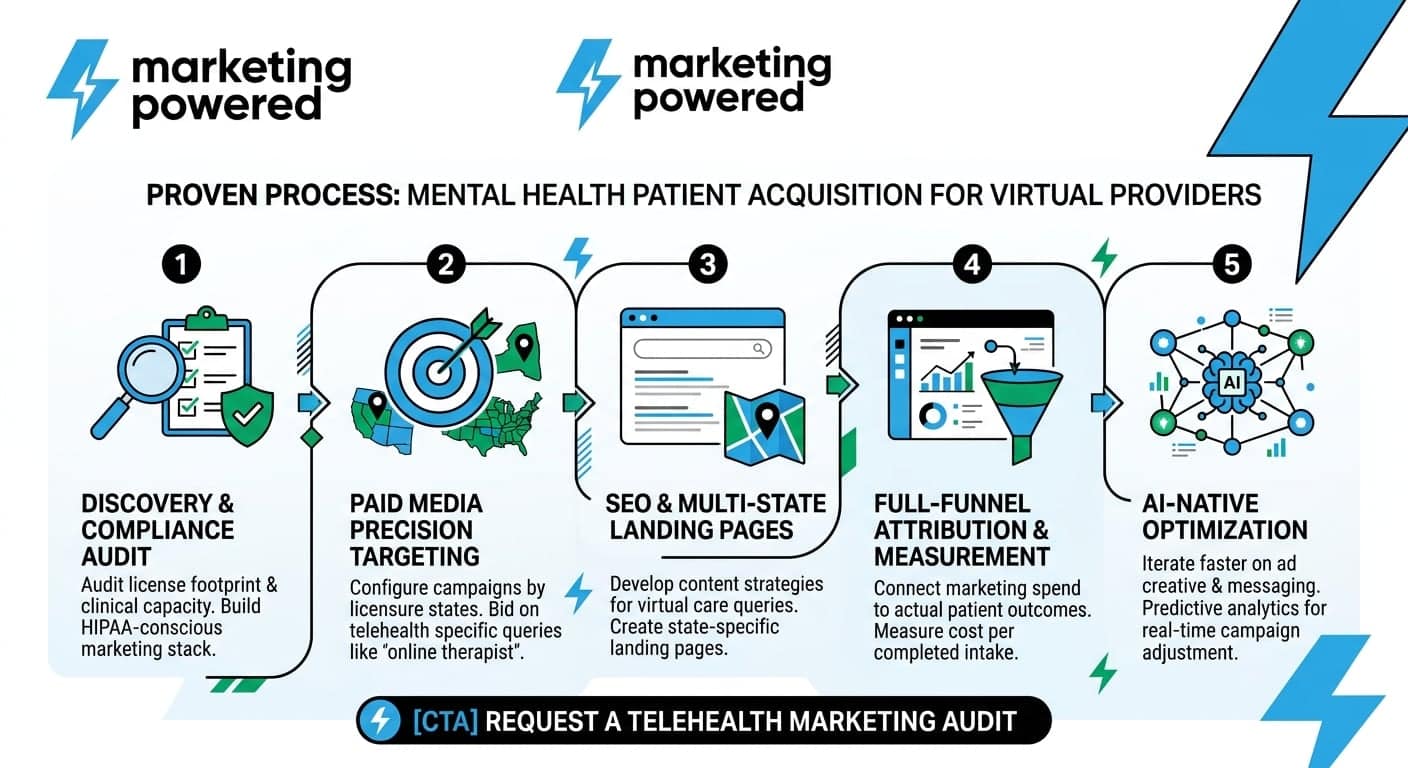
Marketing Powered tracks attribution through to admission, connecting marketing spend to actual patient outcomes. For telehealth providers, this means understanding which channels, campaigns, and creative variations drive patients who actually complete intake and begin treatment.
This attribution discipline comes from our work scaling behavioral health inpatient services and mental health services for anxiety and depression, where the cost of a missed attribution is measured in thousands of dollars per patient.
AI-native optimization
We have operated as an AI-native agency since 2022, building proprietary systems for predictive analytics, multi-variant optimization, and real-time campaign adjustment. For telehealth campaigns, this means faster iteration on what is working, automated budget reallocation toward high-performing segments, and continuous optimization that would be impossible with manual campaign management alone.
The result is campaigns that improve week over week, not campaigns that run on autopilot until the next quarterly review.
Strategy
Want to start with a quick message?
Case Studies: Success in Tele-Mental Health
Our work in telehealth marketing builds on a foundation of proven results in behavioral health and mental health patient acquisition.
Operator-side multi-market growth with Marketing Powered as their marketing partner. That growth required building patient acquisition systems that worked across geographies, adapting to local market conditions while maintaining consistent cost per acquisition targets. The same principles apply to telehealth expansion: geographic precision, attribution discipline, and continuous optimization.
Across our case studies, you will see patterns relevant to telehealth providers: campaigns that tracked attribution through to admission, media spend managed with HIPAA-conscious infrastructure, and growth measured in patients served rather than just leads generated.
For providers offering specialized services like trauma and PTSD treatment, telehealth creates an opportunity to reach patients who might not access in-person care due to geographic barriers or the nature of their condition. Our experience spans these specialized service lines, building campaigns that reach the right patients with messaging that respects the sensitivity of their situation.
Start with a Telehealth Marketing Audit
If you are expanding into telehealth or looking to improve the performance of existing virtual therapy marketing, the next step is a conversation about your specific situation: your licensure footprint, your clinical capacity, your current marketing performance, and your growth targets.
Marketing Powered brings $50M+ in managed BH/MH media spend, AI-native infrastructure, and attribution discipline to telehealth marketing for mental health providers. We understand the compliance constraints, the platform policies, and the patient acquisition economics that determine whether a telehealth expansion succeeds or stalls.
Request a Telehealth Marketing Audit
Discuss your telehealth expansion with a team that has managed $50M+ in behavioral health and mental health media spend. We will review your current performance, compliance posture, and growth opportunities.
Questions, Answered.
Telehealth marketing requires geographic targeting matched to clinician licensure rather than office location, platform compliance with healthcare advertising restrictions, and attribution models that account for virtual intake workflows. Patients search differently for virtual care, using queries like 'online therapist' rather than 'therapist near me,' which demands distinct keyword strategies and landing page structures.
Effective strategies combine paid media with licensure-state targeting, SEO built around virtual care search patterns, and social media for trust-building and B2B referral relationships. Compliance-driven campaign structures that respect Google Ads sensitive healthcare vertical restrictions are non-negotiable. Multi-variant optimization across creative and landing pages identifies what resonates with your specific patient population.
Track beyond cost per lead to cost per scheduled appointment, cost per completed intake, and patient lifetime value. Attribution should connect marketing spend to actual treatment outcomes, not just form submissions. This requires integration between your marketing platforms, scheduling systems, and EHR to follow the patient journey from first click to retained patient.
When campaigns are structured correctly, telehealth marketing can deliver 20-40% lower cost per acquisition than traditional in-person marketing due to expanded geographic reach and reduced overhead costs. However, poorly targeted campaigns waste budget on patients outside your licensure footprint. ROI depends on tight targeting, clean attribution, and continuous optimization.
Ready to see what AI-native marketing can do for your treatment center?
Request a free audit of your paid media, landing pages, attribution, and compliance posture. You'll get a straight assessment of where the opportunities are.
or email us at info@marketingpowered.ai