Accessibility
Understanding Our Accessibility Statement
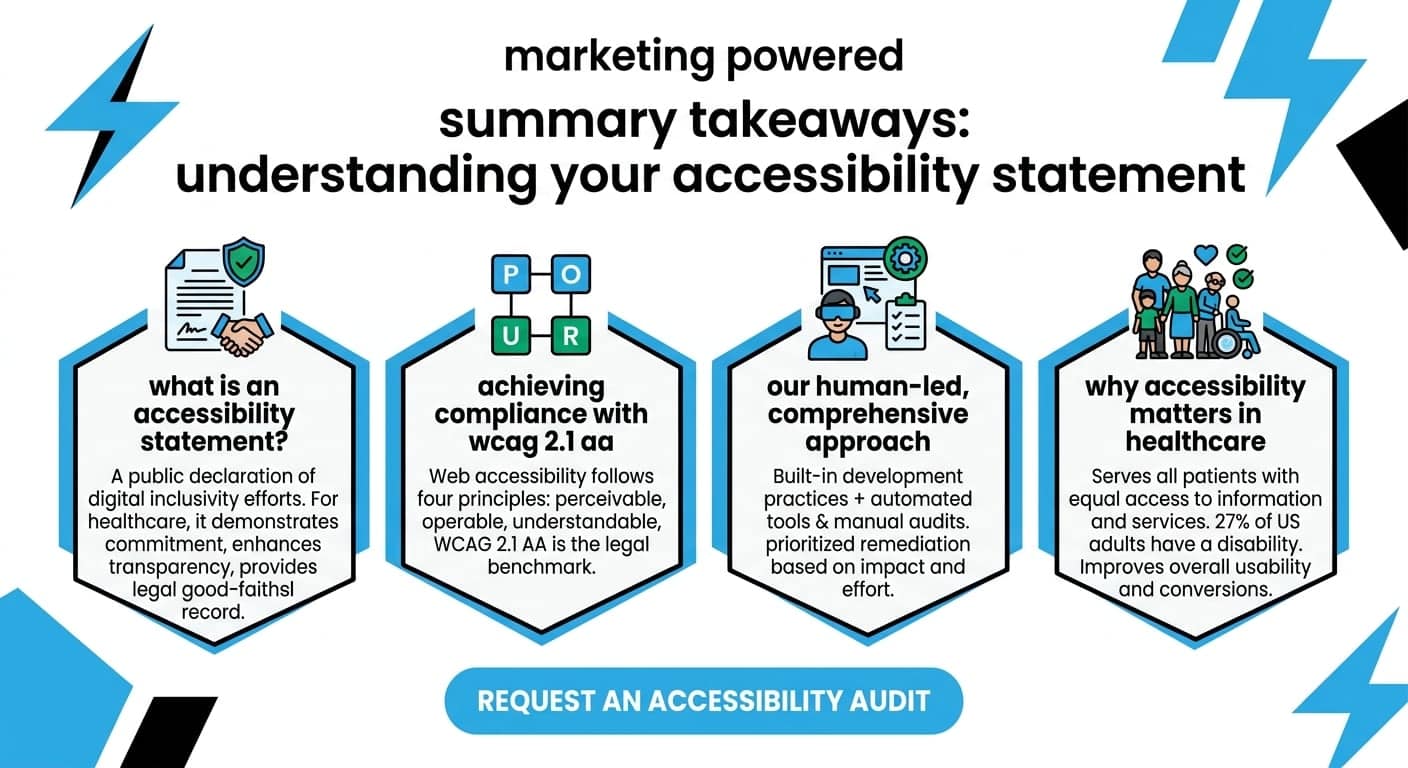
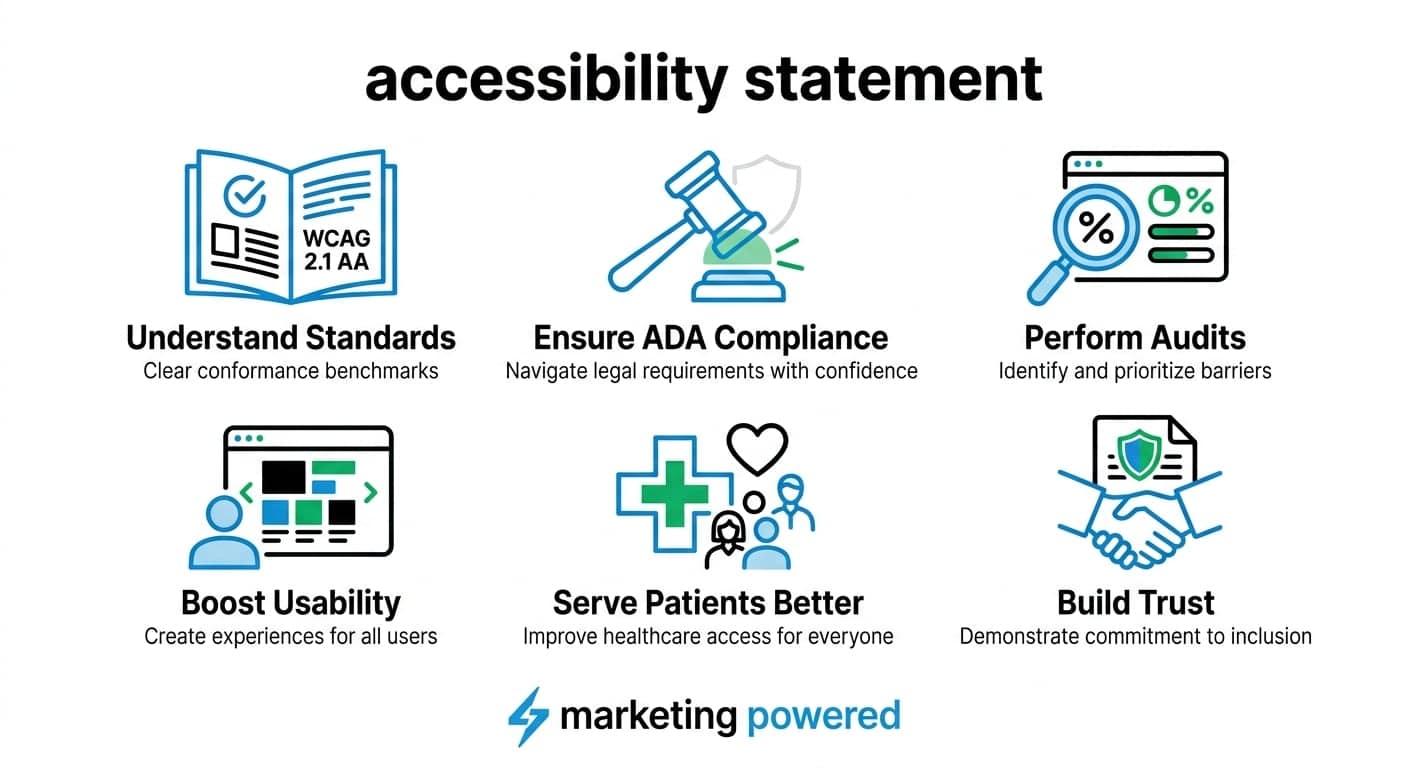
Web accessibility protects your organization, serves your patients, and demonstrates your commitment to inclusive digital experiences.
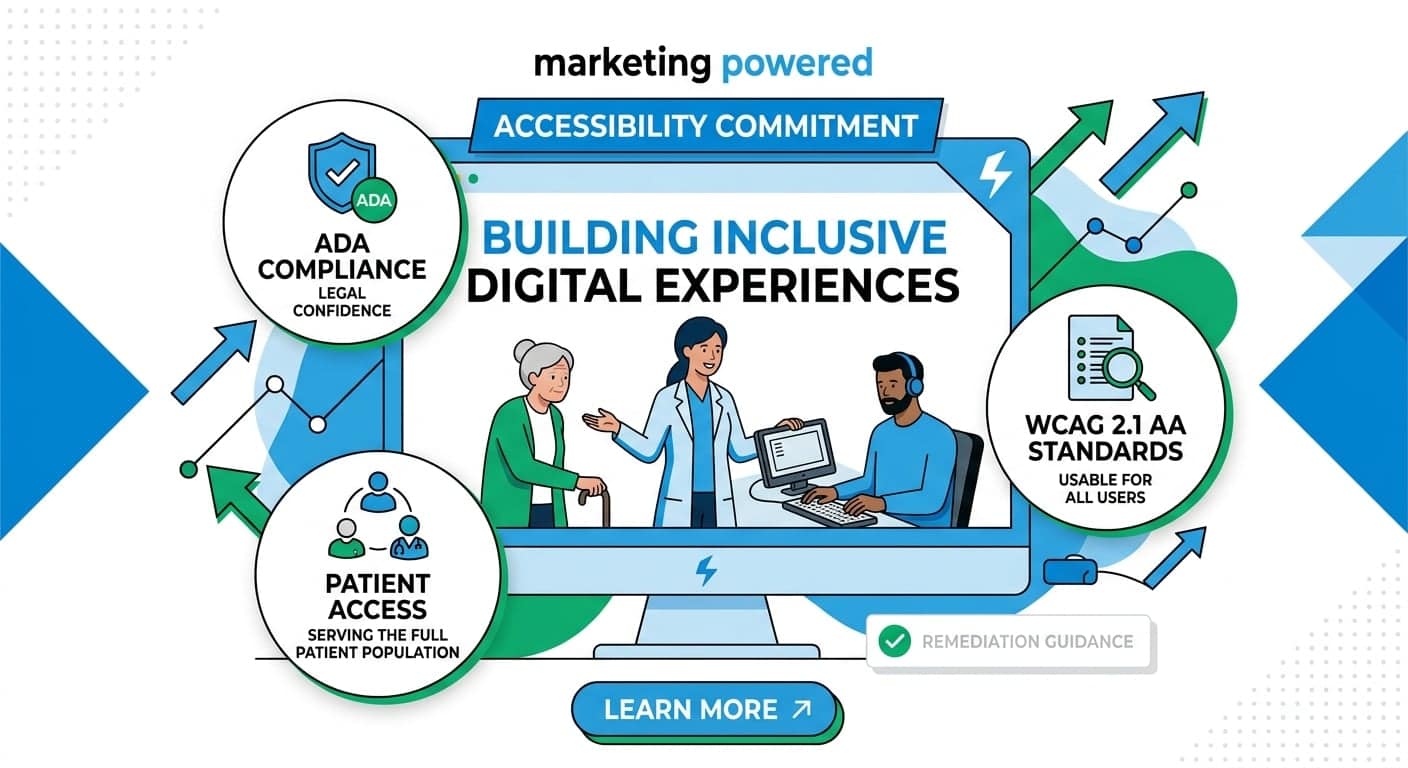
What is an Accessibility Statement?
An accessibility statement is a public declaration that outlines how your website accommodates users with disabilities. It describes the measures your organization has taken to remove barriers, the standards you follow, and how users can report issues or request assistance.
For healthcare organizations, this document serves multiple purposes. It demonstrates a commitment to inclusivity, provides transparency about your digital accessibility efforts, and creates a record of good-faith compliance. When a patient or their family member encounters a barrier on your site, your accessibility statement tells them you take their experience seriously and gives them a clear path to resolution.
Beyond the ethical considerations, an accessibility statement offers legal protection. Under the Americans with Disabilities Act (ADA), websites that serve the public may be considered places of public accommodation. Courts have increasingly interpreted this to include digital properties. A well-crafted accessibility statement shows regulators and potential plaintiffs that your organization has made deliberate efforts toward compliance, which can be a meaningful factor in legal proceedings.
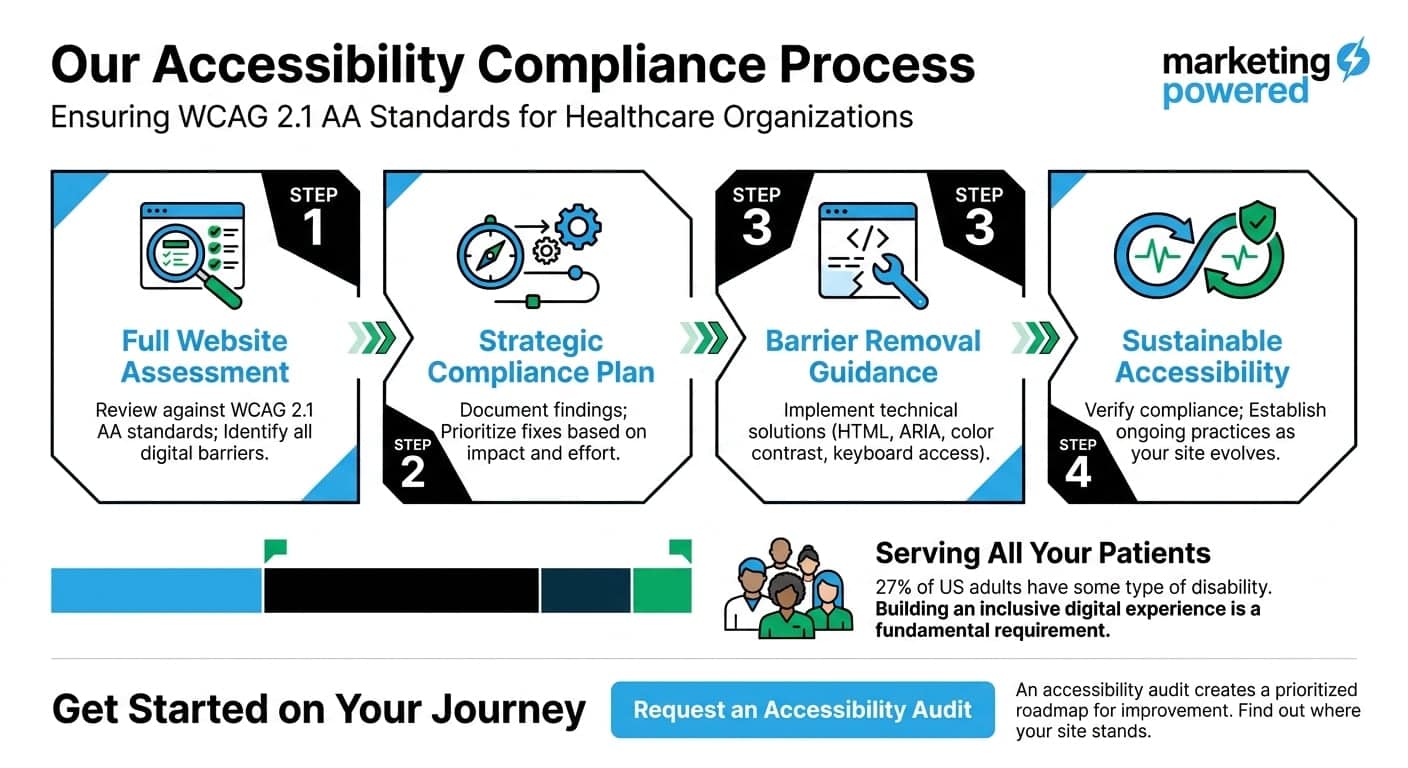
Understanding ADA and WCAG Compliance
ADA compliance for websites means removing barriers that prevent people with disabilities from accessing your digital content. The ADA does not specify technical standards for websites, but courts and regulators consistently point to the Web Content Accessibility Guidelines (WCAG) as the benchmark.
WCAG, published by the World Wide Web Consortium (W3C), provides a framework organized around four principles: content must be perceivable, operable, understandable, and robust. WCAG 2.1 AA is the most commonly referenced conformance level for legal and regulatory purposes. Meeting this standard means your site works with screen readers, supports keyboard navigation, provides sufficient color contrast, and includes alternatives for non-text content.
- Perceivable: Text alternatives for images, captions for video, and content that can be presented in different ways without losing meaning.
- Operable: Full keyboard accessibility, sufficient time to read and interact, and navigation that helps users find content.
- Understandable: Readable text, predictable page behavior, and input assistance that helps users avoid and correct mistakes.
- Robust: Content that works reliably across browsers, devices, and assistive technologies.
How We Ensure Compliance
Marketing Powered approaches accessibility as an ongoing practice, not a one-time checkbox. Our web development services build accessibility into the foundation of every project, starting with semantic HTML structure and progressing through contrast testing, keyboard navigation verification, and screen reader compatibility checks.
We use a combination of automated scanning tools and manual audits. Automated tools catch common issues quickly, but they miss context-dependent problems that only human review can identify. Our process includes testing with actual assistive technologies and reviewing user flows that matter most to healthcare audiences, such as appointment booking, contact forms, and patient portal access.
For organizations with existing sites, we conduct accessibility audits that identify specific barriers, prioritize fixes by impact and effort, and provide clear remediation guidance. We document everything, giving your compliance team the records they need to demonstrate good-faith efforts toward ADA compliance.
Free Audit
Want a straight read on where your budget is leaking?
Why Accessibility Matters in Healthcare
Healthcare websites serve populations that disproportionately include people with disabilities. Patients seeking behavioral health services may be navigating cognitive challenges, visual impairments, or motor limitations. An inaccessible site creates a barrier at the moment someone is trying to get help.
The practical argument is straightforward: accessible sites convert better. When navigation is clear, forms are usable, and content is readable, more visitors complete the actions you want them to take. The ethical argument is simpler still: everyone deserves equal access to healthcare information and services.
According to the CDC, 27% of adults in the United States have some type of disability. Building accessible digital experiences is not a niche concern. It is a fundamental requirement for serving your full patient population.
Get Started with Your Accessibility Journey
Whether you need a full accessibility audit, remediation support, or help crafting your own web accessibility statement, Marketing Powered can help. Our team has managed compliance-sensitive projects across the healthcare and behavioral health sectors, with LegitScript and HIPAA awareness built into how we work.
An accessibility audit identifies where your site stands today and creates a prioritized roadmap for improvement. The process is straightforward: we review your site against WCAG 2.1 AA standards, document findings, and deliver actionable recommendations your team can implement.
You can also explore our case studies to see how we approach complex healthcare marketing challenges, or visit our resources section for additional guidance on compliance topics.
Request an Accessibility Audit
Find out where your site stands and get a clear remediation roadmap. Our audit covers WCAG 2.1 AA standards, prioritizes fixes by impact, and gives your compliance team the documentation they need.
Questions, Answered.
An accessibility statement is a public declaration that describes your website's commitment to serving users with disabilities. It outlines the accessibility standards you follow (typically WCAG 2.1 AA), the measures you have taken to improve usability, known limitations, and how users can request assistance or report barriers they encounter.
The ADA requires that places of public accommodation be accessible to people with disabilities. Courts have increasingly applied this requirement to websites, particularly for organizations that serve the public. Non-compliance can result in lawsuits, demand letters, settlement costs, and reputational damage. Proactive compliance protects your organization and demonstrates respect for all users.
Start with an accessibility audit to identify current barriers. Prioritize fixes based on impact and effort, addressing issues that affect the most users or create the greatest barriers first. Implement changes using semantic HTML, proper color contrast, keyboard accessibility, and alt text for images. Test with assistive technologies and establish ongoing monitoring to maintain compliance as your site evolves.
Automated scanning tools like WAVE, axe, and Lighthouse can identify common accessibility issues quickly. However, automated tools catch only 30-50% of accessibility problems. Manual audits using screen readers (NVDA, VoiceOver, JAWS) and keyboard-only navigation are necessary for thorough compliance verification. Combining both approaches provides the most complete picture of your site's accessibility.
Ready to see what AI-native marketing can do for your treatment center?
Request a free audit of your paid media, landing pages, attribution, and compliance posture. You'll get a straight assessment of where the opportunities are.
or email us at info@marketingpowered.ai