AI Edge
Exploring the Role of AI in Paid Media
Strategic AI integration that turns ad spend into measurable growth, not wasted budget.
Understanding AI in Paid Media
AI in paid media represents a fundamental shift in how advertisers manage campaigns, allocate budgets, and reach qualified audiences. Rather than relying solely on manual bid adjustments and static audience segments, AI systems process thousands of signals per impression to make decisions that would take human teams weeks to analyze.
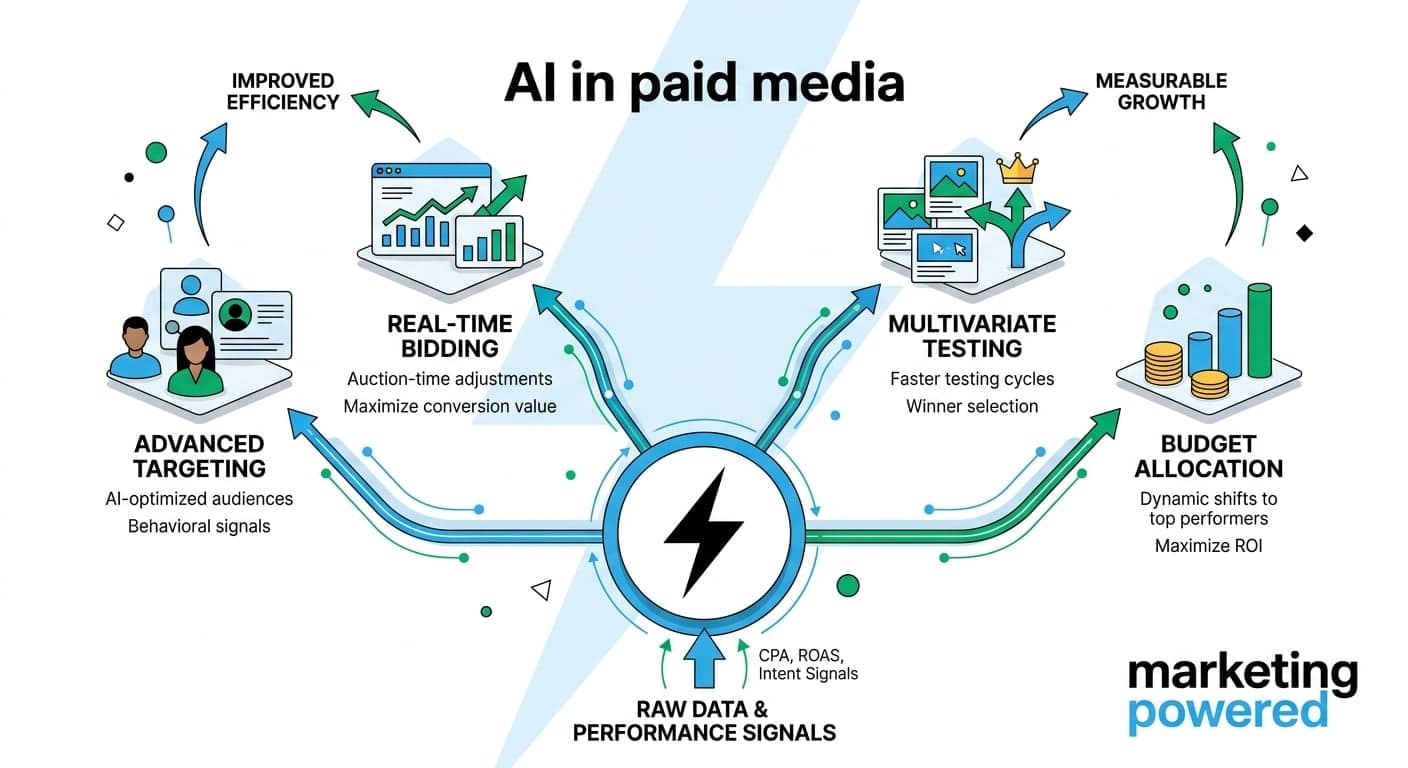
The integration spans three core areas: targeting, bid management, and performance analysis. On the targeting side, machine learning advertising models identify patterns in conversion data that reveal which audience characteristics actually predict purchase intent, not just engagement. For bid management, AI systems adjust bids in real time based on predicted conversion probability, competitive pressure, and budget pacing. Performance analysis moves from retrospective reporting to predictive insights that inform tomorrow's strategy.
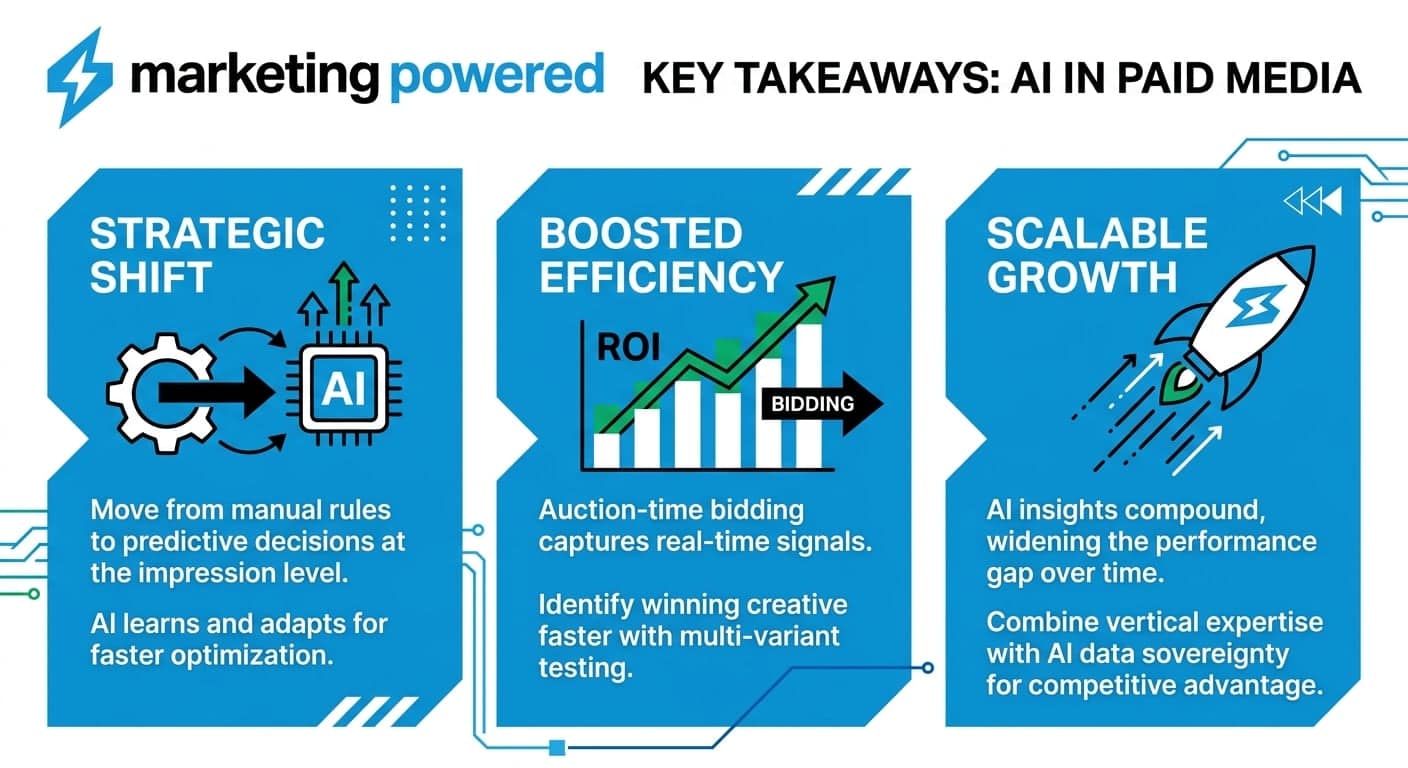
What makes AI-powered ads different from traditional automation is the ability to learn and adapt without explicit programming. A rule-based system follows instructions you set. An AI system identifies patterns you never specified and acts on them within parameters you define. This distinction matters because the variables affecting paid media performance change constantly: competitor behavior, seasonal demand, platform algorithm updates, and audience fatigue.
For agencies managing multiple accounts across verticals, this adaptability compounds. The AI learns from patterns across the portfolio, identifying what works in similar contexts and applying those insights faster than any manual process could replicate. Marketing Powered has operated with AI integration for PPC since 2022, building systems that learn from $50M+ in managed media spend across behavioral health and mental health verticals.
Impact of AI on Advertising Efficiency
Efficiency in paid media comes down to two metrics: how much you spend to acquire a customer and how accurately you predict which spend will convert. AI addresses both by automating the high-frequency decisions that determine campaign performance.
Bid optimization is where most agencies see immediate impact. Instead of setting bids at the ad group or campaign level, AI systems evaluate each auction independently. They factor in device, location, time of day, user behavior signals, and competitive dynamics to determine the optimal bid for that specific impression. According to Google's documentation on Smart Bidding, their machine learning models process billions of signals to predict conversion likelihood in real time.
Creative testing accelerates significantly with AI. Traditional A/B testing requires statistical significance, which means waiting for enough impressions to declare a winner. Multi-variant optimization routes traffic dynamically based on early performance signals, identifying winning combinations faster and reducing wasted spend on underperforming variations.
Budget allocation benefits from predictive models that forecast performance across campaigns and channels. Rather than spreading the budget evenly or adjusting manually based on last week's data, AI systems project where the next dollar will generate the highest return and shift allocation accordingly. Marketing Powered applies this approach across paid media services, where managing $1.5M to $2M monthly in Google Ads requires precision that manual methods cannot match.
The compounding effect matters most. Each optimization builds on previous learnings. Each data point refines the model. Over months, the gap between AI-managed campaigns and manually optimized campaigns widens because the AI accumulates insights that would take human teams years to develop.
Best AI Tools for PPC Management
The AI ppc management space includes platform-native tools from Google and Microsoft, standalone optimization platforms, and custom-built solutions. Each category serves different needs depending on budget, technical resources, and strategic requirements.
- Google Ads Smart Bidding uses machine learning to optimize for conversions or conversion value at auction time. Target CPA, Target ROAS, and Maximize Conversions strategies leverage Google's data on user intent signals that advertisers cannot access directly. The limitation: it optimizes within Google's ecosystem only.
- Microsoft Advertising automated bidding applies similar principles to Bing and the Microsoft Audience Network. For B2B advertisers or those targeting demographics that index higher on Microsoft properties, the AI capabilities parallel Google's, with access to LinkedIn profile data for targeting.
- Performance Max campaigns combine search, display, YouTube, and Discovery into a single AI-driven campaign type. The system allocates budget across channels based on predicted performance. According to Google's Performance Max documentation, the format uses machine learning to find converting customers across all Google inventory.
- Third-party bid management platforms like Marin Software, Kenshoo (now Skai), and Optmyzr layer additional AI capabilities on top of platform-native tools. They enable cross-platform optimization, custom bidding algorithms, and reporting that connects paid media to downstream metrics platforms that cannot track.
- Custom AI solutions built on proprietary data offer the deepest integration but require significant investment. Marketing Powered operates owned AI infrastructure specifically designed for HIPAA-conscious verticals where data cannot flow through third-party APIs. This approach ensures data sovereignty while enabling machine learning that learns from patterns unique to healthcare marketing.
Free Audit
Want a straight read on where your budget is leaking?
Case Studies of AI-Optimized Campaigns
The difference between AI-assisted and AI-optimized campaigns shows most clearly in healthcare verticals where compliance constraints limit standard automation options.
Operator-side multi-market growth while Marketing Powered managed their paid media. The AI systems tracked attribution through to admission, not just to form fills or phone calls. This distinction matters because lead volume means nothing if those leads do not convert to revenue. By training models on admission data rather than surface-level conversions, the campaigns optimized for outcomes that actually drove business growth.
Across AI-driven marketing case studies, a consistent pattern emerges: the combination of vertical expertise and AI capabilities outperforms either alone. Generic AI tools lack the compliance awareness required for behavioral health marketing. Manual optimization by specialists lacks the processing speed to capitalize on real-time signals. The integration of both creates campaigns that perform within regulatory constraints while adapting faster than competitors.
The court-certified marketing expert credential behind Marketing Powered's methodology adds accountability that pure-play AI vendors cannot offer. When strategy requires defense or explanation, the foundation exists to support it with expert analysis in advertising that stands up to scrutiny.
Integrating AI into Your Marketing Strategy
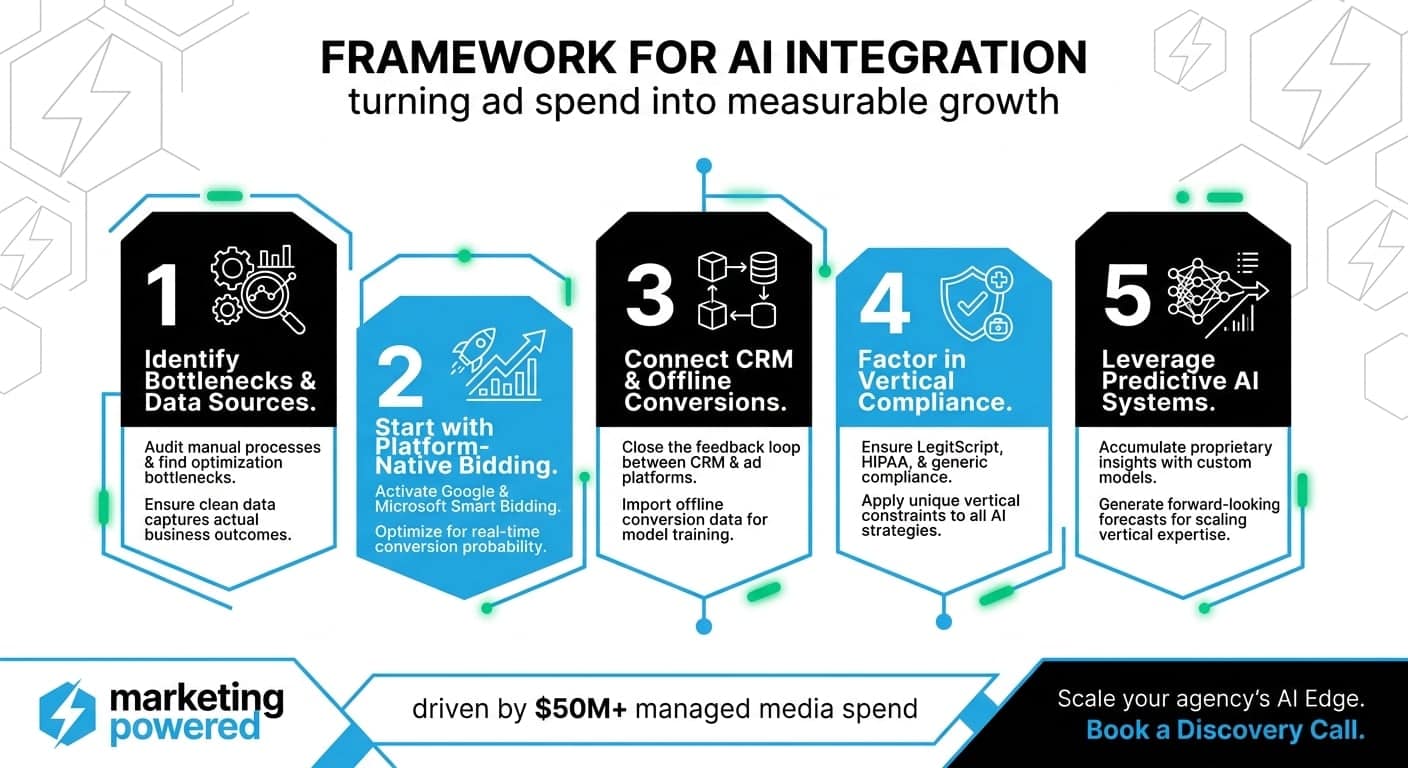
Starting with AI integration does not require replacing your entire paid media infrastructure. The practical path begins with identifying where manual processes create bottlenecks and where data exists to train AI systems.
Audit your current bidding approach first. If you manage bids manually or use basic automated rules, platform-native smart bidding offers immediate improvement with minimal setup. Enable conversion tracking that captures actual business outcomes, not just clicks or form submissions. The AI can only optimize for what it can measure.
Evaluate your data infrastructure next. AI ppc campaigns improve as they learn from more data. If your CRM disconnects from your ad platforms, you lose the feedback loop that makes machine learning effective. Offline conversion imports, customer match audiences, and server-side tracking close these gaps.
Consider compliance requirements before selecting tools. For mental health advertising strategies and other sensitive verticals, standard AI tools may not respect the restrictions that Google's healthcare policies require. LegitScript certification, HIPAA awareness, and the prohibition on retargeting in behavioral health all constrain which AI approaches work.
The integration question is not whether to adopt AI in paid media but how to adopt it in ways that match your vertical's requirements and your organization's data maturity. Marketing Powered builds AI systems designed for exactly these constraints, combining predictive paid media capabilities with the compliance discipline that healthcare-adjacent verticals demand.
Ready to Explore AI Integration for Your Paid Media?
Marketing Powered combines AI-native infrastructure with operator-level expertise in regulated verticals. If you are evaluating how AI can improve your paid media performance while respecting compliance requirements, a discovery call provides the space to discuss strategy, lead quality, and the specific constraints of your vertical.
Questions, Answered.
AI shifts paid media from reactive optimization to predictive decision-making. Instead of analyzing last week's performance to adjust this week's bids, AI systems predict conversion probability at the impression level and act in real time. This changes targeting from demographic assumptions to behavioral pattern recognition, bid management from manual rules to auction-time optimization, and reporting from historical summaries to forward-looking forecasts that guide strategy.
The primary benefits include improved targeting accuracy through pattern recognition that identifies converting audiences, cost efficiency from real-time bid optimization that reduces wasted spend, faster creative testing through multi-variant optimization, and attribution insights that connect ad spend to actual business outcomes. These compounds over time as the AI accumulates data and refines its models.
AI tools optimize PPC through auction-time bidding that adjusts for each impression, dynamic budget allocation that shifts spend toward the highest-performing campaigns, predictive analytics that forecast performance before spend occurs, and automated creative testing that identifies winning combinations faster than traditional A/B testing. The depth of optimization depends on data quality and how well conversion tracking captures real business outcomes.
Google's Smart Bidding and Performance Max represent the most accessible AI options with access to proprietary user signals. Microsoft Advertising offers similar capabilities with LinkedIn data integration. Third-party platforms like Skai and Optmyzr add cross-platform optimization. For regulated verticals like healthcare, custom AI solutions built on owned infrastructure provide the deepest integration while maintaining data sovereignty and compliance.
AI performs best with sufficient conversion volume to train models accurately, typically requiring 30+ conversions per month at a minimum. Campaigns with very low volume, highly seasonal patterns, or rapid market changes may benefit from hybrid approaches that combine AI automation with human strategic oversight. Compliance-sensitive verticals require AI solutions designed to operate within regulatory constraints.
Ready to see what AI-native marketing can do for your treatment center?
Request a free audit of your paid media, landing pages, attribution, and compliance posture. You'll get a straight assessment of where the opportunities are.
or email us at info@marketingpowered.ai