Capabilities
Strategic Landing Page Optimization
Convert more qualified admission calls with landing pages built for behavioral health compliance and performance.
Understanding Landing Page Optimization
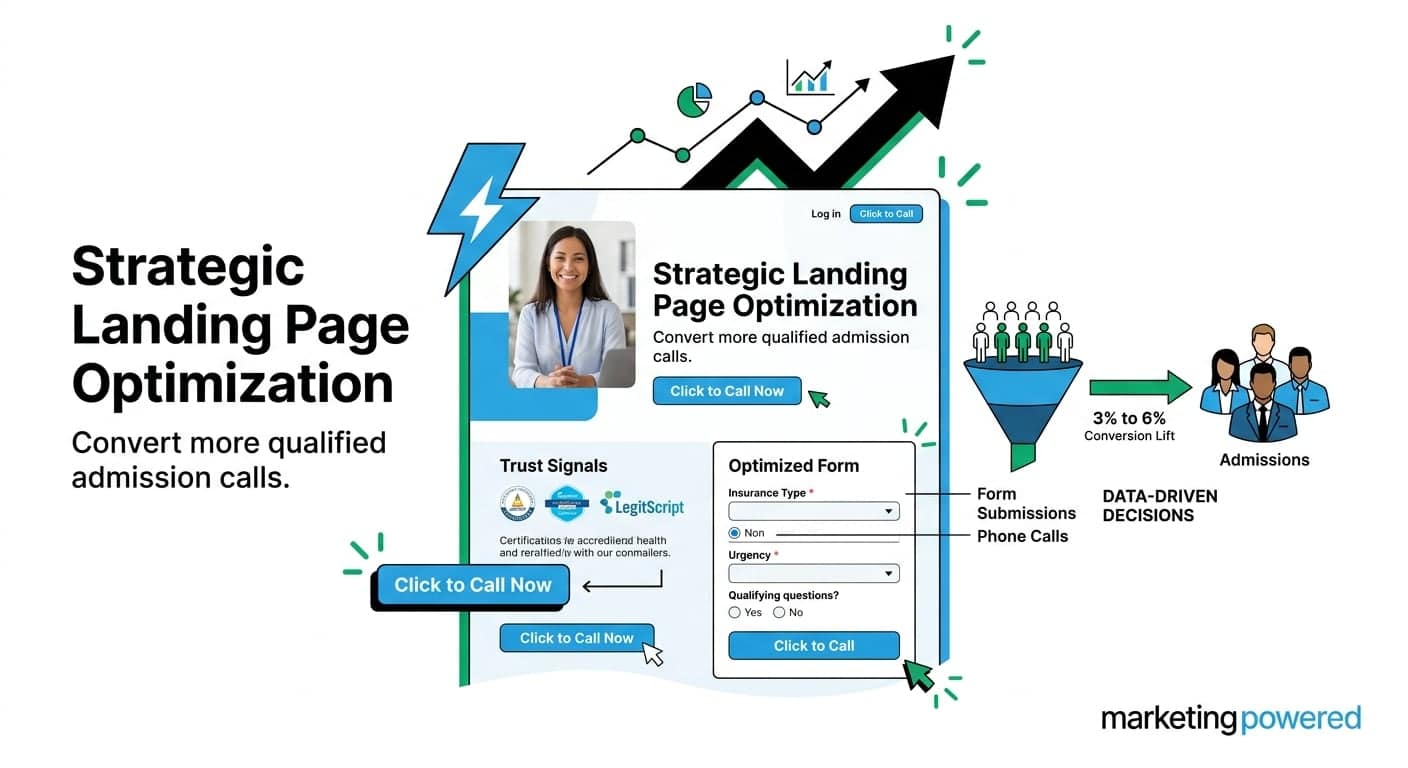
Landing page optimization is the systematic process of improving every element of a page to increase the percentage of visitors who complete a desired action. For behavioral health treatment centers, that action is typically a phone call, form submission, or chat initiation that leads to an admission inquiry. The difference between a 3% and 6% conversion rate on a page receiving 10,000 monthly visitors is 300 additional qualified leads per month.
In the behavioral health vertical, landing page optimization carries specific demands that generic agencies miss. Your pages must comply with LegitScript certification requirements while still persuading visitors in a moment of crisis or consideration. Google Ads healthcare vertical restrictions prohibit retargeting, which means the first visit often must be the converting visit. There is no second chance to re-engage someone who left without acting.
Tailored strategies matter here. A landing page for addiction treatment must address different fears, objections, and urgency levels than one for outpatient therapy. The copy, form length, trust signals, and page speed all influence whether a visitor picks up the phone. Marketing Powered brings operator-level experience to this work, having managed $50M+ in behavioral health and mental health media spend, where landing page conversion directly determined whether campaigns remained profitable.
Key Metrics for Successful Landing Pages
Measuring landing page performance requires tracking the right numbers at the right level of granularity. Vanity metrics distract; actionable metrics drive decisions.
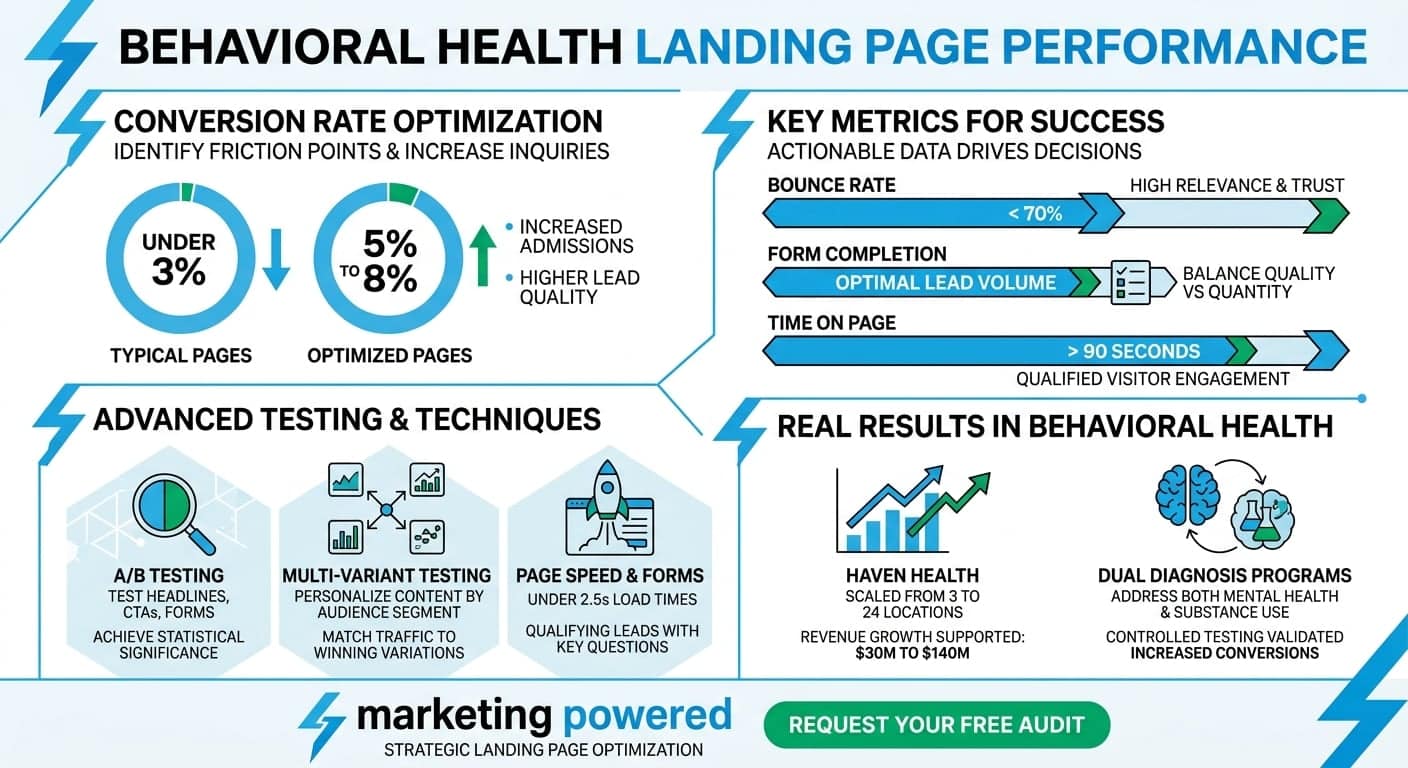
Conversion rate is the primary indicator. For behavioral health landing pages, qualified conversion rates typically range from 3% to 8%, depending on traffic source, treatment type, and geographic market. Pages converting below 3% almost always have identifiable friction points. Pages above 8% are performing well but may still have room for multi-variant optimization.
Bounce rate indicates whether visitors find immediate relevance. High bounce rates (above 70%) on paid traffic suggest a mismatch between ad copy and landing page messaging, slow load times, or a failure to establish trust within the first three seconds. For behavioral health pages, trust signals like accreditation badges, staff credentials, and facility imagery reduce bounce rates measurably.
Form completion rate and call-to-form ratio reveal where visitors prefer to engage. Treatment center audiences often prefer phone calls over forms, particularly for residential programs. If your page shows a 10:1 call-to-form ratio, optimizing the form may matter less than improving click-to-call placement.
Time on page and scroll depth show engagement quality. Visitors who scroll past 50% and spend more than 90 seconds are more likely to convert. These users are reading, not bouncing. Tracking these metrics through tools like Google Analytics 4 and call tracking platforms allows you to identify which page sections hold attention and which lose it.
Marketing Powered tracks attribution through to admission, not just to form fill. This means we know which landing page variations produce leads that actually convert to census, not just leads that look good in a dashboard.
Advanced Techniques in CRO for Landing Pages
CRO for landing pages moves beyond surface-level changes when you apply testing discipline and behavioral understanding. The techniques that produce measurable lifts require controlled experimentation, not guesswork.
A/B testing remains foundational. Test one variable at a time: headline copy, hero image, form placement, CTA button color, or phone number prominence. Run tests until statistical significance is reached, typically 95% confidence with at least 100 conversions per variant. Stopping tests early produces false positives that lead to worse pages, not better ones.
Multi-variant optimization takes testing further by serving different page combinations to different visitor segments based on traffic source, device, geography, or behavioral signals. Rather than finding a single winning page, multi-variant testing identifies which page works best for which audience. A visitor arriving from a branded search may convert better with a shorter page, while someone from a non-branded keyword may need more educational content before acting.
Form optimization deserves specific attention in behavioral health. Shorter forms increase submission rates but may decrease lead quality. Longer forms with qualifying questions (insurance type, urgency level, treatment history) reduce volume but improve the percentage of leads that convert to admission. The right balance depends on your intake team's capacity and your cost-per-admission targets.
Page speed optimization directly affects conversion. According to Google's Core Web Vitals research, pages that load in under 2.5 seconds convert significantly better than slower pages. For behavioral health, where visitors may be searching on mobile devices in stressful moments, a slow page is a lost opportunity.
Trust signal placement matters for conversion-focused landing pages in healthcare. Accreditation logos (Joint Commission, CARF), LegitScript certification badges, and insurance acceptance lists should appear above the fold. Staff photos and credentials build confidence that the facility is legitimate and staffed by qualified professionals.
Marketing Powered has been AI-native since 2022, using machine learning models to identify optimization opportunities faster than manual analysis allows. Our proprietary systems analyze landing page performance data to surface patterns that human reviewers would miss.
Free Audit
Want a straight read on where your budget is leaking?
Case Studies: Proven Results in Behavioral Health
Results in this vertical require more than screenshots of rising graphs. They require understanding the full path from click to admission.
Marketing Powered partnered with a multi-location behavioral health organization to scale through a multi-location expansion over a growth period where landing page conversion was a primary lever. By systematically testing page variations across different treatment modalities and geographic markets, we identified which messaging resonated with each audience segment. The result was a media operation that supported revenue growth from operator-side growth work.
Across our portfolio, we manage $1.5M to $2M monthly in Google Ads for behavioral health and mental health clients. That scale produces enough conversion data to run statistically valid tests quickly. Smaller budgets often stall on landing page testing because they cannot generate sufficient sample sizes within reasonable timeframes.
For dual diagnosis programs specifically, we have found that landing pages addressing both the mental health and substance use components outperform pages that focus on only one. This insight came from controlled testing, not assumption. The data showed visitors to dual diagnosis landing pages converted at higher rates when the page validated the complexity of their situation rather than oversimplifying it.
Our case studies document specific outcomes across treatment types, geographies, and budget levels. The common thread is attribution discipline: we track which page variations produce leads that convert to admission, then allocate budget toward the winners.
Get Started with Marketing Powered
Landing page optimization for behavioral health requires a partner who understands both the marketing mechanics and the compliance constraints. Marketing Powered operates at that intersection.
We bring court-certified expert witness credentials in advertising strategy, LegitScript, and HIPAA awareness built into our process, and paid media services that integrate landing page testing with campaign management. Our web development services team builds pages optimized for speed, compliance, and conversion from the start.
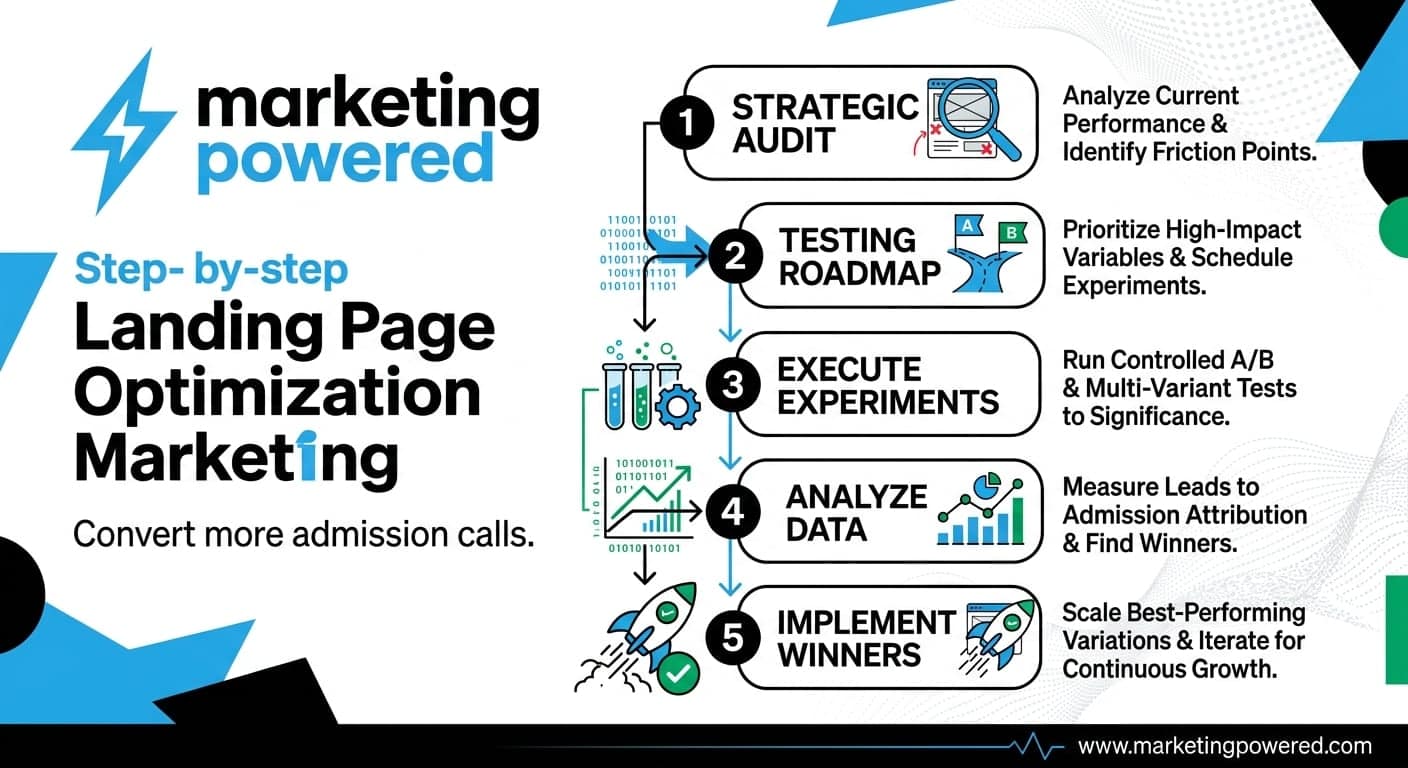
The first step is a landing page audit. We review your current pages against behavioral health best practices, identify friction points, and outline a testing roadmap with projected impact. There is no obligation beyond the conversation.
If you are managing admissions for a treatment center and your landing pages are not converting at 5% or higher, there is likely room to improve. If you are spending on marketing strategies without tracking which pages produce admissions, you are making decisions without the data you need.
Ready to Improve Your Landing Page Performance?
Request a free landing page audit and get a clear roadmap for improving conversion rates, lead quality, and compliance posture. We will review your current pages, identify specific opportunities, and outline a testing strategy tailored to your treatment center.
Questions, Answered.
For behavioral health landing pages, conversion rates typically range from 3% to 8%, depending on traffic source, treatment type, and market competition. Pages converting below 3% usually have identifiable issues with messaging, trust signals, or page speed. Rates above 5% indicate strong performance, though multi-variant optimization can often push results higher. Insurance verification pages and residential treatment pages tend to convert differently, so benchmarks should be compared within the treatment category.
Improving landing page conversion starts with identifying where visitors drop off. Common fixes include reducing form length, improving page load speed, adding trust signals above the fold, and aligning headline copy with ad messaging. For behavioral health specifically, prominent phone numbers, staff credentials, and insurance acceptance lists reduce friction. A/B testing each change in isolation confirms which modifications actually increase conversions rather than just appearing to help.
Effective landing page testing includes A/B testing single variables to statistical significance, multi-variant optimization that matches page versions to visitor segments, form length testing to balance volume against lead quality, and page speed improvements that reduce bounce rates. For behavioral health, trust signal placement and compliance-friendly copy are also optimization levers. Each technique requires sufficient traffic volume to produce valid results within reasonable testing windows.
Behavioral health landing pages must comply with LegitScript certification requirements, Google Ads healthcare vertical policies, and HIPAA guidelines. Non-compliant pages risk ad disapprovals, account suspensions, and legal exposure. Compliance also affects conversion: visitors to treatment center pages look for accreditation badges and professional presentation as trust signals. A compliant page that looks legitimate converts better than a non-compliant page that appears questionable.
The primary metrics for behavioral health landing pages are conversion rate, bounce rate, form completion rate, call-to-form ratio, time on page, and scroll depth. Beyond these, tracking attribution through to admission reveals which page variations produce leads that actually fill beds, not just leads that submit forms. This requires connecting landing page data with CRM and admission records, which most agencies skip, but which determines whether your landing pages are truly performing.
Ready to see what AI-native marketing can do for your treatment center?
Request a free audit of your paid media, landing pages, attribution, and compliance posture. You'll get a straight assessment of where the opportunities are.
or email us at info@marketingpowered.ai