Who We Help
Explore Marketing Strategies for Dual Diagnosis Treatment
Marketing that reflects the complexity of co-occurring disorder treatment, built by operators who have scaled behavioral health programs through multi-market growth.
Understanding Dual Diagnosis Treatment
Dual diagnosis treatment marketing requires a fundamentally different approach than standard addiction or mental health marketing. When a facility treats co-occurring mental health and substance use disorders simultaneously, the marketing must reflect that integrated clinical model with precision and nuance.
Dual diagnosis treatment addresses the intersection where conditions like depression, anxiety, PTSD, or bipolar disorder exist alongside substance use disorders. According to the Substance Abuse and Mental Health Services Administration (SAMHSA), approximately 9.2 million adults in the United States experience co-occurring disorders. This population requires specialized care, and they search for it in distinct ways.
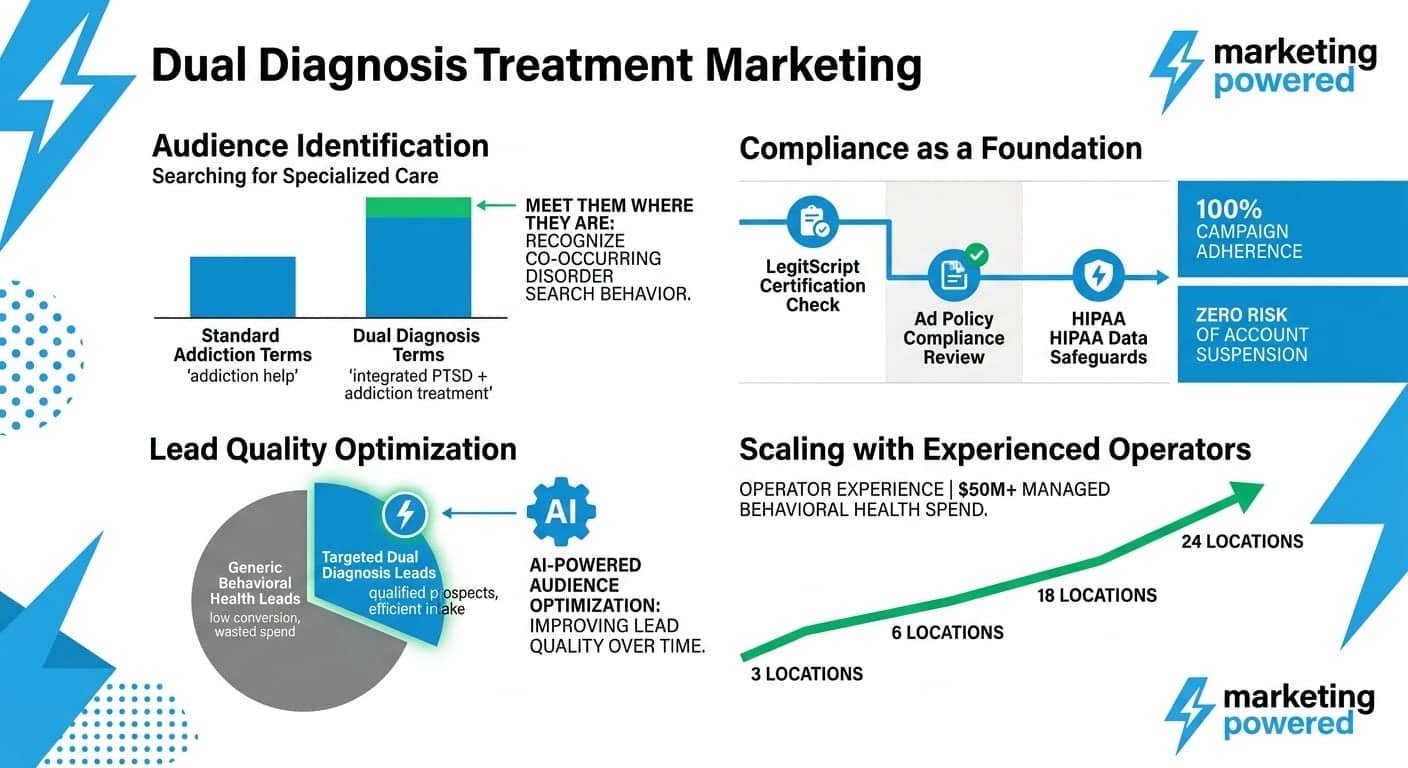
The families and individuals searching for dual diagnosis programs often use different language than those seeking single-diagnosis treatment. They may search for 'co-occurring treatment,' 'integrated treatment,' or describe specific symptom combinations. Your marketing must meet them where they are, speaking to both the mental health component and the substance use disorder, without oversimplifying either.
Marketing that conflates dual diagnosis with standard addiction treatment misses the mark. It fails to communicate clinical differentiation to prospective patients and referral sources, and it competes in the wrong auctions against facilities that do not offer the same level of integrated care. Getting this positioning right is the foundation for everything that follows.
Challenges in Marketing Dual Diagnosis Treatment
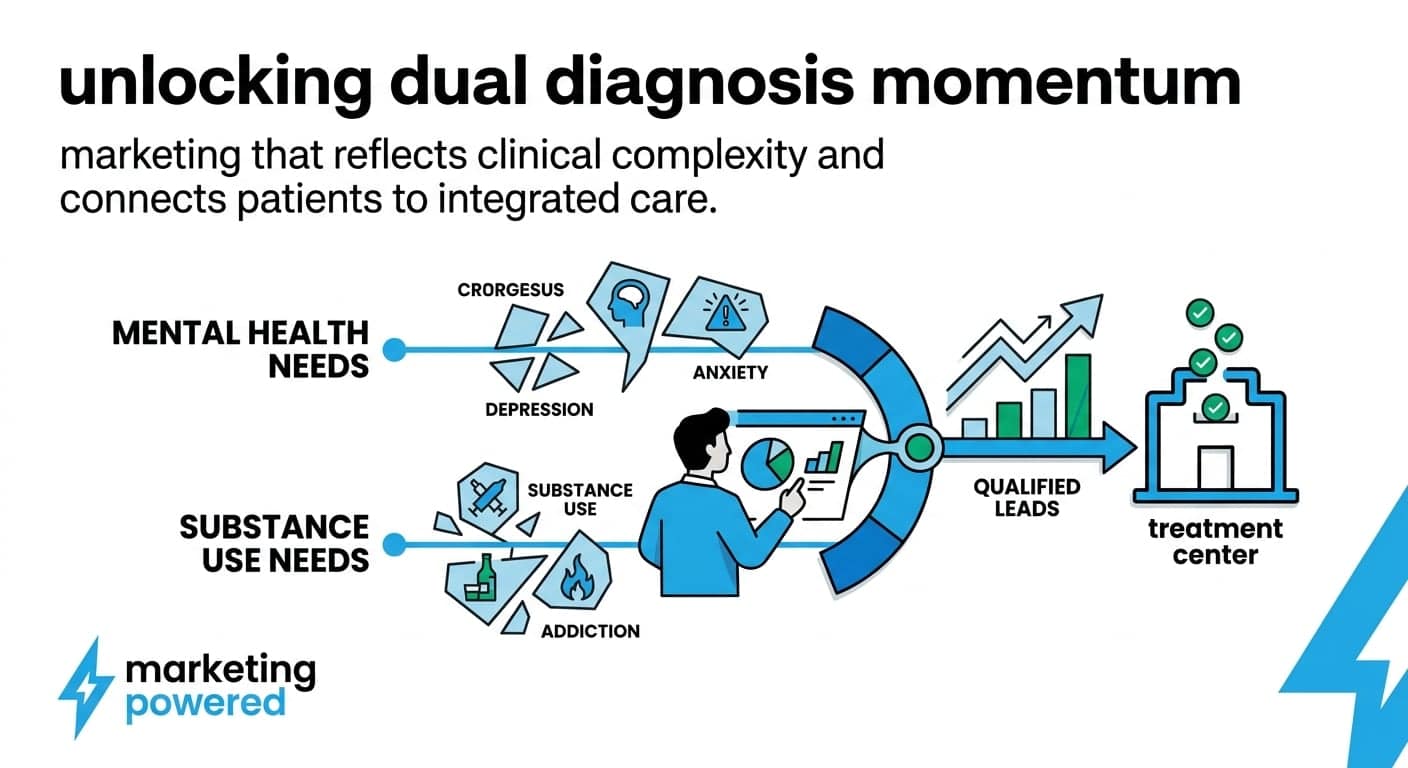
Dual diagnosis centers face marketing challenges that single-focus facilities do not encounter. The complexity starts with audience segmentation: you are reaching people who may not yet understand that their conditions are interrelated, family members researching on behalf of loved ones, and clinical referral sources who need to trust your integrated treatment model.
Lead quality is a persistent concern. Generic behavioral health campaigns attract inquiries from individuals seeking treatment you do not specialize in, wasting intake bandwidth and inflating cost per admission. Dual diagnosis programs need marketing that pre-qualifies prospects before they call, ensuring your clinical team speaks with people who genuinely fit your program's criteria.
Compliance adds another layer of difficulty. Dual diagnosis marketing sits at the intersection of mental health and substance use disorder advertising, which means you face the most restrictive policies from both categories. Navigating LegitScript certification, Google Ads sensitive vertical restrictions, and Meta health policies requires expertise built specifically in this vertical.
Attribution presents its own challenge. Dual diagnosis admissions often involve longer decision cycles, multiple touchpoints, and family involvement. Tracking the path from first click to admission requires infrastructure that most agencies do not build. Without it, you cannot optimize spending toward channels that actually produce admissions.
Effective Marketing Strategies for Dual Diagnosis Programs
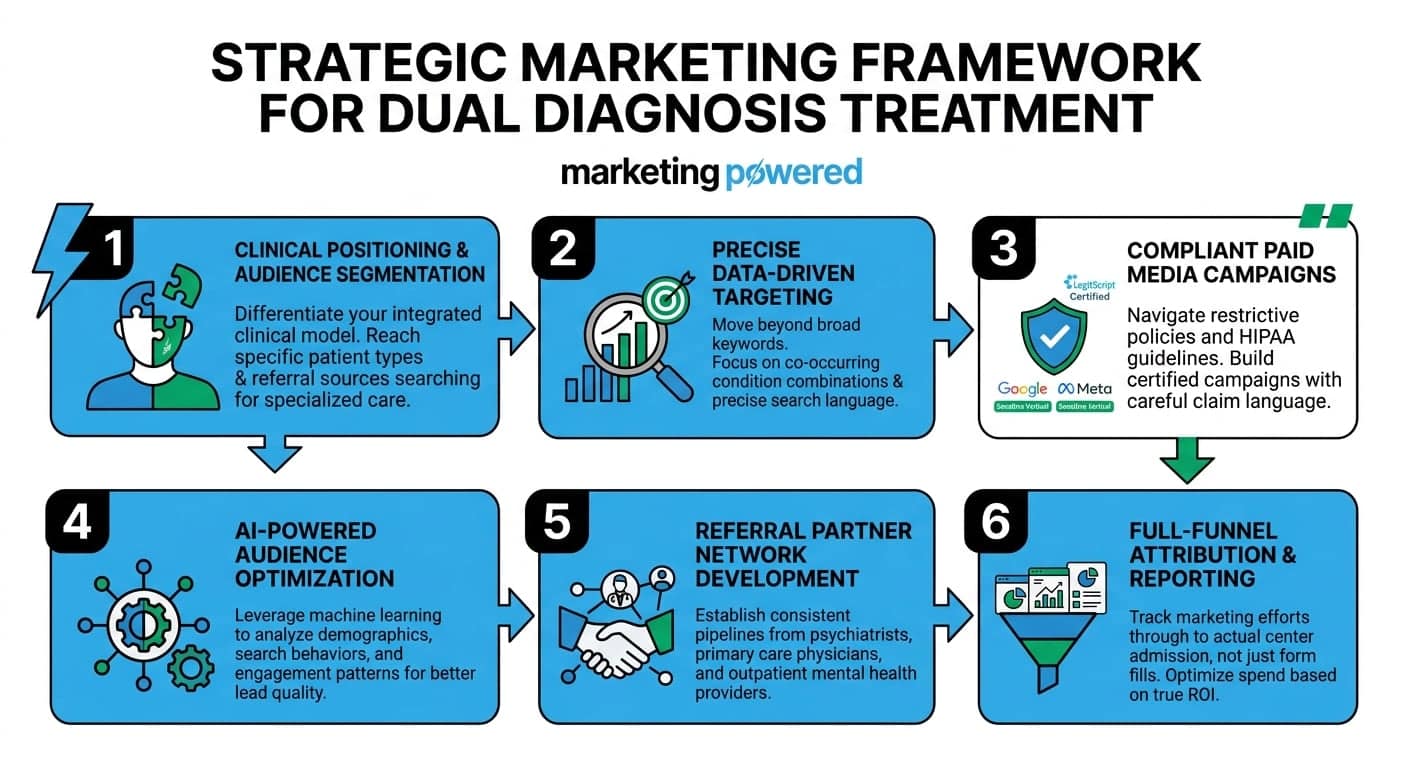
Successful dual diagnosis treatment marketing combines clinical positioning, precise audience targeting, and channel discipline. The strategies that work share a common thread: they respect the complexity of what you offer and communicate it clearly to the right people.
- Content marketing built around clinical differentiation: Create resources that explain integrated treatment approaches, the relationship between specific mental health conditions and substance use, and what patients should expect from a dual diagnosis program. This content serves SEO goals while pre-qualifying prospects who understand they need specialized care.
- Paid media campaigns with condition-specific targeting: Rather than competing on broad addiction keywords, build campaigns around co-occurring condition combinations. Target searches that indicate dual-diagnosis awareness and use ad copy that speaks directly to integrated treatment. This improves quality scores, reduces wasted spend, and attracts prospects who fit your program.
- AI-powered audience optimization: Machine learning models can analyze which combinations of demographics, search behaviors, and engagement patterns predict admission. This moves beyond demographic targeting to behavioral prediction, improving lead quality over time as the models learn from your actual admission data.
- Referral source marketing to clinical partners: Psychiatrists, primary care physicians, and outpatient mental health providers refer patients to dual diagnosis programs. Marketing to these referral sources through targeted content, professional network advertising, and relationship-building campaigns creates a sustainable pipeline that complements direct-to-consumer efforts.
Free Audit
Want a straight read on where your budget is leaking?
Compliance: A Non-Negotiable in Dual Diagnosis Marketing
In dual diagnosis marketing, compliance is not a checkbox. It is the foundation that determines whether your campaigns run at all. Violations result in account suspensions, LegitScript certification issues, and reputational damage that takes months to repair.
Google Ads classifies behavioral health treatment as a sensitive vertical with strict requirements. Retargeting is prohibited. Claims must be carefully worded to avoid implying guaranteed outcomes. Ad copy cannot reference specific substances or conditions in ways that violate platform policies. Meta imposes similar restrictions, with additional scrutiny on health-related targeting.
LegitScript certification is required for advertising addiction treatment on major platforms. The certification process evaluates your facility's licensing, clinical practices, and marketing materials. Your marketing partner must understand these requirements and build campaigns that maintain certification status.
HIPAA considerations extend into marketing operations. Lead data must be handled appropriately, tracking implementations must avoid capturing protected health information, and any use of patient stories requires proper authorization and compliant framing. These safeguards must be built into every campaign from the start, not as an afterthought.
Why Choose Marketing Powered for Dual Diagnosis Marketing
Marketing Powered approaches dual diagnosis treatment marketing from an operator perspective, not an agency perspective. The difference shows in how we build campaigns, measure results, and communicate with your team.
Our founder managed operator-side multi-market growth, managing the marketing that supported that growth firsthand. That operator experience means we understand census pressure, intake capacity constraints, and the real cost of low-quality leads. We have managed $50M+ in behavioral health and mental health media spend, including $1.5M to $2M monthly in Google Ads across 11+ accounts in this vertical.
Attribution discipline separates our work from typical agency output. We track attribution through to admission, not just to form fill. This requires integration with your intake systems and a willingness to be measured on outcomes that matter.
Our AI-native infrastructure, built on proprietary systems since 2022, enables optimization that off-the-shelf tools cannot match. Multi-variant optimization routes each visitor to the landing page variant most likely to convert based on their specific profile. Predictive models identify which leads are most likely to admit, allowing your intake team to prioritize accordingly.
Start with a Marketing Audit
If your dual diagnosis center needs marketing that reflects your clinical sophistication and delivers qualified admissions, begin with an audit. We will review your current campaigns, identify compliance gaps, assess attribution infrastructure, and outline a strategy tailored to your specific program and market.
The audit is free and comes with no obligation. It is a conversation between operators about what is working, what is not, and what the data suggests you should do next.
Email Us
Prefer to send the context directly?
Ready to Improve Your Dual Diagnosis Marketing?
Request a free audit to discuss strategy, compliance, lead quality, and channel mix with a team that has scaled behavioral health programs and managed $50M+ in this vertical.
Questions, Answered.
Integrated marketing approaches that address both mental health and substance use disorder components perform best. This includes content marketing built around clinical differentiation, paid media campaigns targeting condition-specific search terms, and referral source marketing to clinical partners. Strategies should be adjusted to reflect the longer decision cycles and family involvement typical of dual diagnosis admissions.
Compliance requires building campaigns from the ground up with LegitScript certification requirements, Google Ads sensitive vertical restrictions, and HIPAA considerations in mind. This means no retargeting, careful claim language that avoids outcome guarantees, proper handling of lead data, and ongoing monitoring for policy changes. Working with a partner experienced in healthcare marketing compliance reduces risk significantly.
Dual diagnosis treatment combines mental health and substance use disorder care in an integrated model. Generic addiction marketing fails to communicate this clinical differentiation, attracts prospects who do not fit the program, and competes against facilities offering different services. Specialized marketing pre-qualifies prospects, improves lead quality, and positions your program accurately to referral sources.
Co-occurring disorders refer to the simultaneous presence of a mental health condition and a substance use disorder. In a marketing context, this means crafting messages that speak to both conditions and their interaction, using language that families and individuals actually search for, and building campaigns that reach people who understand they need integrated treatment rather than single-focus care.
Ready to see what AI-native marketing can do for your treatment center?
Request a free audit of your paid media, landing pages, attribution, and compliance posture. You'll get a straight assessment of where the opportunities are.
or email us at info@marketingpowered.ai