Who We Help
Effective Marketing for Therapy Practices and Group Therapy Programs
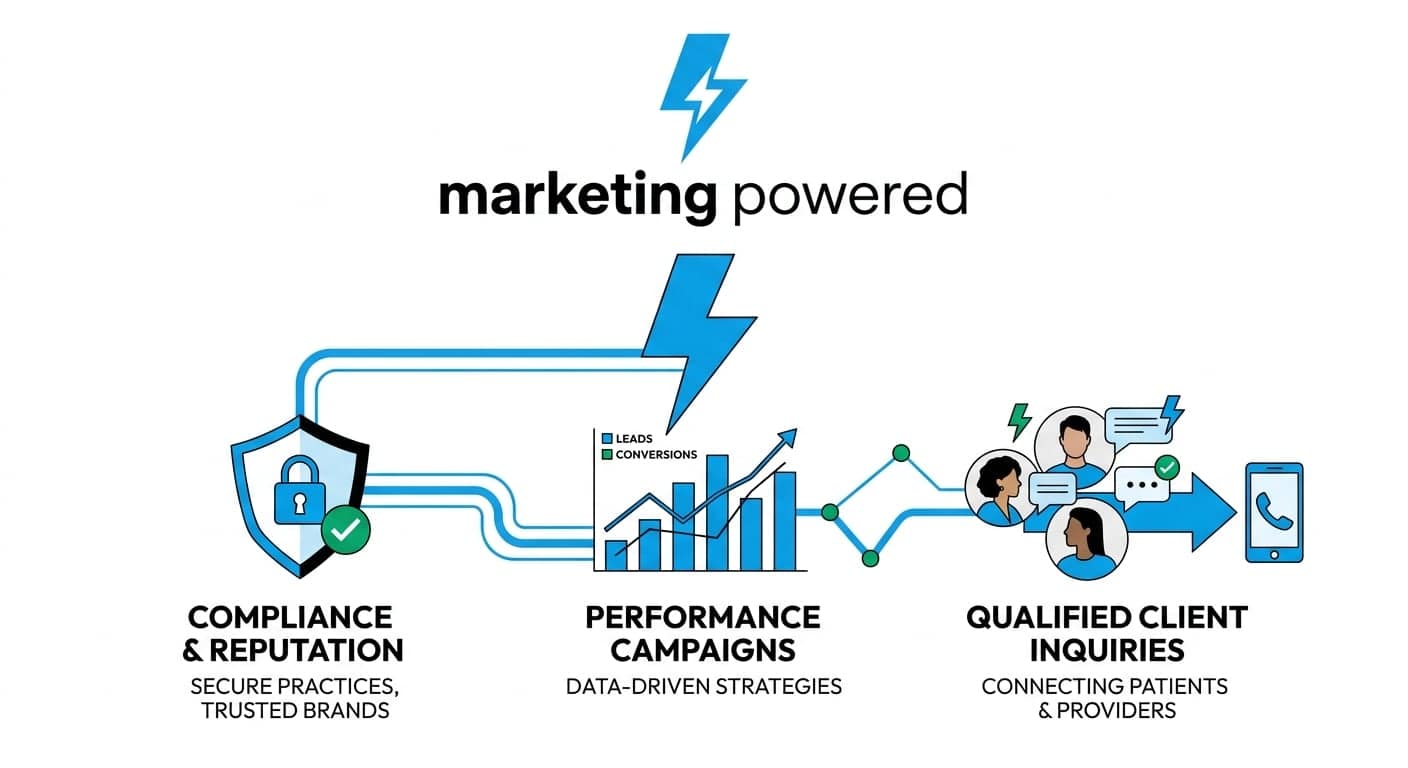
Specialized marketing strategies for therapy group practices that respect compliance, protect your reputation, and deliver qualified client inquiries.

Understanding the Unique Needs of Therapy Practices
Therapy practice marketing requires a different playbook than general healthcare or even broader mental health services marketing. Your practice operates under tighter compliance constraints, serves clients who expect discretion, and competes in a market where trust is the primary currency. Generic marketing approaches fail because they ignore these realities.
Group therapy practices face distinct operational challenges that shape marketing strategy. You are not filling a single therapist's calendar; you are balancing capacity across multiple clinicians, specialties, and locations. Marketing must generate the right volume of inquiries matched to the right service lines, or you end up with overstaffed specialties and waitlists in others. This is a scheduling and attribution problem as much as a lead generation problem.
The compliance environment adds another layer. Operating in a sensitive healthcare vertical means certain advertising tactics are simply unavailable. Google Ads restrictions prohibit retargeting for mental health services. Meta has similar limitations. Agencies unfamiliar with these constraints will waste budget on campaigns that get disapproved or, worse, expose your practice to regulatory risk.
What works is a strategy built from the ground up for therapy group practices: one that respects HIPAA, navigates platform restrictions, and generates inquiries from prospective clients who are actually a fit for your services. That requires operator-level understanding of how therapy practices actually run, not just marketing theory.
Proven Digital Marketing Channels for Therapy Groups
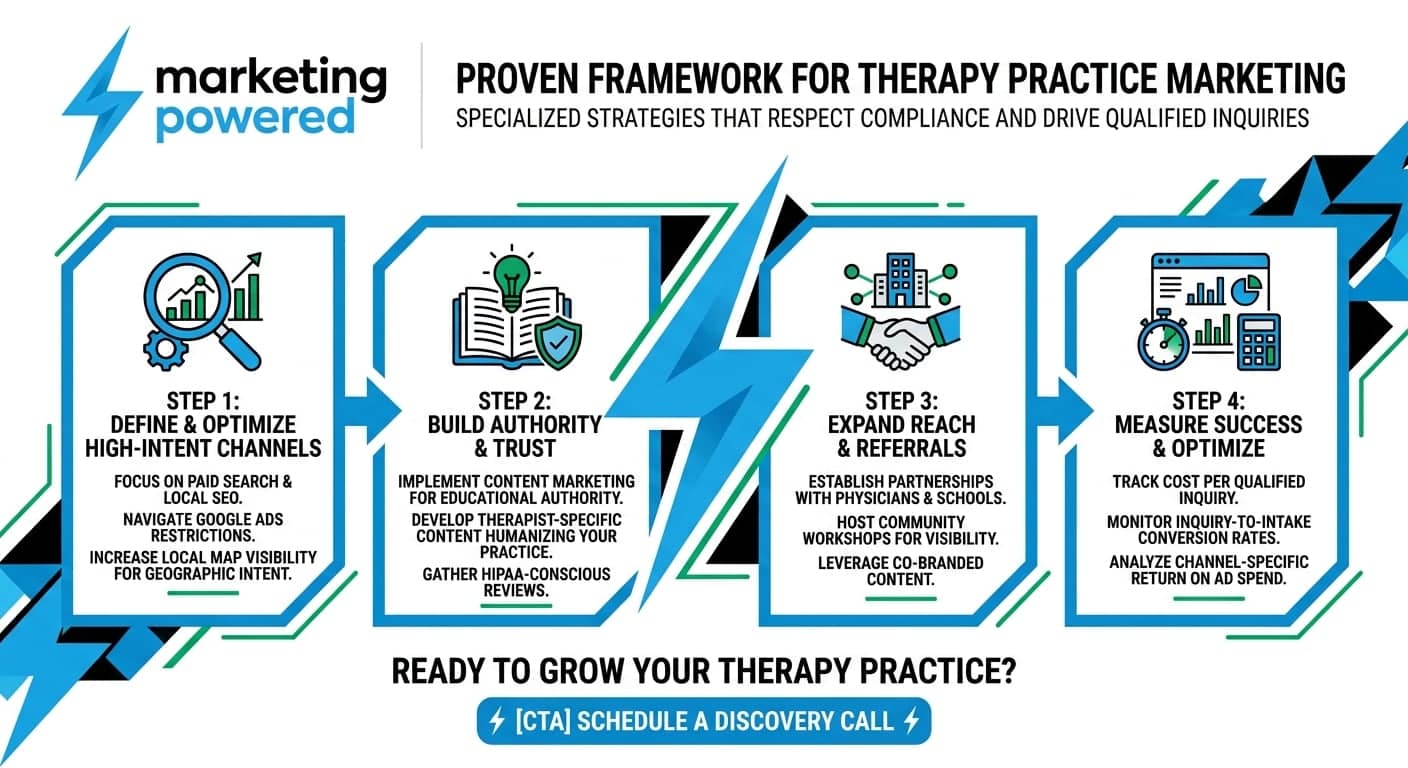
Selecting the right channel mix determines whether your marketing budget generates qualified client inquiries or disappears into vanity metrics. For therapy group marketing, the effective channels are narrower than most agencies admit, but they perform when executed correctly.
Paid search remains the highest-intent channel for therapy practices. Prospective clients searching for specific services such as couples therapy, anxiety treatment, or adolescent counseling are actively seeking help. The challenge is managing cost per click in competitive markets while maintaining compliance with Google Ads healthcare policies. This requires ongoing optimization and an understanding of what Google will and will not approve in mental health advertising.
Local SEO and Google Business Profile optimization drive a significant portion of inquiries for practices with physical locations. Most prospective clients search with geographic intent. Your visibility in map results and local organic rankings directly impacts inquiry volume. This channel compounds over time, making it a strong long-term investment.
Content marketing builds authority and supports SEO while giving prospective clients a reason to trust your practice before they call. Educational content about therapy approaches, what to expect from treatment, and how to evaluate providers positions your practice as credible without making claims that violate compliance standards.
Referral partnerships with primary care physicians, psychiatrists, and employee assistance programs generate high-quality inquiries from trusted sources. Digital marketing can support these relationships through co-branded content, referral landing pages, and attribution tracking that demonstrates value to partners.
Innovative Strategies to Attract More Clients
Beyond the core digital channels, group therapy marketing benefits from strategies that build community trust and differentiate your practice from competitors.
Community engagement creates visibility and credibility in ways paid advertising cannot replicate. Hosting workshops on stress management, parenting challenges, or workplace mental health positions your clinicians as experts while introducing prospective clients to your practice in a low-pressure setting. These events can be promoted digitally and generate warm inquiries from attendees who experienced your team's expertise firsthand.
Strategic partnerships with complementary providers expand your referral network. Employee assistance programs, school counselors, primary care practices, and wellness-focused employers all interact with individuals who could benefit from therapy. A systematic approach to building and maintaining these relationships, supported by trackable referral mechanisms, turns partnership development into a measurable marketing channel.
Therapist-specific content humanizes your practice and helps prospective clients find the right fit. Individual clinician profiles, specialty-focused blog posts, and short video introductions reduce the anxiety of reaching out and improve match quality. Clients who choose a therapist based on genuine fit convert at higher rates and stay in treatment longer.
Review generation systems ensure satisfied clients share their experiences in ways that influence future prospective clients. A structured process for requesting reviews on Google, Psychology Today, and other relevant platforms builds social proof over time. This requires HIPAA-conscious execution: you cannot reference treatment details, but you can make it easy for willing clients to share general feedback.
Free Audit
Want a straight read on where your budget is leaking?
Measuring Success: Metrics That Matter for Therapy Practice Marketing
Therapy practices often track the wrong metrics or track nothing at all. Without clear measurement, you cannot distinguish marketing that works from marketing that feels busy.
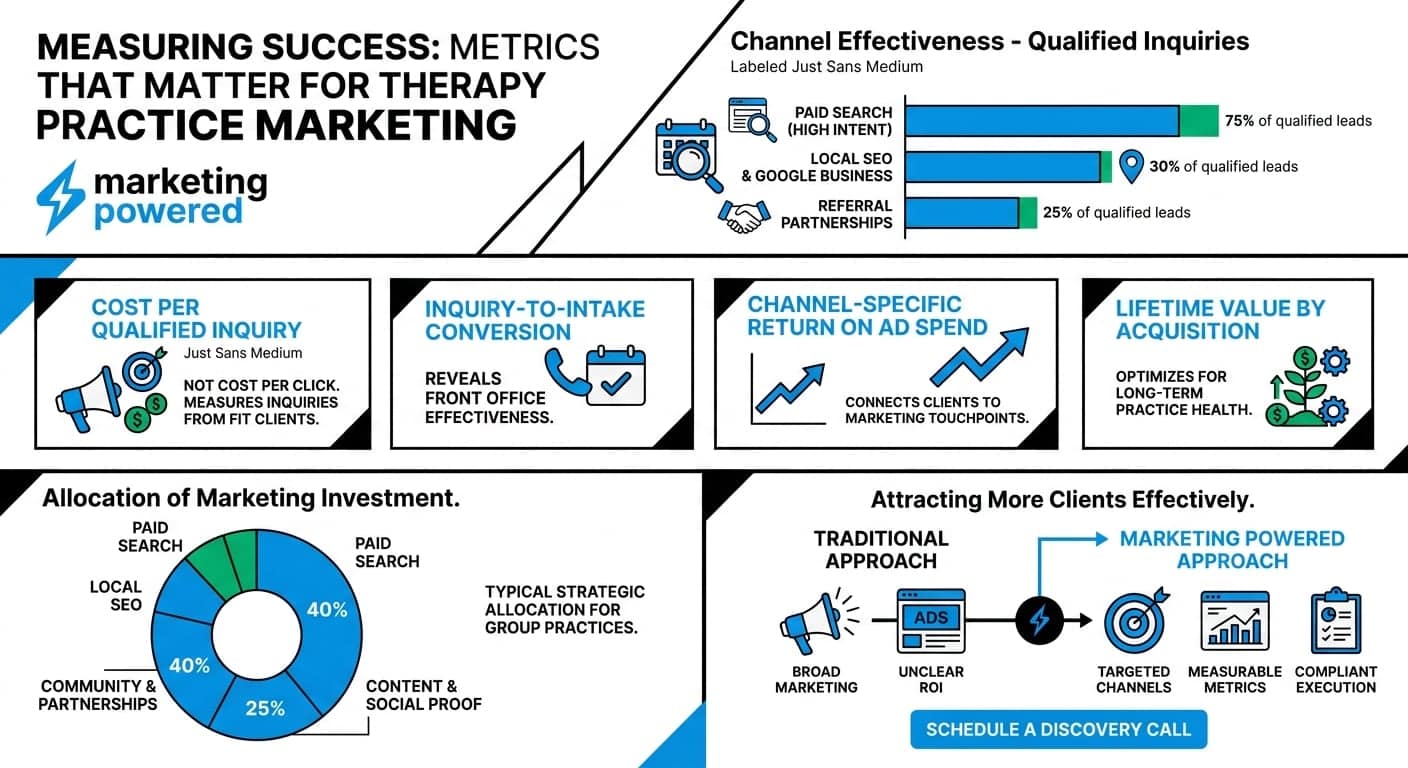
Cost per qualified inquiry is the metric that matters most. Not cost per click, not cost per form fill, but cost per inquiry from a prospective client who is actually a fit for your services. This requires defining what qualified means for your practice and building intake processes that capture source data accurately.
Inquiry-to-intake conversion rate reveals whether your front office is capitalizing on the inquiries marketing generates. A difference of twenty percentage points in conversion rate represents a massive revenue difference on the same marketing spend. Tracking this metric identifies whether problems are upstream in marketing quality or downstream in the intake process.
Channel-specific return on ad spend allows you to allocate budget toward what works and away from what does not. This requires attribution discipline: connecting each new client back to the marketing touchpoints that influenced them. For therapy practices, this often means phone call tracking, form submission attribution, and intake questions about how the client found you.
Lifetime value by acquisition source is the advanced metric that separates sophisticated practices from the rest. Clients acquired through certain channels may stay in treatment longer, refer more often, or generate higher revenue per session. Understanding these patterns allows you to optimize for long-term practice health, not just short-term inquiry volume.
Why Marketing Powered Is the Right Partner for Your Therapy Group
Marketing Powered exists specifically to serve behavioral health and mental health practices. This is not a side vertical for us; it is the entire focus of the agency.
Our founder managed operator-side multi-market growth and serves as a court-certified expert witness in advertising strategy. That operator background means we understand the pressures you face: balancing clinician capacity, managing compliance risk, and generating enough qualified inquiries to sustain growth without compromising the client experience.
We have managed $1.5M to $2M monthly in Google Ads across mental health and behavioral health accounts. We know what Google approves, what gets disapproved, and how to build campaigns that perform within the constraints of sensitive healthcare vertical restrictions. LegitScript awareness and HIPAA discipline are built into our processes, not afterthoughts.
Our AI capabilities give therapy practices access to technology infrastructure that would be impossible to build in-house. We have been AI-native since 2022, running proprietary systems on owned hardware built for HIPAA-conscious local inference. This allows us to optimize campaigns, analyze performance data, and generate insights at a speed and depth traditional agencies cannot match.
The combination of operator experience, compliance discipline, and AI-powered execution makes Marketing Powered the partner therapy group practices need. We understand your business because we have operated in your category. We respect your compliance constraints because we have lived with them. And we deliver results because we measure what matters and optimize relentlessly.
Ready to Grow Your Therapy Practice?
Schedule a discovery call to discuss strategy, compliance, lead quality, and the channel mix that fits your practice. There is no obligation and no generic pitch, just a conversation between operators about what it takes to grow a therapy group responsibly.
Questions, Answered.
Effective therapy practice marketing combines paid search for high-intent prospective clients, local SEO to capture geographic searches, content marketing to build authority, and referral partnerships with complementary providers. The right mix depends on your practice's specialties, locations, and growth goals. Community engagement through workshops and educational events also builds trust and generates warm inquiries that convert at higher rates than cold traffic.
Compliance requires understanding platform restrictions and healthcare regulations. Google Ads classifies mental health as a sensitive healthcare vertical, prohibiting retargeting. HIPAA governs how you handle any information that could identify clients. Compliant marketing focuses on service descriptions rather than outcome claims, avoids testimonials that reference treatment details, and builds intake processes that protect client confidentiality from first contact.
Digital marketing reaches prospective clients at the moment they are searching for help. Unlike traditional advertising, digital channels allow precise targeting by geography, search intent, and demographics. They also provide measurable performance data, allowing you to calculate cost per inquiry and return on ad spend. For therapy practices competing in crowded markets, digital visibility often determines whether prospective clients find you or a competitor.
Focus on cost per qualified inquiry, inquiry-to-intake conversion rate, channel-specific return on ad spend, and lifetime value by acquisition source. These metrics connect marketing activity to business outcomes. Vanity metrics like impressions or clicks matter only insofar as they contribute to actual client acquisition. Attribution discipline is required to connect each new client back to the marketing that influenced them.
Ready to see what AI-native marketing can do for your treatment center?
Request a free audit of your paid media, landing pages, attribution, and compliance posture. You'll get a straight assessment of where the opportunities are.
or email us at info@marketingpowered.ai