Resources
Data Sovereignty in Marketing: Who Controls Your Customer Intelligence?
Every interaction your marketing stack captures, from intake call transcripts to downstream conversion signals, either builds a permanent enterprise asset or trains a vendor's algorithm. True data sovereignty means an organization maintains exclusive operational, legal, and computational authority over its audience records, model weights, and customer intelligence. When marketing teams rely on rented software-as-a-service wrappers and public artificial intelligence APIs, they surrender that authority and introduce significant commercial and regulatory risk.
By Mike Hulick, Founder, Marketing Powered

What Data Sovereignty Means for Marketing Leaders
In commercial marketing, data sovereignty defines whether an organization independently controls the systems, transformations, and strategic value derived from its audience data. It extends beyond basic data ownership contract clauses. While standard terms of service might state that a customer owns their uploaded records, the practical reality inside modern marketing platforms looks very different. When intake notes, web forms, and lead qualification transcripts are passed through external cloud systems, the underlying intelligence is frequently aggregated, abstracted, and locked within proprietary software silos.
Consider the daily intake operation of a multi-location healthcare network or specialized professional services firm. A patient or prospective client visits a landing page, opens a chat widget, and shares sensitive details regarding their personal situation, geographic location, and clinical or financial requirements. An intake coordinator or conversational agent handles the inquiry, generating a timestamped transcript.
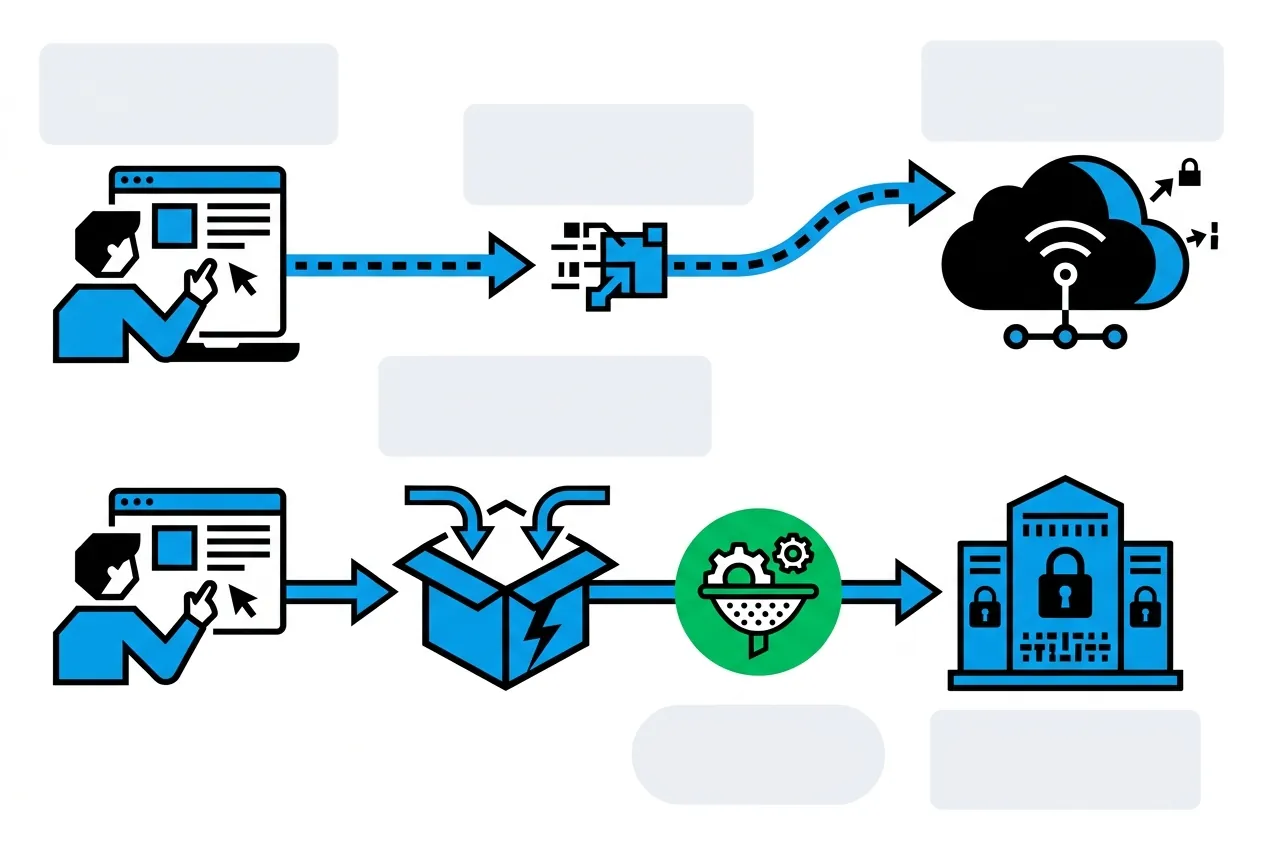
In a sovereign architecture, that transcript is processed immediately through local or private infrastructure. Sensitive identifiers are scrubbed according to internal protocol, structured intent signals are extracted directly into an internal data warehouse, and deterministic attribution models map the session back to the initiating ad campaign. The enterprise retains the raw transcript, the parsed variables, the routing logic, and the attribution record.
In a conventional cloud-dependent marketing stack, that same transcript travels across multiple third-party systems. The web chat vendor runs the text through an external large language model API for real-time summarization. A call-tracking script syncs audio snippets to an ad network for automated bidding optimization. A customer relationship management platform generates lead scores using a black-box machine learning algorithm hosted on external multi-tenant infrastructure.
Under that second model, the enterprise possesses a record of the conversation, but the operational intelligence—the capability to classify, score, predict, and attribute customer behavior—remains inextricably tied to third-party vendors. If the software provider changes its pricing structure, deprecates its API, or modifies its terms of service, the enterprise cannot extract its operating logic and run it elsewhere. Data sovereignty requires that every step of the customer intelligence lifecycle remains fully portable, auditable, and self-directed.

Data Sovereignty vs Data Residency in Enterprise Architecture
Executive teams often confuse data residency with true data sovereignty. While both concepts address information governance, they solve fundamentally different strategic problems.
Data residency specifies the geographic and physical location where data rests. An enterprise might require its cloud database to reside in a specific country or region to satisfy local legal guidelines. Many software vendors address this requirement by deploying regional data centers, allowing marketing executives to select specific geographical regions for data storage.
Data sovereignty encompasses legal jurisdiction, operational autonomy, and computational governance. Storing database snapshots within domestic borders does not protect an organization if the software processing that data is subject to foreign regulatory discovery, unilateral vendor policy updates, or automated platform data sharing.
Furthermore, data residency does not resolve the challenge of proprietary extraction. If a marketing team trains custom classification models, predictive lead scoring engines, or generative search pipelines inside a closed cloud ecosystem, the underlying algorithms and learned patterns cannot be exported. The raw customer files may sit on a regional server, but the intelligence derived from those files remains the intellectual property of the platform host.
For organizations evaluating their long-term digital strategy, confusing residency with sovereignty creates a false sense of security. True data sovereignty requires decoupling customer intelligence from third-party application layers, ensuring that data transformations, model training, and analytical inference occur under the explicit authority of the enterprise. Leaders navigating this distinction can review our guide on AI marketing: what it changes for strategy, teams and budgets to understand how infrastructure choices affect operating capital.
The Hidden Extraction of Rented Cloud AI Platforms
The explosion of commercial generative artificial intelligence has accelerated the loss of customer data control across marketing departments. Many organizations rapidly adopt AI tools by integrating third-party commercial APIs directly into their customer-facing communication channels and back-office marketing workflows.
When marketing teams pipe raw customer inquiries, qualification transcripts, and conversion signals through external foundation models, they create serious commercial and strategic vulnerabilities:
- Algorithmic Expropriation: While major enterprise cloud providers state that commercial API payloads are not used to train base foundation models by default, the metadata, structured outputs, and fine-tuning configurations often remain stored within vendor logging environments. This grants the platform continuous visibility into industry-specific language, customer intent patterns, and proprietary operational workflows.
- Unilateral Deprecation and Rate Limiting: Commercial API providers frequently update model checkpoints, adjust context-window handling, alter safety filtering thresholds, and impose sudden rate restrictions. A customer qualification pipeline built on a rented commercial model can break overnight when the underlying vendor pushes an unannounced system update.
- Compounding Marginal Inference Costs: Commercial API models charge per token processed. As marketing operations scale their content analysis, conversational intake agents, and multi-touch attribution processing, token usage costs compound rapidly. Teams find themselves paying perpetual access fees for commodity language processing that could run more efficiently on owned compute infrastructure.
- Uncontrolled Data Linkage: External tools often link user interactions across distinct software platforms. When marketing departments embed third-party conversational widgets on public web properties, those widgets can correlate user IP addresses, browser fingerprints, and intake queries with global advertising identifiers, bypassing internal governance policies.
Rented cloud software creates an environment where marketing organizations pay vendors to absorb their proprietary market signals. Over time, the enterprise becomes dependent on an external vendor to interpret the very audience behavior the marketing team paid to generate.
Free Audit
Want a straight read on where your budget is leaking?
Protecting Marketing Data Ownership Across Regulated Channels
In regulated sectors such as healthcare, hospital systems, behavioral health networks, finance, and specialized legal services, losing control of customer intelligence carries immediate enforcement consequences. Regulatory authorities and major advertising platforms have instituted stringent measures governing how consumer interaction data can be collected, analyzed, and transmitted.
For example, the Google Ads Personalized Advertising Policy explicitly prohibits the use of sensitive categories, including health conditions, personal hardships, and clinical treatments, for remarketing lists and audience targeting. Advertisers attempting to deploy standard retargeting pixels across sensitive intake funnels risk account suspension.
Simultaneously, the Department of Health and Human Services (HHS) Office for Civil Rights outlined clear operational limits in its guidance on online tracking technologies. Regulated entities cannot transmit protected health information, including user IP addresses, appointment scheduling interactions, and medical search queries, to third-party tracking vendors or platform pixels without formal business associate agreements and explicit authorizations.
Furthermore, the Federal Trade Commission enforces substantial civil penalties under Section 5 of the FTC Act against organizations that share consumer health details and behavioral intake information with external advertising platforms without affirmative consent, as detailed in the FTC business guidance on health privacy.
Operating under these standards requires a marketing data ownership model that prevents client details from touching public tracking scripts or commercial LLM endpoints. Marketing Powered was built from the ground up to navigate these exact operational constraints.
Our operating background includes a former healthcare CMO who ran marketing for a treatment network that grew from 3 to 24 locations, managing $1.5 to $2M per month in Google Ads across 11+ behavioral and mental health accounts. We maintain LegitScript-aware and HIPAA-aware execution standards designed specifically for Google's sensitive healthcare vertical, where retargeting is not permitted.
In these high-stakes environments, attribution cannot rely on client-side tracking pixels or third-party platform algorithms. Attribution must be tracked deterministically to admission or signed contract, not just a superficial lead form submission. That level of measurement requires an uncompromised first-party data pipeline where the enterprise maintains complete ownership over every data point from click to conversion. When vetting potential execution partners, executives should read our framework on how to evaluate an AI marketing agency beyond the label.
How Owned Local Compute Secures Customer Data Control
Achieving true data sovereignty does not require abandoning modern artificial intelligence; it requires shifting from rented cloud APIs to owned local compute infrastructure.
Owned compute infrastructure means the enterprise or its specialized partner operates dedicated hardware and deploys open-weight artificial intelligence models locally. Instead of sending sensitive customer interaction records across the public internet to third-party multi-tenant servers, the raw data is ingested, evaluated, and structured directly within private, dedicated computing environments.
Marketing Powered has been AI-native since 2022, operating owned, local AI infrastructure for HIPAA-aware inference. This technical architecture provides distinct strategic advantages for marketing operations:
- Zero-Leakage Local Processing: Customer phone calls, intake form submissions, and chat interactions can be transcribed, parsed, and classified by open-weight models running on dedicated local hardware. Sensitive personal identifiers can be scrubbed before any sanitized analytical summary is stored, preventing unauthorized third-party exposure.
- Deterministic Model Control: When running local open-weight models, the enterprise controls the model weights, prompt parameters, system temperatures, and context rules. Performance remains consistent over time because an external platform vendor cannot silently alter the underlying model behavior.
- Permanent Knowledge Retention: The custom instructions, contextual taxonomies, and operational scoring rubrics developed to evaluate customer intent remain the exclusive intellectual property of the business. They do not live inside a vendor's web dashboard where they can be lost if an account is terminated.
- Fixed Infrastructure Economics: Local compute replaces variable token fees with predictable capital investment. High-volume marketing tasks such as categorizing thousands of organic search queries, evaluating multi-location ad performance, or analyzing search engine landscape shifts can run continuously without generating unpredictable cloud API bills.
To see how specialized search systems interact with this architecture, review our analysis on what a generative engine optimization agency delivers and how to vet one.

Practical Architecture for Full Customer Data Control
Transitioning an enterprise from a vulnerable, rented marketing stack to a sovereign customer intelligence pipeline requires a phased, practical architectural plan. Marketing teams do not need to rewrite their entire software stack simultaneously; rather, they must systematically eliminate third-party data leakage at key operational points.
Step 1: Establish First-Party Collection Endpoints
Replace third-party client-side web scripts with server-side collection endpoints hosted on your own domain infrastructure. When a user submits an inquiry or triggers a page event, the signal routes directly to your secure server. Your system strips sensitive tracking parameters, sanitizes network identifiers, and structures the record before passing conversion signals downstream.
Step 2: Separate Raw Intelligence from Ad Network Signals
Never send raw customer intake transcripts or detailed diagnostic information to external ad platforms. Instead, convert rich intake events into abstract, deterministic conversion milestones within your owned database. Pass only mathematically hashed, compliance-vetted conversion values back to ad networks via server-to-server APIs, preserving complete attribution accuracy without leaking private customer context.
Step 3: Deploy Local Inference for Sensitive Classification
Route all conversational transcripts, intake notes, and customer qualification workflows through owned, local model deployments. Utilize specialized open-weight models to classify intent, score lead qualification, and generate CRM summaries. This ensures that sensitive customer records never enter multi-tenant commercial cloud logs or train external foundational models.
Step 4: Maintain Model Weight and Pipeline Portability
Store all prompt libraries, fine-tuning datasets, audience segmentation rules, and scoring logic in standard, open formats within internal version-controlled repositories. Avoid building core operational intelligence directly into proprietary software wrappers. If any single infrastructure vendor changes pricing or terms, your team should be capable of migrating workloads to alternative dedicated servers without rewriting operational logic.
For organizations seeking to implement this level of technical governance without managing complex hardware in-house, Marketing Powered provides dedicated execution through our specialized AI systems, delivering sovereign marketing infrastructure tailored to complex, regulated sectors.
Questions, Answered.
Data sovereignty is the principle that digital information is subject to the legal, operational, and computational authority of the organization that generated it, governed by the laws and technical structures under which it is processed. In marketing, it means an enterprise maintains complete control over its customer intelligence, audience data, and predictive models rather than leasing temporary, restricted access from third-party software platforms.
Data residency refers purely to the geographic location where physical data files are stored on disk. Data sovereignty goes further, encompassing legal jurisdiction, computational access, and operational independence. While an external cloud vendor can store files in a domestic data center to meet residency standards, true sovereignty requires that the enterprise retains full control over how that data is processed, analyzed, and extracted, free from third-party vendor lock-in or platform exploitation.
Owned compute allows regulated organizations, such as hospitals, behavioral health clinics, and professional service firms, to run natural language processing and customer analytics on dedicated, private hardware. Because interaction transcripts and customer identifiers never leave the private local environment, marketing teams can automate lead classification, sentiment scoring, and operational routing without violating federal privacy guidelines or platform policies that prohibit sending sensitive consumer information to external public cloud networks.
No. Establishing data sovereignty does not mean isolating your business from major advertising channels like Google or Meta. Instead, it changes how your systems interface with them. Rather than allowing client-side ad network pixels to scrape unprotected consumer behavior directly from your digital properties, a sovereign architecture processes and stores customer data internally, transmitting only privacy-compliant, server-side conversion signals back to ad platforms to optimize media performance. Talk with Marketing Powered about owning your marketing AI stack.
Ready to see where your marketing can improve?
Request a free audit of your paid media, landing pages, attribution, and measurement setup. You'll get a straight assessment of where the opportunities are.
or email us at info@marketingpowered.ai