Capabilities
Selecting a Generative Engine Optimization Agency for Accountable Growth
Conversational interfaces and synthesized answer engines increasingly replace traditional search result listings across Google, Perplexity, and SearchGPT. Selecting an operator-led generative engine optimization agency ensures that your brand remains visible, accurately cited, and commercially competitive as search behaviors shift. This operational guide breaks down what genuine generative search optimization requires, how retrieval systems evaluate your authority, and how to evaluate external partners before risking your data or brand equity.

What a Specialized Generative Engine Optimization Agency Delivers
Most digital agencies treat artificial intelligence search as a lightweight copywriting exercise. They generate bulk articles with generic prompt chains and hope that large language models ingest the text. In contrast, a specialized generative engine optimization agency treats generative discovery as a distributed information retrieval and knowledge representation problem.
The core deliverable of an authentic partner centers on structured entity definition, verifiable information extraction, and platform consensus. Large language models do not read websites the way human visitors browse pages. Instead, these engines rely on retrieval-augmented generation systems that search index repositories, extract verified factual triplets (subject, predicate, object), and evaluate external consensus before assembling an answer.
To position an enterprise inside these synthesized summaries, a technical team maps every core service, leadership credential, and clinical or commercial capability into explicit schema nodes. They audit how your organization appears across public registries, authoritative directories, industry publications, and technical documentation. When an answer engine scans the web to synthesize a solution for a high-intent commercial query, it selects sources that present dense, unambiguous, and corroborated facts. A dedicated agency builds that verifiable digital footprint so your enterprise becomes the default citation.
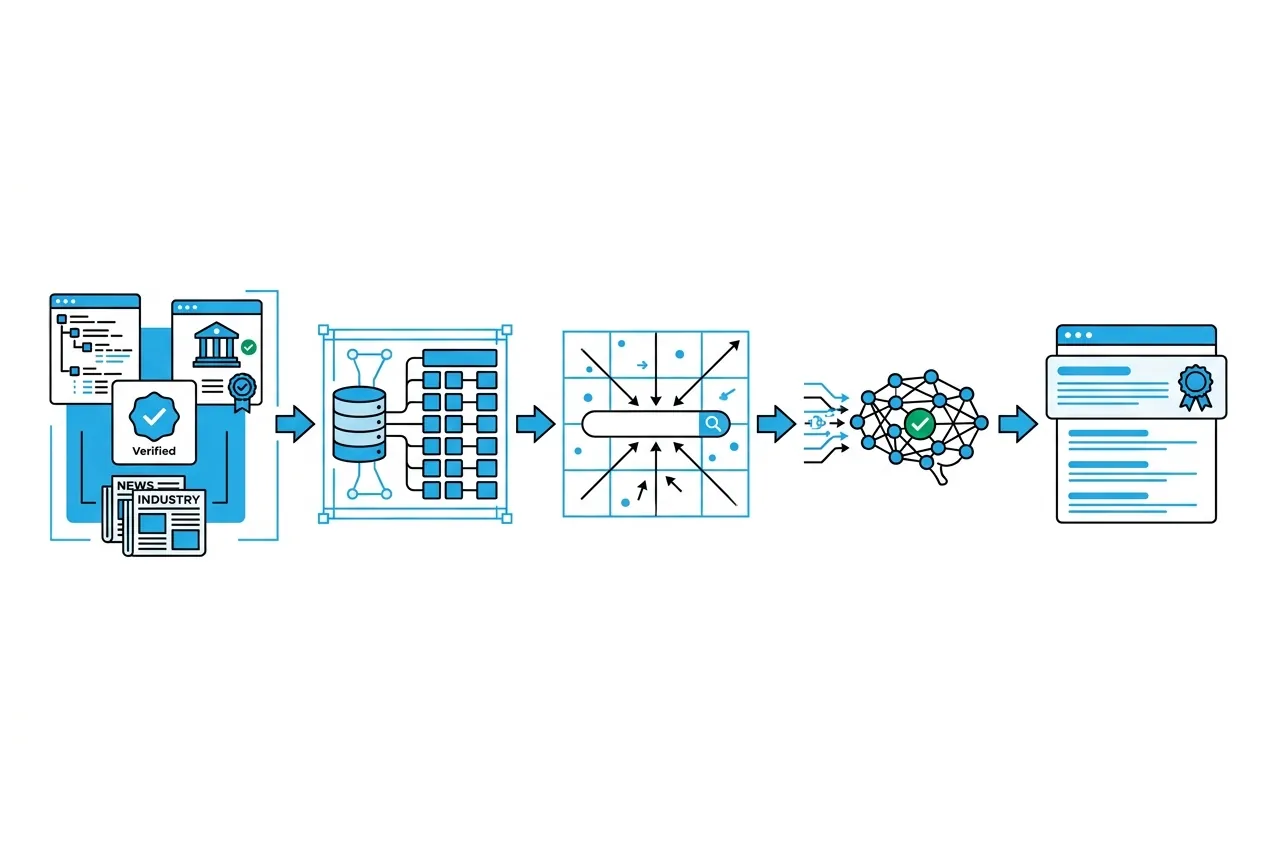
How Answer Engines Synthesize Brand Authority and Citation Share
Traditional search engine optimization rewarded keyword repetition, backlink quantity, and targeted URL positioning across ten blue links. In contrast, generative systems like Google AI Overviews, Perplexity, and SearchGPT evaluate semantic relevance, factual accuracy, and source consensus.
When a prospective buyer asks a conversational engine to evaluate vendors in a regulated vertical, the system does not simply retrieve pages containing those exact phrases. The engine executes a multi-step retrieval process:
- Query Decomposition: The engine splits the user prompt into semantic intents, identifying the entity categories, geographic boundaries, and operational capabilities required.
- Retrieval and Vector Search: The platform searches its indexed web corpus and vector databases for content that demonstrates high semantic proximity and factual density.
- Consensus and Reliability Filtering: The model cross-references retrieved statements against established knowledge bases and third-party citations to filter out unverified claims and hallucinations.
- Answer Synthesis and Attribution: The model generates a conversational summary, explicitly hyperlinking the digital sources that supplied the verified facts.
Because synthesized answers push traditional organic links further down the page, conventional rank tracking no longer reflects true commercial pipeline visibility. The vital metric is citation share: the percentage of category-specific prompts where an engine names and references your brand. Earning that citation share requires publishing original research, verified data points, and explicit entity relationships rather than repetitive marketing commentary.
Generative Engine Optimization Services: Entity Graphs and Schema
Comprehensive generative engine optimization geo services focus on three technical domains: entity graph architecture, off-site consensus synchronization, and machine-readable indexation controls.
First, technical teams implement advanced Schema.org structured data across your web architecture. This goes far beyond basic blog post markup. It establishes precise Organization, Service, About, and Mentions schemas, anchoring your digital footprint to unambiguous knowledge identifiers like Wikidata and official government registries via sameAs declarations. If your enterprise manages multiple clinics, practices, or operational facilities, local structured entities must align perfectly across state licensing boards, commercial registries, and regional databases. Any factual discrepancy between your web properties and public records causes language models to downgrade entity confidence, resulting in omitted citations.
Second, geo services manage crawler access and server delivery. Search systems deploy specialized automated agents to ingest data for retrieval and model refinement. Technical teams audit server access logs and configure permissions for agents such as GPTBot, PerplexityBot, and Google-Extended within robots.txt directives. By managing which directories AI crawlers inspect, you protect non-public intellectual property while ensuring high-value factual assets are rapidly ingested.
Third, specialized teams audit information density. Language models discard low-substance prose to minimize context window processing costs. Technical generative optimization extracts the core factual assertions of your business: regulatory licenses, accepted insurance plans, commercial pricing models, operational facility counts, and executive leadership histories. It structures this data into concise tables, schema blocks, and clear semantic statements that model parsers can parse and quote without ambiguity.
Free Audit
Want a straight read on where your budget is leaking?
How to Evaluate Generative Engine Optimization Companies Beyond the Hype
As enterprise demand for AI search visibility grows, hundreds of conventional marketing providers have rebranded their basic content packages under generative labels. Marketing leaders must evaluate generative engine optimization companies by auditing their technical capabilities, verification processes, and measurement frameworks rather than relying on presentation slides.
- Production Model. Surface-Level Agency Claims: High-volume generative text prompts using generic public APIs. Specialized Technical Partner: Systems-driven content engineering based on proprietary data and technical schema.
- Primary Metric. Surface-Level Agency Claims: Keyword rankings, raw impressions, and surface-level web traffic. Specialized Technical Partner: Model citation share, entity confidence scores, and pipeline attribution.
- Data Privacy. Surface-Level Agency Claims: Pushes client copy and strategic documents through public model portals. Specialized Technical Partner: Runs data-isolated workflows on owned compute infrastructure for regulated privacy.
- Search Engine Strategy. Surface-Level Agency Claims: Superficial backlink purchasing and keyword placement. Specialized Technical Partner: Knowledge graph anchoring, SameAs schema verification, and crawler log optimization.
- Commercial Attribution. Surface-Level Agency Claims: Disconnected contact form submissions and vanity metrics. Specialized Technical Partner: Full tracking connecting citation discovery directly to qualified deals or admissions.
When vetting prospective partners, ask direct operational questions:
- How do you isolate our proprietary data and commercial documentation from public model training cycles?
- Can you diagram the entity graph you plan to construct across our digital footprint?
- What exact methodology and query sets do you use to benchmark model citation frequency over time?
- How does your technical team audit server logs for dedicated answer engine crawlers?
Firms that answer with vague statements about artificial intelligence or offer guaranteed search placements reveal an absence of technical depth. Legitimate generative engine optimization companies explain the trade-offs of knowledge graphs, vector embeddings, and search engine crawler parameters with clear engineering precision.

Choosing Generative Engine Optimization Services for Regulated Markets
Regulated sectors such as hospitals, healthcare systems, legal practices, and financial institutions face rigorous legal boundaries that render generic digital tactics unusable. Finding the best generative engine optimization services requires selecting an organization that understands vertical-specific compliance restrictions.
In sensitive consumer markets like behavioral healthcare, conventional retargeting pixels and user tracking cookies are strictly prohibited by regulatory agencies. Advertising and organic discovery must operate under strict consumer privacy guardrails. Furthermore, healthcare platforms must adhere to advertising certifications like LegitScript and federal privacy mandates under HIPAA. If an external provider pastes sensitive clinical workflows, confidential business operations, or identifiable patient inquiries into consumer-grade cloud AI platforms, they expose your business to severe compliance penalties.
The best generative engine optimization companies design workflows tailored specifically to these regulatory realities. They structure public factual assets (such as accepted insurance networks, clinical credentials, board certifications, and physical facility addresses) to maximize answer engine visibility without exposing protected operational data. They track commercial impact through attribution models that trace acquisition paths down to confirmed appointments, qualified corporate contracts, or clinical admissions, rather than relying on surface-level web forms.

The Marketing Powered Approach: Operational AI on Owned Infrastructure
Marketing Powered was built to solve the commercial and technical hurdles of modern search. As an operator-led marketing firm that has been AI-native since 2022, the organization approaches generative engine optimization through technical rigor, regulatory accountability, and transparent infrastructure.
The firm's founder is a former healthcare Chief Marketing Officer who directed marketing for a treatment network that scaled from 3 to 24 locations, personally managed $1.5 to $2M per month in Google Ads across 11+ behavioral and mental health accounts, and serves as a court-certified expert witness in advertising strategy. Operating in complex, highly regulated verticals led Marketing Powered to build an execution framework centered on strict compliance: LegitScript-aware, HIPAA-aware, and built for sensitive environments where third-party retargeting is barred.
Instead of relying on commercial cloud prompt wrappers that risk data leaks, Marketing Powered maintains owned, local AI infrastructure for HIPAA-aware inference. This localized computing architecture allows the team to run entity extraction, document structuring, schema generation, and semantic analysis entirely on private hardware. Sensitive client operations, internal data models, and strategic playbooks never enter third-party public training loops.
Marketing Powered tracks attribution directly to verified business outcomes: qualified commercial pipeline, booked consultations, and treatment admissions, rather than basic lead counts. In addition to search architecture, the firm builds custom systems and marketing workflows on dedicated hardware. You can learn more about how we deploy these capabilities by reviewing our work in specialized AI systems and AI-native marketing operations.
Questions, Answered.
Traditional search engine optimization targets specific keywords to rank web pages within the traditional list of blue links. Generative engine optimization structures your entire digital entity (factual credentials, clinical services, physical locations, and technical schema) so large language models and answer engines like Google AI Overviews and Perplexity cite your organization directly in synthesized summaries.
Generative answer engines evaluate sources based on semantic relevance, information density, cross-source web consensus, and structured schema markup. Platforms favor sources that present verifiable facts, consistent organizational details across public registries, and unambiguous entity definitions that can be retrieved and quoted without hallucination.
No agency can guarantee specific placements, citations, or rankings within generative models. AI search platforms dynamically generate responses based on individual user prompts, probabilistic retrieval algorithms, and ongoing model updates. A legitimate partner focuses on maximizing entity authority, structured data consistency, and cross-source consensus to position your brand for the highest statistical likelihood of citation.
Inputting proprietary corporate data, operational workflows, or sensitive customer details into public consumer AI tools can expose that information to model training sets. In regulated markets like healthcare, finance, or legal services, using non-isolated public models can trigger severe regulatory and privacy violations. Enterprise optimization must use isolated environments or owned, local inference infrastructure.
Performance is measured by tracking citation frequency across a targeted repository of commercial queries, monitoring brand sentiment within model responses, measuring referral traffic from AI platforms, and connecting those touchpoints to verified downstream pipeline, signed contracts, or facility admissions. Talk with Marketing Powered about owning your marketing AI stack
Ready to see where your marketing can improve?
Request a free audit of your paid media, landing pages, attribution, and measurement setup. You'll get a straight assessment of where the opportunities are.
or email us at info@marketingpowered.ai