Capabilities
Reputation Management Agency: What a Specialist Partner Delivers and How to Vet One
Multi-location organizations do not win local search prominence through reactive public relations or generic software subscriptions that send automated follow-up messages. Selecting the right reputation management agency requires an operational framework that turns authentic customer experiences across every facility into sustained visibility, qualified demand, and defensible local search rankings.

How a modern reputation management agency drives local search prominence
What is reputation management services for multi-location brands?
To understand how modern search visibility functions, marketing executives must clarify what is reputation management services in a multi-location operational context. Historically, public relations firms defined reputation management as narrative repair, press release distribution, and reactive crisis communications. In contrast, local software vendors treated reputation as a passive aggregation dashboard that imported reviews from Google, Yelp, and Healthgrades into a single web portal.
Neither approach solves the commercial challenge faced by clinical healthcare networks, franchise groups, and distributed regional service businesses. In these distributed environments, reputation operates at the physical point of service. Every clinic consultation room, front-desk checkout counter, and customer service desk generates everyday human sentiment that either builds or drains regional market share.
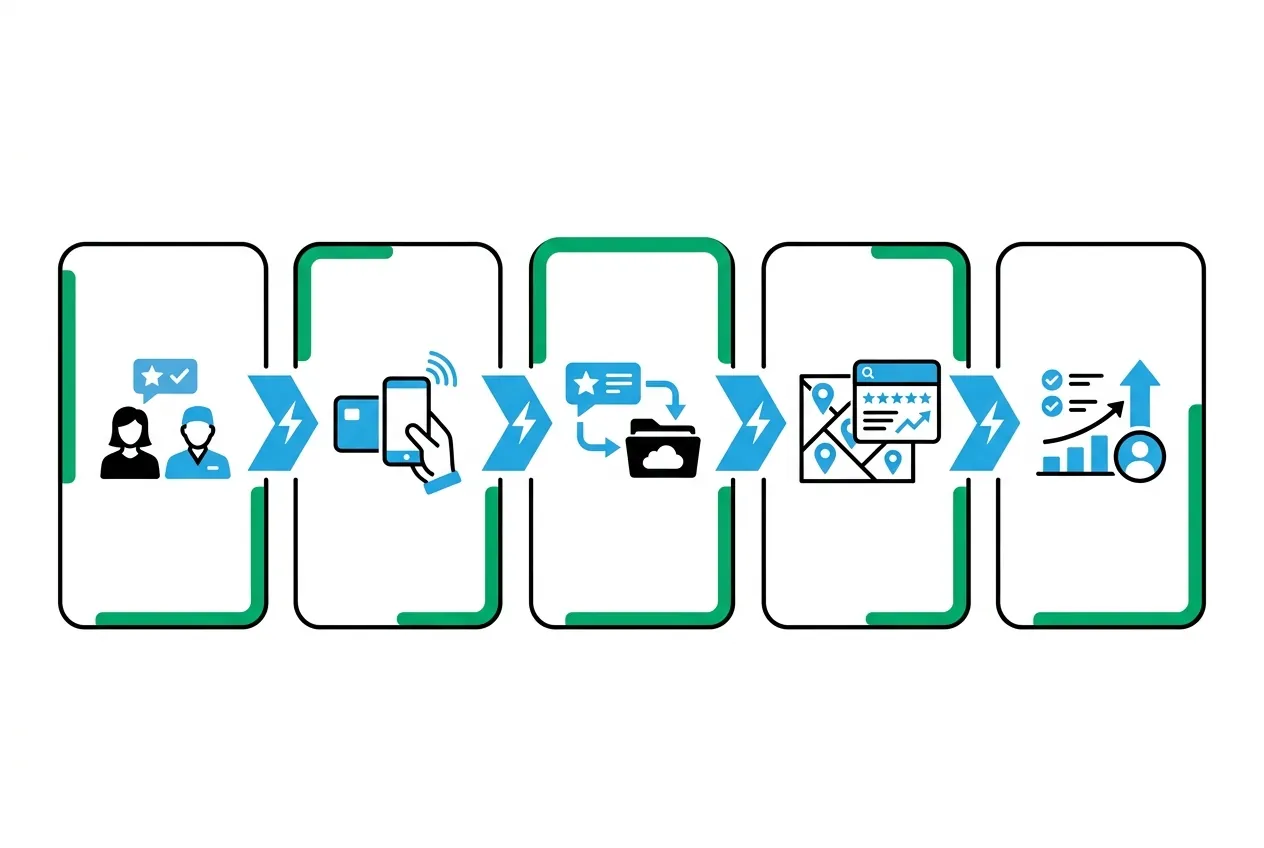
Modern reputation management is the disciplined process of collecting authentic customer sentiment, distributing verified reviews directly to primary search profiles, monitoring location-level sentiment trends, and applying operational feedback to improve local service delivery. Instead of reacting to occasional negative comments after public sentiment sours, an effective partner treats review generation as an active, daily operational pipeline that fuels organic discovery across every individual branch.
Google evaluates local listings using three primary criteria: relevance, distance, and prominence. As confirmed in the Google Business Profile ranking documentation, review count and positive review score factor directly into a business's local search ranking. A high volume of positive, steady reviews signals to search algorithms that an organization is active, trustworthy, and validated by real consumers in that specific geographic area.
A specialist reputation management agency connects this algorithmic reality to location-level marketing operations. When an organization operates twenty separate facilities, high-performing locations often mask struggling branches if leadership reviews only company-wide star ratings. Search algorithms evaluate each profile independently. A flagship facility with 400 positive reviews does nothing to assist a newly opened suburban clinic with four reviews and an unresolved three-star complaint.
Review frequency, recency, and contextual keywords within patient or customer feedback directly influence whether a profile enters the Google Local Three-Pack for high-intent search terms. A dedicated partner focuses on systematic acquisition across every operational market. This consistent flow of feedback provides search crawlers with steady relevance signals while building immediate credibility for prospective consumers comparing regional providers. For multi-unit operators, this work integrates directly with technical site architecture, as outlined in our strategic guide to multi-location SEO: how to rank every location without duplicate content.
The regulatory and search risks of review gating and filtering
Many conventional reputation platforms sell automated tools that promise higher star ratings through sentiment filtering, commonly known as review gating. In these systems, automated surveys ask customers whether their experience was positive or negative. Customers who indicate satisfaction receive a direct link to Google Business Profile, while customers who express frustration are routed to a private internal feedback form.
This deceptive practice creates existential legal and commercial risks. Under the Federal Trade Commission Consumer Reviews and Testimonials Rule, suppressing negative consumer reviews or steering consumer feedback based on sentiment is prohibited. Regulatory penalties for deceptive consumer practices can reach tens of thousands of dollars per violation.
Simultaneously, search platforms actively penalize artificial manipulation. The Google Prohibited and Restricted Content policies explicitly forbid fake engagement, customer review gating, offering incentives in exchange for reviews, and pressuring customers on-site. When algorithms detect suspicious review patterns or automated gating funnels, profiles face review suppression, ranking drops, or outright account suspension. A legitimate partner protects institutional brand equity by establishing compliance-first capture workflows that invite all authentic customer voices without filtering or conditional incentives.
Free Audit
Want a straight read on where your budget is leaking?
Solving frontline review capture at the point of service
Automated follow-up emails and SMS message blasts suffer from severe attrition. In retail clinics, specialty practices, and local service settings, post-appointment text messages often arrive hours after the customer has left the facility. By that point, emotional connection has dissipated, open rates decline, and SMS deliverability faces strict carrier filtering.
Physical-to-digital capture bridges this gap by engaging the customer at the exact moment of peak satisfaction. Consider the front-desk checkout setting in a regional healthcare clinic. When administrative personnel hand an appointment summary to a patient, they can simultaneously provide a physical interaction point. By using NFC-enabled tap cards or clear QR destinations, staff eliminate the friction of navigating multi-step verification forms or searching Google for the exact business profile name.
A patient simply taps their smartphone against the card or scans the code, which instantly launches the official Google review dialogue on their personal device. The entire transaction requires under fifteen seconds, operates entirely on the customer's authenticated personal account, and requires no collection of private contact data by secondary software vendors. This operational workflow is explained in detail within our resource on Google review cards: using NFC and QR cards to collect reviews at the point of service.

How do reputation management companies work behind the scenes?
Prospective buyers often ask how a dedicated reputation management company coordinates operations across dozens of disparate business profiles. Behind the scenes, a capable firm combines technical infrastructure, local data governance, and operational frontline enablement.
First, technical teams audit and synchronize business listings across authoritative directories to ensure NAP (name, address, and phone number) consistency. Discrepancies between website locators and search profiles dilute local authority. Second, the partner establishes continuous rank-grid tracking. Instead of monitoring a single ranking from a fixed zip code, grid tracking maps visibility across five-mile to twenty-mile radii, showing exactly where a clinic appears in the map pack down to individual street intersections.
Third, the agency establishes direct API connections to ingest inbound reviews in real time, routing them into structured triage workflows. Positive reviews receive professional brand responses that incorporate location-specific service keywords. Negative reviews trigger operational alerts to designated practice managers, allowing rapid service recovery without public escalation. Finally, the partner delivers frontline staff training programs, teaching administrative coordinators and customer care specialists how to introduce review opportunities naturally without scripting or pressure.
Five criteria to evaluate the best reputation management services
Selecting among top reputation management companies requires looking past generic software demonstrations and examining operational rigor. Use these five criteria to identify the best reputation management services for your organization:
- Uncompromising Data Ownership: Confirm that your business retains complete, direct administrative ownership of all Google Business Profiles, directory listings, and customer review assets. Many software vendors lock profile access behind proprietary dashboards, complicating departures if you change agencies.
- Compliance with Regulatory and Search Policies: Inspect the provider's exact solicitation workflows. If their product includes sentiment filtering, review gating, pre-written review copy, or customer incentives, they introduce severe regulatory and platform liability.
- Physical-to-Digital Collection Tools: Inquire how the agency drives point-of-service capture. Relying exclusively on delayed email campaigns yields lower response rates than enabling frontline teams with direct NFC and QR capture infrastructure.
- Hyper-Local Measurement Methodology: Demand reporting that tracks geographic rank grids, local map pack prominence, and direct call or appointment actions per location. Avoid agencies that summarize performance into a single vanity metric such as an aggregate national star rating.
- Multi-Location Operational Understanding: Partner with operators who understand the complexities of multi-unit expansion, decentralized staff adoption, and regulated operating environments, as discussed in our analysis of multi location seo services: what a specialist partner delivers and how to vet one.
Email Us
Prefer to send the context directly?
The Marketing Powered approach to multi-location reputation and search
Marketing Powered approaches reputation management as an operational distribution system designed to drive qualified customer demand. Our leadership brings direct executive background, including a former healthcare CMO who ran marketing for a treatment network that grew from 3 to 24 locations, and experience managing $1.5 to $2M per month in Google Ads across 11+ behavioral and mental health accounts. As a court-certified expert witness in advertising strategy, our leadership insists on defensible attribution, strict platform compliance, and rigorous data handling.
Our local search and reputation programs integrate technical local SEO with on-the-ground review capture tools through Powered Cards. We equip multi-location healthcare systems, clinical groups, and distributed service businesses with NFC and QR tap-to-review hardware tied directly to verified Google Business Profiles. This physical infrastructure eliminates operational friction for front-desk personnel, enabling consistent, policy-compliant review acquisition directly at checkout or discharge.
Because we are AI-native since 2022 and operate owned, local AI infrastructure for HIPAA-aware inference, we process local sentiment analysis, review response workflows, and ranking analytics without exposing sensitive business intelligence to unauthorized third parties. For healthcare and regulated organizations, our processes adhere to LegitScript-aware and HIPAA-aware standards developed in Google's sensitive verticals, where retargeting is not permitted and marketing performance must be tracked down to actual customer intake and admission rather than superficial form fills.
Questions, Answered.
Local search prominence responds to consistent review velocity rather than sudden spikes. While individual reviews publish to Google Business Profiles immediately upon platform approval, measurable improvements in local map pack rankings typically emerge over several months of steady feedback. Maintaining a predictable, weekly pace of verified customer reviews across every branch location provides Google with continuous signals of geographic relevance and business health.
No agency can unilaterally remove a legitimate negative Google review. A competent partner audits negative feedback against platform guidelines, submitting formal removal requests for reviews that violate policies regarding harassment, hate speech, conflicts of interest, or off-topic spam. For valid negative reviews, the correct approach involves posting a professional, compliant public response while using the operational feedback internally to address customer service deficiencies.
Review software provides a software-as-a-service dashboard where your internal team must configure alerts, design outreach templates, monitor profile listings, and draft public responses. A managed reputation agency provides the end-to-end strategic, technical, and operational execution. This includes listing synchronization, geo-grid rank tracking, frontline staff training, physical point-of-service card deployment, and compliance oversight across all business locations.
Yes. Google explicitly prohibits review gating, which involves screening customers to determine satisfaction before deciding whether to provide a public review link. Furthermore, federal regulators penalize practices that suppress or hide unfavorable customer feedback. All customers must receive the same neutral opportunity to leave public feedback, regardless of their sentiment. Get a multi-location visibility audit from Marketing Powered
Ready to see where your marketing can improve?
Request a free audit of your paid media, landing pages, attribution, and measurement setup. You'll get a straight assessment of where the opportunities are.
or email us at info@marketingpowered.ai