Capabilities
Multi Location SEO Services for Expanding Regional Footprints
Operating across five, twenty, or fifty physical sites creates an operational marketing bottleneck where physical growth outpaces organic discovery. Deploying dedicated multi location seo services bridges the divide between corporate marketing strategy and physical branch utilization. Achieving market-level prominence across every location requires technical site architecture, local entity validation, and verified point-of-service customer engagement.

Operational Deliverables of Multi Location SEO Services
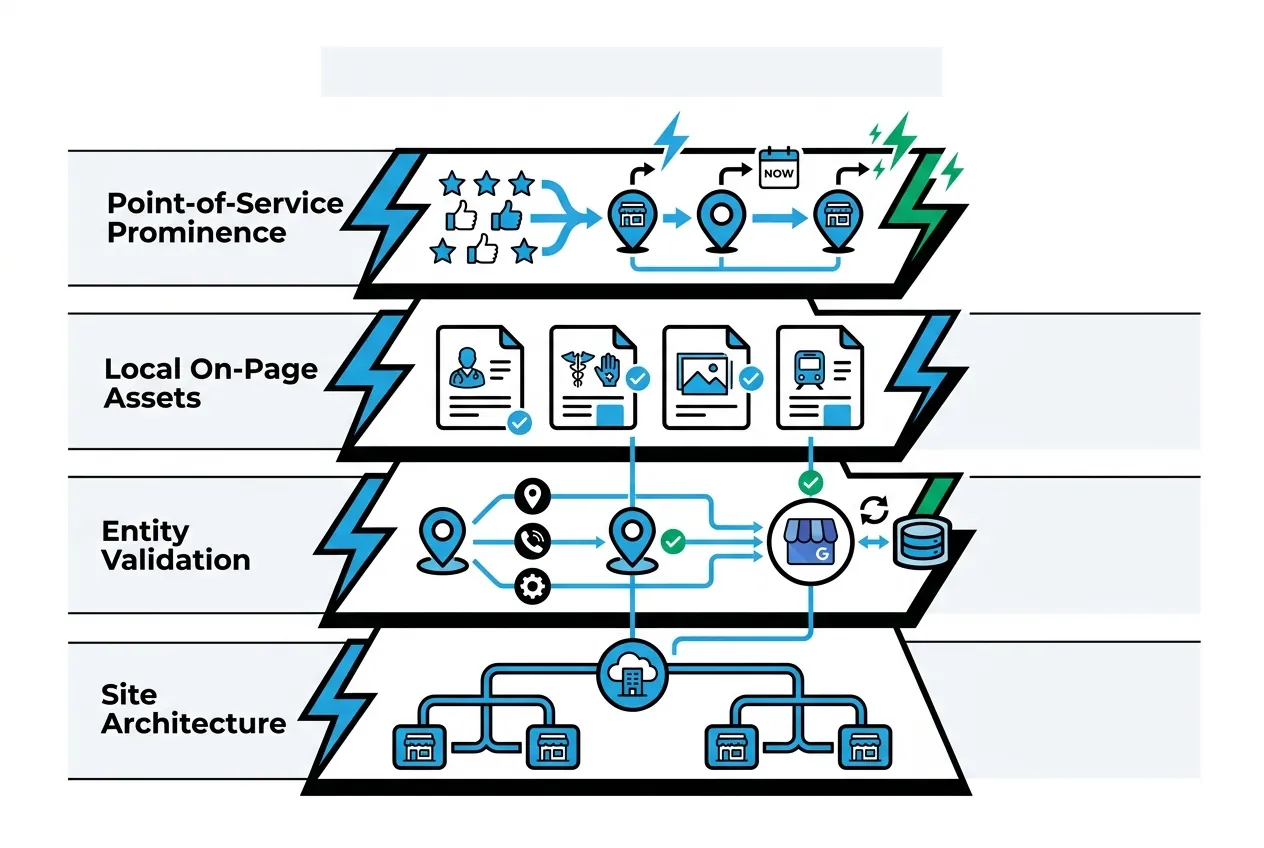
Multi-site search visibility is fundamentally a distributed data architecture problem rather than a standard blogging campaign. When healthcare networks, outpatient clinics, or regional franchise groups expand into new territories, central marketing teams frequently struggle to establish local relevance for each pin on the map. A specialized search partner executes across four interdependent layers to secure top-tier organic visibility and local pack rankings.
First, technical site structure must establish unambiguous relationships between parent brands and satellite locations. Every physical location requires an independent, indexable page built on clean URL structures rather than dynamic parameters or hidden scripts.
Second, entity validation anchors each site to its verified geographic market. This includes standardizing Name, Address, and Phone number (NAP) data across primary data aggregators, syncing category configurations in Google Business Profile (GBP), and nesting local business schema structured data within the page code.
Third, localized on-page assets must provide verifiable real-world utility. Instead of generic placeholder copy, pages must display verified practitioner rosters, clinical specializations, direct entrance photography, transit options, and facility-specific intake protocols.
Fourth, localized authority requires continuous point-of-service engagement. According to Google Business Profile Help, local search rankings are determined primarily by relevance, distance, and prominence. Prominence reflects review count, review score, and broader web reputation. A competent search partner designs sustainable operational systems so individual satellite teams gather fresh customer feedback daily.
Building a Scalable Multi Location SEO Strategy Without Doorway Pages
The most destructive shortcut in regional expansion is mass-generating low-effort city pages. Multi-location marketing directors often feel pressured to capture surrounding suburban demand by copying a single template and swapping geographic names across hundreds of URLs.
This practice directly violates search engine quality standards. Under Google Search Central doorway guidelines, pages created solely to funnel searchers to a central offering without unique value are classified as doorway pages. These programmatic pages trigger indexation exclusions, dilute core domain authority, and fail to convert skeptical users.
A defensible multi location seo strategy uses a disciplined parent-child hierarchy:
- Brand Hub (/locations/): A clean national or regional directory providing an interactive map, state or provincial indexing, and clear internal navigation.
- Regional Clusters (/locations/region/): Mid-level index pages organizing physical facilities across metropolitan areas or health authorities, helping search engines understand regional density.
- Location Endpoints (/locations/region/facility-name/): Canonical digital front doors for each verified brick-and-mortar operation, hosting unique data, localized schema, and facility-specific operational information.
- Localized Service Modifiers (/locations/region/facility-name/service/): Sub-pages reserved exclusively for unique regional offerings or licensed specializations housed at that specific physical address.
For deeper insights into establishing hierarchical site architecture that avoids duplicate penalties, read our detailed guide on Multi-location SEO: how to rank every location without duplicate content.
Multi Location SEO Content Strategy: Digital Front Doors for Every Branch
Search engines reward content depth that matches the physical realities of the site. A durable multi location seo content strategy treats every branch landing page as a complete commercial utility rather than an advertising brochure.
To satisfy search algorithms and prospective patients or buyers, every endpoint landing page must feature non-duplicative information:
- Named Personnel and Credentials: Feature profiles of licensed providers, branch managers, or clinic directors who actively practice at that physical address, reinforced by MedicalBusiness or LocalBusiness schema.
- Geographic and Transit Identifiers: Include clear descriptions of cross streets, highway exits, transit stops, parking structures, and accessible building entrances.
- Insurance, Payment, and Licensure Details: Provide granular lists of accepted regional insurance plans, local financing terms, and provincial or state operating licenses specific to that branch.
- Community Integration and Direct Imagery: Display high-resolution exterior and interior photography showing physical waiting areas, private consultation rooms, and genuine facility signage. Stock photography weakens regional conversion rates.
- Hyper-Local FAQs: Answer questions regarding local intake appointments, regional referral workflows, and neighborhood-specific service arrangements.
When clinical facilities require rigorous positioning, working alongside a dedicated healthcare seo company: what a specialist partner delivers and how to vet one ensures that medical content complies with strict regulatory frameworks while meeting high organic quality thresholds.
Free Audit
Want a straight read on where your budget is leaking?
Point-of-Service Reputation: Solving Review Velocity with Powered Cards
Satellite branches frequently suffer from review starvation. While a company headquarters or flagship clinic naturally accumulates hundreds of customer reviews, newer or suburban locations languish with single-digit counts and outdated feedback. Centralized email blasts or SMS sequences sent days after an appointment typically yield low completion rates.
Review volume and review recency directly determine your visibility across regional map packs. Addressing this deficit requires capturing feedback at the point of service, exactly when customer satisfaction is highest.
Marketing Powered solves this operational bottleneck through Powered Cards. Powered Cards are physical, programmable review cards equipped with near-field communication (NFC) chips and high-contrast dynamic QR codes. Positioned at clinic check-out desks, hospital discharge stations, or handed directly by service technicians, they allow satisfied patients or customers to tap their smartphone and open the facility's verified Google review interface in under three seconds.
Deploying physical review capture must strictly honor legal and platform standards:
- No Gating or Filtering: Under the Google Maps User Contributed Content Policy, merchants cannot screen customers or route negative feedback away from public profiles.
- Zero Review Incentives: Platform rules and the FTC Consumer Review Regulations strictly prohibit offering compensation, entry into raffles, fee discounts, or gifts in exchange for reviews.
- Neutral In-Person Workflows: Staff members present the card neutrally as an open invitation to provide direct feedback, without pressuring the customer or dictating positive language.
To review hardware specifications and operational implementation workflows, explore Google review cards: using NFC and QR cards to collect reviews at the point of service.

Regional Search Dynamics: Scaling Local Footprints Across Markets
Multi-location enterprises operate under distinct regional competitive factors. Scaling an organic presence in a decentralized American metro area like Dallas-Fort Worth presents completely different regulatory and proximity thresholds than executing multi location seo ottawa or across eastern Ontario.
In Canadian metropolitan centers like Ottawa, multi-location search campaigns navigate bilingual English and French language considerations, strict privacy governance under PIPEDA, and the regional boundaries of the Ontario Health network. Search engines weigh physical proximity heavily in dense urban corridors. If your physical address is registered across municipal borders, such as in Nepean, Kanata, or Gatineau, your entity optimization must accurately balance regional primary categories and distinct landing pages to prevent algorithmic filtering.
Whether your branches operate across Canadian commercial zones or United States healthcare regions, algorithmic prominence requires true local roots. Maintaining consistent directory citations, active regional phone numbers, verified municipal licensing details, and distinct regional community associations prevents search algorithms from misattributing geographic authority.
How to Vet a Multi Location SEO Agency: Accountability and Attribution
Selecting an external multi location seo agency requires evaluating data governance, compliance management, and downstream tracking. Agencies that rely on superficial metrics like keyword rankings or blended regional traffic often conceal severe underperformance at individual branches.
Marketing leadership should use five objective criteria during the evaluation process:
- Site Architecture. Red Flag Practice: Automated mass generation of spun doorway pages covering nearby towns. Verified Operational Standard: Clean parent-child subdirectory hierarchy featuring validated, branch-specific data and schema.
- Review Acquisition. Red Flag Practice: Email review gating software that filters negative reviews before posting. Verified Operational Standard: Compliant point-of-service tools (like NFC Powered Cards) adhering to FTC guidelines.
- Measurement & Tracking. Red Flag Practice: Aggregate organic traffic reports that hide zero-impression satellite clinics. Verified Operational Standard: Geo-grid rank heatmaps tracking map-pack visibility radius paired with dynamic call tracking.
- Data Governance. Red Flag Practice: Routing sensitive intake inquiries through unvetted third-party cloud tools. Verified Operational Standard: Strict, privacy-conscious data handling and local infrastructure designed for regulated sectors.
- Attribution Modeling. Red Flag Practice: Vanity metrics ending at generic form submissions or soft phone clicks. Verified Operational Standard: Downstream attribution tracking local search engagement directly to booked admissions or revenue.
In regulated industries such as healthcare, partner qualifications must extend beyond standard marketing playbooks. Agencies must demonstrate verified operational experience, clear technical boundaries, and deep familiarity with sensitive verticals where retargeting is prohibited and patient privacy is paramount.

Email Us
Prefer to send the context directly?
Multi Location Search Optimization with Marketing Powered
Marketing Powered approaches multi-location search from an operator perspective. Our leadership foundation includes serving as CMO for a rapid-growth healthcare network that expanded from 3 to 24 locations, managing $1.5 to $2M per month in Google Ads across 11+ behavioral and mental health accounts, and serving as a court-certified expert witness in advertising strategy.
We do not treat multi-location search as an isolated technical exercise. Our team aligns physical operations with digital discovery:
- Unified Technical Architecture: We construct pristine multi-location directories, eliminating canonical confusion and establishing structured schema markup that clearly signals regional authority to search engines.
- Downstream Attribution Systems: We connect local search visibility, geo-grid rank performance, and dynamic local call tracking directly to CRM status and verified admissions, avoiding reliance on shallow top-of-funnel vanity metrics.
- Operational Reputation Tools: We deploy custom Powered Cards directly to your regional teams, turning everyday clinical discharges and customer service touchpoints into durable local review velocity without violating platform rules.
- Data Sovereignty: We operate owned, local AI infrastructure for HIPAA-aware inference, ensuring regulated patient data and sensitive business intelligence never leak to third-party public models.
Multi-location organizations scale when their marketing infrastructure matches their operational footprint. Marketing Powered delivers the structural clarity, compliance rigor, and local visibility required to expand customer acquisition across every community you serve.
Questions, Answered.
Organizations operating three or more physical branches benefit immediately from a structured multi-location hierarchy. At three locations, internal competition, overlapping service areas, and citation inconsistencies begin to divide local organic authority if not properly organized under a centralized parent directory.
Satellite locations often vanish from map packs due to weak prominence, overlapping primary categories with nearby competitors, or address proximity issues. If your branch has minimal local reviews, inconsistent NAP data across online directories, or lacks an address-specific landing page with local schema, search engines default to competing businesses closer to the user.
Yes, but you should not invent fake addresses or create low-value doorway pages. You can expand visibility by listing secondary service areas within your Google Business Profile, earning editorial backlinks from regional organizations, and writing unique, high-utility service area guides that genuinely address the needs of neighboring communities.
Email review requests frequently arrive hours or days after an appointment, getting lost in crowded inboxes and resulting in low conversion rates. Powered Cards engage the customer directly at the physical point of service. A simple smartphone tap takes the customer directly to your Google review submission screen in seconds, capturing genuine sentiment while the positive experience is fresh. Get a multi-location visibility audit from Marketing Powered.
Ready to see where your marketing can improve?
Request a free audit of your paid media, landing pages, attribution, and measurement setup. You'll get a straight assessment of where the opportunities are.
or email us at info@marketingpowered.ai