Capabilities
Meta Ads Agency Selection Guide: What Specialist Partners Deliver
Hiring a meta ads agency should expand your commercial pipeline without introducing data liabilities or account lock-in. For organizations operating in healthcare, professional services, and multi-location sectors, sustainable paid social performance requires rigorous data hygiene, server-side tracking infrastructure, and direct integration with sales intake workflows. Evaluating prospective agency partners on these technical foundations ensures your paid media investments generate verified business revenue rather than platform vanity metrics.

What a Specialist Meta Ads Agency Delivers
A specialized meta ads agency operates as a technical growth partner rather than a transactional media buyer. In regulated sectors such as healthcare, legal services, and multi-site operations, campaign performance depends directly on how effectively an agency configures platform machine learning systems. Generalist agencies often launch broad campaigns reliant on native interest targeting, leaving delivery algorithms to guess which leads represent real commercial value. A specialist engineers custom audience pipelines, builds multi-stage creative testing matrices, and routes clean conversion data back to platform delivery systems.
Inside a high-performing agency workroom, paid media specialists and data engineers collaborate across dual-monitor workstations. While the media buyer reviews audience penetration and ad fatigue curves, the data engineer audits server payloads to verify that custom events populate correctly inside ad reporting tools. The focus centers on end-to-end acquisition infrastructure. This begins with audience research and creative production tailored to distinct decision stages. It extends through custom landing pages designed for conversion, followed by real-time data synchronization with your customer relationship management (CRM) platform or enterprise scheduling software. When ad interactions tie directly to verified sales appointments, consultations, or patient admissions, platform algorithms learn to prioritize high-intent prospects over casual scrollers.
A dedicated specialist also enforces strict data hygiene. In regulated sectors, standard web pixels can inadvertently transmit personal identifiers or health context to third-party endpoints. A competent agency builds data scrubbing layers and compliant intake flows, protecting your organization from regulatory penalties while preserving the machine learning feedback loops necessary for bid optimization.

Account Ownership and the Meta Ads Manager Login Protocol
A critical warning sign during agency procurement is an outside firm insisting on running campaigns through agency-owned ad accounts. When an agency controls the root ad account, your organization loses its accumulated pixel history, algorithmic optimization data, and audience records if you part ways. A professional partner mandates that your internal team maintains root ownership of your Meta Business Manager and all associated ad accounts.
Securing Your Meta Ads Login and Business Assets
Proper governance follows a structured administrative routine. To grant access, your internal administrator signs in via the official meta ads login page, navigates to Business Settings, and assigns the agency as an external partner using their verified Business Manager ID. The agency team accesses your assets through their own agency portal without sharing individual user passwords or requiring root control over your primary billing methods.
This administrative separation keeps your meta ads manager login secure and preserves historic marketing assets inside your corporate infrastructure. If your organization transitions to an internal media team or changes agency partners in the future, your accumulated conversion intelligence, custom audiences, and creative history remain entirely intact.
Server-Side Tracking and Conversions API Engineering
Relying exclusively on browser-based tracking pixels produces degraded performance data. Browser privacy features, ad blockers, and mobile operating system restrictions routinely strip tracking parameters, obscuring which ad placements generate qualified revenue. Performance specialists resolve this visibility gap by deploying the Meta Conversions API through a dedicated server-side environment.
Server-side measurement establishes a direct connection between your web server or CRM and Meta endpoints. When a prospective customer completes a form, schedules an appointment, or signs a contract, the server captures the transaction and sends a hashed, privacy-compliant event payload directly to Meta. This process bypasses browser-level blockades, stabilizes event match quality scores, and provides delivery algorithms with the reliable signals needed to optimize automated bidding.
For healthcare providers, server-side infrastructure serves as a necessary compliance boundary. The U.S. Department of Health and Human Services tracking technology guidance restricts deploying unvetted tracking pixels on authenticated patient portals or pages that convey individual health intentions. A specialist partner builds server-side middleware that strips personal identifiers, IP addresses, and medical identifiers before conversion events route to advertising platforms, maintaining optimization signals without compromising patient privacy.
Free Audit
Want a straight read on where your budget is leaking?
Creative Testing Systems Using the Meta Ads Library
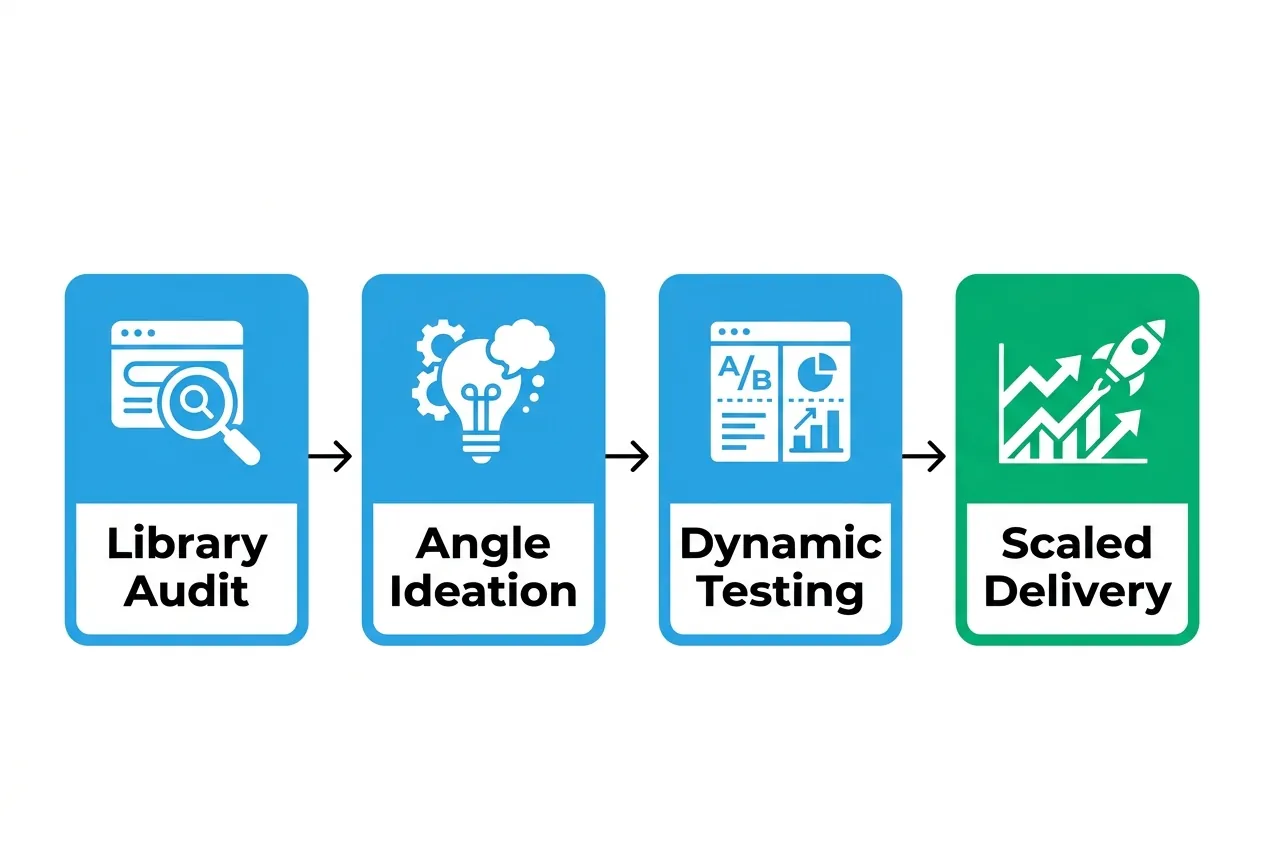
Because modern paid social algorithms use creative assets as the primary mechanism for audience segmentation, systematic creative production is essential to performance. Unspecialized agencies often launch a handful of static graphics and allow them to run until performance declines. A structured partner operates an ongoing testing framework that evaluates messaging angles, visual hooks, formats, and editorial structures across distinct prospect segments.
Competitive benchmarking begins by monitoring the public Meta Ad Library, where active commercial campaigns across all industries are indexed for transparency. In an agency creative sprint, a strategist analyzes competitor positioning, creative velocity, and message longevity within your specific market. Ads that have run continuously for several months indicate stable underlying unit economics, offering valuable baseline intelligence regarding consumer pain points and compliance-approved messaging in your category.
Once baseline insights are established, the agency deploys dynamic creative configurations to test single-variable changes. Headline variations, short-form video hooks, customer testimonials that follow Federal Trade Commission consumer endorsement guidelines, and static infographic summaries are evaluated methodically. High-performing concepts graduate into primary scaling campaigns, while fatigue-prone variations are paused before rising customer acquisition costs damage campaign profitability.
Full-Funnel Integration Across Paid Social and Paid Search
Meta advertising rarely reaches maximum efficiency when operated in isolation. High-performing customer acquisition strategies integrate paid social demand generation with paid search capture. When potential buyers encounter an educational video or problem-aware carousel ad on Meta, their immediate response is frequently a search query on Google rather than an immediate social conversion.
If your marketing ecosystem does not align these channels, you risk losing prospects to competitors bidding on your brand name or category keywords. A coordinated media strategy aligns audiences across platforms:
- Paid social introduces category solutions, builds brand recall, and activates passive prospects who are not actively searching.
- Paid search captures the resulting high-intent demand when prospects turn to search engines to evaluate options.
- Attribution tracking connects initial social ad exposure to downstream search conversions, crediting the touchpoints that contributed to the pipeline.
To examine how search capture integrates with demand creation, review our guide to Healthcare PPC: structuring paid search for qualified patient demand. For teams auditing specialized search execution, our companion breakdown on Google ads agency selection details search infrastructure requirements, while our overview of Healthcare ppc services explains vertical-specific regulatory safeguards.
Technical Criteria to Identify the Best Meta Ads Agency
Distinguishing high-performing technical partners from superficial agencies requires probing their operational infrastructure and business governance. During vendor evaluation, ask prospective partners these specific vetting questions:
- How do you structure account ownership and partner permissions? Verify that the agency uses Business Manager partner access and mandates that your company retains root ownership of all ad accounts, datasets, and creative assets.
- What is your server-side tracking and Conversions API implementation process? The best meta ads agency will clearly explain how they configure server-side containers, maintain event match quality, and sanitize sensitive user payloads.
- How do you integrate downstream sales or CRM records into campaign optimization? Ask how offline conversion data, qualified sales calls, or patient intake records feed back into Meta delivery algorithms to train bid systems on closed revenue.
- What is your cadence and framework for creative velocity? Require the agency to outline their pipeline for testing hooks, script angles, and visual formats to avoid audience fatigue.
- How do you manage regulatory and platform compliance in our vertical? Ensure the vendor understands specific platform constraints, including category advertising restrictions, endorsement guidelines, and healthcare privacy boundaries.

Email Us
Prefer to send the context directly?
Accountable Paid Media Systems at Marketing Powered
Marketing Powered engineers accountable paid media systems for organizations in healthcare, professional services, and multi-location markets. We build acquisition infrastructure designed to track performance past initial form submissions directly to verified client admissions and closed revenue.
Our operational approach is informed by executive-level enterprise experience:
- Directed by a former healthcare CMO who led marketing operations for a multi-site treatment network that scaled from 3 to 24 physical locations.
- Direct background managing paid search across 11+ behavioral and mental health accounts.
- Strategic consultation backed by credentials as a court-certified expert witness in advertising strategy.
- AI-native operating processes established in 2022, utilizing owned, local AI infrastructure for HIPAA-aware inference and analytics.
- Specialized campaign architecture built for sensitive healthcare verticals where ad retargeting is prohibited, incorporating LegitScript-aware and HIPAA-aware controls.
Our operational environment pairs enterprise attribution software with on-premises compute clusters, processing intake records through secure local analytics pipelines. By linking server-side event tracking, localized conversion assets, and CRM intake workflows, we eliminate data discrepancies and optimize ad spend toward verified bottom-line growth. Learn more about our technical methodology across our Google and Meta paid media management services.
Questions, Answered.
A Meta ads agency is a specialized media firm that designs, executes, and optimizes paid advertising campaigns across Meta technologies, including Facebook, Instagram, Messenger, and the Audience Network. Specialist partners handle creative production, audience modeling, server-side tracking, and CRM revenue integration.
A Meta agency ad account is an ad account housed inside an agency Business Portfolio that receives specialized tier support or consolidated invoicing. Organizations should verify that any agency ad account structure provides complete transparency and portability, ensuring historic conversion data remains accessible to the client.
A client should never share individual employee login credentials. Instead, log in to your Meta Business Manager, open Business Settings, select Partners, and add the agency using their official Business ID. You can then assign specific permissions to ad accounts, catalogs, and tracking datasets while maintaining root administrative control.
Google Ads captures active, existing demand from users searching for specific solutions, while Meta advertising generates new demand by introducing solutions to targeted audiences based on demographics, professional profiles, and online behaviors. The two channels perform best when integrated into a unified acquisition strategy. Schedule a technical paid media evaluation with Marketing Powered
Ready to see where your marketing can improve?
Request a free audit of your paid media, landing pages, attribution, and measurement setup. You'll get a straight assessment of where the opportunities are.
or email us at info@marketingpowered.ai