Resources
Reputation Management Software: What to Look For and What to Avoid
Managing local prominence across multiple facilities requires reliable visibility, but purchasing reputation management software does not automatically generate authentic patient or customer feedback. Software functions as an operational and monitoring layer, yet many multi-location teams find that automated post-service messages produce low response rates and unexpected compliance risks. Choosing the right platform means understanding how direct directory integrations work, avoiding deceptive gating workflows, and solving the collection bottleneck at the physical point of service.
By Mike Hulick, Founder, Marketing Powered

Key Features to Demand in Reputation Management Software

What is Reputation Management for Multi-Location Organizations?
Before comparing software vendors, operators must clarify what is reputation management within distributed operations. In a business with five, twenty, or fifty locations, reputation management encompasses the active monitoring, collection, analysis, and resolution of public customer feedback across every geographic profile. It is not public relations spin or social media broadcasting. Instead, it is the systematic management of your local digital storefronts.
For multi-unit healthcare systems, dental service organizations, behavioral health networks, and regional service franchises, public sentiment directly dictates search discovery. According to Google Business Profile Help, local ranking prominence incorporates review count and overall score alongside geographic relevance and distance. A facility with steady, authentic review volume appears more reliably in Google Map Pack results than a competitor with stagnant ratings.
Managing this dynamic across dozens of distinct Google Business Profiles introduces operational complexity. Frontline staff turnover, varied patient experiences across regional clinics, and decentralized operational standards make manual tracking impossible. Without structured oversight, a clinical site or branch location can accumulate negative sentiment or policy violations for months before regional leadership identifies the issue.
Software provides the centralized oversight necessary to track incoming sentiment across markets. However, the system succeeds only when regional teams understand that software measures customer sentiment; it does not manufacture goodwill.
When evaluating modern reputation management software, leadership teams often encounter vendor sales pitches crowded with generic features like social post schedulers, website widgets, and automated survey engines. Multi-location operators should look past marketing add-ons and evaluate software against four structural capabilities.
1. Direct, Authorized Platform Integrations
Your software must connect directly via authorized APIs to primary search engines and directories, including Google Business Profile, Apple Business Connect, and industry-specific aggregators. Avoid vendors that rely on automated scraping. Scraping breaks whenever directories update code bases, and third-party scraping can trigger platform-level security blocks that sever your reporting connection when you need it most.
2. Centralized Multi-Location Inbox and Role Governance
Enterprise platforms require a unified operational dashboard capable of ingesting reviews from every location in real time. Look for granular permission architecture. Local facility managers should have access to respond to feedback from their specific location, while regional vice presidents require aggregated sentiment views, automated alerts for low ratings, and escalated workflows for sensitive operational complaints.
3. Native Sentiment Categorization and Operational Rollups
Standard star ratings conceal the root causes of operational friction. Modern reputation management platforms should categorize text feedback by operational department, such as billing clarity, scheduling wait times, bedside manner, or physical facility hygiene. This capability allows regional executives to distinguish between a marketing visibility problem and an underlying operational bottleneck at a single site.
4. Flexible, Unrestricted Invitation Workflows
Platforms must support direct review requests without proprietary barriers. Avoid software that forces reviewers into proprietary walled gardens, mandatory login screens, or private feedback loops. The software should cleanly deliver direct, deep-linked URLs that send customers straight to the public directory review box on their mobile device or desktop browser.
What to Avoid: The Hidden Traps of Legacy Reputation Management Tools
The reputation software sector contains practices that expose multi-location operators to severe regulatory penalties and platform bans. As scrutiny from government agencies and search engines intensifies, buying the wrong tooling creates direct business liability.
Review Gating and Deceptive Sentiment Filtering
Legacy reputation management tools frequently promote review gating. In a gated system, the software prompts a customer with an initial survey question such as, "How was your visit today?" If the user clicks four or five stars, the tool forwards them to Google. If the user clicks one, two, or three stars, the tool intercepts the user and directs them to a private internal feedback form.
This practice directly violates the Google Maps User-Contributed Content Policy, which expressly prohibits discouraging or prohibiting negative reviews or selectively soliciting positive reviews. Furthermore, the Federal Trade Commission Consumer Reviews and Testimonials Rule regulates deceptive review practices, including suppressing negative reviews or conditioning review requests on consumer sentiment. Platforms caught using deceptive gating risk sudden review removal, public profile warnings, or full suspension of their Google Business Profiles across every location.
Proprietary Review Hosting Lock-In
Be cautious of vendors whose primary strategy involves embedding review widgets on your website while retaining ownership of the review data. If you terminate your contract, those collected testimonials disappear from your domain. A durable digital reputation strategy builds equity on independent platforms like Google, Apple Maps, and independent healthcare directories, ensuring your public prominence remains intact regardless of software vendor changes.
Feature Bloat and Per-Seat Billing
Many enterprise vendors charge aggressive monthly licensing fees per location by bundling tools your organization will never use. Email newsletter builders, social media calendars, and generic conversational chatbots inflate software costs while pulling focus away from local search fundamentals. Select software that prioritizes review aggregation, compliance monitoring, and API stability over bloated toolkits.
Free Audit
Want a straight read on where your budget is leaking?
Evaluating Multi-Location Reputation Management Platforms and Costs
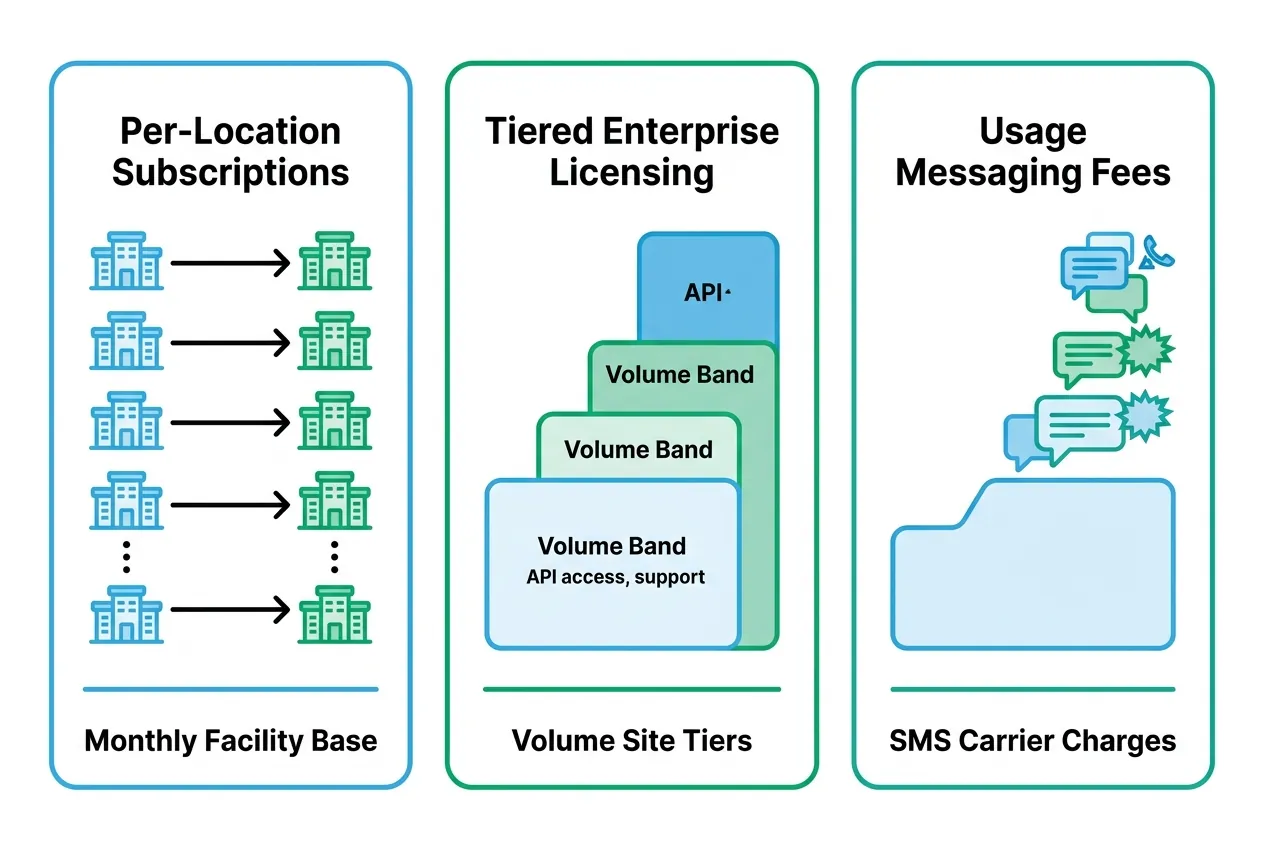
Purchasing software across a distributed footprint requires a clear model of total cost of ownership. Platforms structure their pricing across three main frameworks:
- Per-Location SaaS Subscriptions: Vendors charge a baseline monthly fee for each active physical location. While predictable, costs scale rapidly when an organization operates 20, 50, or 100 clinics or branch offices.
- Tiered Enterprise Licensing: Pricing is based on location volume bands. These agreements usually include custom API limits, dedicated account managers, and enterprise Single Sign-On (SSO) integrations.
- Usage-Based Messaging Fees: Platforms that send automated review requests via SMS often add carrier passthrough fees, Short Code registry costs, and per-message charges on top of baseline licensing.
When vetting software providers, evaluate whether your internal team has the bandwidth to manage the operational inputs the tool requires. If your software dashboard requires dozens of local branch managers to manually upload CSV contact lists every Friday, adoption will stall. Unused dashboards deliver zero return on invested capital. The true cost of software includes the operational labor required to maintain it.
The Point-of-Service Problem: Why Digital Follow-Ups Underperform
The central limitation of standalone reputation software lies in its delivery mechanism. Most software platforms rely on post-visit email drips or automated text messages sent hours or days after a customer leaves a facility.
In real-world operations, these delayed digital requests encounter steep operational friction:
- Inaccurate or Incomplete Contact Records: Frontline intake personnel frequently mistype phone numbers, skip email collection fields, or fail to secure appropriate marketing consent.
- Carrier Filtering and Spam Folders: Automated SMS outreach from shared short codes faces aggressive filtering from telecommunications carriers, while automated transaction emails land in promotional or spam folders.
- Severe Sentiment Decay: Customer engagement drops sharply as time elapses. A patient who felt genuine gratitude toward their physical therapist or physician at 2:00 PM is unlikely to stop dinner at 7:30 PM to authenticate a Google account and write three paragraphs of text.
When digital requests arrive late, conversion rates plunge. Organizations then face the temptation to send repeated reminder messages, irritating customers and increasing unsubscribe requests. Software can automate outbound messaging, but it cannot recreate the genuine human connection present during on-site service delivery.
Powered Cards: Connecting On-Site Encounters to Public Profiles
To solve the collection bottleneck without running afoul of platform terms, organizations must bridge the physical service environment with their digital profiles. This operational gap is why Marketing Powered developed Powered Cards.
Powered Cards are dedicated physical cards equipped with Near Field Communication (NFC) chips and dynamic QR codes, assigned to specific clinics, branch counters, or frontline staff members. When a customer completes an appointment, service encounter, or checkout, a team member can present the card. With a single tap of an NFC-enabled smartphone or a quick scan of the QR code, the customer's phone opens the native Google Business Profile review screen directly.
This approach delivers three critical operational advantages:
- Zero Technological Friction: The customer bypasses email inboxes, SMS links, third-party authentication screens, and corporate survey portals. They land directly on the public directory review module while their smartphone is already authenticated.
- Absolute Regulatory Alignment: Powered Cards do not gate sentiment. Every customer accesses the same open, neutral directory screen, adhering strictly to the Google Maps User-Contributed Content Policy and FTC rules.
- Immediate Feedback Capture: The request occurs at the peak of positive interaction, transforming customer gratitude into public search visibility in seconds.
Marketing Powered integrates point-of-service hardware with comprehensive multi-location search campaigns, ensuring review velocity supports your broader local visibility. For organizations seeking to dominate local search across complex markets, our Multi-Location SEO Services unify on-site collection hardware, technical site architecture, and directory prominence. You can also explore our technical approach to Google review cards: using NFC and QR cards to collect reviews at the point of service to understand how hardware accelerates local visibility.

Email Us
Prefer to send the context directly?
Reputation Management Examples Across Regulated and Local Sectors
Review acquisition operates differently across distinct commercial sectors. Review strategies must reflect industry-specific operational realities and privacy considerations.
Regulated Healthcare and Behavioral Health
Hospitals, outpatient surgical centers, and behavioral health facilities operate under strict privacy constraints. Staff members must never ask for reviews in clinical treatment settings, nor may they reference patient medical conditions.
In these environments, reputation management software serves as a compliance shield, alerting compliance officers to reviews where a patient may have inadvertently revealed protected health information (PHI) so legal teams can post neutral, privacy-compliant responses. Meanwhile, physical access points like reception counter cards allow patients or their families to leave voluntary feedback on their own terms without clinical pressure. For a complete blueprint on coordinating regional visibility, review our framework on Multi-location SEO: how to rank every location without duplicate content.
Dental Service Organizations (DSOs) and Specialty Clinics
In retail healthcare and DSO groups, patients evaluate consumer satisfaction, front-desk efficiency, and facility cleanliness. When front-desk teams incorporate a physical review card into the final checkout step, collection velocity stabilizes. Staff members invite feedback neutrally: "If you have a moment, we would appreciate your honest feedback on Google; you can tap this card with your phone to open our profile." Software then tracks review velocity across 30 regional practices, identifying underperforming locations that require operational retraining.
Commercial Service Franchises and Multi-Unit Retail
Service technicians and retail branch managers operate in fast-paced transactional settings. Franchise networks use reputation management platforms to maintain brand consistency while giving franchisees clear visibility into local customer sentiment. Equipping technicians with dedicated review cards ensures that customers who express satisfaction with an on-site installation or repair have an immediate, frictionless path to record their rating on public maps before the technician departs.
Questions, Answered.
Review management software is specialized technology designed to monitor, collect, analyze, and respond to customer reviews across multiple public directories and search engines from a centralized dashboard. It helps businesses maintain operational oversight of customer sentiment and track local search prominence across physical business locations.
Reputation management software cannot remove legitimate negative reviews from platforms like Google or Yelp. Software tools help organizations flag reviews that violate official platform policies, such as spam, hate speech, or competitor defamation. Authentic negative customer reviews must be addressed through professional public responses and operational improvements, not software suppression.
Review monitoring is the passive tracking, aggregation, and notification of incoming public feedback across search engines and directory profiles. Review generation is the active, systematic process of inviting authentic customers to share their direct experiences on those platforms through digital requests or point-of-service touchpoints.
Review gating violates the Federal Trade Commission Consumer Reviews and Testimonials Rule if it suppresses negative feedback or selectively routes consumers based on sentiment. It also breaches Google's content policies, which prohibit filtering or selectively soliciting reviews. Violating these standards can lead to federal enforcement actions, fines, and the suspension of your business profiles. Request an acquisition audit
Ready to see where your marketing can improve?
Request a free audit of your paid media, landing pages, attribution, and measurement setup. You'll get a straight assessment of where the opportunities are.
or email us at info@marketingpowered.ai