Resources
Healthcare Marketing Platform: How to Evaluate Your Options
Hospital and health system marketing leaders face an increasingly complex acquisition environment as privacy regulators restrict tracking technologies and major advertising networks prohibit condition-based retargeting. Selecting an enterprise healthcare marketing platform requires moving past superficial software demos to inspect the underlying data architecture, clinical intake integration, and attribution models. Evaluating your options demands a clear framework focused on capturing verified patient demand across multi-facility networks while maintaining strict data sovereignty.
By Mike Hulick, Founder, Marketing Powered

The Core Job of a Healthcare Marketing Platform
In a commercial business-to-business or retail enterprise, a marketing platform functions primarily as an automated messaging engine. It tracks digital touchpoints, scores consumer interactions, and triggers drip email sequences designed to push prospects toward an e-commerce cart or a sales representative. Applying that standard software model to hospitals, specialty clinics, and behavioral health networks consistently produces operational failure. Healthcare is not an impulse purchase, and patient journeys do not follow linear digital funnels.
A healthcare marketing platform must function as an operational bridge connecting external patient demand to internal clinical capacity. Consider what happens inside a regional health network on a typical Monday morning. In the marketing department, campaign managers review regional search queries for orthopedic joint replacements, cardiology consultations, and acute psychiatric evaluations. Two floors away in the centralized patient access center, intake coordinators answer inbound calls, verify commercial insurance coverage, review provider scheduling calendars, and enter patient records into the electronic health record system.
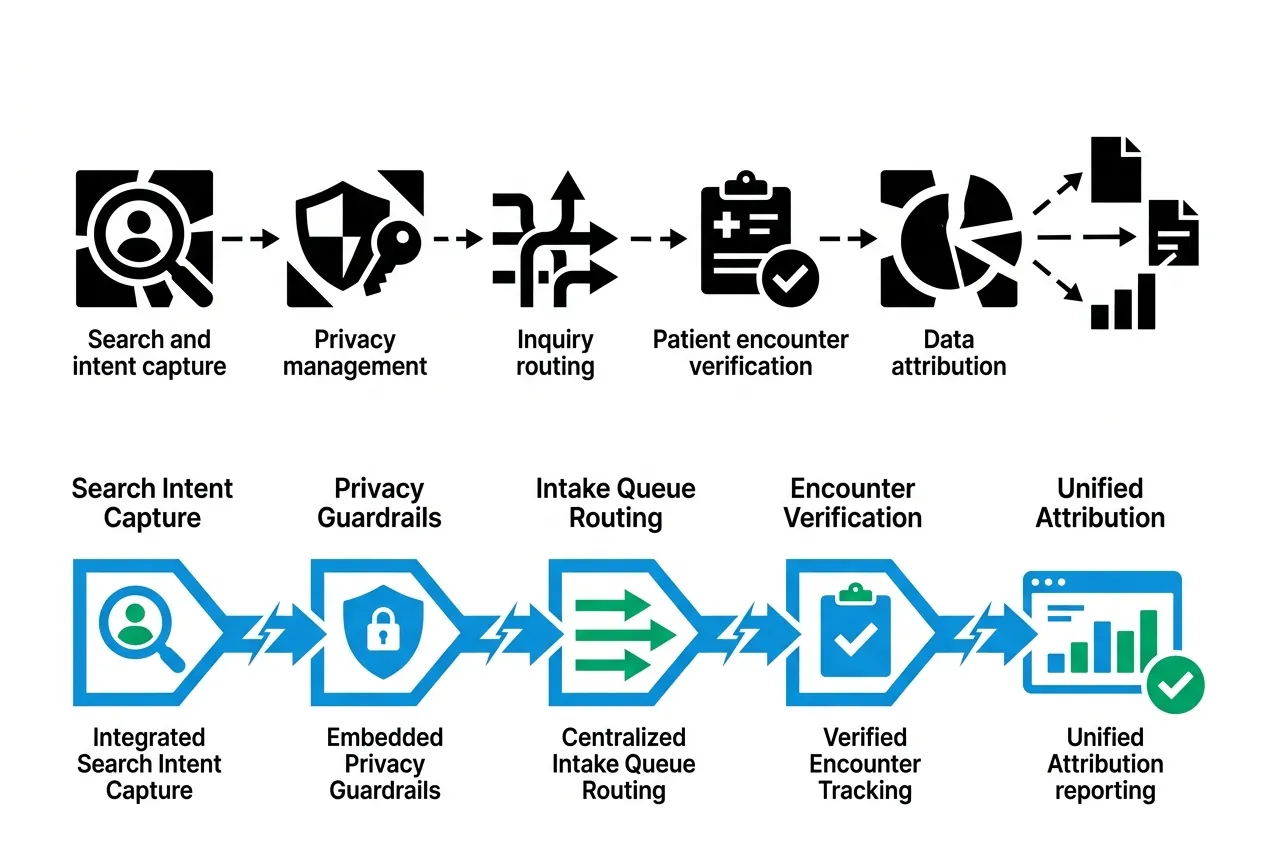
When software platforms treat patient acquisition as mere lead generation, these two environments operate in complete isolation. Marketing reports form fills and low cost-per-click metrics, while intake coordinators struggle with unverified inquiries, out-of-network callers, and mismatched appointment requests. A true platform solves this disconnect. Its primary job is to orchestrate four operational requirements: capturing high-intent search demand compliant with privacy regulations, maintaining strict data boundaries before clinical handoff, integrating directly with intake workflows, and measuring marketing performance against completed clinical encounters rather than aggregate web traffic.

Compliant Demand Acquisition Under Non-Retargeting Rules
Evaluating the acquisition capabilities of any platform begins with advertising policy realities. In standard commercial verticals, digital advertisers rely heavily on behavioral remarketing. If a user visits an automotive or software website, tracking cookies follow that user across the web with personalized display ads. In regulated healthcare, this practice is largely prohibited.
Google maintains strict personalized advertising policies that forbid targeting audiences based on personal health conditions, medical treatments, or sensitive physiological states. Platform buyers can review these explicit restrictions in the Google Ads Help: Personalized Advertising Policies. If a prospective patient searches for substance use disorder treatment, cardiac surgery, or depression management, an advertiser cannot capture that visit to build a retargeting audience list on Google or Meta.
Because condition-based remarketing is off-limits, an enterprise platform cannot rely on multi-stage digital nurture campaigns to convert passive visitors over time. The platform must capture demand at the precise moment of intent. This operational reality elevates the importance of high-intent search architecture, localized landing environments, and rapid conversion paths.
When evaluating potential vendors or internal architectures, examine how the system manages keyword intent, facility-level geographic routing, and real-time intake matching. If a platform vendor promises automated audience-re-engagement algorithms designed for general retail, those mechanisms will fail Google policy reviews or introduce substantial compliance exposure in healthcare. High-performing platforms focus their acquisition engines on structured paid search campaigns, localized organic visibility, and frictionless inbound call routing that captures prospective patients when they actively seek care.
First-Party Data Boundaries and Regulatory Compliance
Data governance represents the sharpest dividing line between generic customer relationship management software and a defensible healthcare acquisition platform. For years, digital marketing teams routinely deployed third-party advertising pixels from Meta, Google, and analytical vendors across health system websites. Those tracking scripts frequently transmitted patient Internet Protocol (IP) addresses, unique device identifiers, and specific Uniform Resource Locators (URLs) detailing medical conditions directly to advertising platforms.
Federal regulatory enforcement has fundamentally eliminated that approach. The Office for Civil Rights at the U.S. Department of Health and Human Services issued formal guidance regarding tracking technologies, clarifying that covered entities violate federal privacy protections when transmitting protected health information or identifying metadata to third-party ad networks without proper authorization. Health system leaders should reference the official HHS Guidance on Online Tracking Technologies to understand the strict parameters governing public-facing web pages.
Simultaneously, the Federal Trade Commission has demonstrated aggressive enforcement against digital healthcare providers that shared sensitive consumer health data with commercial advertising channels. The details of these regulatory enforcement actions are documented in the FTC Enforcement Overview on Health Data Privacy.
These enforcement actions alter how health systems must evaluate platform architecture. Monolithic platforms that demand the installation of client-side tracking scripts across every patient portal or appointment scheduling page create immediate regulatory exposure. A modern evaluation requires verifying how the platform manages data boundaries. The platform must separate anonymous top-of-funnel campaign engagement from authenticated clinical intake data. It must utilize server-side tracking environments, customer data platforms with signed business associate agreements, and owned data stores where patient identifiers are never exposed to external ad network algorithms.
Free Audit
Want a straight read on where your budget is leaking?
Point Solutions Versus an Integrated Operating System
Health system marketing teams frequently find themselves trapped in a sprawl of disconnected healthcare marketing tools. A typical marketing technology stack might include a dedicated call-tracking provider, an automated review-generation tool, a landing page builder, a general-purpose CRM, and third-party web analytics software.
This fragmentation creates severe operational friction. Picture the physical reality of a specialty clinic intake office. A coordinator sits with three monitors open: one displaying an electronic scheduling portal, another showing an unassigned web inquiry queue from an external landing page builder, and a third running a softphone application connected to a standalone call tracker. When a patient calls, the coordinator must manually search across these disconnected healthcare marketing tools to identify whether the caller previously submitted an online consultation request.
Data fragmentation inevitably leads to delayed patient outreach. In acute specialty lines, including behavioral health and oncology, a delay of thirty minutes in responding to an inquiry dramatically reduces the likelihood of scheduling an appointment. Furthermore, because each tool stores isolated data points, the health system marketing team receives conflicting reports. The landing page software claims one hundred conversions, the call tracking platform reports seventy calls, and the clinic scheduling desk records only fifteen attended patient consultations.
When evaluating your platform options, determine whether a vendor adds another isolated dashboard to your stack or provides an integrated operating framework. An effective platform unifies local search presence, call tracking, consent-governed landing environments, and intake routing into a cohesive data stream. Rather than buying multiple point solutions that require fragile third-party integrations, health systems benefit from an architecture where top-of-funnel media metrics connect directly to intake queue events.
Intake Integration and Attribution to Clinical Admission
The ultimate test of any healthcare acquisition platform is how it calculates conversion. In general B2B marketing, a form submission or downloaded white paper counts as a qualified lead. In hospital and healthcare marketing, an unverified form submission has almost zero commercial value. A substantial portion of raw web inquiries represent clinical questions from existing patients, billing disputes, solicitations, or individuals seeking services outside the provider's geographic network or clinical licensure.
If your marketing platform optimizes campaigns around raw leads, ad networks will systematically allocate your budget toward low-cost, low-intent inquiries. To drive actual patient volume, attribution must track through to verified clinical appointments and admissions.
This requires your platform to link front-end paid media click identifiers with back-end intake milestones without violating patient privacy. When a prospective patient calls an intake center from a localized search campaign, the platform captures the attribution session server-side. Once the clinical team determines that the inquiry represents a clinically appropriate, insurance-verified patient who schedules an appointment, an authorized milestone event updates the analytics engine.
Tracking attribution to admission, not just to initial inquiry, fundamentally changes media efficiency. Health systems running multi-facility networks can identify which campaigns generate scheduled procedures and which campaigns generate administrative noise. Marketing leaders can then reallocate capital toward the specific facilities, service lines, and geographic territories that possess open bed capacity or appointment availability.
Organizational Enablement, Industry Education, and Team Readiness
Deploying a sophisticated healthcare marketing platform requires more than software procurement; it demands operational readiness across your marketing and clinical operations teams. Technology alone cannot solve misaligned incentives between regional marketing directors and hospital service-line administrators.
To evaluate platforms effectively, leadership teams must stay informed about evolving regulatory frameworks and technical capabilities. Executive teams frequently explore these systemic shifts by participating in national healthcare marketing conferences. Attending specialized events, such as the annual conferences hosted by the Society for Healthcare Strategy & Market Development (SHSMD) or the Healthcare Marketing & Physician Strategies Summit (HMPS), allows marketing leaders to benchmark internal data governance against peer institutions. As organizations prepare long-term capital budgets for healthcare marketing conferences 2026, the primary agenda focus has shifted decisively from creative brand campaigns toward privacy-compliant data infrastructure and clinical conversion attribution.
Simultaneously, building institutional knowledge internally is essential for long-term data sovereignty. Health systems often fail to extract value from enterprise platforms because internal staff lack technical operational training, leaving the organization dependent on vendor professional services. Forward-thinking hospital networks bridge this skills gap by structuring healthcare marketing internships that expose emerging professionals to real-world health informatics, server-side tracking, and multi-location search management. When internal teams understand both clinical workflows and data architecture, the health system can operate its marketing platform with strategic autonomy.
Observe the physical environment of an effective health system marketing department. Cross-functional teams comprising digital strategists, data privacy officers, and clinical access managers meet regularly to review intake conversion rates by service line. They examine localized campaign data alongside clinical staffing schedules, adjusting media pacing to match surgeon availability or outpatient facility hours. This level of operational coordination transforms a marketing platform from a static reporting tool into an active driver of health system throughput.

Email Us
Prefer to send the context directly?
How Marketing Powered Engineers Healthcare Acquisition Infrastructure
Marketing Powered approaches healthcare growth through an operator-led model focused on measurable business outcomes, first-party data ownership, and regulatory rigor. Rather than locking healthcare organizations into rigid, proprietary software silos, we design and deploy integrated acquisition systems that align paid search, localized conversion infrastructure, and down-funnel clinical attribution.
Our technical perspective is rooted in deep operational history. Marketing Powered's founder is a former healthcare Chief Marketing Officer who directed marketing for a rapid-growth treatment network expanding from 3 to 24 locations, personally managed $1.5 to $2M per month in Google Ads across 11+ behavioral and mental health accounts, and serves as a court-certified expert witness in advertising strategy.
We deliver complete healthcare and hospital marketing programs that unite commercial strategy, compliant paid media management, search engine optimization, and advanced measurement architecture. Our frameworks are explicitly built for Google's sensitive healthcare verticals, where condition-based retargeting is prohibited and campaign success depends on capturing verified intent at the local facility level. We are LegitScript-aware and HIPAA-aware, ensuring that acquisition systems comply with platform policies and federal data privacy standards.
Crucially, our infrastructure does not stop at lead capture. We engineer attribution models that track prospective patient interactions through to clinical admission and completed appointments, providing marketing executives and board members with verifiable commercial clarity. To maintain absolute data sovereignty, we have been AI-native since 2022, utilizing owned, local AI infrastructure for HIPAA-aware inference. This allows health systems to analyze inquiry trends, automate operational workflows, and govern intelligence models locally without transmitting sensitive internal data to third-party cloud vendors.
To explore our broader operating philosophy, health system executives can consult our foundational guides:
- Healthcare marketing: the operating guide for health systems and provider groups
- Healthcare marketing agency: what to expect and how to choose one
- Hospital marketing company: what a specialist partner delivers and how to vet one
Questions, Answered.
Healthcare marketing is a specialized discipline that aligns clinical services, provider capacity, and patient communications to connect individuals with appropriate medical care. Unlike commercial retail marketing, healthcare marketing operates under strict federal privacy regulations, including HIPAA and state consumer protection laws, and must adhere to advertising network restrictions governing sensitive personal health conditions. An effective healthcare marketing program focuses on patient education, high-intent local accessibility, transparent service-line communication, and ethical intake operations that support clinical care delivery.
A standard customer relationship management platform is designed for commercial sales pipelines, relying on client-side tracking cookies, automated email nurture sequences, and lead scoring based on continuous web browsing activity. A healthcare marketing platform is engineered around clinical care realities and privacy boundaries. It separates anonymous web traffic from protected clinical interactions, complies with federal tracking guidance by avoiding third-party ad pixels on sensitive pages, integrates with clinical scheduling or EHR systems, and evaluates success based on verified appointments and patient admissions rather than unverified contact records.
Major advertising networks, including Google and Meta, enforce strict policies prohibiting personalized remarketing based on sensitive health data. These policies prevent advertisers from tracking users who research specific medical conditions, prescription drugs, mental health concerns, or clinical procedures and serving them targeted display or social advertisements. Because remarketing is restricted, healthcare platforms cannot rely on passive audience recapture. They must excel at capturing active, high-intent search demand at the exact moment a patient or family member seeks care.
Measuring marketing return on investment requires an attribution architecture that tracks external acquisition spend to completed clinical encounters without transmitting protected health information to external ad platforms. This is accomplished by capturing anonymous ad click identifiers server-side, routing callers through privacy-safe intake systems, and matching conversion milestones back to campaign sources within a secure, internal data warehouse. By tracking attribution to admission rather than relying on raw web form fills, health systems calculate true acquisition economics while maintaining complete regulatory compliance. Request a healthcare marketing assessment
Ready to see where your marketing can improve?
Request a free audit of your paid media, landing pages, attribution, and measurement setup. You'll get a straight assessment of where the opportunities are.
or email us at info@marketingpowered.ai