Resources
Consent Mode and Cookie Consent for Regulated Healthcare Marketing
Healthcare marketing executives face an operational conflict between automated campaign measurement and statutory privacy rules. Deploying consent mode allows ad platforms to model lost conversions, but client-side tags can still transmit sensitive network metadata to third parties. Navigating this technical boundary determines whether your marketing programs maintain algorithmic bidding efficiency or expose your organization to regulatory penalties.
By Mike Hulick, Founder, Marketing Powered

What Google Consent Mode v2 Changes at the Browser Level
Modern digital advertising platforms rely on continuous event streams to train smart bidding algorithms and measure campaign performance. As international privacy frameworks and browser vendors restricted third-party cookies, Google introduced consent mode to bridge measurement gaps. Under Google Developers Consent Mode Documentation, this API allows websites to adjust how Google tags behave based on the consent choices of individual users.
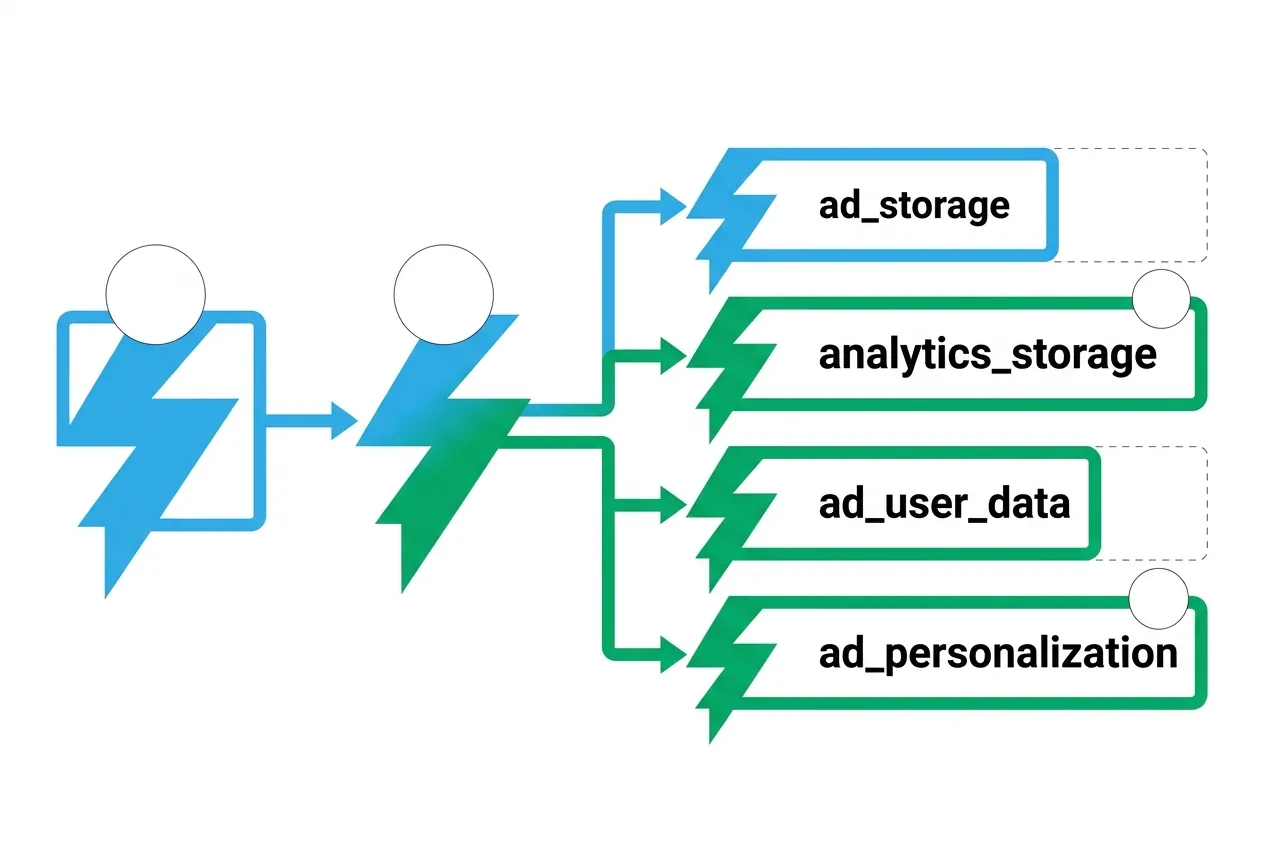
In early 2024, Google mandated Google Consent Mode v2 for advertisers using automated bidding and audience features. The initial version of consent mode relied on two primary signals: ad_storage, which dictates whether cookies can be stored for advertising purposes, and analytics_storage, which governs analytics cookies. Consent Mode v2 introduced two mandatory additional parameters: ad_user_data and ad_personalization.
The parameter ad_user_data controls whether an end user's personal data can be sent to Google for advertising purposes. The parameter ad_personalization controls whether collected data can be leveraged for personalized remarketing campaigns. When a user interacts with a website consent banner, the consent management platform captures those preferences and communicates them to the global site tag through the gtag('consent', 'update', ...) command.
For commercial e-commerce businesses, this mechanism functions seamlessly. When consent is granted, tags fire normally and store cookies on the visitor's device. When consent is denied, the tags adjust their execution state dynamically. However, in regulated verticals such as behavioral health, acute hospital care, and specialized medical clinics, how these tags execute when consent is withheld creates significant compliance exposure.
Why a Cookie Banner Does Not Ensure HIPAA Compliance
Many healthcare organizations mistakenly assume that adding a cookie banner and capturing opt-in consent insulates them from federal privacy enforcement. A cookie consent banner satisfies certain commercial privacy requirements, such as the European Union's General Data Protection Regulation (GDPR) or state-level consumer privacy laws. It does not, by itself, satisfy statutory obligations under the Health Insurance Portability and Accountability Act (HIPAA).
The United States Department of Health and Human Services (HHS) Office for Civil Rights outlined this risk in the HHS Bulletin on Tracking Technologies. According to the guidance, disclosing an individual's protected health information (PHI) to a third-party tracking vendor without a signed HIPAA authorization or an executed Business Associate Agreement (BAA) violates the HIPAA Privacy Rule. PHI is created online whenever an identifier (such as an IP address, device ID, or unique cookie identifier) is linked to information regarding an individual's past, present, or future health conditions, healthcare services, or healthcare payments.
A standard cookie banner informing a user that "we use cookies to improve your experience" does not meet the strict legal criteria of a HIPAA-compliant authorization. HIPAA authorizations require explicit statutory disclosures, including the specific recipients of the data, the exact scope of information shared, expiration terms, and revocation rights. Furthermore, major digital advertising platforms, including Google and Meta, refuse to sign Business Associate Agreements for their standard measurement and advertising pixels.
Relying on a standard consent interface to justify running third-party advertising tags across clinical service pages creates unmanaged regulatory liability. To understand the wider legal environment governing health campaigns, review our guide to HIPAA compliant marketing: what the rules mean for campaigns and tracking.
How Does Google Consent Mode Work with Cookieless Pings?
To understand the core technical vulnerability of consent frameworks in healthcare, marketing and IT teams must answer a mechanical question: how does Google Consent Mode work when an individual declines tracking?
When a visitor explicitly rejects tracking or arrives from a region where consent must be obtained prior to tracking, Google Consent Mode v2 alters tag execution by disabling cookie read and write operations. The tag does not place new cookies, nor does it read existing Google advertising cookies from the browser cache. Instead, the tag sends what Google classifies as "cookieless pings" directly to its collection endpoints.
Cookieless pings fall into three distinct functional categories:
- Consent state pings: These requests communicate the active status of ad_storage, analytics_storage, ad_user_data, and ad_personalization, notifying Google servers whether consent was granted or denied.
- Conversion pings: When a designated conversion event occurs while consent is denied, a ping transmits aggregated technical attributes (such as timestamp, user-agent string, and referrer URL) to inform conversion modeling.
- Page-view pings: During basic page loads, a cookieless ping fires to record page view counts for modeled reporting.
These cookieless pings are designed to feed machine learning models in Google Ads and Google Analytics 4, allowing platforms to reconstruct lost conversion counts. However, cookieless pings are still outbound HTTP network requests initiated by the visitor's client browser.
Because an HTTP request cannot reach a destination server without transmitting network routing parameters, every cookieless ping inherently delivers the user's public IP address to Google servers. The request headers also include the full destination URL and user-agent string. If a patient visits a public-facing page dedicated to a specific diagnosis, such as clinical depression, substance use disorder treatment, or oncology consultations, the browser automatically transmits the condition-revealing URL alongside the user's IP address. Under federal tracking technology guidance, this unmanaged data transmission constitutes an impermissible disclosure of protected health information if executed without a BAA.
Free Audit
Want a straight read on where your budget is leaking?
Implementing Consent Mode: Basic Versus Advanced Deployments
When setting up Google Consent Mode v2, organizations must choose between two distinct architectural configurations: Basic Consent Mode and Advanced Consent Mode. The differences dictate network-layer behavior and determine whether an implementation can be safely deployed across regulated web properties.
Basic Consent Mode
In a Basic Consent Mode architecture, Google tags are prevented from executing until the visitor explicitly grants consent through the site's consent interface.
If the visitor declines consent or ignores the banner, the tags never load. No script executes, no network requests are dispatched, and zero cookieless pings travel across the public internet to third-party endpoints. Under this configuration, ad platforms utilize conversion modeling based strictly on deterministic observations gathered from consented users, without collecting cookieless behavioral signals from non-consenting visitors.
For healthcare providers and regulated entities operating unauthenticated pages with condition-specific URLs, Basic Consent Mode represents the only defensible client-side configuration. By blocking the tag entirely at the browser level, the organization eliminates the risk of transmitting an individual's IP address and diagnostic page path to an ad network.
Advanced Consent Mode
In an Advanced Consent Mode architecture, Google tags load immediately when the web page renders, before the visitor interacts with the consent interface.
The tags read the default consent state (which can be configured to "denied" by default) and suppress cookie placement. However, the tags immediately dispatch cookieless pings for page views and subsequent user actions. If the visitor subsequently grants consent, the tags update their state and begin reading and writing cookies. If the visitor declines consent, cookieless pings continue to fire for conversion interactions.
While Advanced Consent Mode maximizes the volume of data available for platform-level conversion modeling, it introduces immediate compliance vulnerabilities for healthcare providers. Because client-side requests occur regardless of consent status, sensitive health information can be transferred without proper statutory safeguards. Regulated organizations must recognize that vendor-recommended "best practices" designed for retail websites cannot be copied directly into healthcare environments.
For a deeper analysis of how analytics platforms handle regulated health data, review our breakdown of Google Analytics and HIPAA: what healthcare marketers can and cannot do.

Selecting a Consent Management Platform for Sensitive Healthcare Workflows
Implementing a defensible consent structure requires an enterprise consent management platform (CMP). A CMP automates the presentation of consent banners, records user selections, stores auditable consent records, and transmits standardized consent signals to underlying tag management systems.
When evaluating a consent management platform for a hospital system, behavioral health network, or regulated enterprise, compliance and marketing teams should assess four technical criteria:
- Google CMP Certification: Ensure the platform is officially certified by Google to support Consent Mode v2. Certified CMPs integrate directly with Google Tag Manager through native community templates, ensuring that ad_user_data and ad_personalization parameters are passed consistently without custom JavaScript overrides.
- Granular Tag Blocking and Script Governance: The CMP must support strict tag blocking capabilities, preventing tracking tags from firing before consent is granted. Many turnkey CMP configurations default to asynchronous tag execution, which allows cookieless pings to slip through before the user selects their preferences.
- Geo-Targeted Banner Logic: Consumer privacy regulations vary significantly across jurisdictions. The CMP should support location-aware rules, serving strict opt-in banners to visitors in jurisdictions like the European Union or states with stringent consumer health data laws, while serving opt-out notices where permitted.
- Data Sovereignty and Audit Logging: The CMP must store timestamped, tamper-evident logs of consent states without capturing clinical context or connecting consent records to unencrypted personal data.
A properly configured consent management platform functions as an orchestration layer. It informs the browser which scripts may execute, but it does not inspect the underlying payload of the tags it allows to fire. For healthcare providers, managing client-side consent is only the first step in building a resilient digital acquisition stack.
Privacy-Safe Measurement Architecture for Regulated Advertisers
Protecting patient privacy while maintaining paid media performance requires decoupling ad network measurement from client-side browser execution. Marketing Powered approaches this challenge from direct operational experience. Founded by a former healthcare CMO who ran marketing for a treatment network that grew from 3 to 24 locations and managed $1.5 to $2M per month in Google Ads across 11+ behavioral and mental health accounts, Marketing Powered builds acquisition architectures specifically engineered for strict regulatory boundaries.
In regulated healthcare verticals, standard commercial tactics like retargeting are fundamentally prohibited. Under the Google Ads Help on Personalized Advertising policy, advertisers cannot deploy retargeting lists or utilize sensitive interest categories related to physical or mental health conditions. As a result, healthcare advertisers cannot rely on downstream audience remarketing to salvage inefficient paid acquisition. Conversion systems must succeed on intent capture, landing page conversion efficiency, and clean algorithmic bidding signals on the initial interaction.
To resolve the conflict between measurement and compliance, Marketing Powered deploys private, server-side measurement pipelines:
- Server-Side Proxy Architecture: Instead of allowing Google tags to fire directly from a patient's browser, tracking events route through a private server environment under a signed Business Associate Agreement. This proxy layer strips public IP addresses, eliminates device fingerprints, and removes sensitive URL query parameters before any signal exits the secure infrastructure.
- Consent-Aware Signal Routing: The server-side container reads the user's consent status directly from the consent management platform. If consent is absent, the infrastructure completely halts external data transmission. If consent is present, the pipeline normalizes the conversion event into an anonymized data packet.
- Downstream Attribution to Admission: Instead of optimizing campaigns around unverified web leads or surface-level form submissions, our measurement systems track attribution to admission, not just lead. By connecting acquisition channels to downstream operational milestones within a HIPAA-aware environment, bidding models optimize for real clinical outcomes rather than bot clicks.
- Owned, Local Infrastructure for Sensitive Workflows: Marketing Powered operates owned, local AI infrastructure for HIPAA-aware inference, ensuring that proprietary marketing models and regulated intake workflows execute on controlled hardware without routing sensitive data to public cloud APIs.
To evaluate how your organization can deploy privacy-first tracking architectures that protect ad performance, explore our specialized privacy-safe tracking and marketing technology for healthcare and regulated organizations. If you are evaluating outside support, review our framework on Hipaa compliant marketing companies: what a specialist partner delivers and how to vet one.
Questions, Answered.
Google Consent Mode works by receiving user consent choices from a website consent banner and adjusting how Google tags behave in real time. If a user grants consent, tags read and write advertising and analytics cookies normally. If a user denies consent, the tags suppress cookie storage and, under advanced configurations, transmit cookieless pings containing technical metadata to enable algorithmic conversion modeling.
To implement consent mode v2 safely on healthcare websites, organizations should configure a certified consent management platform and set the deployment architecture to Basic Consent Mode on all clinical or condition-specific pages. This ensures that Google tags are completely blocked from firing until explicit consent is granted, preventing cookieless pings from transmitting visitor IP addresses and diagnostic URLs to third-party ad networks.
In Basic Consent Mode, tags are entirely blocked from loading until the user interacts with the banner and grants consent; non-consenting users generate zero network traffic or cookieless pings. In Advanced Consent Mode, tags load immediately before user interaction and dispatch cookieless pings if consent is withheld, allowing Google to run conversion modeling at the expense of creating client-side data transmission risks.
To check consent mode implementation, developers use Google Tag Assistant and the browser's developer console. By inspecting the dataLayer object, technical teams can verify that default consent commands execute before any tags fire and that consent, update commands execute immediately following banner interactions. Network inspection tools should confirm that no outbound requests to Google endpoints occur when consent is denied under a Basic configuration.
To enable consent mode Google Ads tracking without exposing protected health information, organizations must move from client-side tracking to server-side tracking pipelines protected by Business Associate Agreements. The server container receives browser events, strips identifying parameters such as IP addresses and condition-specific URL strings, maps the appropriate Consent Mode v2 signals, and transmits sanitized conversion data directly to Google via the Google Ads API. Request a privacy and tracking review of your marketing stack
Ready to see where your marketing can improve?
Request a free audit of your paid media, landing pages, attribution, and measurement setup. You'll get a straight assessment of where the opportunities are.
or email us at info@marketingpowered.ai