Resources
AI SEO Tools: What They Can and Cannot Do for Rankings
Enterprise growth leaders face immense pressure to deploy autonomous software across organic discovery workflows, yet unguided automation routinely dilutes authority and degrades search visibility. Navigating modern organic acquisition requires understanding the operational scope of ai seo tools, identifying their structural limitations, and recognizing why commercial authority requires an owned intelligence layer.
By Mike Hulick, Founder, Marketing Powered

Four Functional Categories of AI Search Tools in the Enterprise Stack
What Are AI SEO Tools in Enterprise Marketing Operations?
Marketing executives evaluating digital strategy often ask fundamental operational questions: what are ai seo tools, and what is their functional purpose within an enterprise growth model? At their foundation, these platforms combine natural language processing, statistical pattern matching, web scraping engines, and predictive language models to accelerate organic search analysis. Instead of manually inspecting hundreds of search engine results pages, marketing teams use software to parse vast volumes of query data, evaluate existing content structures, identify semantic gaps, and automate initial text generation.
The market adoption of automated search software stems from the operational necessity to streamline complex, labor-intensive research cycles. In digital marketing environments, these systems serve as force multipliers for technical site auditing, competitive keyword grouping, and metadata organization. They allow a digital marketing team to process in seconds what historically required weeks of manual spreadsheet cross-referencing.
However, mechanical speed is not synonymous with commercial insight. These platforms operate exclusively by scraping, analyzing, and synthesizing material that has already been published, indexed, and evaluated across the public web. They reveal how existing top-ranking pages structure their subheadings, what related queries searchers input, and where text density patterns converge. They do not formulate novel commercial arguments, identify emerging shifts in consumer behavior, or construct differentiated positioning. Understanding that distinction separates teams that treat algorithmic search tools as administrative assistants from organizations that mistakenly hand strategic oversight to automated wrappers.
Rather than evaluating search software through arbitrary software comparison lists, enterprise operators must classify ai search tools by their architectural function across the organic acquisition lifecycle.
1. Topical Research and Semantic Clustering Engines
These platforms analyze entity associations and natural language patterns across top-ranking domains. By running continuous semantic audits across thousands of related search queries, they group fragmented keywords into unified intent clusters. This allows marketing teams to map comprehensive site architectures, identify content gaps across complex subject areas, and eliminate accidental keyword cannibalization across regional or multi-location landing pages.
2. Drafting and On-Page Content Optimization Systems
Content generation software relies on large language models to construct article outlines, format metadata, and generate preliminary drafts against predefined target keywords. Most systems evaluate drafts against an automated scoring rubric that grades copy based on term frequency, readability scores, and header composition derived from current SERP competitors. While these tools drastically reduce the time needed to draft routine technical descriptions, their outputs reflect aggregate web consensus rather than original insight.
3. Technical Auditing and Architectural Crawlers
Algorithmic crawlers systematically inspect complex enterprise digital properties to identify structural bottlenecks that impair search indexing. They automatically detect broken internal link pathways, incorrect canonical tags, rendering errors within single-page JavaScript frameworks, and structured schema validation errors. For hospitals, multi-location healthcare systems, and regional professional service providers managing hundreds of dynamic pages, these automated systems provide vital operational oversight.
4. AI Citation and Answer Engine Monitors
As search patterns evolve toward conversational answer engines, a new class of generative engine optimization tools has emerged. These monitoring systems track how brand entities, product lines, and service capabilities get synthesized within conversational environments such as Google AI Overviews, Perplexity, and conversational chat interfaces. They evaluate brand presence, sentiment, and source attribution across generated answers, giving visibility into how generative search platforms present an organization to prospective buyers.
What AI Search Tools Cannot Do: The Structural Limits of Algorithmic Content
Despite vendor promises of hands-off organic dominance, off-the-shelf software encounters unavoidable mathematical and strategic boundaries. When marketing organizations rely on automation to generate search collateral without deep domain expertise, three core failure points consistently emerge.
The first structural barrier is the homogenization trap. Language models are statistical engines designed to predict the most probable sequence of words based on their training data. When hundreds of competing companies use similar software to write about the same commercial query, the software evaluates the same top-ten search results and generates nearly identical answers. The resulting material lacks original perspective, firsthand operational data, and unique commercial viewpoints. According to Google Search Central guidance on AI-generated content, search algorithms prioritize content that demonstrates high quality and helpfulness, evaluating materials against the principles of Experience, Expertise, Authoritativeness, and Trustworthiness (E-E-A-T), while penalizing automation deployed primarily to manipulate search rankings. Content produced entirely by statistical consensus fails the foundational requirement for demonstrated firsthand experience.
The second barrier is the inability to access or interpret proprietary, first-party data. Public software platforms cannot review your closed-loop intake metrics, analyze proprietary customer operational patterns, examine balance sheet performance, or capture executive clinical observations. True market authority comes from publishing empirical evidence, proprietary case studies, and specialized operational insights that exist only inside your business. Rented software can format text, but it cannot manufacture primary source material.
The third barrier is algorithmic hallucination and factual drift. Large language models frequently construct plausible-sounding citations, fabricate regulatory guidelines, or state inaccurate industry standards as absolute fact. In consumer goods marketing, minor inaccuracies cause brand confusion; in regulated healthcare or professional advisory verticals, publishing unverified, hallucinated guidance creates severe regulatory exposure and damages enterprise credibility.
Free Audit
Want a straight read on where your budget is leaking?
Generative Engine Optimization Tools and AI Citation Tracking
Organic search is undergoing an architectural shift away from static lists of ten blue links toward direct, synthesized answers. Modern buyers frequently rely on conversational search summaries to evaluate vendors, compare services, and diagnose organizational problems. This behavioral shift necessitates an evolution from traditional keyword tracking toward generative engine optimization tools that measure how well language models comprehend and cite your enterprise.
Generative discovery engines evaluate information differently than traditional search crawlers. Traditional search ranking heavily relies on URL-level link metrics, keyword density, and anchor text distribution. In contrast, generative systems parse semantic entity associations, structured schema architecture, and cross-web topical consensus to determine which sources are credible enough to synthesize into a direct answer.
To earn inclusion within conversational search overviews, an organization must become a recognized entity of record within its field. Generative engine optimization tools monitor this dynamic by evaluating:
- Entity Salience: How consistently a brand entity connects with specific industry solutions, specialized service capabilities, and technical subject matters across verified knowledge graphs.
- Structured Citation Density: The frequency with which an organization's proprietary frameworks, original data points, and published executive insights are referenced by authoritative third-party publications.
- Information Completeness: How thoroughly your digital assets answer direct, high-intent buyer inquiries through clean schema markup and structured data that automated systems can ingest without ambiguity.
Succeeding in generative search environments does not require publishing hundreds of automated blog posts. It requires establishing authoritative, verifiable web positions that conversational search platforms can extract as primary source truth. For organizations re-evaluating their growth strategy, reviewing our analysis on AI marketing: what it changes for strategy, teams and budgets provides a roadmap for aligning operational resources behind this shift.

Why Regulated Brands Face Hidden Risks With Off-the-Shelf AI Platforms
Organizations operating within regulated environments, including hospital networks, regional behavioral health providers, and specialized professional services, encounter distinct operational risks when integrating public search tools into their growth workflows.
The primary exposure involves data privacy and intellectual property leakage. Many commercial SaaS wrappers pass user inputs directly to third-party model providers for model training. When internal marketing teams feed proprietary intake trends, internal business reviews, or patient service documentation into public web platforms to generate search articles, they risk exposing confidential corporate intellectual property. In healthcare environments subject to federal privacy rules, inputting any non-public operational data or protected identifiers into unvetted cloud software violates core governance protocols.
Furthermore, search engines apply rigorous quality standards to Your Money or Your Life (YMYL) content areas where inaccurate information directly harms a consumer's financial well-being, physical safety, or health outcomes. Algorithm updates continuously evaluate behavioral and clinical content for verified medical oversight and established institutional authority. Pumping generic, unmonitored automated text into a clinical or regulated search footprint signals low editorial governance, exposing the entire domain to algorithmic traffic devaluation.
Paid acquisition channels face similar scrutiny. In Google Ads, policy guidelines strictly ban personalized retargeting within sensitive healthcare verticals, such as addiction treatment and mental health conditions. Organizations in these sensitive environments cannot rely on cookie-based retargeting to recapture lost prospects; they must capture organic intent cleanly, establish immediate institutional trust, and convert high-value demand directly on the first interaction. Using commoditized, unverified text directly undermines that fragile conversion pathway.
When to Hire an AI SEO Agency Versus Renting Commercial Software
As executive leadership teams review operational expenditures, a recurring question emerges: should the organization license commercial search software for in-house teams, or partner with an ai seo agency to build an enterprise organic pipeline?
Purchasing commercial software licenses makes sense when an organization possesses seasoned, in-house subject matter experts, technical developers, and experienced content editors who require workflow acceleration. In this operating model, the internal team uses software strictly to handle clerical parsing, leaving strategic direction, primary research, and editorial verification firmly in human hands.
However, organizations frequently encounter internal resource limitations when attempting to scale organic growth. When in-house teams lack technical search expertise, hiring an ai marketing agency: how to evaluate one beyond the label helps distinguish real technical capabilities from superficial SaaS resale. Many digital marketing vendors market themselves as advanced search partners while simply charging hefty markups to run client briefs through commodity generative tools.
A specialized generative engine optimization agency: what a specialist partner delivers and how to vet one approaches organic discovery as an architectural and technical challenge. Rather than treating search visibility as a volume game, a legitimate agency partner focuses on:
- Developing proprietary entity relationships across knowledge graphs.
- Structuring technical data and schema architecture for machine readability.
- Conducting rigorous, human-led expert reviews to protect institutional compliance and brand integrity.
- Integrating acquisition data directly with CRM and intake platforms to measure revenue impact rather than vanity search impressions.
Organizations should evaluate specialized ai seo services not by how many automated articles a partner can produce, but by their ability to translate specialized market experience into protected, defensible organic market share.

Email Us
Prefer to send the context directly?
Specialized AI Systems: How Marketing Powered Deploys Owned Marketing AI
Marketing Powered approaches organic discovery and marketing automation from an operator-led perspective. Founded by a former healthcare Chief Marketing Officer who directed marketing operations for a treatment network that expanded from 3 to 24 locations, our operational methodology was built within high-scrutiny, competitive commercial environments.
Having managed $1.5 to $2M per month in Google Ads across 11+ behavioral and mental health accounts, our founder operates with deep respect for compliance boundaries, data sovereignty, and full-funnel economics. In regulated sectors where retargeting is prohibited, organic visibility, technical site precision, and conversion systems must operate in complete alignment.
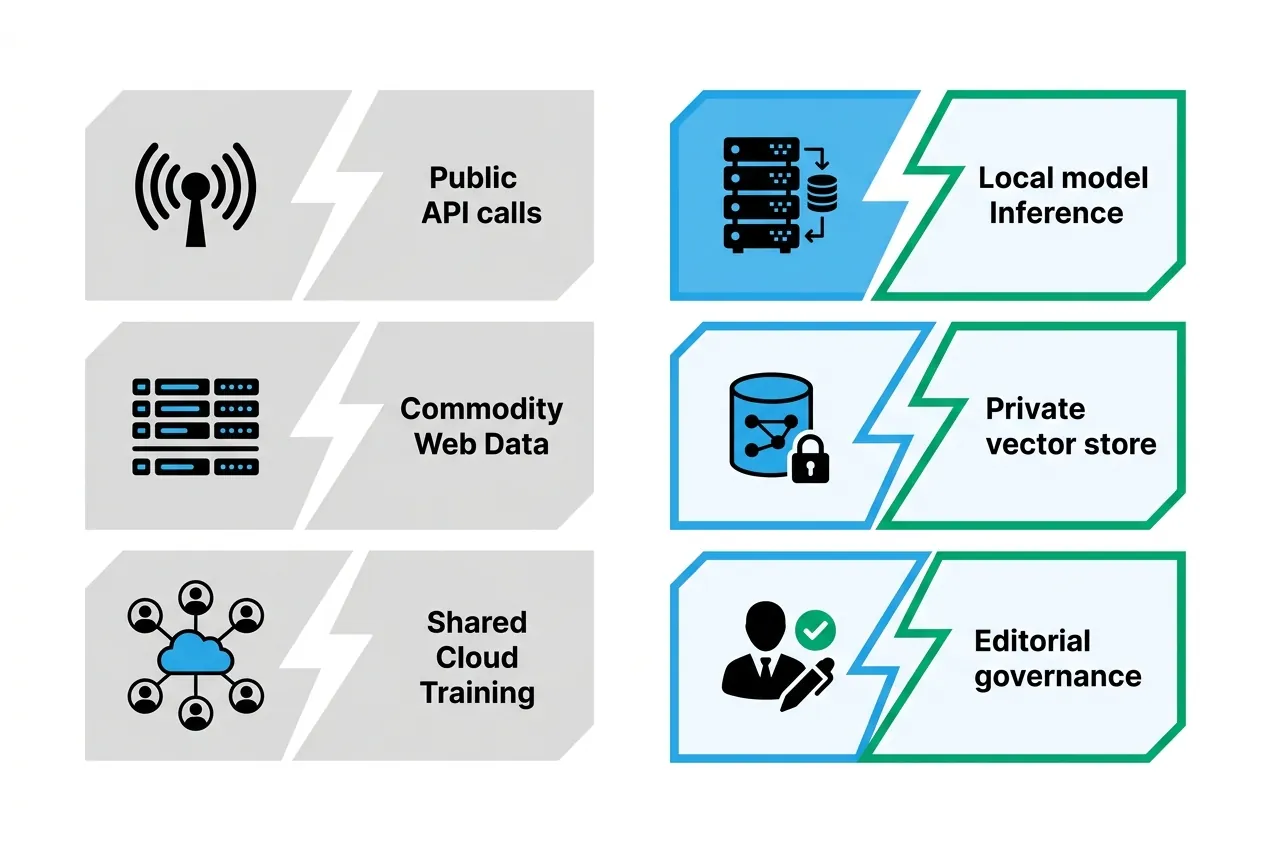
Instead of routing proprietary enterprise data through shared third-party software wrappers, Marketing Powered deploys specialized AI systems utilizing owned, local AI infrastructure for HIPAA-aware inference. AI-native since 2022, we maintain dedicated computing hardware to process data securely, evaluate semantic search footprints, and build custom intelligence workflows without transferring sensitive internal records to public cloud repositories.
Our systems do not operate autonomously without strategic governance. As a court-certified expert witness in advertising strategy, our leadership enforces rigorous validation across every marketing workflow. Every automated search insight, competitive entity audit, and structured schema implementation is anchored by human expertise and verified against commercial performance metrics. Furthermore, we measure acquisition effectiveness through intake platforms directly to admitted clients or realized revenue, rather than stopping tracking at top-of-funnel form fills.
To explore how our proprietary infrastructure and operator-led methodology support enterprise growth, review our specialized AI systems and marketing operations.
Questions, Answered.
AI SEO tools are primarily used to automate data-heavy, repetitive search engine optimization tasks. These include clustering related search queries, analyzing search intent patterns, auditing sites for broken links or technical schema flaws, evaluating competitive content structures, and assisting teams with preliminary drafting and metadata generation. They serve as productivity systems rather than autonomous replacements for human strategy.
Traditional SEO software relies on historical databases, explicit keyword search volumes, and rule-based scraping to show past search performance. Modern AI search tools incorporate natural language processing, semantic entity analysis, and predictive language models to evaluate conceptual relationships, predict search intent, and assess how conversational answer engines synthesize brand information across generative search results.
Using automation does not automatically result in a search penalty. Google assesses content based on quality, accuracy, and whether it provides helpful, firsthand value to searchers. However, using automated tools to mass-produce low-quality, programmatic content designed solely to manipulate search rankings directly violates platform spam policies. In regulated or YMYL sectors, publishing unverified, inaccurate automated text often leads to algorithmic downgrades due to failing core E-E-A-T standards.
Traditional rank trackers monitor a website's static position across ten blue links for specific keyword queries. Generative engine optimization tools monitor conversational AI summaries, measuring brand entity mentions, citation sources, and sentiment across conversational engines. They evaluate whether an organization is positioned as a primary, trustworthy authority that language models can cite directly within generated responses. Talk with Marketing Powered about owning your marketing AI stack.
Ready to see where your marketing can improve?
Request a free audit of your paid media, landing pages, attribution, and measurement setup. You'll get a straight assessment of where the opportunities are.
or email us at info@marketingpowered.ai