Resources
AI SEO Pricing: What Drives the Cost and How to Budget
Evaluating modern ai seo pricing requires peeling back vendor software markups to understand the actual technical scope being delivered. When marketing teams look past automated text generation, the true investment centers on data architecture, human verification, and whether an organization rents third-party language wrappers or builds on owned systems.
By Mike Hulick, Founder, Marketing Powered

What the AI SEO Term Really Describes
The ai seo term has become a catch-all phrase that obscures two very different technical disciplines. On one side, vendors use automated scripts to generate mass content or adjust on-page metadata. On the other side, specialized engineering teams structure enterprise data so that retrieval-augmented generation systems and neural search engines can index, verify, and cite brand entities. In modern enterprise discussions, advanced ai seo is called Generative Engine Optimization (GEO) or Large Language Model Optimization (LLMO).
When reviewing proposals, growth leaders often see identical line items masking radically different workflows. One proposal might quote five hundred dollars per month for a plugin that pings an external language model API to draft generic blog summaries. Another might quote fifteen thousand dollars per month to engineer custom schema, eliminate deep crawl debt, and establish verifiable entity relationships across dozens of physical facility locations.
In practice, this operational divide looks like two distinct production floors. In a low-cost automated setup, a single junior coordinator prompts a web-based dashboard to push out hundreds of unverified pages each week directly into a content management system. In a structured enterprise deployment, a data engineer, a technical search specialist, and a subject-matter expert review semantic entity graphs in a development environment, testing retrieval accuracy across search interfaces before deploying structured schema to production servers. Determining an accurate scope starts with knowing which of these two disciplines a vendor actually provides.

Core Cost Drivers Behind AI SEO Pricing
Several technical, structural, and regulatory factors determine realistic market pricing. Because modern search engines penalize manipulative automation under Google Search Central spam policies, substantive search optimization requires specialized engineering rather than simple script execution. Four primary variables dictate quote structures across the industry:
- Data Architecture and Technical Remediation: The baseline health of an existing digital estate establishes the starting workload. If a website suffers from architectural bloat, orphan URLs, conflicting redirects, or absent structured data, language models cannot reliably extract factual business attributes. Pricing scales directly with the hours required to audit entity relationships, build clean JSON-LD knowledge graphs, and align site architecture with modern retrieval models.
- Regulatory Exposure and Clinical Review: In regulated markets like healthcare, medical devices, legal services, and finance, publishing incorrect information creates direct legal liability and conversion failure. Organizations operating under strict compliance standards must incorporate rigorous human review into every workflow. Retainers in these sectors reflect the operational necessity of subject-matter experts verifying clinical, legal, or regulatory claims before publication.
- Physical Footprint and Directory Complexity: Managing local visibility for a single location requires a fraction of the data management demanded by regional or national footprints. Multi-location health networks, hospital systems, and distributed service networks require synchronized directory management, localized entity citation, and programmatic consistency across dozens of regional digital properties.
- Compute Infrastructure and Model Deployment: How models run directly affects marginal expenditure. Agencies relying entirely on third-party public cloud APIs incur unpredictable token consumption fees that scale with content volume and database queries. Conversely, operations that run dedicated models on owned, local hardware eliminate per-token licensing fees, stabilizing operational overhead over multi-year cycles.
The AI SEO Skill Set That Dictates Real Labor Cost
Agency pricing is primarily a reflection of specialized talent rather than software seat licenses. When marketing leaders examine agency proposals, understanding the required ai seo skill profile helps distinguish strategic partners from repackaged software vendors. Effective execution demands cross-disciplinary capabilities that standard creative agencies rarely possess in-house.
First, technical practitioners must understand semantic search algorithms and vector space retrieval. This discipline involves configuring entity schemas, topic clusters, and semantic relationships so that algorithmic discovery engines can parse domain context without ambiguity. The practitioner must know how search models extract facts, map knowledge graphs, and assess page quality.
Second, teams require structured data engineering capabilities. The technician must be capable of authoring custom JSON-LD markups, building connected knowledge graphs, and resolving entity conflicts across external registries. This level of technical execution requires working directly within site code and server configurations rather than relying on automated software plugins that insert generic, fragmented metadata.
Third, domain-specific governance requires senior editorial leadership. As outlined in the Google Search Central helpful content guidelines, search ranking systems reward original reporting, operational experience, and verified technical depth while actively demoting unoriginal, automated copy. Maintaining this standard requires human specialists who possess actual domain experience, particularly when translating complex clinical, technical, or multi-location operational details into public resources.
Finally, an advanced search operation requires attribution engineering. Teams must connect organic citations and rankings directly to commercial admissions, intake calls, or enterprise revenue. Without closed-loop attribution, search spend remains disconnected from measurable enterprise valuation.
Free Audit
Want a straight read on where your budget is leaking?
Rented Software vs Owned Infrastructure: Total Cost of Ownership
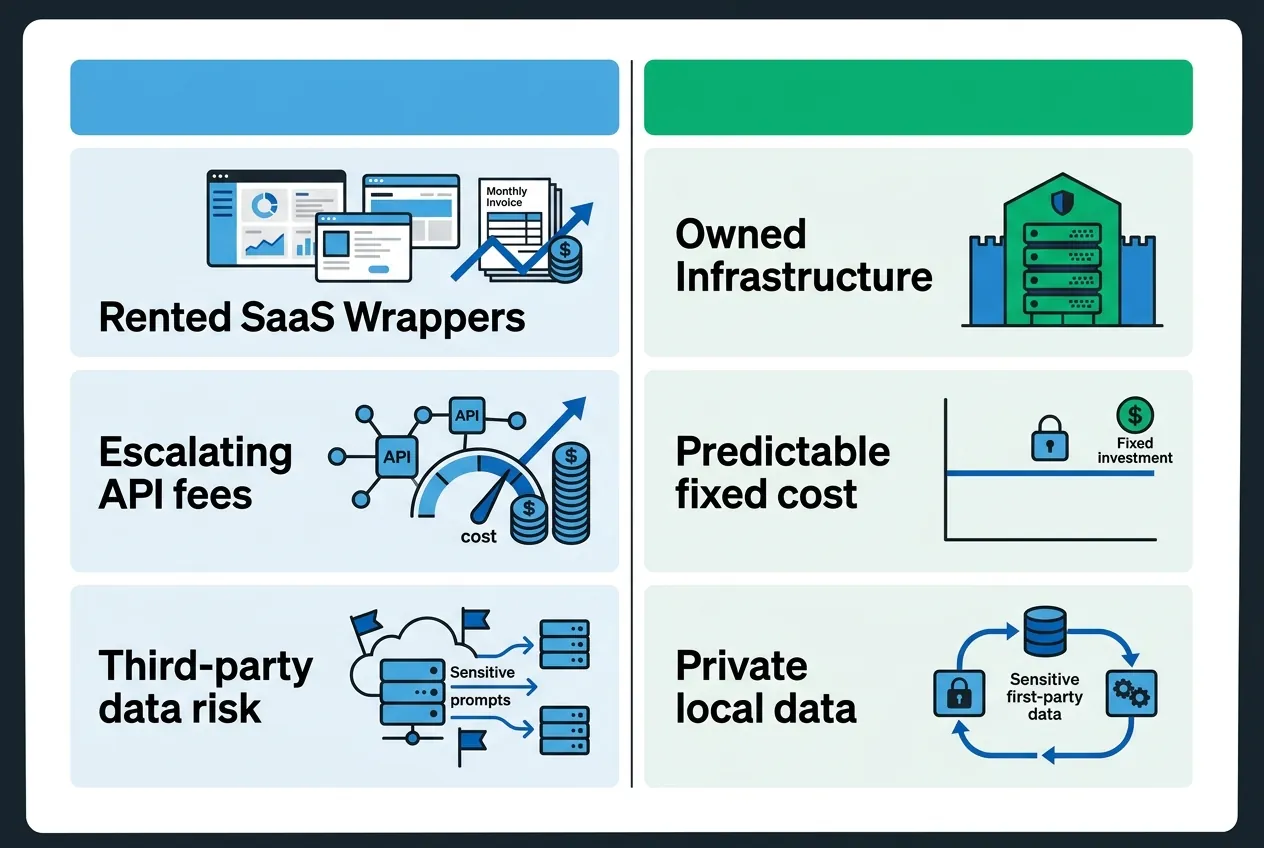
Budget discussions frequently overlook the structural distinction between renting third-party software subscriptions and investing in owned operating systems. Most commercial platforms operate on software-as-a-service models, billing per seat, per domain, or per API token. Over multi-year operating horizons, these recurring subscriptions create compounding expenses while accumulating technical debt.
- Recurring Licensing Costs. Rented Third-Party Software Stack: Escalating monthly seat licenses and API overage charges. Owned Computing and Model Infrastructure: Fixed capital investment with near-zero marginal inference fees.
- Data Governance and Privacy. Rented Third-Party Software Stack: Sensitive internal data and prompts pass through external servers. Owned Computing and Model Infrastructure: Localized data processing protects first-party operational intelligence.
- Customization and Control. Rented Third-Party Software Stack: Constrained by rigid vendor product roadmaps and generic model weights. Owned Computing and Model Infrastructure: Fully configurable workflows tailored to specific regulatory and entity needs.
- Asset Capitalization. Rented Third-Party Software Stack: Operational expense that builds zero enterprise balance-sheet equity. Owned Computing and Model Infrastructure: Reusable proprietary intellectual property that strengthens enterprise valuation.
Consider a typical marketing operations room evaluating these models side by side. In a rented environment, analysts sit behind commercial dashboards, watching monthly software invoices increase as additional team members, regional locations, or customer data queries are added. Each workflow adjustment depends on external vendor feature releases.
In an owned infrastructure setup, high-performance computing hardware runs dedicated, open-weight models locally within the organization's private network perimeter. The engineering team fine-tunes custom retrieval workflows directly against first-party databases. Operational costs remain predictable regardless of query volume, sensitive business intelligence never leaves the internal environment, and the resulting automation frameworks remain permanent corporate assets.
For teams managing complex multi-location networks or sensitive data streams, the total cost of ownership decisively favors owned operational systems. Renting third-party wrappers leaves an organization vulnerable to vendor price increases, model deprecation, and policy shifts. Building capability on owned infrastructure converts recurring operating spend into defensible, enterprise-owned intellectual property.
To explore how these operational shifts affect executive strategy, review our analysis on AI marketing: what it changes for strategy, teams and budgets.
Applying AI SEO Optimization to Regulated and Multi-Location Markets
Deploying programmatic ai seo optimization across regulated or multi-location sectors demands exceptional operational discipline. In sectors like healthcare systems, professional services, and multi-unit clinic networks, low-cost automated output introduces severe commercial hazards.
When low-tier vendors flood a domain with mass-produced synthetic articles, the content almost invariably lacks authentic clinical perspective, real case context, and structural accuracy. Search engines recognize these synthetic patterns, leading to algorithmic demotions that suppress organic discoverability across the entire domain. In healthcare specifically, inaccurate medical statements or unverified claims compromise patient trust, create regulatory vulnerability, and depress phone conversions at the facility level.
For multi-location systems, search performance depends on establishing verifiable entity authority for each physical site. A regional healthcare network operating twenty or more locations does not need generic informational blog posts. It requires synchronized, location-specific schema, consistent provider credentials across national databases, and precise service mappings linked to local search intent.
Achieving this level of regional market authority requires integrating technical search architecture with broader customer acquisition programs. When evaluate vendor capabilities across these complex requirements, use our guide on how an AI marketing agency: how to evaluate one beyond the label provides practical vetting frameworks.
Specialized AI Systems: How Marketing Powered Delivers Search Operations
Marketing Powered approaches organic search and discovery from an operator-led perspective. The firm was built by a former healthcare CMO who ran marketing for a treatment network that grew from 3 to 24 locations, personally managed $1.5 to $2M per month in Google Ads across 11+ behavioral and mental health accounts, and serves as a court-certified expert witness in advertising strategy.
Being AI-native since 2022, the firm does not rely on off-the-shelf software wrappers or superficial copy generators. Instead, Marketing Powered designs and operates specialized AI systems running on owned, local AI infrastructure for HIPAA-aware inference. This technical foundation allows deep semantic analysis, automated technical audits, and high-volume data transformation without exposing sensitive client information to public cloud models or incurring runaway token fees.
Because the firm operates with deep awareness of LegitScript and HIPAA standards, execution is specifically engineered for sensitive verticals where conventional marketing tactics like retargeting are strictly prohibited by Google advertising policies. Rather than reporting on vanity metrics like impressions or raw lead volume, Marketing Powered tracks performance to concrete operational outcomes, measuring success by verified facility admissions and completed client engagements.
Organizations ready to build permanent marketing assets can inspect our approach to specialized AI systems to understand how owned computing transforms acquisition efficiency.

Email Us
Prefer to send the context directly?
A Practical Framework to Budget for Search and Retrieval
Building an accountable budget requires moving away from arbitrary agency retainer tiers and focusing on measurable operational phases. Marketing leaders should allocate capital across three clear strategic stages to maintain control over total expenditure.
Phase 1: Foundational Audit, Architecture, and Data Remediation
The initial stage addresses existing technical debt and establishes semantic readiness. Capital allocation during this phase should fund:
- Deep structural crawl audits to eliminate redirect chains, orphan files, and indexing errors.
- Entity mapping and custom JSON-LD schema deployment across all core service lines and locations.
- Comprehensive content auditing to prune or consolidate thin, low-performing, or automated text that violates search engine quality standards.
- Local infrastructure planning to establish secure data handling and model retrieval protocols.
Phase 2: System Integration and Production Infrastructure
The second phase establishes the repeatable operational workflows required to build and distribute authoritative domain assets:
- Deploying owned or dedicated model environments to eliminate variable third-party API consumption charges.
- Designing human-in-the-loop governance protocols connecting technical writers with licensed subject-matter experts.
- Building automated citation and retrieval monitoring systems to track brand visibility across both traditional search engines and emerging conversational answer engines.
- Integrating analytics pipelines to trace incoming search traffic through conversion points to verified intake, consultation, or admission.
To evaluate external partners capable of managing both traditional search engines and conversational language platforms, consult our framework on what a Generative engine optimization agency: what a specialist partner delivers and how to vet one must provide.
Phase 3: Continuous Governance, Entity Expansion, and Conversion Tuning
The ongoing operational phase protects organic market share and scales domain authority across regional territories:
- Regular updates to structured schema as services, medical providers, or business locations expand.
- Ongoing publication of original, evidence-backed editorial resources governed by subject-matter authorities.
- Systematic conversion rate optimization on key intake and appointment landing pages.
- Routine cross-checking of brand entity citations across public knowledge graphs and industry registries.
By budgeting along this phased trajectory, chief marketing officers avoid paying indefinite markups for commodity software tools. Every invested dollar funds tangible data assets, verified compliance governance, and durable organic discovery.
Questions, Answered.
In a modern search environment, pricing is based on architectural complexity, entity engineering, compliance requirements, and the level of expert human verification required. Rather than paying for raw article word counts, budgets reflect the engineering work needed to structure data for neural retrieval and the specialized labor required to ensure domain content satisfies search quality guidelines.
Software tools provide raw data, automated alerts, or draft text, but they cannot execute custom schema engineering, resolve technical infrastructure conflicts, or provide licensed subject-matter review. Relying entirely on low-cost software subscriptions often leads to the publication of generic content that fails search engine helpfulness standards and creates long-term technical debt.
Owned infrastructure shifts marketing expenses from variable, recurring operational fees to capitalized technology assets. Running fine-tuned, open-weight models on dedicated local hardware eliminates recurring per-token cloud costs, protects sensitive proprietary data from public model exposure, and gives an enterprise complete control over its publishing and optimization workflows.
Unchecked automated content generation frequently introduces factual errors, hallucinations, and unverified claims. In regulated markets like healthcare, legal services, or finance, these inaccuracies expose the organization to compliance liabilities and destroy consumer trust at the point of conversion. Furthermore, search engines actively identify and demote unoriginal, low-value automated material across entire domains. Talk with Marketing Powered about owning your marketing AI stack
Ready to see where your marketing can improve?
Request a free audit of your paid media, landing pages, attribution, and measurement setup. You'll get a straight assessment of where the opportunities are.
or email us at info@marketingpowered.ai