Resources
Facebook Ads for Dentists: Campaigns That Book High-Value Patients
Most dental practices investing in facebook ads for dentists generate sporadic inquiries that fail to show up for scheduled clinical exams. Discount offers attract price-sensitive shoppers who switch clinics as soon as a competitor undercuts fees, wasting front-desk labor on low-margin procedures. Building an acquisition engine requires targeting procedure-specific demand, maintaining strict platform compliance, and converting interest into scheduled chair time.
By Mike Hulick, Founder, Marketing Powered

The Economics of Facebook Ads for Dentists: High-Value Care vs. Discounts
Dental practices frequently fall into the trap of running promotions for low-margin preventative services. A campaign promoting a deeply discounted cleaning or routine exam floods the front desk with inquiries, but the operational economics rarely pencil out. Staff members spend hours chasing leads who fail to confirm appointments, cancel at the last minute, or refuse recommended restorative care after their initial visit. When a chair sits empty because a promotional patient failed to show, the clinic loses both production revenue and the provider hourly overhead allocated to that operatory.
Sustainable practice growth depends on aligning paid social campaigns with high-production procedures. Focusing marketing budgets on dental implants, full-arch restorations, clear aligners, sleep apnea appliances, and cosmetic dentistry fundamentally changes the return on ad spend. A single completed dental implant case or clear aligner plan covers acquisition expenses and generates substantial gross margin. Shifting the focus of your dental advertising toward these complex procedures changes the profile of the patient contacting your practice. Instead of bargaining over a basic copay, these prospective patients are seeking clinical competence, financing transparency, and long-term restorative solutions.
Evaluating marketing success requires looking past top-of-funnel metrics like cost per lead or raw click volume. In clinical operations, the metrics that matter are cost per qualified consultation, show rate, case acceptance rate, and realized production value. A campaign generating twenty leads at a low cost that yields zero accepted treatment plans is a net loss for the business. Conversely, an ad set producing five inquiries at a higher acquisition cost that results in two completed full-arch consultations delivers exceptional returns.

Navigating Meta Ad Policies and Patient Privacy Rules
Running healthcare campaigns on social platforms requires strict adherence to regulatory standards and advertising policies. Many dental campaigns face sudden account suspensions or ad rejections because marketing teams do not understand the Meta Advertising Standards on Personal Attributes. Meta strictly prohibits ad creative, copy, or headlines that assert or imply personal attributes, including physical health conditions or medical treatments. Direct questions such as "Are you missing teeth?" or "Are you embarrassed by your crooked smile?" violate these guidelines because they explicitly call out the viewer's physical condition.
Compliant copy shifts the perspective from the patient's perceived flaw to the doctor's clinical capability, available modern technology, and general educational concepts. Instead of asking if someone is struggling with ill-fitting dentures, high-performing ads highlight how 3D guided surgery and modern materials restore chewing function and stability. Framing the message around clinical techniques, provider qualifications, and restorative technology informs the prospect without triggering automated compliance flags.
Beyond ad copy compliance, dental organizations must address online tracking and data transmission. The HHS Guidance on Online Tracking Technologies outlines strict limitations on how HIPAA-covered entities utilize third-party pixels and code snippets. Deploying standard social tracking pixels on web pages where a patient may reveal health status, medical history, or appointment requests risks transmitting protected health information without valid authorization. Practices must deploy privacy-safe server-side tracking, strict consent management, and compliant conversions API setups that safeguard individual privacy while still feeding necessary optimization signals back to ad platforms.
Creative Frameworks That Convert: Video, Proof, and Procedure Walkthroughs
Static stock images of people with unnaturally white teeth no longer generate trust on social media. Prospective patients recognize generic stock photography instantly and scroll past it. High-performing dental facebook ads rely heavily on authentic, high-definition video assets shot directly inside the clinic. Video content humanizes the clinical team, demystifies complex dental procedures, and directly dismantles procedural fear.
Provider-led direct-to-camera video is one of the most reliable creative formats for high-ticket elective dentistry. When a practicing clinician spends ninety seconds explaining what happens during an implant consultation, how modern sedation dentistry eliminates pain, or how clear aligner treatment plans are engineered, patient apprehension declines. Hearing the dentist explain procedures clearly and calmly builds provider authority long before the patient steps foot into the operatory.
Financial transparency represents another essential creative lever. High-value dentistry carries significant out-of-pocket costs, and uncertainty around pricing often prevents qualified candidates from reaching out. Video walkthroughs that discuss payment plans, third-party healthcare financing options, and the factors that influence total treatment costs eliminate hesitation. Pairing these educational videos with clinical facility walkthroughs and natural before-and-after documentation showing actual restorations provides tangible proof of clinical skill.
Free Audit
Want a straight read on where your budget is leaking?
Integrating Social Acquisition with Dental PPC and Search Demand
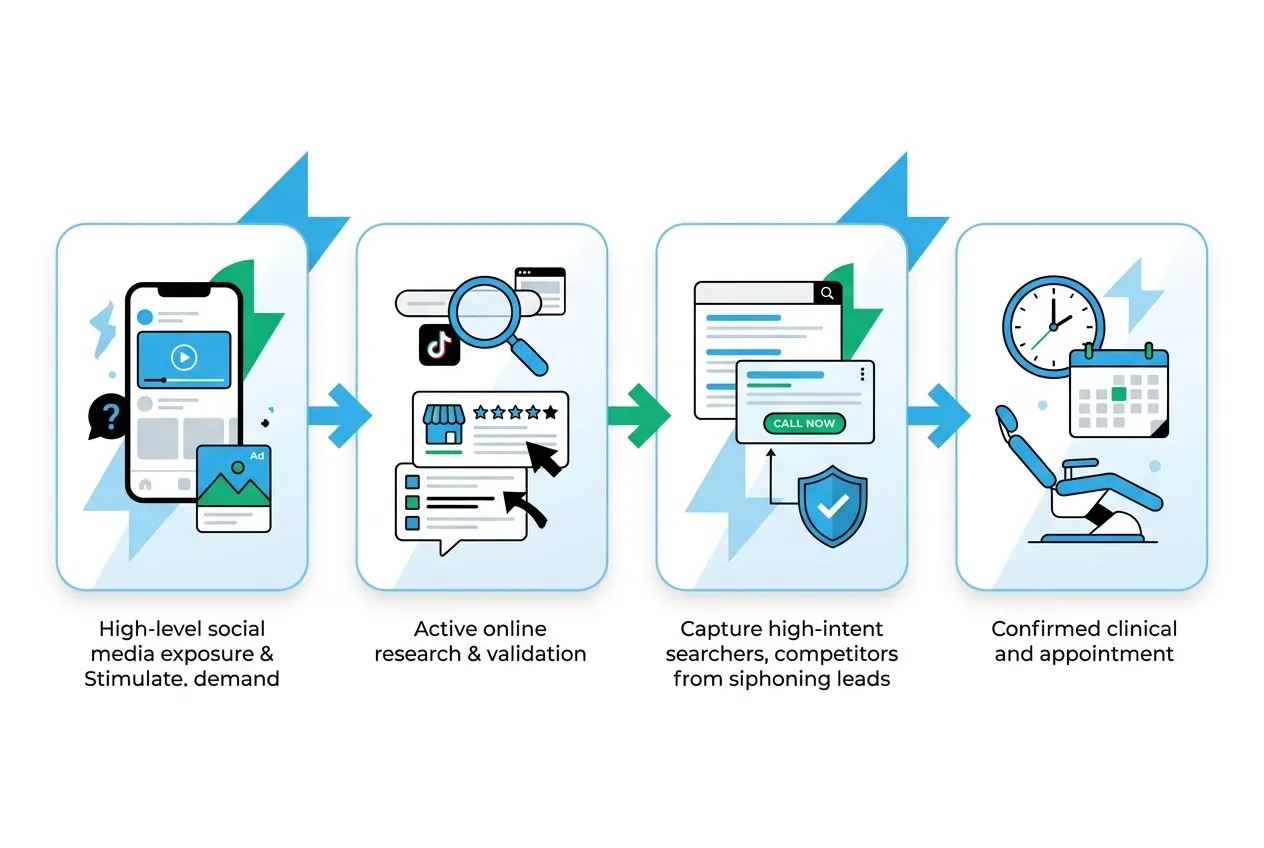
Social acquisition should never operate in a silo. Meta platforms excel at stimulating latent demand by introducing clinical solutions to prospective patients who may not have begun searching actively. However, when a patient encounters an engaging video about full-mouth rehabilitation, their standard behavioral response is to open a browser and research the clinic, read Google Business Profile reviews, and compare regional specialists. If your search presence is neglected, that social campaign simply drives prospective patients into the hands of competing clinics that dominate local search.
Capturing this high-intent interest requires active coordination between social campaigns and dental ppc. Maintaining branded search campaigns prevents competitors from bidding on your practice name and siphoning away patients who discovered you on social media. Simultaneously, running targeted search campaigns for procedure-specific terms captures patients who transition from passive social interest to active clinical evaluation. Understanding how paid search captures qualified patient demand is outlined in our guide to healthcare PPC.
A unified acquisition system synchronizes messaging across both platforms. If your social ads emphasize advanced digital dentistry and same-day dental crowns, your Google search ads and landing pages should reflect identical clinical advantages. When marketing directors coordinate keyword strategy, geographic targeting parameters, and negative keyword lists between paid search and paid social, the overall efficiency of the acquisition budget improves. Practices evaluating external execution can review our analysis of what to look for in a healthcare PPC services partner, as well as standards for vetting a Google ads agency.
Fixing Intake: Transforming Inquiries into Booked Appointments
The single most common point of failure in dental marketing occurs after the ad click takes place. Marketing teams frequently deliver inquiries to practices, only for the administrative staff to allow leads to sit untouched for hours or days. In competitive local markets, speed-to-lead dictates conversion efficiency. Inquiries contacted within five minutes convert at substantially higher rates than those contacted after an hour. If a patient submitting an inquiry about clear aligners waits twenty-four hours for a response, they have often already booked an initial evaluation with a competing local practice.
Fixing intake friction requires deploying automated, multi-channel response workflows. The moment an inquiry enters the system, an automated SMS confirmation should acknowledge the request, establish friendly clinical communication, and provide an instant link for direct self-scheduling. Modern dental software allows pre-qualified prospective patients to review open consultation slots and book directly into designated provider operatory calendars without phone tag.
Front-desk staff must also be trained on specific triage protocols for elective procedure inquiries. When an administrative team handles an implant consultation inquiry like a routine six-month dental hygiene recall, conversion rates suffer. Dedicated intake personnel should understand the emotional drivers of elective care, address high-level financing questions neutrally, and secure commitment through structured appointment confirmations and automated reminder sequences that minimize no-shows.

How Marketing Powered Manages Paid Media for Healthcare and Clinical Practices
Marketing Powered approaches paid acquisition from an operator perspective. Our founder is a former healthcare CMO who ran marketing for a treatment network that expanded from 3 to 24 locations, managing $1.5 to $2M per month in Google Ads across 11+ behavioral and mental health accounts. As a court-certified expert witness in advertising strategy, our leadership understands the legal, regulatory, and financial stakes involved in running clinical paid media campaigns.
We apply these operational principles directly to healthcare and multi-location clinical practices. We do not stop tracking at the point of lead generation; our systems track attribution to admission and completed clinical appointments to measure true production value. Our campaigns are built specifically for sensitive healthcare verticals, remaining fully LegitScript-aware and HIPAA-aware where retargeting is not permitted.
To maintain compliance and protect proprietary data, Marketing Powered utilizes owned, local AI infrastructure for HIPAA-aware inference. This allows us to process data, optimize campaign messaging, and build operational intelligence without exposing sensitive information to third-party commercial clouds. For practices seeking predictable, compliant growth across search and social channels, our team provides full-funnel management through our dedicated paid media management services.
Questions, Answered.
Budgets should be determined by targeted procedure margins and local market density rather than arbitrary monthly amounts. A general practice marketing routine dentistry requires less capital than a surgical practice seeking complex full-arch implant cases. When targeting high-value procedures, practices must account for the local cost per click and allocate enough spend to generate sufficient statistical data for the ad delivery algorithms to optimize properly.
Native Meta Lead Forms typically generate higher inquiry volumes at a lower initial cost per lead because they auto-populate user contact information inside the platform. However, they frequently produce lower-intent inquiries with higher rates of unverified phone numbers. Custom external landing pages introduce beneficial friction, allowing practices to incorporate detailed clinical videos, pre-qualification questionnaires, and direct scheduling tools that yield higher appointment show rates.
Retargeting rules in healthcare are strictly regulated. Ad platforms restrict remarketing lists built around sensitive health conditions or specific medical visits. Furthermore, federal tracking guidance limits the deployment of third-party tracking pixels on patient-facing healthcare web pages without specific authorization. Practices must rely on privacy-safe measurement strategies, first-party CRM data collection, and broad contextual targeting rather than invasive web tracking.
Establishing predictable acquisition economics requires an initial learning and calibration period, typically spanning thirty to sixty days. This timeframe allows the platform algorithm to test audience segments, enables the marketing team to refine creative messaging based on engagement data, and provides the front-desk intake team sufficient time to work consultations through the scheduling pipeline to actual production. Request a paid media audit from Marketing Powered
Ready to see where your marketing can improve?
Request a free audit of your paid media, landing pages, attribution, and measurement setup. You'll get a straight assessment of where the opportunities are.
or email us at info@marketingpowered.ai