Resources
Fractional CMO: When It Makes Sense and What to Expect
Hiring a fractional CMO offers mid-market companies, healthcare organizations, and professional service firms an operational alternative to an expensive full-time executive search. When commercial growth stalls or marketing spend outpaces revenue visibility, bringing in seasoned executive leadership on a part-time basis can bring discipline to your budget and strategy. Success with this model requires understanding where strategic oversight ends and where tactical execution and intake systems must take over.
By Mike Hulick, Founder, Marketing Powered

When Hiring a Part-Time CMO Makes Commercial Sense

What a Fractional CMO Actually Is (and What It Isn't)
A fractional CMO is an experienced marketing executive who integrates into your leadership team on a retained, part-time basis. Rather than managing daily task checklists, this executive establishes commercial strategy, aligns capital allocation with revenue targets, manages agency partners, and institutes strict performance metrics across the entire customer acquisition lifecycle.
Many organizations misunderstand the scope of the role. A fractional CMO is not a general freelance marketer, a campaign manager, or an in-house copywriter working limited hours. If a company expects an executive working ten to twenty hours a week to personally configure ad sets, write landing page copy, configure email workflows, and audit analytics tags, the engagement will stall. Tactical tasks consume operational bandwidth, preventing the executive from addressing structural problems such as unit economics, market positioning, and revenue attribution.
In practice, a qualified fractional marketing leader steps into the executive room alongside the CEO, COO, and finance leadership. They review customer acquisition cost (CAC), lifetime value (LTV), margin contributions by channel, and the conversion efficiency of the operational pipeline. For multi-location healthcare providers, hospital networks, and regulated services, this involves evaluating how demand translates into booked appointments or clinical admissions rather than stopping at superficial top-of-funnel lead tallies.
Understanding fractional cmo roles requires recognizing this division between leadership and production. The executive designs the blueprint, sets the commercial standards, and holds internal staff and outside vendors accountable to clear economic benchmarks. Without dedicated tactical execution beneath them, even an exceptional commercial strategy remains theoretical.
Organizations rarely need an expensive corporate marketing executive during early operational stages. However, as organizations expand into multi-location operations or scale their marketing investments past five figures per month, ad-hoc leadership by a founder, CEO, or operations director hits clear limits. Bringing in a part time cmo resolves specific structural inflection points:
- Spend scaling without clear unit economics. When an organization spends $30,000 to $150,000 monthly across search, social, and offline channels without visibility into which campaigns generate gross margin, executive intervention is necessary.
- The multi-location demand puzzle. Expanding a clinic network or regional service firm from three locations to ten or twenty introduces regional variance, cannibalization risks, and local market positioning problems that local facility managers cannot solve on their own.
- The agency management vacuum. When three separate niche agencies manage search engine marketing, organic search, and creative production with zero internal coordination, performance degrades. A fractional executive unifies agency scorecards, removes redundant retainers, and demands clean data governance.
- Interim executive bridge. Recruiting an enterprise-grade, full-time marketing officer often requires six to nine months of executive search time. A fractional arrangement stabilizes operations, audits historical assets, and defines the exact profile needed for the permanent hire.
In these environments, fractional marketing leadership delivers immediate leverage. Instead of committing to long-term executive overhead, the organization acquires senior perspective to audit marketing investments, eliminate unprofitable spend, and align acquisition efforts with verified operational capacity.
The Execution Gap: Why Outsourced CMO Engagements Fail
The primary failure point in fractional executive arrangements is the execution gap. When an organization brings in an outsourced cmo without securing the tactical machinery required to implement their plans, progress stops.
Executive leaders identify systemic issues quickly: underperforming landing pages, unsegmented customer databases, poor lead response times, and broken tracking tags. But identifying a bottleneck is different from engineering its solution. If the company lacks internal designers, media buyers, CRM specialists, and front-end developers, the fractional executive is forced to choose between two failing paths:
- Path A: The Strategy Dossier. The executive writes exhaustive strategy decks, channel forecasts, and conversion roadmaps that sit untouched inside project folders because nobody on staff has the technical capability to implement them.
- Path B: The Tactical Trap. The executive attempts to build the assets themselves. A high-value strategist spends fifteen retained hours drafting social posts or troubleshooting form tracking scripts, turning an expensive leadership resource into an inefficient production contractor.
To avoid these failures, business owners must evaluate their marketing apparatus as an integrated ecosystem. High-level planning must connect directly to conversion infrastructure. As detailed in our guide to conversion rate optimization for lead generation: a system, not a list of tests, strategic media investment produces negative returns if landing pages fail to communicate relevance or if intake staff cannot process inbound volume within minutes.
Before retaining a fractional executive, evaluate whether your internal team or existing agency roster has the capacity to ship new landing pages, manage bid strategies, adjust customer intake workflows, and execute technical changes on schedule.
Free Audit
Want a straight read on where your budget is leaking?
Fractional CMO Cost Structures and Compensation Models
Evaluating the economics of an outsourced executive requires comparing fractional compensation against the full burden of an in-house C-level hire.
According to executive wage data from the U.S. Bureau of Labor Statistics Occupational Employment and Wage Statistics, median annual wages for top marketing managers and chief executives in commercial enterprises consistently run into significant six-figure baselines. When factoring in performance bonuses, equity packages, health coverage, employment taxes, and initial search firm retainers, onboarding a permanent chief marketing officer regularly demands an annual financial commitment exceeding $350,000 to $450,000.
For mid-market enterprises generating between $5 million and $50 million in annual gross revenue, that fixed overhead is often disproportionate to actual operational requirements.
- Full-Time CMO; Typical Monthly Investment: $28,000 – $40,000+ (fully loaded); Execution Capability Included?: Strategic oversight only; requires internal team; Ideal Operational Stage: Mature enterprises ($40M+) with large established teams
- Fractional CMO. Typical Monthly Investment: $5,000 – $15,000 (retainer). Execution Capability Included?: Strategic oversight and governance only. Ideal Operational Stage: Scaling firms ($5M–$40M) with existing execution capacity.
- Tactical Agency; Typical Monthly Investment: $4,000 – $12,000 + media fees; Execution Capability Included?: Production and execution only; lacks board-level strategy; Ideal Operational Stage: Early-to-mid stage firms needing raw production bandwidth
- Integrated Growth Partner. Typical Monthly Investment: Scope-dependent monthly model. Execution Capability Included?: Executive strategy combined with conversion engineering. Ideal Operational Stage: Scaling organizations needing unified leadership and delivery.
Fractional engagements operate primarily on monthly retained advisory structures, typically ranging between $5,000 and $15,000 per month depending on time allocation, operational intensity, and organizational size. Some practitioners charge day rates or project fees for distinct operational transformations, such as auditing an acquisition tech stack or restructuring internal marketing departments.
Evaluating this cost requires looking directly at capital efficiency. If a fractional executive working across a $100,000 monthly media budget identifies tracking errors, terminates unproductive vendor contracts, and improves conversion yield by twenty percent, the engagement pays for itself out of reclaimed margin.
However, paying a retained executive fee without allocating separate budget for creative testing, development, and conversion technology creates an imbalanced marketing ledger.

How Fractional Marketing Integrates with Intake and Conversion Systems
Marketing strategy in regulated, high-consideration sectors cannot stop at the form fill or phone click. For hospitals, outpatient clinics, behavioral health networks, legal practices, and specialized business services, lead generation numbers mean nothing if intake operations fail to convert prospects into revenue events.
When fractional marketing leadership reviews customer acquisition channels, they must audit the friction points between ad engagement and closed operational files:
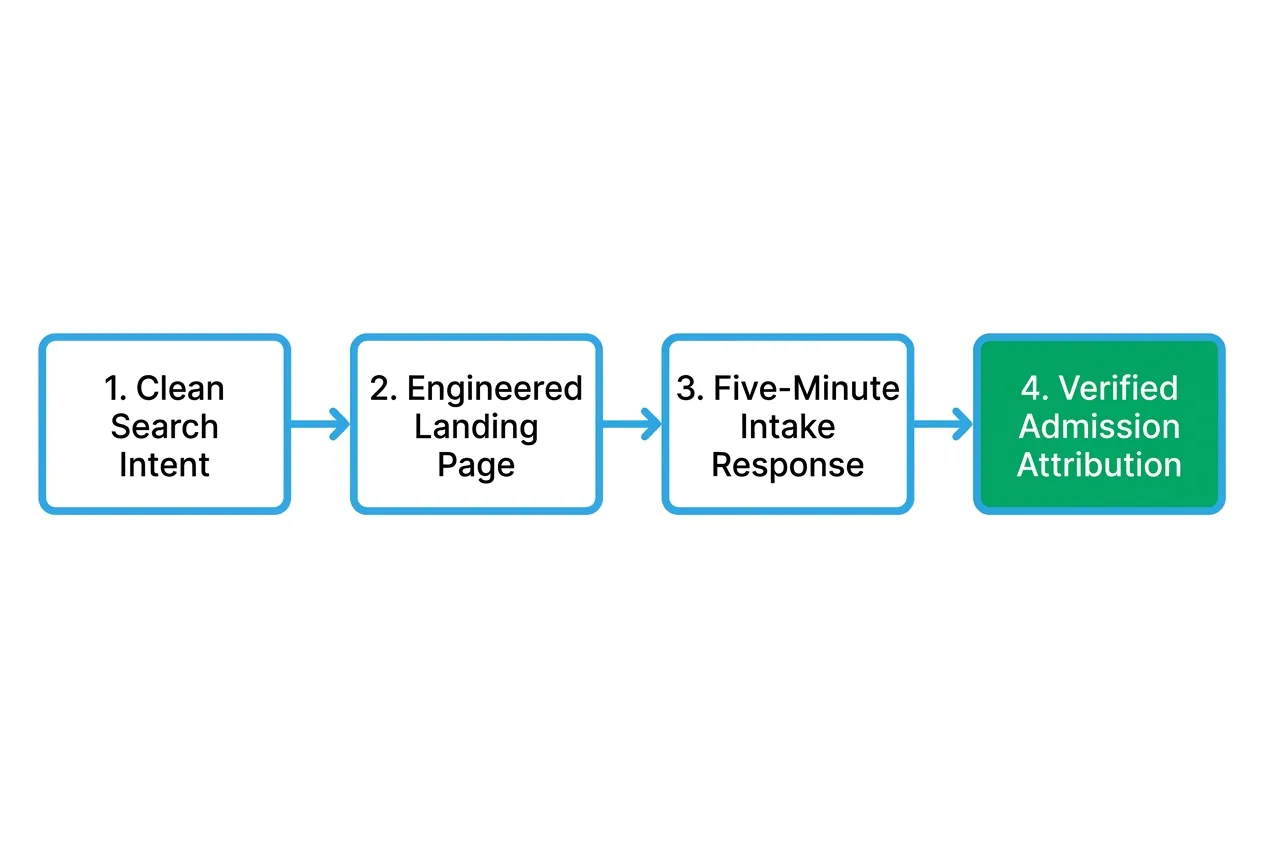
- Privacy-Safe Channel Constraints: Operating in healthcare environments requires strict alignment with platform privacy standards. For instance, Google Ads Personalized Advertising Policies explicitly prohibit retargeting users based on sensitive health interests, mental health inquiries, or medical conditions. A fractional executive operating in these sectors must build acquisition models around clean search intent, local authority, and direct conversion rather than relying on automated remarketing crutches.
- Landing Page Architecture: Standard corporate websites convert general traffic at low percentages because they present too many competing navigation choices. When vetting execution resources, reviewing the guidance in our breakdown of a landing page optimization agency: what a specialist partner delivers and how to vet one helps leadership understand the difference between simple graphic redesigns and structured, conversion-engineered layouts.
- Operational Intake Automation: A qualified lead left untouched for two hours has a dramatically lower likelihood of conversion than one contacted within five minutes. Fractional leadership must review call center response speeds, automated SMS routing, CRM pipeline stages, and staff scheduling patterns.
- Attribution to Commercial Outcome: A vanity cost-per-lead metric can easily mask escalating acquisition costs. True attribution maps media spend directly to admitted patients, signed retainers, or closed commercial contracts.
When fractional leaders connect paid acquisition directly to downstream intake systems, the entire marketing apparatus shifts from an unaccountable cost center to a predictable revenue system.
How Marketing Powered Delivers Intake, Conversion, and Fractional Leadership
Marketing Powered resolves the traditional divide between executive marketing strategy and tactical implementation. Led by a former healthcare CMO who ran marketing for a treatment network that grew from 3 to 24 locations, our team approaches commercial growth with operator discipline rather than consultant abstractions.
Our founder managed $1.5 to $2M per month in Google Ads across 11+ behavioral and mental health accounts and serves as a court-certified expert witness in advertising strategy. We combine this real-world operational perspective with an AI-native infrastructure developed since 2022, purpose-built to deliver both strategic direction and technical execution.
Rather than leaving executive recommendations stranded in slide presentations, we actively engineer the downstream conversion and data infrastructure required to make marketing spend profitable:
- Attribution Tracked to Admission: We reject vanity metrics. We construct tracking architectures that follow prospective customers from the initial search click through phone intake, CRM qualification, and final clinical admission or signed agreement.
- Regulated Sector Compliance: We are fully LegitScript-aware and HIPAA-aware. Our acquisition architectures operate cleanly within Google's sensitive healthcare vertical constraints, where retargeting is prohibited and patient data confidentiality is non-negotiable.
- Owned, Sovereign AI Computing: We deploy owned, local AI infrastructure for HIPAA-aware inference, enabling rapid data analysis, intake workflow automation, and custom model applications without exposing sensitive operational records to public third-party endpoints.
- Conversion System Implementation: We do not simply tell your team to improve conversion rates; we engineer, test, and deploy high-converting landing environments, call tracking flows, and intake automation systems directly.
To understand how our technical delivery complements strategic marketing direction, explore what an experienced conversion rate optimization agency: what a specialist partner delivers and how to vet one provides, or review our comprehensive conversion optimization and intake automation services. We ensure that every strategic dollar deployed into the market is backed by an operational engine built to capture and convert qualified demand.
Questions, Answered.
A fractional CMO sets high-level marketing strategy, allocates media budgets across channels, audits unit economics (such as CAC and LTV), manages internal marketing teams and external agencies, and institutes rigorous reporting dashboards. They focus on commercial strategy, positioning, and conversion systems rather than daily copywriting or graphic production.
A marketing agency typically delivers execution services within specific tactics, such as managing search campaigns, writing blog posts, or designing collateral. A fractional CMO acts as an internal executive who oversees those agencies, establishes business priorities, eliminates vendor waste, and ensures that marketing tactics align with broader revenue targets.
Most experienced fractional CMOs operate on monthly retained agreements ranging from $5,000 to $15,000 per month, depending on company size, operational scope, and time commitment. This provides mid-market organizations with enterprise-level strategic leadership at a fraction of the $350,000+ total cost required to recruit and retain a full-time C-level executive.
Generally, no. Fractional executives provide strategy, governance, and architecture. Expecting a fractional CMO to write ad copy, manage bid adjustments, and develop web pages in limited retained hours leads to poor execution and misallocated budget. Organizations must pair fractional strategic leadership with internal specialists or a dedicated execution partner.
Your business is typically ready for a fractional CMO when annual revenues reach between $5 million and $50 million, monthly marketing spend exceeds $20,000, and executive leadership lacks clear visibility into which marketing channels produce profitable downstream revenue. If your internal team struggles to coordinate vendors or convert inbound demand into qualified sales, fractional leadership can re-establish operational clarity. Schedule a strategy call with Marketing Powered
Ready to see where your marketing can improve?
Request a free audit of your paid media, landing pages, attribution, and measurement setup. You'll get a straight assessment of where the opportunities are.
or email us at info@marketingpowered.ai