Capabilities
Landing Page Optimization Agency: How to Vet a Partner
Hiring a landing page optimization agency is the most reliable lever to protect paid acquisition margins when customer acquisition costs rise across digital channels. A true conversion partner re-engineers intake infrastructure and aligns upstream ad intent with downstream operational capacity rather than merely tweaking surface aesthetics. This guide details what an elite specialist delivers, provides an operational evaluation framework, and outlines verifiable criteria to select the right growth team.

What a Specialist Landing Page Optimization Agency Delivers
A dedicated landing page optimization agency approaches conversion as a discipline of intake engineering rather than decorative graphic design. Generalist creative agencies frequently build visually attractive pages that collapse under performance marketing demands because they treat the landing environment in isolation from the media source and the intake operation.
When media buyers scale budgets on paid search or paid social, traffic arrives with precise expectations established by specific ad copy, search keywords, and audience triggers. A specialized partner establishes strict message match, ensuring that the primary value proposition, vocabulary, and operational assurances directly reflect the source creative.
In high-consideration and regulated industries, the functional demands on a page are particularly exacting. For example, in sensitive categories like addiction treatment, mental health, and medical care, Google Ads policy on personalized advertising explicitly prohibits remarketing and audience targeting.
When an organization cannot remarket to visitors who leave without converting, the initial session represents the sole opportunity to capture demand. In this operational setting, a conversion partner must build first-touch capture systems that diagnose hesitation, answer clinical or economic criteria immediately, and present frictionless contact paths.
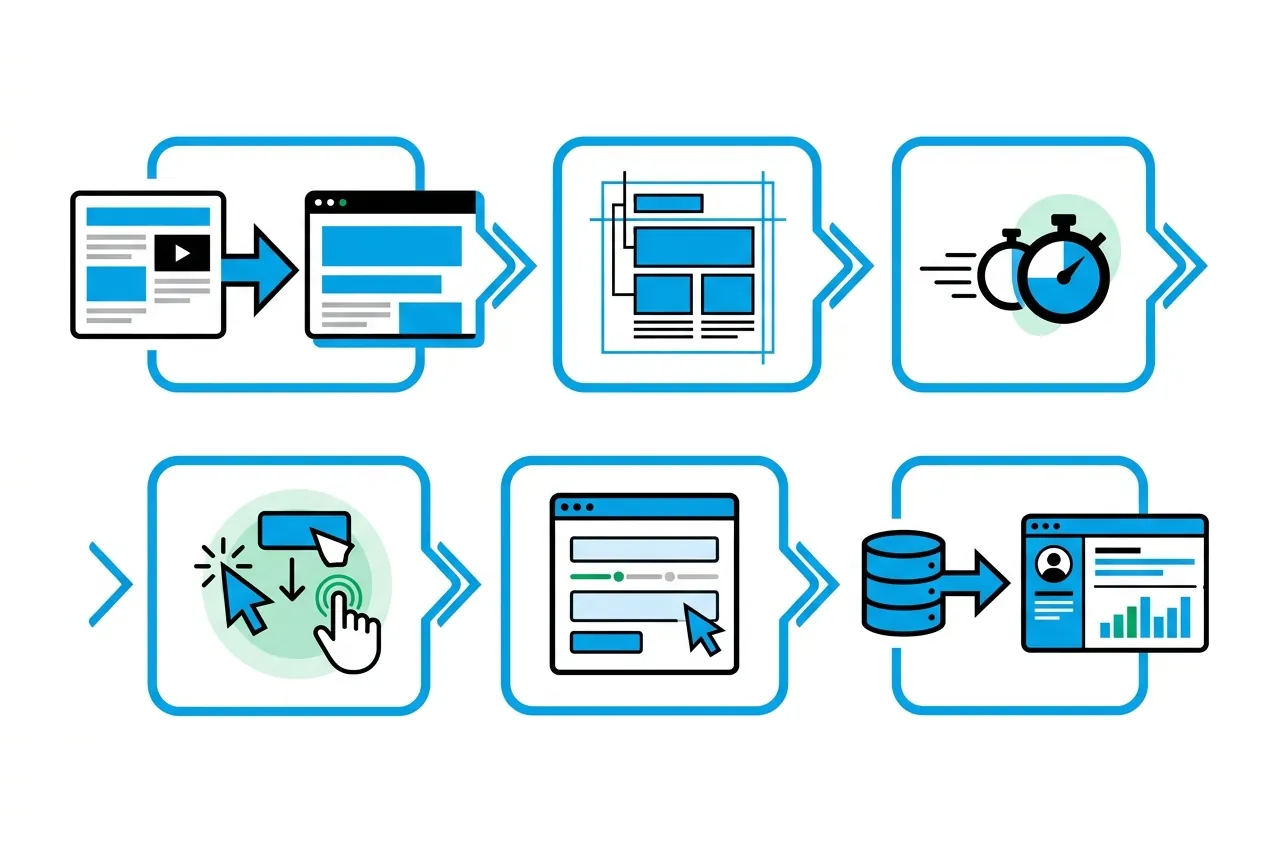
The scope of work delivered by a specialist partner extends across four technical layers:
- Information architecture and copy calibration: Restructuring page hierarchies so that prospective buyers find critical qualification criteria, pricing or insurance parameters, and operational credibility markers within seconds of arrival.
- Technical performance engineering: Stripping unnecessary Document Object Model (DOM) bloat, eliminating render-blocking client-side scripts, and ensuring lightning-fast load times across mobile devices and cellular networks.
- Data capture instrumentation: Configuring event listeners that record field-level form abandonment, user progression, and telephone interactions without sending unmasked data to third-party ad networks.
- Intake and routing automation: Connecting form submissions, chat dialogues, and phone calls directly to internal CRM systems and intake queues, reducing operational lag.
Technical Architecture and Landing Page Optimization Tools
Modern conversion operations require an integrated infrastructure stack. Professional practitioners do not rely on standard drag-and-drop page builders that inject bloated stylesheets and unvetted tracking scripts. Instead, they deploy modular, lightweight codebases managed through secure container environments.
The deployment of landing page optimization tools falls into three distinct categories:
Experimentation and Testing Engines
Statistical testing platforms such as Optimizely, VWO, or custom server-side experimentation frameworks allow teams to run controlled A/B and multivariate splits. Enterprise-grade agencies favor server-side testing over client-side JavaScript injection. Client-side tools alter the page after it loads in the user's browser, which causes visual flickering, degrades Core Web Vitals, and distorts user behavior. Server-side testing delivers pre-rendered variations directly from the edge server, ensuring zero layout shift and accurate performance telemetry.
Behavioral Diagnostics and Interaction Tracking
Tools like heatmaps, scroll-depth monitors, and session replay utilities identify where visitors stall or disengage. However, in regulated environments, standard diagnostic software presents severe legal exposure. According to the HHS guidance on online tracking technologies, deploying third-party tracking scripts that capture identifiable patient data or health condition inquiries across unauthenticated web pages violates federal privacy rules.
A qualified agency uses privacy-compliant diagnostic setups or owned, server-side data collection pipelines that anonymize interaction telemetry before storage.
Intake Acceleration and Dynamic Call Tracking
For complex services, telephone calls often represent the highest-intent conversion channel. Specialist agencies implement dynamic number insertion (DNI) to tie incoming telephone inquiries back to the specific campaign, keyword, and landing page variant that generated the call. These systems bridge digital engagement with human sales or admissions teams, ensuring intake departments receive rich context before answering the line.
Behavioral Frameworks and Landing Page Optimization by Tim Ash
The foundational principles of conversion architecture were established in the seminal work Landing Page Optimization: The Definitive Guide to Testing and Tuning for Conversions by Tim Ash. Published by Wiley, the text outlined the scientific methodology required to diagnose user hesitation and engineer landing environments for maximum decision velocity.
Applying landing page optimization by Tim Ash requires moving away from aesthetic opinions and implementing structured behavioral matrices:
- Eliminating visual and cognitive friction: Visitors arrive with finite attention. Ash's framework emphasizes removing extraneous links, visual clutter, conflicting calls to action, and unnecessary navigation menus that distract users from the primary conversion path.
- Diagnosing landing page pathologies: Identifying systemic design failures, such as asking for sensitive commitments too early in the interaction, presenting ambiguous value propositions, or failing to provide immediate evidence of credibility.
- Structuring test matrices over isolated guesses: Rather than testing random elements like button colors or stock photography, Ash established testing frameworks that alter the entire value proposition, risk reversal mechanism, or page narrative structure.
When evaluating an agency, ask how their experimentation roadmap incorporates these classical principles. Teams that focus solely on minor micro-copy adjustments rarely generate the step-function conversion improvements required to fundamentally improve marketing economics.
Free Audit
Want a straight read on where your budget is leaking?
Practical Landing Page Optimization Examples in Regulated Sectors
Examining concrete landing page optimization examples reveals how architectural choices alter commercial outcomes in high-consideration environments.
Example 1: Multi-Location Healthcare and Treatment Intake
In healthcare and behavioral health environments, prospective patients or family members often navigate pages during moments of acute stress.
High-performing conversion architecture incorporates:
- A streamlined single-column layout that avoids multi-tiered sidebars.
- Prominent, verifiable regulatory certifications, such as LegitScript verification badges required under Google Ads healthcare advertising policies.
- Prominently displayed telephone numbers featuring instant tap-to-call mechanics on mobile devices.
- Clear confidentiality notices positioned adjacent to intake forms, assuring users that their inquiries remain private and secure.
- Interactive insurance verification tools that resolve financial hesitation without requiring the user to navigate away from the primary conversion path.
Example 2: High-Value B2B and Enterprise Professional Services
For enterprise technology, corporate advisory, or specialized legal firms, landing environments must establish deep institutional authority while accommodating prolonged buying cycles.
Effective structural elements include:
- Concrete above-the-fold problem statements that reflect the exact commercial pain described in the ad creative.
- Progressive multi-step qualification forms that begin with low-friction diagnostic questions before requesting executive contact information.
- Quantified proof points and structured methodology summaries rather than generic client praise.
- Explicit service level assurances clarifying the exact timeline and operational process that follows form submission.

How to Optimize Landing Page Performance for Operational Intake
Understanding how to optimize landing page performance requires looking beyond the moment of form submission. A landing page that generates a high volume of low-intent inquiries often overwhelms internal sales or intake departments, lowering contact rates and degrading unit economics.
To engineer landing pages for operational efficiency, specialist partners follow a strict implementation process:
- Implement progressive qualification: Add conditional logic to forms to screen for buyer qualification, geographic service availability, or budget fit before an inquiry enters the CRM.
- Optimize for mobile response speed: Ensure tap targets, input fields, and mobile layouts permit rapid data entry without zooming or horizontal scrolling.
- Calibrate thank-you pages for secondary conversion: Transform standard confirmation pages into active onboarding assets that prompt visitors to complete pre-intake assessments, schedule a calendar appointment, or download preparatory briefing documents.
- Enforce first-party data sovereignty: Route form data through secure, server-side webhooks rather than unmonitored browser tags, protecting sensitive customer information from unauthorized third-party tracking.
A Technical Landing Page Optimization Checklist for Vendor Selection
Before hiring a conversion agency, growth leaders should evaluate prospective partners against a rigorous technical standard. Use this landing page optimization checklist during agency discovery calls:
- Attribution and telemetry capability: Can the agency track conversion events through to qualified pipeline, patient admission, or closed revenue, rather than relying exclusively on front-end form submissions?
- Compliance and tracking governance: Does the agency understand the nuances of state and federal privacy mandates, including the HHS guidance on online tracking technologies? Can they articulate how their tracking architecture avoids data leakage?
- Testing methodology: Does the partner design experiments based on behavioral hypotheses and statistical significance calculations, or do they execute random changes without control groups?
- First-touch capture expertise: How does the team engineer conversion pathways in environments where remarketing is prohibited, such as sensitive healthcare or regulated financial verticals under Google Ads advertising policies?
- Intake integration: Does the agency possess the technical expertise to connect landing assets directly into your operational CRM, Electronic Health Record (EHR), or telephony platform?

Email Us
Prefer to send the context directly?
Conversion Infrastructure and Intake Automation at Marketing Powered
Marketing Powered approaches conversion optimization as an integrated engineering discipline. The firm is led by a former healthcare CMO who ran marketing operations for a multi-location treatment network that expanded from 3 to 24 facilities. Having managed $1.5 to $2M per month in Google Ads across 11+ behavioral and mental health accounts, our operational practice was built under the strictest performance constraints.
In high-stakes acquisition environments where retargeting is not permitted by platform rules, conversion infrastructure must perform on the first touch. Marketing Powered tracks attribution down to verified admission or sale, ensuring that optimization decisions support bottom-line enterprise value rather than unverified vanity metrics.
As a court-certified expert witness in advertising strategy, our leadership brings verifiable standards to marketing governance. AI-native since 2022, Marketing Powered utilizes owned, local AI infrastructure for HIPAA-aware inference, enabling rapid content iteration, operational testing, and deep data analysis without transmitting sensitive client records to public cloud models.
Our core service focuses on conversion optimization, landing pages, and CRM and intake automation. By uniting ad scent, server-side data capture, and automated intake workflows, we build dependable conversion engines for hospitals, healthcare networks, and regulated commercial enterprises.
To explore how conversion architecture fits into broader operational growth, review our analysis on conversion rate optimization for lead generation: a system, not a list of tests. If your organization is evaluating leadership models, explore what a fractional cmo agency delivers, or evaluate our detailed guide to selecting a conversion rate optimization agency.
Questions, Answered.
A traditional web design firm focuses primarily on visual aesthetics, brand styling, and layout balance. A landing page optimization agency operates as a quantitative performance partner. Specialists engineer user paths based on cognitive psychology, ad creative alignment, technical performance, and measurable conversion velocity, tracking success by qualified pipeline and bottom-line revenue rather than artistic subjective preference.
Initial performance improvements often appear within two to four weeks following the deployment of aligned message matching, technical speed enhancements, and mobile intake streamlining. Achieving statistical significance in multivariate or A/B testing cycles depends on traffic volume, typically requiring 30 to 60 days of consistent paid acquisition to establish definitive performance baselines.
In regulated sectors, advertising platforms like Google restrict the use of personalized advertising, remarketing lists, and lookalike targeting under sensitive vertical rules. Because advertisers cannot deploy follow-up retargeting ads to re-engage departed visitors, landing pages must resolve user hesitation, address clinical or economic qualification, and secure engagement on the very first touch.
Federal regulatory guidance, including HHS bulletins on tracking technologies, restricts the use of standard third-party pixels and analytics scripts that transmit unmasked IP addresses or page engagement data to advertising networks. A qualified conversion partner implements compliant data layers and server-side tracking pipelines that protect customer privacy while maintaining accurate acquisition attribution. Schedule a strategy call with Marketing Powered
Ready to see where your marketing can improve?
Request a free audit of your paid media, landing pages, attribution, and measurement setup. You'll get a straight assessment of where the opportunities are.
or email us at info@marketingpowered.ai