Capabilities
Hospital Marketing Company: What a Specialist Partner Delivers and How to Vet One
Selecting the right hospital marketing company requires balancing clinical service-line growth with strict regulatory boundaries and complex intake operations. Generalist marketing programs often fail because health systems cannot afford untracked media spend or regulatory exposure. A dedicated healthcare partner aligns localized patient demand with verified clinical capacity while safeguarding institutional data sovereignty.

What a Specialist Hospital Marketing Company Delivers
Hospital acquisition differs fundamentally from standard commercial advertising. In a typical consumer business, marketing teams optimize for digital carts or simple lead forms. In a regional medical center or multi-facility health system, marketing must coordinate across fragmented clinical service lines, distinct geographic facility footprints, medical staff credentialing, and multi-tiered intake channels.
A dedicated healthcare partner understands that driving raw call volume into an unprepared central intake office creates operational friction rather than patient care. For service lines like orthopedics, cardiology, bariatrics, or behavioral health, patient acquisition involves distinct clinical pathways. Some patients require rapid access to outpatient consultations, while others require acute inpatient evaluations. A specialist team designs acquisition workflows that reflect these clinical realties.
Specialized partners manage four interrelated functions across the patient journey:
- Intent-Driven Demand Capture: Capturing active patient search queries within specific geographic catchments for specialized procedures and urgent consultations.
- Local Infrastructure and Campus Visibility: Managing physician profiles, department-level directory listings, and campus-specific location assets to capture local search demand.
- Frictionless Intake Routing: Aligning digital campaigns with call-center routing, interactive scheduling tools, and central intake workflows so inquiries turn into scheduled appointments.
- Data Governance and Protocol Alignment: Establishing clear boundary rules between advertising platforms, website analytics, and clinical operations to prevent compliance risks.
At the hospital campus level, marketing directors and clinical department chairs frequently review intake metrics together in administrative conference rooms. They do not need vanity metrics such as reach or impressions. They need to see whether digital campaigns generated booked consultations in local clinics, how intake friction affected conversion rates, and whether specific physician schedules have open capacity. Specialist partners structure their deliverables around these operational touchpoints.

Overcoming the Measurement Gap in Hospital Marketing Services
The primary failure point in traditional hospital marketing services is the reliance on surface-level proxy metrics. Cost per click and cost per lead reveal nothing about clinical utilization. A low cost per lead frequently signals low-intent inquiries that overwhelm intake coordinators, waste administrative labor, and fail to generate completed patient visits.
Connecting advertising spend to validated patient encounters requires overcoming the healthcare measurement gap. Health systems operate under strict privacy constraints that make standard commercial tracking mechanisms dangerous. Patient privacy rules govern how patient status, appointment booking, and diagnostic interest can be communicated. Standard client-side conversion pixels cannot be embedded across scheduling pages without creating compliance exposure.
Solving this challenge requires a disciplined, server-side data architecture. A specialist partner builds measurement frameworks that track initial acquisition signals without sending unauthorized protected health information to advertising networks.
By utilizing anonymized transaction identifiers, server-side data endpoints, and closed-loop data matching conducted inside secure healthcare infrastructure, health systems can reconcile media spend against appointment status. Attribution must connect past the initial lead to verified consultations, scheduled procedures, and admissions where data authorization exists. This level of measurement accountability allows healthcare leadership to allocate media capital based on actual service-line contribution margin.
For a broader perspective on institutional acquisition architecture, read Healthcare marketing: the operating guide for health systems and provider groups.
Compliance and Privacy: Navigating HIPAA and Advertising Restrictions
Data privacy is not an afterthought in healthcare advertising; it dictates the technical architecture of every campaign. In recent years, regulatory enforcement has intensified regarding how digital marketing technologies handle patient data on healthcare websites.
The Department of Health and Human Services issued explicit standards under the HHS OCR Guidance on Tracking Technologies, warning covered entities about the deployment of third-party tracking pixels. The guidance clarifies that transmitting an individual's IP address, device identifier, or browsing behavior alongside health-related search terms or appointment-scheduling activities to commercial third parties can constitute an unauthorized disclosure of protected health information. Hospital marketing leadership must audit every script, tag, and tracking tool operating across their digital properties to prevent privacy breaches.
Simultaneously, major advertising networks enforce strict limitations on sensitive categories. Under the Google Advertising Policies on Personalized Advertising, advertisers are prohibited from using retargeting lists or personalized audience targeting based on sensitive health conditions, medical treatments, or personal hardships.
These platform constraints eliminate standard remarketing playbooks. An agency cannot simply capture a visitor who browsed an oncology or cardiac care page and serve them follow-up display ads across the web. Instead, the marketing system must succeed on the initial touchpoint.
Winning on first-touch acquisition requires granular search keyword structures, highly relevant localized landing environments, rapid mobile page performance, and clear, privacy-safe calls to action. A competent partner designs marketing systems specifically for environments where retargeting is not permitted.
Free Audit
Want a straight read on where your budget is leaking?
How to Evaluate and Vet a Hospital Marketing Agency
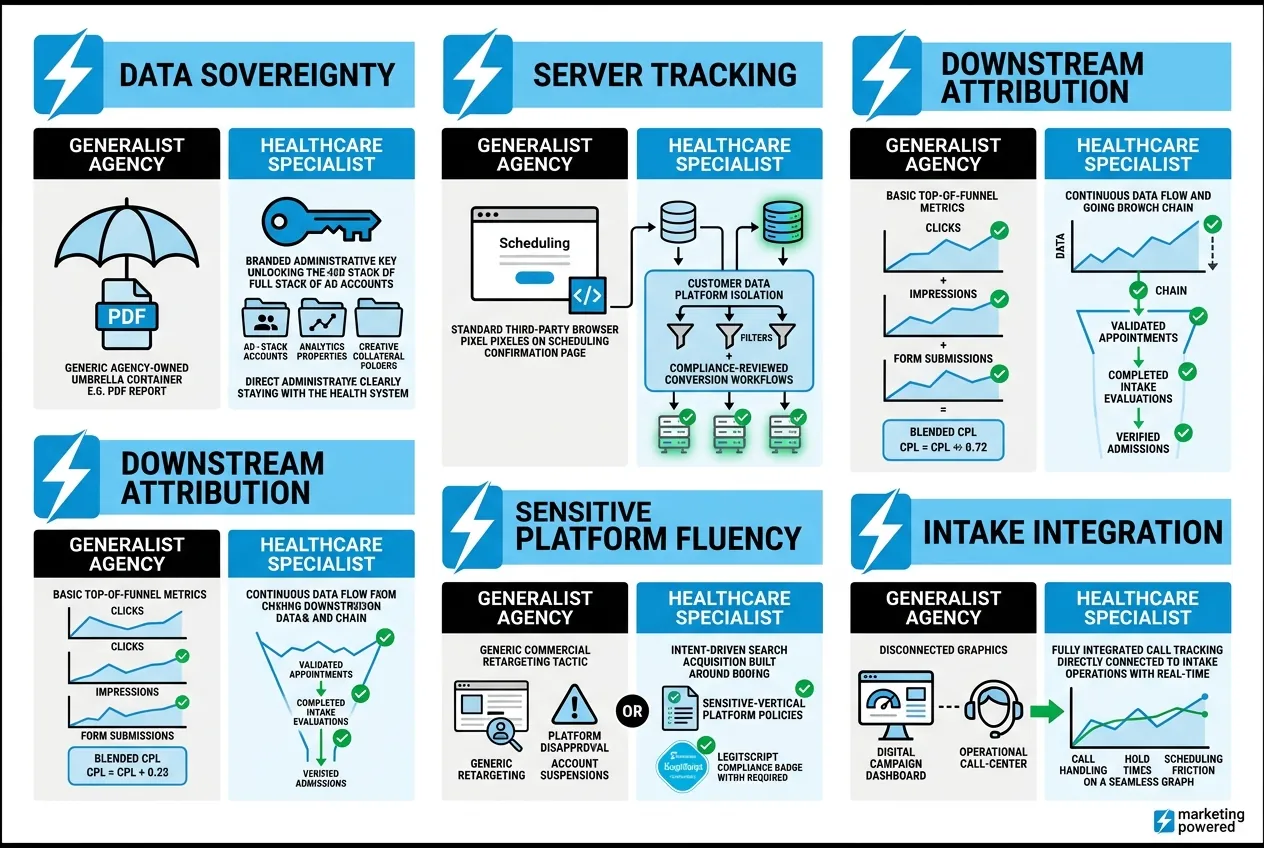
Selecting a partner requires rigorous procurement standards. Hospital CMOs, procurement committees, and compliance officers can evaluate any prospective hospital marketing agency using five objective criteria:
- Data Sovereignty & Account Ownership; What Generalist Agencies Provide: Accounts housed in agency-owned umbrellas; health systems receive aggregated PDF reports.; What a Healthcare Specialist Delivers: Direct administrative ownership of all ad accounts, analytics properties, and creative collateral remains with the health system.
- Tracking Architecture. What Generalist Agencies Provide: Standard third-party browser pixels placed on scheduling confirmation pages. What a Healthcare Specialist Delivers: Server-side tracking pipelines, customer data platform isolation, and compliance-reviewed conversion workflows.
- Measurement & Attribution. What Generalist Agencies Provide: Top-of-funnel metrics: clicks, impressions, form submissions, and blended cost-per-lead. What a Healthcare Specialist Delivers: Downstream tracking to validated patient appointments, completed intake evaluations, and verified admissions.
- Sensitive Platform Fluency. What Generalist Agencies Provide: Standard commercial retargeting tactics that risk platform disapproval or account suspensions. What a Healthcare Specialist Delivers: Intent-driven search acquisition built around sensitive-vertical platform policies and LegitScript compliance where required.
- Intake Integration. What Generalist Agencies Provide: Disconnect between digital campaigns and operational call-center capacity. What a Healthcare Specialist Delivers: Call tracking integrated with intake operations to monitor call handling, hold times, and scheduling friction.
During partner vetting, executive teams should assemble marketing directors, compliance counsel, and intake supervisors in an evaluation session. Bring candidate agencies into this operational forum to review real workflow diagrams. Ask their technical leads to whiteboard how their tracking infrastructure avoids client-side data leaks, how their campaigns adjust when a regional clinic reaches full scheduling capacity, and who holds master encryption keys for campaign data.
To compare specialized partner scopes with smaller medical group models, examine Medical practice marketing services: what a specialist partner delivers and how to vet one.
What Distinguishes the Best Hospital Marketing Company from Generalist Firms
Generalist marketing agencies often depend on broad brand awareness campaigns, creative awards, and high-level reach metrics. While brand awareness plays a role in community trust, health systems require measurable patient volume across core clinical service lines. The best hospital marketing company approaches growth through operational capacity modeling rather than creative speculation.
Capacity-Driven Media Allocation
A generalist firm spends media budget evenly across calendar months. A specialist firm aligns media pacing with clinical capacity. If an orthopedic clinic has an eight-week waitlist for joint replacements, continuing to direct high-intent search traffic to that location wastes capital and frustrates patients. A specialized partner coordinates with operational leaders to redirect budget toward service lines with available surgical slots or new provider capacity.
Comparing a Generalist Team to the Best Hospital Marketing Agency
Generalist agencies rely heavily on out-of-the-box software stacks and cookie-cutter ad copy that treats patient care like consumer retail. The best hospital marketing agency recognizes that patients seeking clinical care are often anxious, vulnerable, and looking for immediate clinical credibility.
Specialist agencies write messaging that respects clinical dignity, complies with state medical board advertising standards, and adheres to strict medical review protocols. Every piece of copy is vetted for clinical accuracy, avoiding unsubstantiated procedural claims while providing clear guidance on provider credentials, insurance acceptance, and facility capabilities.
If your leadership team is deciding between broad agency support and focused healthcare teams, read Healthcare marketing agency: what to expect and how to choose one.

How Marketing Powered Delivers Healthcare Marketing Programs
Marketing Powered provides specialized healthcare and hospital marketing programs encompassing growth strategy, paid media management, search engine optimization, and attribution systems for health systems and multi-location provider groups. Our operating model reflects deep, practical healthcare leadership rather than theoretical agency advice.
Our approach is informed by executive experience:
- Our founder is a former healthcare CMO who ran marketing for a treatment network that grew from 3 to 24 locations.
- Our founder managed $1.5 to $2M per month in Google Ads across 11+ behavioral and mental health accounts.
- Our founder serves as a court-certified expert witness in advertising strategy.
- We have been AI-native since 2022, deploying owned, local AI infrastructure for HIPAA-aware inference without transmitting institutional data to shared public cloud models.
- We build acquisition systems specifically for Google's sensitive healthcare vertical, where retargeting is not permitted, winning entirely on high-intent search capture and direct conversion paths.
- We design attribution tracked to admission and completed appointment, not just lead.
- We maintain LegitScript-aware and HIPAA-aware operational workflows across every media channel we manage.
Inside our operating environment, technical strategists use dedicated local compute systems to analyze campaign performance, map search query demand across multi-campus networks, and isolate conversion bottlenecks. Campaign data remains protected under strict data sovereignty controls. We work directly with health-system marketing leadership to turn paid search, technical search optimization, and intake systems into a measurable driver of clinical volume.
Questions, Answered.
Measuring return on media investment safely requires separating public browsing data from clinical records. A specialist partner uses server-side tracking environments to collect non-identifiable campaign parameters, processes conversions through secure endpoints, and uses de-identified match keys to reconcile marketing spend against validated patient visits inside the health system's secure environment. Client-side tracking pixels should never be placed on authenticated patient portals or sensitive booking pages.
Google and Meta enforce strict advertising policies that prohibit personalized retargeting based on medical conditions, prescription drugs, or sensitive health status. While hospitals can run contextual ads or general awareness campaigns, they cannot target users based on their prior visits to specific clinical service-line pages. Hospital marketing must therefore focus on capturing high-intent search queries at the exact moment a patient seeks care, supported by conversion-optimized landing pages.
The hospital or health system must maintain primary administrative ownership of all ad platform accounts, analytics properties, call-tracking portals, and creative assets. Generalist agencies sometimes run client spend through agency-owned master accounts, which obscures cost data and creates vendor lock-in. A specialized partner operates directly inside client-owned accounts, ensuring complete data sovereignty and institutional transparency.
Multi-location healthcare marketing requires a centralized technical foundation combined with localized execution. Technical taxonomy, brand standards, and data governance are managed centrally. Meanwhile, search engine optimization, Google Business Profile listings, and paid search campaigns are partitioned by physical campus location and clinical service line. This structure allows the health system to adjust budgets dynamically based on individual facility capacity, local market competition, and regional physician onboarding. Request a healthcare marketing assessment from Marketing Powered
Ready to see where your marketing can improve?
Request a free audit of your paid media, landing pages, attribution, and measurement setup. You'll get a straight assessment of where the opportunities are.
or email us at info@marketingpowered.ai