Capabilities
HIPAA Compliant Marketing Companies: What Specialist Partners Deliver
Healthcare organizations face an immediate commercial challenge: generating qualified patient demand while adhering to aggressive privacy enforcement from federal regulators. Vetting hipaa compliant marketing companies requires looking past signed business associate agreements to inspect actual web architecture, server-side data routing, and marketing measurement pipelines. Without technical safeguards that isolate protected data at the perimeter, conventional advertising campaigns expose providers to severe compliance liability while obscuring true acquisition performance.

What HIPAA Compliant Marketing Companies Actually Deliver
A genuine healthcare marketing partner operates at the intersection of regulatory privacy and acquisition engineering. Many general digital agencies treat compliance as a routine administrative task, offering a signed Business Associate Agreement (BAA) while deploying standard, unmanaged tracking scripts across patient intake flows. According to the HHS Office for Civil Rights tracking guidance, regulated entities cannot deploy online tracking technologies that disclose protected health information (PHI) to tracking technology vendors without valid HIPAA authorizations or appropriate BAA contracts in place.
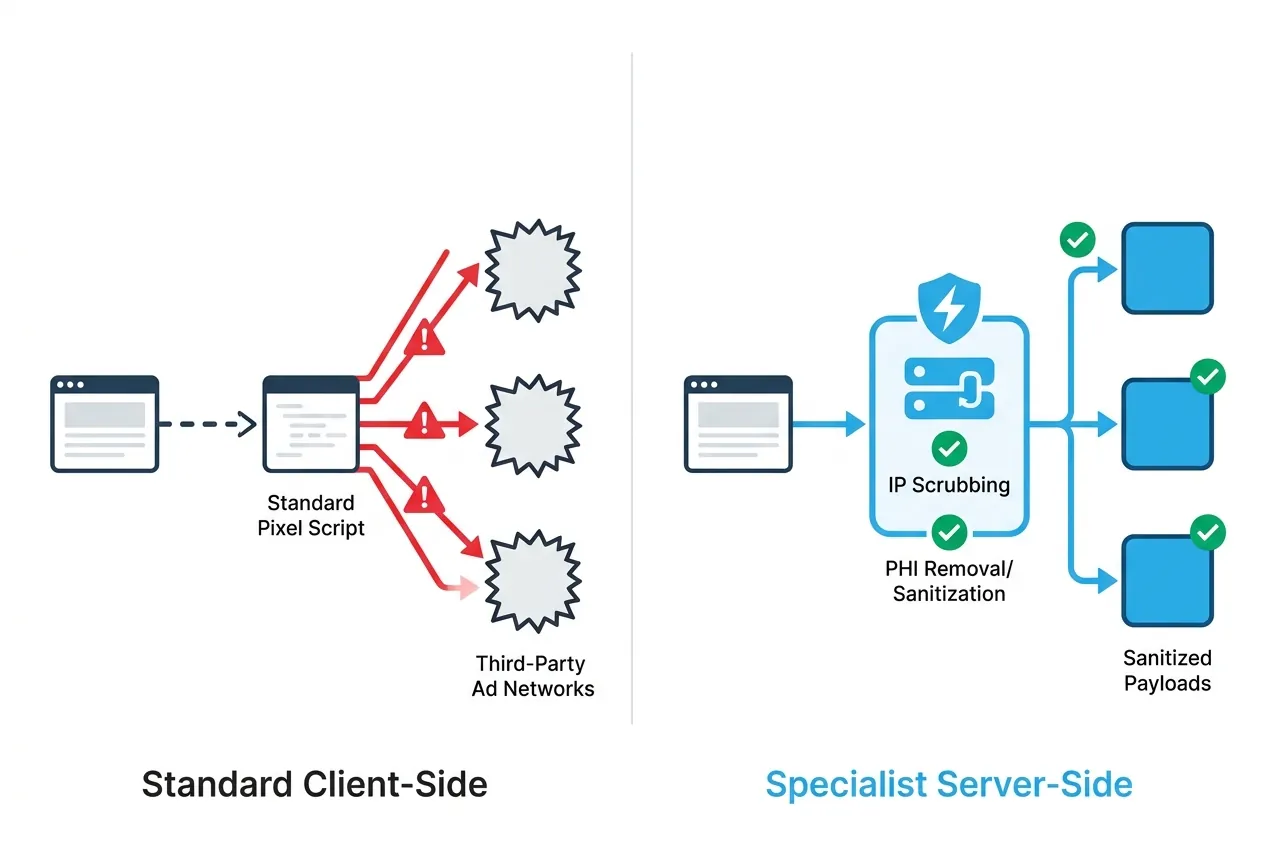
Specialist hipaa compliant marketing companies deliver an engineered barrier between your patients and third-party advertising platforms. In practice, this means building dedicated server-side environments where web events are intercepted, scrubbed of personal identifiers, and sanitized before any payload reaches an external endpoint. In a typical client-side deployment, a user visiting a specialized clinical care page triggers scripts that broadcast their IP address, browser fingerprint, and full destination URL directly to ad networks. A specialist replaces those client-side tags with secure reverse-proxy pipelines. Web events pass through an isolated processing layer where identifiers are stripped, timestamps are modified, and query parameters containing condition codes or location indicators are purged. This technical architecture protects patient privacy while preserving the aggregated conversion signals marketing teams need to steer paid campaigns.
Core HIPAA Marketing Rules Healthcare Leaders Must Navigate
Compliance officers and commercial growth leaders must operate within the strict framework established by federal privacy rules. Under core hipaa marketing rules, any communication that encourages the recipient to use or purchase a specific service constitutes marketing and requires explicit individual authorization, unless a specific statutory exception applies. While standard operations such as appointment reminders, direct treatment coordination, and general health education do not require prior authorization, promotional acquisition campaigns directed at prospective patients demand rigorous data isolation.
Regulatory enforcement has expanded beyond internal medical records to encompass public web interactions. The FTC health information privacy guidance makes clear that sharing sensitive consumer health details with third-party advertising vendors without unambiguous affirmative consent violates federal consumer protection standards. The definition of protected health information now regularly encompasses online identifiers when paired with health-seeking context. If a user lands on a specialized service page for addiction medicine, oncology, or adolescent psychiatry, their IP address and appointment scheduling metadata can constitute protected health information. Consequently, deploying standard analytics pixels or conversion tags on intake pages without data transformation violates administrative rules and creates substantial legal exposure.
Essential HIPAA Compliant Marketing Practices for Paid Media and Tracking
Executing performance marketing under healthcare privacy constraints requires specialized operational discipline. Generalist marketing firms often rely on broad retargeting campaigns to capture unconverted visitors. Under the Google Ads Personalized Advertising policy, personalized advertising and retargeting are strictly prohibited for sensitive health categories, physical conditions, and mental health treatments. Platforms enforce these boundaries rigorously, penalizing or banning accounts that attempt to track users based on clinical search history.
Specialist healthcare agencies build acquisition programs that succeed without retargeting. Sustainable hipaa compliant marketing practices focus on capturing direct, high-intent search demand and driving first-touch conversions through focused landing pages. Instead of placing third-party tags on intake forms, specialist teams deploy server-to-server conversion modeling. Attribution is engineered downstream: conversion events are validated in private CRM or intake software, stripped of personal identifiers, and passed back via secure offline conversion APIs. This maintains algorithmic bidding signals across Google and Meta without passing patient names, phone numbers, or clinical details to advertising systems. Marketers who want to examine these tracking risks across specific channels can review our analyses of Google Analytics and HIPAA: what healthcare marketers can and cannot do, as well as Meta Pixel and HIPAA: reducing tracking risk on healthcare websites.
Free Audit
Want a straight read on where your budget is leaking?
Evaluating Your MarTech Stack: Is Mailchimp HIPAA Compliant?
Marketing leaders frequently ask whether standard commercial software can support healthcare campaigns. Specifically, is Mailchimp HIPAA compliant for patient communication and prospect acquisition? The direct answer is no: Intuit Mailchimp states in its standard security terms that its core platform is not designed for HIPAA compliance and the company does not execute standard Business Associate Agreements for regular commercial accounts.
Deploying non-compliant software creates immediate regulatory risk when workflows involve prospective or current patients. An email marketing workflow often records contact names, personal email addresses, open rates, and click paths across specific service links. When these interactions occur in a general-market platform, the vendor stores and processes health-related intent on infrastructure that lacks required administrative and physical safeguards. A specialist marketing partner evaluates every tool in your stack, migrating sensitive prospect communication to dedicated platforms that execute institutional BAAs, encrypt data in transit and at rest, and maintain immutable audit logs. General newsletters containing non-sensitive community announcements may reside in standard platforms only if separated entirely from clinical inquiry data and intake routing.

Selecting a HIPAA Compliant Marketing Automation Platform
Scaling a healthcare network across multiple clinics or service lines requires automation that integrates with patient intake systems. Selecting an enterprise-grade hipaa compliant marketing automation platform involves technical scrutiny of access boundaries, logging capabilities, and data storage policies. The platform must support role-based permissions, multi-factor authentication, end-to-end data encryption, and full API integration with private clinical management systems.
A compliant automation stack handles lead capture, SMS appointment confirmations, call routing, and intake triage without leaking data across unauthorized boundaries. When a prospective patient submits a confidential assessment form, the marketing platform must isolate clinical details from external ad platforms while routing notifications to the admissions team. Dynamic phone tracking must use HIPAA-aware call tracking platforms that sign BAAs, redact sensitive audio recordings, and withhold caller transcripts from unencrypted email notifications. Automation architecture must serve the patient journey efficiently while creating an auditable paper trail for internal compliance reviews.
Seven Technical Questions to Vet Healthcare Marketing Agencies
Before engaging an agency, healthcare marketing and compliance executives should conduct a technical audit of the provider's operational practices. Use these direct questions during agency evaluations:
- How do you configure tag management on appointment and intake pages? Reject answers that rely on standard browser-side pixels. The agency should demonstrate a server-side proxy architecture that intercepts web requests before data reaches third parties.
- Will your agency sign a comprehensive Business Associate Agreement covering all marketing subcontractors? A compliant partner signs a BAA and maintains active BAAs with all upstream technology vendors, call tracking providers, and infrastructure hosts.
- How do you handle IP addresses and URL query parameters? The agency must articulate how it strips patient IP addresses, device identifiers, and clinical query strings prior to compiling analytical reports.
- How do you optimize paid media campaigns without remarketing lists? Because platforms restrict retargeting in sensitive health categories, the agency must demonstrate expertise in high-intent keyword capture, conversion rate optimization, and first-visit conversion design.
- How is marketing attribution connected to validated admissions? Vetted partners track downstream outcomes to verified admissions or completed visits rather than relying on raw form fills or click metrics.
- Where does your AI and analytics infrastructure process proprietary data? If the agency uses artificial intelligence for data analysis or ad creation, verify whether prompt data is transmitted to public cloud models or processed within sovereign, HIPAA-aware infrastructure.
- Can you demonstrate an understanding of platform-specific certifications like LegitScript? For behavioral health and addiction medicine networks, the partner must understand LegitScript certification requirements and advertising category constraints.

Email Us
Prefer to send the context directly?
How Marketing Powered Aligns Acquisition Performance with Privacy
Marketing Powered approaches healthcare growth from an operator-led perspective. Founded by a former healthcare CMO who ran marketing for a treatment network that grew from 3 to 24 locations, our operational frameworks solve the real-world friction between revenue goals and regulatory boundaries. Having managed $1.5 to $2M per month in Google Ads across 11+ behavioral and mental health accounts, our team understands how to sustain acquisition efficiency under strict policy constraints. Our founder has also served as a court-certified expert witness in advertising strategy, ensuring that every deployment stands up to legal and technical scrutiny.
We build privacy-safe marketing systems tailored for healthcare networks, hospitals, and regulated professional services. Our infrastructure is LegitScript-aware and HIPAA-aware, designed specifically for Google's sensitive healthcare vertical where retargeting is not permitted. Attribution is tracked to admission, not just lead, ensuring commercial investments align with verified business outcomes. Furthermore, we maintain AI-native capabilities dating back to 2022, utilizing owned, local AI infrastructure for HIPAA-aware inference. This allows our partners to analyze campaign patterns, process lead intake signals, and optimize multi-location campaigns without exposing sensitive information to public machine-learning models. Learn how these operational frameworks function in practice by reviewing our comprehensive guide on HIPAA compliant marketing: what the rules mean for campaigns and tracking.
Questions, Answered.
A compliant marketing agency implements administrative, physical, and technical safeguards across every marketing channel. This includes executing Business Associate Agreements, configuring server-side tracking boundaries to prevent data leaks to ad networks, auditing MarTech software, and training personnel on health data handling.
Google Analytics 4 can be used only if it is configured to eliminate the transmission of protected health information. Google explicitly states that users must not pass health information or personal identifiers into GA4, and Google does not sign a BAA for standard analytics. Operating compliantly requires a server-side proxy that removes IP addresses, user identifiers, and sensitive URL query strings before events reach Google servers.
No. A signed Business Associate Agreement is a legal prerequisite, but it does not alter technical data flow. If an agency with a signed BAA places standard ad platform pixels directly on clinical service pages, those pixels broadcast visitor IP addresses and page context to third parties, violating federal tracking rules regardless of the signed agreement.
Healthcare providers track acquisition performance by connecting offline conversion APIs to internal CRM or intake platforms. When a prospective patient completes an appointment or admission, an anonymized transaction identifier is sent back to ad networks via encrypted server endpoints. This trains ad bidding algorithms without exposing clinical identifiers. Request a privacy and tracking review of your marketing stack
Ready to see where your marketing can improve?
Request a free audit of your paid media, landing pages, attribution, and measurement setup. You'll get a straight assessment of where the opportunities are.
or email us at info@marketingpowered.ai