Resources
HIPAA Compliant Marketing: What the Rules Mean for Campaigns and Tracking
Healthcare marketing compliance has collided with modern digital tracking. Marketing teams face intense pressure to demonstrate qualified demand and return on advertising spend, yet routine tracking technologies now create severe regulatory exposure under federal privacy standards. Building a sustainable hipaa compliant marketing program requires understanding statutory definitions, diagnosing tracking risks, and shifting from client-side data leaks to governed, privacy-safe measurement systems.
By Mike Hulick, Founder, Marketing Powered

The Tracking Pixel Trap: HHS Guidance and Analytics Risks

What Constitutes HIPAA Compliant Marketing Under Modern Enforcement?
Navigating healthcare marketing compliance begins with the statutory text of the Health Insurance Portability and Accountability Act (HIPAA) Privacy Rule. Under 45 CFR 164.501, marketing is defined as any communication about a product or service that encourages recipients to purchase or use that product or service. The baseline rule established in 45 CFR 164.508 is unequivocal: a covered entity or business associate must obtain a valid, signed HIPAA authorization from an individual before using or disclosing Protected Health Information (PHI) for marketing purposes, unless an explicit statutory exception applies.
Exceptions exist for treatment communications, case management, care coordination, and describing health-related products or services offered by the provider. However, those exceptions govern operational and clinical outreach, such as a clinic emailing its existing patients about seasonal flu vaccines or a hospital notifying post-surgical patients about rehabilitation therapies. They do not grant permission to feed patient identifiers into commercial ad networks to optimize digital customer acquisition campaigns.
The practical breakdown in modern healthcare marketing rarely occurs at the clinic registration desk or in printed patient mailers. It occurs silently inside the digital intake workflow. Picture a physical intake coordinator sitting at an admissions desk in an outpatient surgical center. If that coordinator took a patient file containing a name, an email address, and a scheduled cardiology procedure and handed it directly to a digital media vendor without consent, compliance teams would immediately classify the incident as an impermissible disclosure.
Yet, when a patient visits that same surgical center's website, navigates to an appointment inquiry page, and fills out a digital intake form while an unconstrained client-side tracking script runs in their web browser, the exact same data transfer takes place programmatically.
Under HIPAA, PHI is created whenever health information is linked to any of the 18 individual identifiers defined by the Privacy Rule. In a digital context, those identifiers extend beyond obvious elements like Social Security numbers or full legal names. They encompass:
- IP addresses assigned by Internet service providers
- Unique device identifiers and advertising IDs
- Browser fingerprint data and persistent cookie identifiers
- Web page URLs containing search terms, medical diagnostic codes, or condition-specific slugs
- Form submission metadata including timestamp, location, and click IDs (such as Google gclid or Meta fbclid parameters)
When an individual visits a health system's oncology subpage or a specialty clinic's depression intake portal, their IP address or persistent device ID pairs directly with the metadata showing an inquiry into specialized care. The moment that combined data payload transmits to a third-party ad vendor without an executed Business Associate Agreement (BAA) and without signed authorization, an impermissible disclosure occurs. Achieving healthcare marketing compliance requires recognizing that technical ad signals are legal disclosures under current federal enforcement.
Digital tracking technologies once operated in a regulatory grey zone. That ambiguity ended when the Department of Health and Human Services (HHS) Office for Civil Rights (OCR) published its landmark guidance on tracking mechanisms. The HHS OCR Bulletin on Online Tracking Technologies confirmed that covered entities and business associates violate the HIPAA Privacy Rule when they deploy tracking tools that route PHI to third-party tracking vendors without proper authorization or business associate protections.
The regulatory scrutiny surrounding hipaa and marketing focuses on two distinct technical environments: authenticated web pages and unauthenticated web pages.
Authenticated Web Pages
Authenticated pages are digital environments behind a user login, including patient portals, electronic health record (EHR) access points, telehealth interfaces, and billing portals. The regulatory consensus on authenticated pages is absolute. Tracking pixels, session recorders, and third-party advertising scripts deployed behind a login screen capture unambiguous PHI.
Transmitting portal login events, prescription refill requests, lab result views, or appointment scheduling details to external ad networks constitutes an indefensible regulatory breach. No commercial advertising tag should ever execute within an authenticated patient session.
Unauthenticated Web Pages
Unauthenticated pages are publicly accessible websites: homepages, service line pages, physician directories, and general contact forms. Historically, marketing executives argued that because visitors on public pages are anonymous, tracking scripts could not possibly convey PHI. OCR directly rejected that assumption.
In its guidance, OCR clarified that tracking technologies on unauthenticated pages capture PHI if the collected data connects an individual's identity (such as their IP address or browser ID) to an inquiry regarding their own physical or mental health, medical condition, or healthcare treatment.
Following legal challenges regarding visitor intent on public-facing sites, OCR revised its bulletin in March 2024. The revised guidance specifies that the connection between the online tracking data and the individual's personal health status depends on whether the visit relates to the individual's own health conditions or healthcare services.
However, because a client-side tracking script cannot determine whether a site visitor is researching diabetes symptoms for themselves, reading medical news for a school paper, or evaluating clinical programs on behalf of a family member, deploying unmanaged third-party tracking scripts across condition-specific pages creates immediate legal vulnerability.
Federal regulators outside HHS have accelerated this enforcement posture. The Federal Trade Commission (FTC) has utilized its authority under Section 5 of the FTC Act and the Health Breach Notification Rule to prosecute digital health platforms that disclose user health information to advertising networks.
In the FTC GoodRx enforcement, regulators penalized the company for sharing sensitive prescription details, personal identifiers, and pharmacy selections with digital advertising platforms via tracking pixels without affirmative user consent.
Similarly, the FTC BetterHelp enforcement banned the mental health platform from disclosing consumer health data, including intake questionnaire responses and email addresses, to third-party platforms for advertising purposes after explicitly promising user confidentiality.
These enforcement actions establish an undeniable precedent: standard consumer tracking workflows deployed by general marketing agencies violate modern privacy enforcement when applied to health-related interactions.
Understanding HIPAA Marketing Rules Across Ad Platforms
Healthcare marketing leaders face an operational dilemma: the major commercial advertising networks do not accommodate traditional HIPAA compliance out of the box. Marketing teams cannot resolve tracking liability simply by requesting legal paperwork from tech conglomerates.
The Business Associate Agreement Reality
A covered entity cannot lawfully share PHI with an external vendor unless that vendor executes a BAA agreeing to safeguard the data under federal standards. Neither Google nor Meta will sign a BAA covering the use of their core advertising products, standard website pixels, or web conversion tags.
- Google: While Google will enter into a BAA for specific enterprise infrastructure products like Google Cloud Platform (GCP) or Google Workspace under enterprise terms, standard Google Analytics 4 (GA4) and Google Ads tracking tags are explicitly excluded from BAA protections.
- Meta: Meta offers no BAA for its standard Meta Pixel, Conversions API (CAPI), or advertising delivery platform.
Attempting to run client-side ad network code on web pages where users seek clinical services or submit contact details places the healthcare provider in immediate, unmitigated breach of hipaa marketing rules.
Platform Policy Restrictions on Sensitive Categories
Beyond federal statutory penalties, advertising platforms impose their own strict behavioral restrictions. The Google Ads Personalized Advertising Policy explicitly prohibits advertisers from utilizing personalized advertising, interest-based audience building, or remarketing lists targeting sensitive personal categories, including:
- Physical or mental health conditions, treatments, or medical procedures
- Substance use disorder and addiction recovery services
- Specific clinical service lines, surgeries, or specialized consultations
- Sexual health, reproductive health, and chronic illness management
This means that traditional e-commerce retargeting—such as running display or social ads reminding an abandoned visitor to return and complete their consultation request—is an immediate violation of both platform terms of service and federal healthcare privacy standards.
In sensitive healthcare verticals, including addiction treatment and specialized behavioral health, advertisers must operate without remarketing audiences. Success depends entirely on intent capture, landing page conversion efficiency, and first-touch attribution integrity rather than re-engagement campaigns.
The Failure of Standard Cookie Banners
To mitigate liability, many organizations implement commercial cookie banners, assuming that a visitor clicking "Accept All Cookies" satisfies regulatory obligations. Under HIPAA, this assumption is false.
A standard website cookie banner does not satisfy the statutory requirements of a valid HIPAA authorization under 45 CFR 164.508. A legally valid authorization requires:
- A specific description of the health information to be used or disclosed.
- The name or specific identification of the person or entity authorized to make the disclosure.
- The name of the recipient (e.g., the specific ad tech vendor).
- A clear description of the purpose of the disclosure.
- An expiration date or event.
- A plain-language notification of the individual's right to revoke the authorization in writing, along with exceptions and instructions on how to revoke.
- A clear statement that treatment, payment, or enrollment cannot be conditioned on whether the individual signs the authorization.
A generic pop-up banner stating that "we use cookies to improve your browsing experience" meets none of these standards. Relying on basic consent banners to shield client-side pixel leakage on healthcare intake pages creates a false sense of compliance while leaving systemic legal risks untouched.
Free Audit
Want a straight read on where your budget is leaking?
Client-Side Versus Server-Side Tracking Architectures
Resolving tracking vulnerability does not mean turning off analytics and operating media campaigns blind. It requires an engineering migration: moving data collection out of the client browser and into a secure, controlled server environment.
The Technical Anatomy of Client-Side Data Leaks
To understand why client-side pixels fail compliance standards, examine the raw mechanics of an HTTP request generated by a user's web browser:
When a prospective patient visits an intake page on a healthcare provider's website, third-party JavaScript scripts execute directly on the user's local machine. The user's browser automatically packages and transmits an HTTP request payload directly to the external vendor's servers. This raw payload routinely contains:
- The Request Header: Exposing the user's actual external IP address and user-agent string (operating system, browser type, device specifications).
- The Referrer URL: Transmitting the exact web path the user navigated from, which frequently contains descriptive condition parameters, such as /treatment-programs/adult-depression-inpatient.
- Query Strings: Revealing parameters appended to URLs, including search terms, click IDs, UTM parameters, and sometimes unencrypted user inputs.
- First- and Third-Party Cookies: Supplying unique tracking IDs that ad platforms link directly to the user's commercial consumer profile.
In a client-side setup, the healthcare organization has zero control over this transmission. The data passes directly from the patient's machine to the ad platform's data centers. The ad platform ingests the IP address and the clinical context simultaneously, completing an impermissible disclosure.
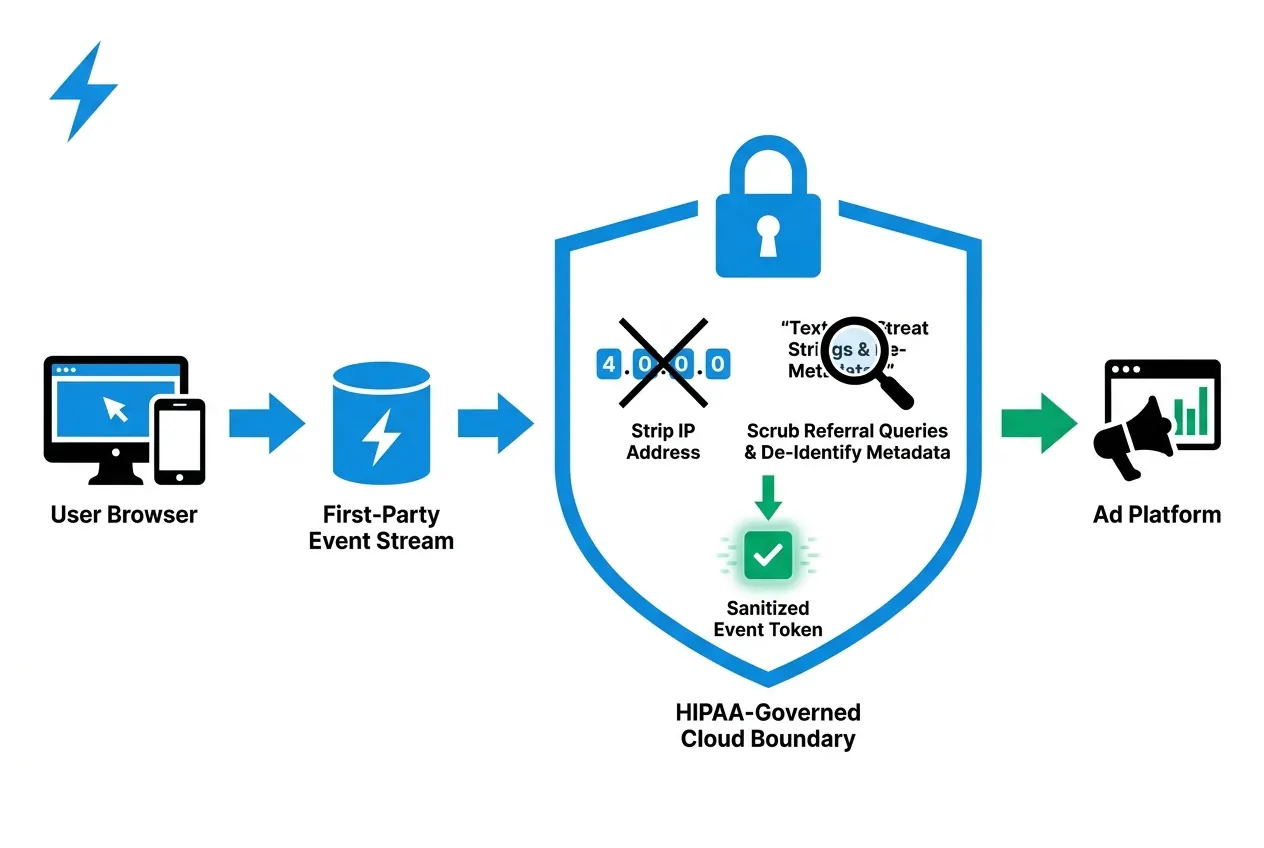
The Server-Side Solution: Establishing a Governed Data Boundary
Server-side tracking eliminates the direct connection between the visitor's browser and third-party advertising platforms.
Instead of loading third-party scripts locally in the browser, the healthcare organization implements a single first-party collection endpoint running on its own subdomain (for example, analytics.healthcareprovider.org). When a user interacts with the website, events transmit solely to this dedicated first-party server.
This server environment must be hosted within a cloud infrastructure where a valid BAA is executed (such as Google Cloud Platform or Amazon Web Services under enterprise healthcare terms). Within this private computing perimeter, the organization acts as a strict data gatekeeper, processing every event before transmitting any downstream payload:
- IP Address Stripping: The server discards the visitor's IP address entirely or replaces it with a generic, non-identifiable regional geographic code.
- URL and Query Parameter Scrubbing: The server inspects the event URL and referral strings, stripping clinical directory names, sensitive page paths, and identifiable parameters, converting /services/cardiology/congestive-heart-failure-consultation to an abstract identifier such as /service-line-04/form-submit.
- Data De-Identification: Identifiable user inputs (names, email addresses, phone numbers) are stripped completely. If conversion value matching is required, data is irreversibly hashed or transformed via mathematically secure tokenization systems before any signal leaves the cloud boundary.
- Controlled Outbound Routing: The sanitized, scrubbed event payload is sent from the private server to external analytics or ad platform endpoints via API (such as Meta Conversions API or Google Ads API).
Because the ad vendor never receives the user's raw IP address, browsing history, or identifiable health inquiry, the data boundary remains intact. Measurement continues without leaking PHI.
For marketing teams seeking in-depth analysis of how specific analytics platforms operate within this architecture, our guide on Google Analytics and HIPAA examines what healthcare marketers can and cannot configure under federal guidelines.
Managing Healthcare Marketing Compliance Across Paid Media Funnels
Maintaining healthcare marketing compliance requires implementing privacy controls across every touchpoint in the digital acquisition funnel: landing pages, intake forms, call tracking, and attribution pipelines.
Privacy-Preserving Landing Page Architecture
Standard marketing landing pages frequently integrate dynamic session-recording tools, live chatbots, and heatmap software. In a regulated healthcare environment, these tools represent severe compliance vulnerabilities. Session recording scripts capture keystrokes, mouse movements, and text entries. If a prospective patient starts typing clinical concerns, medication histories, or symptoms into a form field, session software captures and stores that text even if the visitor never clicks "Submit."
To protect user privacy and adhere to compliance baselines, marketing infrastructure must enforce strict frontend isolation:
- Exclude third-party session recording scripts from any page containing healthcare contact forms, symptom checklists, or scheduling tools.
- Configure all frontend web forms with strict field masking, ensuring that browser autofill entries and keystroke events cannot be captured by intermediary scripts.
- House landing pages on architectures that explicitly separate educational marketing content from functional patient intake workflows.
Secure Intake Forms and Dynamic Call Tracking
When a prospective patient decides to reach out, digital marketing funnels typically split into two primary paths: web form submissions and inbound phone calls. Both channels must be engineered to isolate PHI from advertising platforms.
For digital forms, submissions must route directly into an encrypted, HIPAA-compliant Customer Relationship Management (CRM) or intake database operating under a signed BAA. Form submission success events can be fed back to media channels to train bidding algorithms, but those event signals must be fully anonymized conversion tokens. Passing form data fields (such as "Reason for Visit" or patient contact information) into ad tracking pixels is strictly impermissible.
Inbound call tracking introduces comparable compliance hurdles. Traditional call-tracking tools record audio, log caller IDs, transcribe spoken conversations, and link phone calls back to digital ad clicks via dynamic number insertion (DNI).
To deploy call tracking safely:
- The call tracking vendor must execute a BAA with the healthcare entity.
- Call recording and transcription features must be disabled unless encrypted, HIPAA-compliant storage and administrative safeguards are explicitly configured.
- Call conversion signals pushed back into Google Ads or Meta must be stripped of caller phone numbers and identity data, communicating only the occurrence of an inquiry event and an assigned campaign ID.
First-Touch Conversion Optimization Without Retargeting
Because the Google Ads Personalized Advertising Policy prevents retargeting across sensitive health categories, media managers cannot rely on multi-touch display remarketing to capture unconverted visitors. The media strategy must be optimized for first-touch relevance and immediate conversion action.
This operational reality requires:
- Exact Intent Keyword Targeting: Focus media investment on high-intent search terms that reflect immediate service needs rather than broad informational queries.
- Frictionless Conversion Paths: Build landing pages that answer core patient questions immediately (accepted insurance carriers, facility location, clinical leadership, intake procedures) and provide immediate, secure communication channels.
- Strict Audience Exclusions: Prevent campaigns from serving ads to irrelevant audiences by maintaining rigorous negative keyword lists and explicit geographic targeting boundaries.
Engineering Privacy-Safe Measurement: The Marketing Powered Framework
At Marketing Powered, we approach healthcare marketing compliance as an engineering discipline rather than a legal roadblock. Digital marketing systems must satisfy two demanding criteria simultaneously: they must provide rigorous conversion measurement so marketing leaders can allocate budgets effectively, and they must guarantee data privacy by design.
Our technical framework decouples marketing attribution from raw patient identifiers through a governed measurement pipeline.
Decoupling Attribution from Identifiers
Rather than relying on client-side browser tags that leak sensitive web journeys, our architecture establishes private cloud routers that capture conversion events inside a secure perimeter.
When an inquiry occurs, the system logs an internal, pseudonymous transaction token. Personal identifiers, clinical notes, and IP addresses remain strictly within the HIPAA-governed environment under an executed BAA. The external ad platform receives only what it strictly requires to optimize programmatic bidding: an anonymized conversion marker, a click identifier (such as a gclid), and a de-identified transaction value.
Ad networks receive the optimization feedback required to train their machine learning models without ever gaining access to protected health information or identifying the person behind the conversion.
Attribution Tracked to Admission, Not Just a Lead
Traditional lead generation agencies focus on top-of-funnel conversion metrics: cost per click, click-through rate, and form submissions. In healthcare and regulated clinical environments, form submissions represent an incomplete and often misleading operational metric. A substantial percentage of web submissions fail clinical screening, carry incompatible insurance, or fail to complete the intake consultation.
Our methodology bridges marketing acquisition data directly with verified operational outcomes:
- Attribution is tracked to admission, not just a lead form submission.
- Intake milestones (clinical qualification, insurance verification, completed consultation, admission) are connected to original media channels using tokenized identifiers.
- Bidding algorithms are trained against verified patient admissions rather than unvetted form completions, directing media budgets toward campaigns that generate actual clinical utilization.
Owned, Local AI Infrastructure for HIPAA-Aware Processing
Modern intake optimization frequently benefits from automated data classification, transcript analysis, and inquiry routing. However, routing sensitive prospective patient inquiries into standard commercial cloud AI APIs creates severe data sovereignty and regulatory risks.
Marketing Powered solves this vulnerability through owned, local AI infrastructure for HIPAA-aware inference. By maintaining dedicated, internally operated compute infrastructure, natural language processing and campaign analytics run locally without transmitting sensitive data across third-party consumer AI interfaces. Data processing remains completely within secure operational boundaries, maintaining total data sovereignty.
Grounded in High-Scale Healthcare Operations
This architectural framework reflects direct operational experience in high-stakes healthcare environments. Marketing Powered's founder:
- Served as a former healthcare CMO who ran marketing for a treatment network that grew from 3 to 24 locations.
- Managed $1.5 to $2M per month in Google Ads across 11+ behavioral and mental health accounts.
- Serves as a court-certified expert witness in advertising strategy.
- Operates as an AI-native firm since 2022, built specifically for Google's sensitive healthcare vertical where retargeting is not permitted.
- Maintains complete operational familiarity with LegitScript certification standards and federal data privacy boundaries.
To learn more about selecting the right operational partner for your organization, review our guide on HIPAA compliant marketing companies to understand what specialized infrastructure and vetting protocols require.
Questions, Answered.
No. Signing a BAA with Google Cloud Platform covers enterprise cloud hosting services, but it does not apply to standard Google Analytics 4 or Google Ads tracking tags. Google explicitly excludes its free and commercial web measurement tools from its standard cloud BAA. To utilize web analytics compliantly on healthcare sites, organizations must route data through an isolated server-side environment where IP addresses, condition-specific URL strings, and personal identifiers are scrubbed before events transmit to analytics endpoints.
HIPAA applies strictly to Covered Entities (such as healthcare providers, health plans, and healthcare clearinghouses) and their Business Associates. If an organization is not a covered entity or business associate, HIPAA does not apply. However, non-covered entities are still subject to enforcement by the Federal Trade Commission (FTC) under the FTC Act and the Health Breach Notification Rule. The FTC has repeatedly penalized non-HIPAA health apps and digital wellness platforms for sharing consumer health data with commercial advertising networks without explicit, informed consent.
Under platform policies and federal privacy guidance, retargeting individuals based on their visits to health condition pages is effectively prohibited. The Google Ads Personalized Advertising Policy bans remarketing lists based on health conditions or clinical treatments. Simultaneously, targeting ads to an individual because they visited a specific medical condition page requires building a custom audience list. Transmitting that user's web interaction history to an ad platform to populate a retargeting audience constitutes an impermissible disclosure under HIPAA unless the individual has signed a valid, comprehensive authorization.
No. Standard website cookie consent banners do not satisfy the rigorous statutory requirements for a valid HIPAA authorization under 45 CFR 164.508. A HIPAA authorization requires specific statutory disclosures, including the exact data shared, named recipients, purpose statements, an expiration event, and explicit notifications regarding revocation rights. A simple opt-in banner does not protect a covered entity from federal enforcement if client-side pixels transmit IP addresses and health inquiries directly to commercial advertising platforms.
The safest and most defensible method is to implement server-side tracking hosted within a private cloud environment under an executed BAA. In this architecture, all website interactions flow to a private, controlled server endpoint. The server strips external IP addresses, removes clinical page slugs and query parameters, and de-identifies form events before passing clean, anonymized conversion tokens to advertising platforms via secure APIs. This preserves campaign optimization and return-on-ad-spend attribution while eliminating the transmission of PHI. Request a privacy and tracking review of your marketing stack
Ready to see where your marketing can improve?
Request a free audit of your paid media, landing pages, attribution, and measurement setup. You'll get a straight assessment of where the opportunities are.
or email us at info@marketingpowered.ai