Resources
Google Ads Explained: A Plain-Language Guide for Decision Makers
Google Ads is an auction-based digital advertising system where organizations pay to display commercial search listings, local map placements, and video promotions to users demonstrating active intent. In this guide, Google ads explained simply means cutting through agency jargon so executive leadership can evaluate click volume against real operational capacity. When commercial teams understand the underlying auction mechanics, paid search becomes a predictable lever for capturing qualified demand rather than an unmonitored line-item expense.
By Mike Hulick, Founder, Marketing Powered

Bidding strategies: what decision makers must control
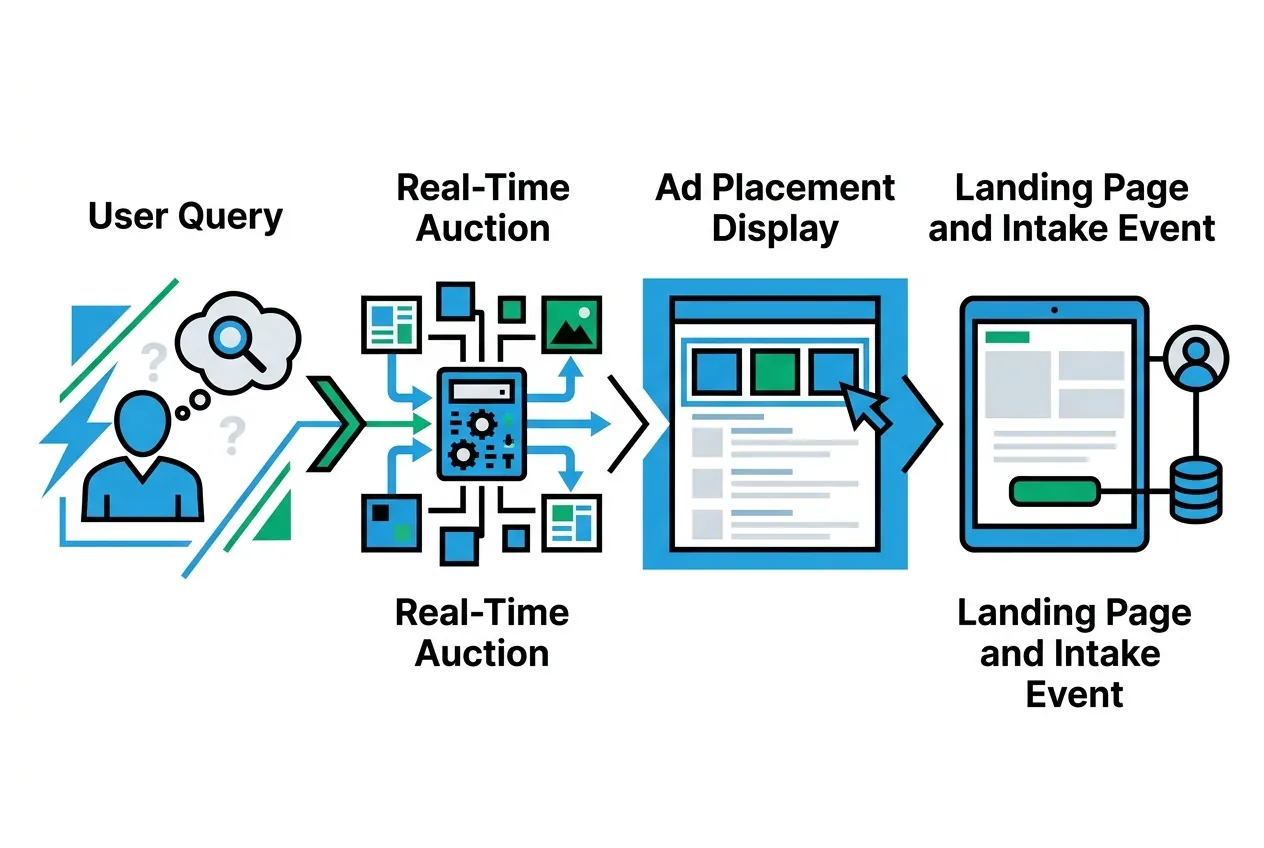
What is Google Ads and how does the platform work?
At its foundation, what is Google Ads comes down to intent capture. Unlike social media channels that push promotional messages to passive audiences browsing a feed, Google search ads appear at the exact second an individual actively searches for a solution. When a prospective patient, client, or commercial buyer types a query into Google, the platform executes a real-time auction among competing advertisers and presents sponsored results above and alongside organic listings.
The commercial process involves four distinct stages:
- User Query: A user enters a specific search term indicating high commercial or clinical urgency, such as an inquiry for specialized medical care or regional corporate counsel.
- Auction Trigger: Google identifies all active advertiser accounts bidding on keywords that match that user query.
- Auction Filtering: Google evaluates competing entries through an automated calculation known as Ad Rank, which scores bid amounts, creative relevance, and user experience.
- Traffic Delivery: The winning ads appear on the search results page. The advertiser incurs a cost only when the user clicks the sponsored link to visit a designated landing page.
For executive teams, recognizing this distinction between demand capture and demand generation is critical. Paid search does not convince an uninterested person to buy a product or seek medical treatment. Instead, it positions your organization directly in front of buyers who have already identified their problem and are actively evaluating providers. The strategic objective for leadership is ensuring that the intake or sales infrastructure converts that incoming volume into validated revenue before media spend is exhausted.
Google Ads vs Google AdSense: what is Google AdSense?
Executive confusion frequently arises between Google Ads and Google AdSense, yet the two systems sit on opposite sides of the commercial advertising transaction. Answering what is Google AdSense requires examining how website publishers generate revenue versus how commercial enterprises purchase customer acquisition.
Google Ads is the buy-side platform. Businesses, medical practices, and professional service firms use Google Ads to buy targeted visibility. Advertisers configure campaigns, define audience targeting, set bids, and pay Google whenever a prospective customer clicks on an ad placed across Google Search, Google Maps, YouTube, or third-party partner websites.
In contrast, Google AdSense is the sell-side platform. Independent website owners, digital publishers, and blog operators install AdSense code on their digital properties to monetize their web traffic. When publishers enroll in AdSense, they allocate digital real estate on their pages for display banners and text links. Google fills that space using ads purchased by advertisers through the Google Ads network, collecting payment from the advertiser and remitting a share of that revenue to the publisher.
This operational divide carries direct implications for corporate governance. Marketing teams that do not configure their Google Ads accounts properly often find their search budgets siphoned into display placements across low-quality publisher sites through the Google Display Network and search partner networks. For high-ticket service providers and healthcare systems, buying accidental publisher clicks through misconfigured network settings wastes capital on low-intent impressions rather than capturing active commercial searches.
Free Audit
Want a straight read on where your budget is leaking?
How the auction works and what is Google Ads charge?
A common misconception among business leaders is that the company with the largest budget automatically wins the top placement on Google. In reality, the mechanics of what is Google Ads charge depend on a multi-variable auction governed by Ad Rank rather than raw capital.
According to Google Ads Help on Ad Rank, your position on the results page is calculated using your maximum bid, the quality of your ads and landing page, minimum Ad Rank thresholds, the search context of the user, and the expected impact of ad assets such as phone numbers and site links.
Google evaluates three primary components to establish Quality Score:
- Expected Click-Through Rate (CTR): Google's algorithmic estimate of how likely a searcher is to click your ad when shown.
- Ad Relevance: How closely the language in your ad copy matches the specific intent of the search term.
- Landing Page Experience: How relevant, transparent, and easy to navigate your destination page is for visitors once they arrive.
Because Quality Score acts as an auction multiplier, an advertiser with high creative relevance and an exceptional mobile landing page can achieve top ad placement while paying a lower cost per click (CPC) than a competitor bidding twice as much with a generic home page.
Billing mechanics are equally structured. Under Google Ads Help on Billing Thresholds, accounts on automatic payments are charged either when their accrued costs hit a specific monetary threshold or 30 days after their last payment, whichever comes first. Setting daily budget caps protects accounts from runaway media spend, but leaders must monitor how aggressive competition in regulated sectors can elevate average CPCs. In specialized verticals, a single click can cost between $15 and $100. When clicks command that level of capital, operational margin depends entirely on filtering out unqualified inquiries before the click occurs.
Account structure: what is Google Ads account architecture?
A high-performing advertising operation relies on deliberate account organization. When reviewing agency performance or internal dashboards, executives must understand what is Google Ads account architecture to determine whether media spend is structured for control or obscured by messy campaign consolidation.
An accountable account adheres to a five-tier structural hierarchy:
- Account Level: Houses executive administrative access, primary billing information, and top-level conversion actions.
- Campaign Level: Governs daily budgets, geographic targeting boundaries, language selections, and bidding strategies. A regional health network, for instance, must separate campaigns by geographic facility to ensure marketing dollars stay aligned with specific operational service lines.
- Ad Group Level: Houses tightly themed clusters of related keywords and the specific ad copy written to answer them. If an ad group contains unrelated concepts, relevance scores decline and acquisition costs rise.
- Ad Creative: The actual responsive search ads, headlines, descriptions, and extensions displayed to the searcher.
- Keywords and Search Terms: The triggers configured within the system.
A non-negotiable operational responsibility is maintaining the distinction between keywords and actual search terms. Keywords are the terms you instruct Google to target; search terms are the literal phrases users typed before clicking your ad. Without rigorous daily negative keyword management, automated broad matching routinely matches your ads to irrelevant search queries, draining ad spend on student job inquiries, competitor customer service numbers, or completely unrelated services.
Google offers various bidding options, ranging from manual control to advanced automated Smart Bidding. While automated strategies such as Target Cost Per Acquisition (Target CPA) and Target Return on Ad Spend (Target ROAS) use machine learning to evaluate contextual auction signals, decision makers must retain executive control over what the algorithms are instructed to optimize toward.
Automated bidding algorithms are mathematical systems designed to achieve the conversion goal you assign to them. If an organization feeds raw web form submissions or generic page views into Smart Bidding as primary conversions, the platform will locate the easiest, lowest-cost users willing to submit a web form. In commercial and clinical environments, this frequently floods administrative teams with unqualified leads, spam inquiries, and out-of-network requests.
To protect commercial profitability, marketing leadership must configure bid optimization around qualified demand rather than raw lead volume. For multi-location healthcare systems and specialized professional service firms, this means engineering conversion systems that feed downstream milestones back into the advertising account. When bidding algorithms optimize for verified patient intake appointments or validated sales opportunities instead of anonymous top-of-funnel form fills, capital allocation shifts naturally toward high-value search queries.
Google ads explained for regulated verticals and healthcare PPC
Advertising in regulated sectors introduces severe platform constraints that standard agency playbooks fail to accommodate. For organizations operating in healthcare, clinical services, and mental health, general advertising strategies do not apply directly due to Google's strict consumer privacy mandates.
Under Google Ads Personalized Advertising Policy and Google Ads Healthcare and Medicines Policy, advertisers are strictly prohibited from using personalized advertising, remarketing lists, or retargeting pixels for content related to personal health conditions, medical treatments, or clinical procedures. In commercial e-commerce, brands routinely deploy retargeting ads to track website visitors across the internet for weeks until they complete a purchase. In healthcare and sensitive services, retargeting is not permitted.
This single policy restriction fundamentally alters advertising unit economics:
- Zero Retargeting Safety Net: Every visitor arriving from a paid search click must be qualified and engaged on that primary interaction. If your landing page architecture fails to clarify insurance participation, clinical credentials, and immediate contact pathways on the first visit, that media capital is permanently lost.
- Strict Certification Requirements: Certain specialized categories require dedicated third-party certifications, such as LegitScript verification for addiction treatment centers, before accounts are authorized to enter the auction.
- Privacy Compliance: Conversion tracking architecture must maintain patient privacy and data sovereignty, ensuring that protected health identifiers are never passed into ad platform tracking scripts.
Operational success in sensitive verticals requires building high-intent paid search campaigns designed for qualified capture from the very first touch. Exploring this architecture in depth is detailed in our strategic pillar guide on Healthcare PPC: structuring paid search for qualified patient demand.
Email Us
Prefer to send the context directly?
Accountable paid media management with Marketing Powered
Marketing Powered manages paid search and social campaigns through an operator-led model centered on commercial outcomes rather than vanity click reporting. Our operational focus is engineered specifically for hospitals, healthcare systems, professional services, and multi-location organizations navigating competitive auctions and strict regulatory environments.
Our leadership history includes a former healthcare CMO who ran marketing for an operational treatment network that grew from 3 to 24 locations, personally directing $1.5 to $2M per month in Google Ads across 11+ behavioral and mental health accounts. As a court-certified expert witness in advertising strategy, our leadership brings rigorous evidentiary standards to campaign governance, conversion attribution, and platform policy compliance.
Being AI-native since 2022, we deploy owned, local AI infrastructure for HIPAA-aware inference, allowing our team to process campaign intelligence, local keyword patterns, and negative search term audits without exposing sensitive proprietary data to open public models. Every campaign we manage is LegitScript-aware and HIPAA-aware, designed specifically for Google's sensitive healthcare vertical where retargeting is prohibited.
Rather than reporting on top-level form fills or platform-reported conversion metrics, our measurement architecture tracks attribution through to actual admissions, scheduled procedures, and qualified customer intake. Teams seeking to evaluate prospective agency partners can review our detailed industry analysis covering Healthcare ppc services: what a specialist partner delivers and how to vet one, alongside our practical evaluation framework on Google ads agency: what a specialist partner delivers and how to vet one.
Questions, Answered.
Budgets must be dictated by customer economics and local auction density rather than arbitrary industry percentages. Leadership should calculate allowable customer acquisition cost (CAC) based on gross lifetime value, evaluate current local cost-per-click levels across priority keywords, and fund campaigns with sufficient capital to generate statistically significant intake data each month.
Search engine optimization (SEO) focuses on improving technical site performance, content authority, and regional signals to earn organic, unpaid rankings over time. Google Ads purchases immediate sponsored placement at the top of search results on a pay-per-click basis. Sustainable commercial growth models pair organic search authority with disciplined paid search demand capture.
This disconnect occurs when the agency defines a conversion as any top-level action, such as a contact form submission, live chat start, or button click. If the account's bidding strategy is optimized for volume rather than verified business qualification, the algorithm actively targets low-intent users who submit incomplete or spam forms. Conversion tracking must be tied to downstream CRM intake stages.
For commercial retail and standard professional service firms, retargeting is standard practice. However, if your organization operates in healthcare, behavioral health, or specialized clinical services, Google's personalized advertising policies strictly bar remarketing based on personal health conditions. In those verticals, marketing teams must focus entirely on first-visit conversion architecture. Request a paid media audit from Marketing Powered
Ready to see where your marketing can improve?
Request a free audit of your paid media, landing pages, attribution, and measurement setup. You'll get a straight assessment of where the opportunities are.
or email us at info@marketingpowered.ai