Resources
Multi Location Marketing Strategy: Why Big Budgets Lose Locally
Building an effective multi location marketing strategy requires recognizing where central corporate scale fails to penetrate local territory. Enterprise organizations frequently deploy substantial paid media budgets and enterprise syndication tools, only to find their regional offices and satellite clinics consistently outranked by neighborhood operators. Sustained visibility across distributed markets demands an operational system that captures authentic, location-level signals rather than a centralized advertising campaign that treats every zip code as an interchangeable ad group.
By Mike Hulick, Founder, Marketing Powered

The Centralization Trap in Multi Location Marketing Strategy
Centralized marketing models are designed for corporate efficiency, unified reporting, and brand governance. In a corporate headquarters, an executive team reviews aggregated cost-per-click metrics, regional media efficiency, and brand reach across hundreds of markets. Meanwhile, thirty miles away in a suburban medical office or service branch, an office manager sits behind an empty front desk, waiting for appointments that never materialize because prospective customers in that specific neighborhood cannot find the facility in local map packs.
This disconnect happens because central digital teams rely on centralized proxies. To manage thirty, fifty, or one hundred properties without proportional overhead, corporate teams deploy national directory distribution software, automate regional search ad spend, and build templated landing page directories. These tactics preserve central control, but they produce digital assets that feel generic to local searchers and register as low-value duplicates to search engines.
When regional clinic personnel, facility administrators, and intake staff are treated as passive recipients of corporate marketing rather than active participants in local visibility, the organization forfeits its most valuable search assets: immediate physical proximity and authentic point-of-service customer validation. Independent operators who lack central marketing departments win these battles because their daily operational activity naturally feeds the local discovery algorithms that corporate software suites attempt to automate from afar.

Why Search Engines Favor the Neighborhood Competitor
Local search algorithms evaluate businesses differently than national organic search engines. Google Business Profile Help confirms that local search results depend primarily on three foundational criteria: relevance, distance, and prominence. Prominence reflects how well known a business is, informed by signals Google gathers across the web, including review counts, positive ratings, and local content depth.
An independent medical clinic, specialized treatment provider, or single-unit franchise operates with an inherent algorithmic advantage in its immediate radius. Its physical address, community interactions, local citations, and patient reviews are concentrated entirely at a single geographic coordinate. Every piece of digital evidence gathered about that practice reinforces one location.
By contrast, a distributed multi-location network splits its digital authority across dozens of distinct entities. If an enterprise network relies on automated, delayed email sequences to solicit patient feedback, it often collects only a handful of sporadic reviews each quarter. If an agile neighborhood competitor down the street generates five authentic reviews every week directly from satisfied patients walking out the door, the search engine interprets that regular flow of local activity as superior prominence. A larger central budget cannot override an algorithm built to prioritize localized prominence and authentic customer validation.
What Is Place Strategy in Marketing for Multi-Unit Networks?
When evaluating local marketing strategy, operators often encounter the academic question: what is place strategy in marketing? In traditional commercial frameworks, place simply meant physical distribution, site selection, or territory supply chains. You chose a retail intersection with high vehicle traffic, built a facility, and bought print or broadcast media to announce your arrival.
In modern multi-unit enterprises, place strategy represents the complete technical and physical pathway between local digital discovery and on-site consumer intake. It is not merely the real estate lease or the geographic coordinates of a building. Place strategy is the intentional integration of physical location workflows with localized digital infrastructure.
A modern place strategy connects four distinct elements:
- The physical point of care or service delivery where customer interactions happen.
- The localized web architecture that gives search engines verified, non-duplicate technical data about that specific facility and its staff.
- The operational review capture process implemented by front-desk or checkout personnel in the lobby.
- Downstream attribution systems that track local inquiries through to verified admissions or sales rather than stopping at the raw digital inquiry.
When place strategy is treated merely as real estate selection while digital marketing is run out of a detached central silo, the two halves work against each other. An organization ends up paying premium rent for physical locations while funding digital campaigns that fail to direct nearby searchers into those very doors.
Free Audit
Want a straight read on where your budget is leaking?
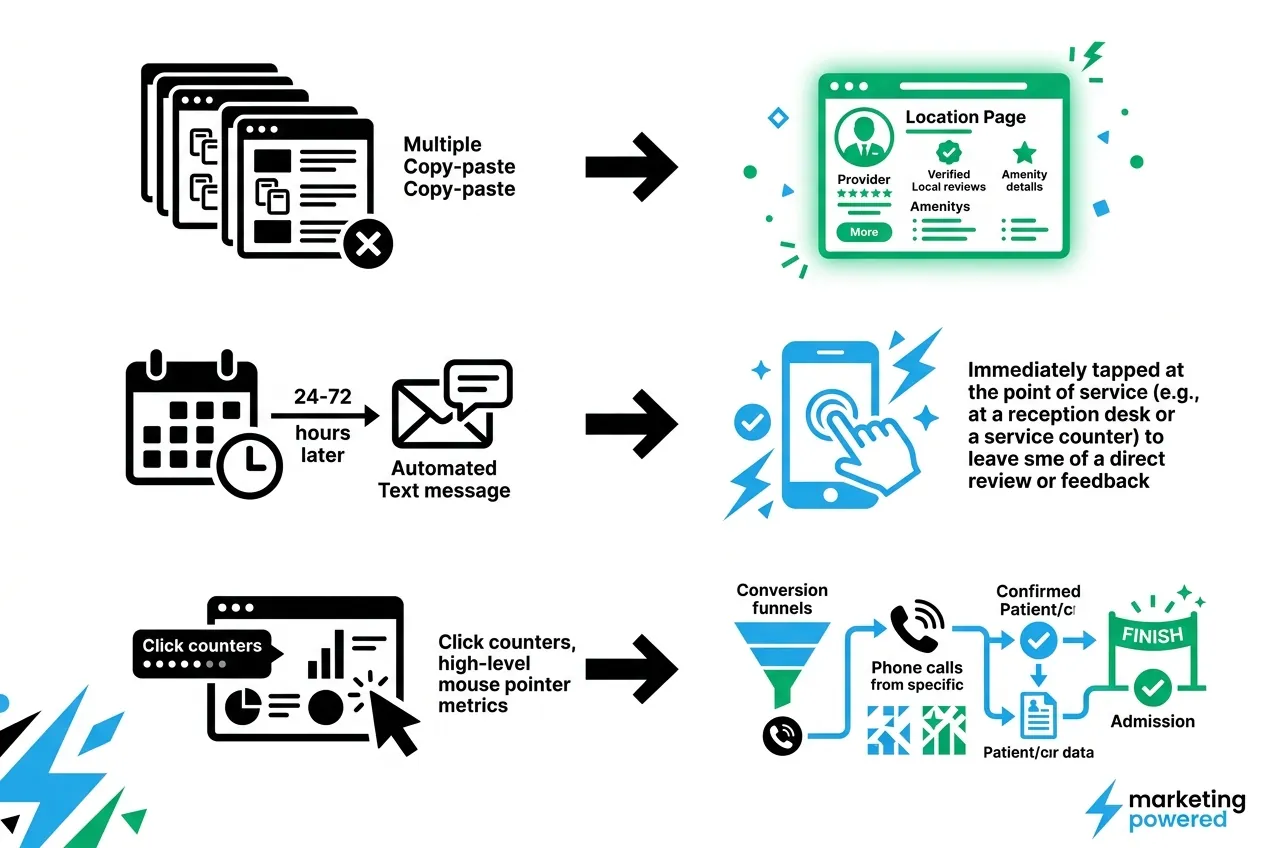
Three Architectural Flaws in Multi Location Brand Marketing
Most multi location brand marketing fails not because of the creative message, but because of underlying technical and operational shortcuts. Enterprise organizations trying to maintain control across diverse markets routinely fall into three structural traps.
1. Cloned Landing Pages and Programmatic Duplication
The most common failure in multi location marketing is the cookie-cutter location directory. A corporate team designs a single landing page layout, copies it across forty subdirectories, and swaps out only the city name, address, and telephone number.
Search engines easily identify repetitive, low-substance templates. When twenty pages across a domain share 90 percent of the same boilerplate text, search crawlers deprioritize or filter those pages out of organic search results. A location page must present substantive, unique local information: the credentials of the on-site providers, specific services delivered at that facility, direct parking and transit instructions, community partnerships, and verified local patient reviews. Our foundational guide, "Multi-location SEO: how to rank every location without duplicate content", explores the precise content architecture required to establish genuine location depth without triggering duplication filters.
2. Delayed, Post-Service Review Sequences
Enterprise brands commonly manage reputation through batch-processed customer satisfaction emails or automated text messages dispatched 24 to 72 hours after service delivery. By the time a patient or client receives an email asking for feedback, the emotional connection to their positive experience has faded.
These delayed requests yield conversion rates in the low single digits. Even worse, delayed automated outreach disproportionately attracts unhappy consumers who are motivated to vent, while the vast majority of pleased customers simply delete the notification. This skews a location's public rating downward, directly damaging local prominence in map packs.
3. Disconnected Funnel Attribution
Corporate multi-location dashboards routinely celebrate vanity metrics: impressions, clicks, form submissions, and inbound call volumes. However, an inquiry is not an admission or a paying customer. In high-stakes service categories like behavioral healthcare, a digital lead generation campaign can deliver hundreds of phone calls that never convert into facility admissions due to network mismatch, geographic friction, or operational delays at intake.
When marketing performance is evaluated solely on the cost per lead generated at the corporate tier, media buyers inadvertently double down on campaigns that drive low-intent, unqualified volume to local intake coordinators. Real local marketing efficiency requires tracking attribution straight through to admission or purchase, revealing which specific geographic micro-markets and ad placements drive qualified revenue.
Building an Operational Engine for Point-of-Service Reputation
Review acquisition is an operational discipline that belongs at the front desk, not inside an automated email campaign. A patient standing in a clinical lobby after receiving attentive, compassionate care is at peak satisfaction. If you provide an effortless mechanism to share feedback at that precise moment, review generation shifts from an awkward administrative chore into a predictable daily process.
This is why physical point-of-service tools like Powered Cards bridge the corporate-local divide. Powered Cards combine tap-to-review Near Field Communication (NFC) chips with high-contrast, dynamic QR codes on durable, physical hardware. When placed at a discharge desk, check-in counter, or consultation room, on-site personnel can invite a client to tap their smartphone against the card or scan the code. The device opens the facility's verified Google review prompt in seconds, without requiring the user to search for the business name or navigate a complex directory.
This process must operate strictly within regulatory and platform standards. Google Maps User Contributed Content Policy strictly bans fake engagement, paid incentives, review gating (filtering unhappy customers away from public profiles), and prohibited solicitation schemes. Similarly, the Federal Trade Commission regulates deceptive endorsements and testimonials, prohibiting consumer reviews obtained through required-sentiment compensation or deceptive practices.
Compliant point-of-service programs do not pressure clients, script their words, or offer financial rewards. They simply remove technical friction. To understand the operational implementation of these physical tools, read our detailed analysis, "Google review cards: using NFC and QR cards to collect reviews at the point of service".
How Marketing Powered Solves Multi-Location Execution
Bridging corporate scale with field-level execution requires an operating partner who understands both corporate economics and clinical reality. Marketing Powered is an operator-led marketing and technology firm founded by a former healthcare Chief Marketing Officer who ran marketing for a treatment network that grew from 3 to 24 locations, while managing $1.5 to $2M per month in Google Ads across 11+ behavioral and mental health accounts.
Having served as a court-certified expert witness in advertising strategy, our leadership approaches multi-location systems with legal and regulatory precision. In sensitive sectors like healthcare, standard agency playbooks fall apart. Retargeting is strictly prohibited under Google's sensitive healthcare vertical policies, requiring an acquisition strategy focused on qualified organic discovery, local pack dominance, and high-intent inbound search.
Marketing Powered has been AI-native since 2022, deploying owned, local AI infrastructure for HIPAA-aware inference. This proprietary computational setup ensures sensitive healthcare data never touches public cloud pipelines while enabling localized content analysis, data structuring, and geo-grid rank intelligence at scale. Crucially, our attribution models are built to track marketing expenditure straight through to patient admission, eliminating the reporting illusions created by raw lead counts.
When evaluating potential growth partners, marketing leaders should review our operational evaluation framework, "Multi location seo services: what a specialist partner delivers and how to vet one", to understand the technical prerequisites of sustainable multi-unit growth.
Questions, Answered.
Place strategy in marketing defines how a business coordinates physical facility access, distribution channels, and local digital pathways so that nearby buyers can discover, evaluate, and purchase services. In modern multi-unit enterprises, this requires aligning Google Business Profiles, localized website architecture, point-of-service review collection, and intake workflows.
Independent competitors often outrank corporate locations because Google's local search algorithm prioritizes physical proximity and local prominence. A single-location business concentrates all of its citations, local content, and customer reviews into a single geographic entity, generating a higher density of local signals than a corporate satellite reliant on centralized, generic campaigns.
Review velocity refers to the steady, ongoing frequency with which a business profile earns authentic customer feedback. Google views frequent, consistent positive reviews as an active signal of business prominence and operational quality. An erratic spike in reviews followed by months of silence provides weaker ranking signals than a predictable, steady volume captured at the point of service.
Brands can automate administrative tasks like data distribution and technical reporting, but automating customer reviews through batch emails or publishing cloned landing pages often degrades local performance. Search engines favor distinct, location-specific content, while consumers respond best to authentic, point-of-service engagement that takes place inside the physical facility. Request an acquisition audit
Ready to see where your marketing can improve?
Request a free audit of your paid media, landing pages, attribution, and measurement setup. You'll get a straight assessment of where the opportunities are.
or email us at info@marketingpowered.ai