Capabilities
Marketing Attribution Agency: What a Specialist Partner Delivers and How to Vet One
Most marketing leaders can see what they spend on paid media, but few can verify which campaigns produce cleared revenue, qualified consultations, or enrolled clients. Selecting a specialized marketing attribution agency is often the turning point between relying on self-reported platform conversion counts and allocating capital based on verified business outcomes. This guide outlines what technical attribution partners build, how measurement operates under strict data privacy rules, and how to evaluate an outside firm before handing over your tracking architecture.

What a Marketing Attribution Agency Actually Delivers

What Is Attribution in Marketing Beyond Platform Dashboards?
In basic digital advertising, attribution is the rule or statistical model that assigns credit for a sale or conversion to specific marketing touchpoints. Ad platform dashboards simplify this process by using in-platform pixels and default attribution windows. When a user clicks a search ad and fills out a form three days later, the ad network claims complete credit for that lead.
That reporting model breaks down in complex, high-consideration, or regulated sales cycles. A prospective patient, hospital client, or commercial buyer rarely converts on a single digital interaction. They research across organic search, evaluate peer reviews, abandon web forms, and eventually call an intake line or schedule an offline appointment weeks later. When every platform uses last-touch or self-reported credit, Google Ads, Meta Ads, and organic search will often each claim 100 percent credit for the exact same transaction.
Relying on platform-reported numbers leads to distorted capital allocation. Marketing teams scale ad spend on campaigns that generate high volumes of low-intent digital form submissions, while starving high-performing campaigns that generate high-value phone calls and qualified pipeline. Moving beyond platform metrics requires building a unified measurement pipeline that connects the initial click identifier to the offline phone conversation, intake record, and final financial milestone.
A specialized marketing attribution agency does not deliver a static monthly slide deck or a resold reporting dashboard. The true deliverable is an owned, durable data architecture that captures user journeys across digital touchpoints, routes conversion data securely, and closes the loop between intake systems and paid media platforms.
Rather than installing client-side JavaScript tags that fire unvetted events into third-party ad networks, a technical measurement partner configures server-side data routing. This process captures incoming click identifiers, session source parameters, and interaction types, storing them in your owned database or customer relationship management (CRM) software.
The partner engineers the bi-directional feedback loops that ad networks require for algorithmic bidding. When an intake coordinator qualifies an inquiry or an admissions team verifies an intake, that milestone is programmatically matched to the original ad click and pushed back to the advertising platform as an offline conversion. This trains automated bidding systems to hunt for verified revenue rather than top-of-funnel web clicks.
Core Marketing Attribution Services: Call Tracking and CRM Synchronization
Engineering this data loop requires distinct technical disciplines. Comprehensive marketing attribution services focus on three foundational layers: voice event mapping, first-party data capture, and closed-loop offline synchronization.
Dynamic Call Tracking and Voice Event Mapping
In high-intent sectors, high-value opportunities occur over the phone. A patient in acute need, a commercial buyer arranging a facility contract, or a client seeking specialized legal counsel picks up the phone instead of filling out an online form. Standard web analytics treat phone calls as blind drop-offs unless dynamic number insertion is configured.
A technical attribution partner deploys dynamic number pools that swap phone numbers on your site based on the visitor session. This links the incoming phone call to the specific search keyword, campaign, and ad click identifier (such as a GCLID or privacy-safe platform identifier). The partner routes call metrics, interactive voice response (IVR) selections, and call disposition outcomes directly into the CRM intake queue without passing personal customer data to public ad networks. The operational details of this discipline are explored in the cross-pillar guide to call tracking services: what a specialist partner delivers and how to vet one.
First-Party Data Capture and Server-Side Tagging
Relying on browser-based marketing pixels exposes your measurement to ad blockers, browser privacy restrictions, and data leakage. Attribution partners replace vulnerable client-side tracking with server-side tagging containers.
When a visitor lands on your web property, the server records the interaction and passes event parameters through an isolated first-party proxy. This ensures your organization retains data sovereignty over every digital breadcrumb. You control what information gets recorded, which identifiers are stored, and what data gets excluded before any event ping leaves your private boundary.
Offline Conversion Synchronization
Capturing leads is only half of the measurement challenge. The attribution pipeline must follow the record through the CRM lifecycle:
- Initial Inquiry: The inbound form submission or dynamic phone call captures attribution parameters alongside contact details.
- Operational Qualification: The intake or sales team assesses eligibility, verifies insurance or commercial fit, and marks the record as qualified.
- Verified Milestone: The prospect attends a clinical assessment, completes an intake admission, or executes a service agreement.
- Data Cleansing and Hashing: The attribution pipeline extracts the conversion event, matches it to the stored click identifier, and prepares a privacy-safe conversion payload.
- Offline Conversion Import: The system uploads the validated event to Google Ads or Meta Ads, feeding the exact revenue value or milestone weight back into the bidding algorithm.
Teams looking to structure these operational stages can review the broader methodology in Marketing attribution: a practical guide for teams that need real answers.
Free Audit
Want a straight read on where your budget is leaking?
The Compliance Boundary: Privacy-Safe Attribution in Regulated Sectors
Attribution becomes significantly more complex in regulated environments. Healthcare systems, behavioral health providers, and specialized legal practices cannot deploy standard commercial tracking scripts without introducing severe compliance exposure.
Under the HHS OCR guidance on online tracking technologies, covered entities are restricted from deploying unauthenticated tracking tools that transmit protected health information (PHI), IP addresses, or geographic identifiers to third-party ad networks. Simultaneously, the Google Ads personalized advertising policies strictly prohibit the creation of remarketing lists or audience targeting based on sensitive personal health categories.
Generic marketing agencies routinely violate these rules by placing standard Meta pixels and Google tags on therapy service pages, patient portals, and consultation request forms. A specialized attribution partner approaches tracking through strict data isolation:
- Business Associate Agreements: Executing verified Business Associate Agreements with all call tracking, data routing, and infrastructure vendors.
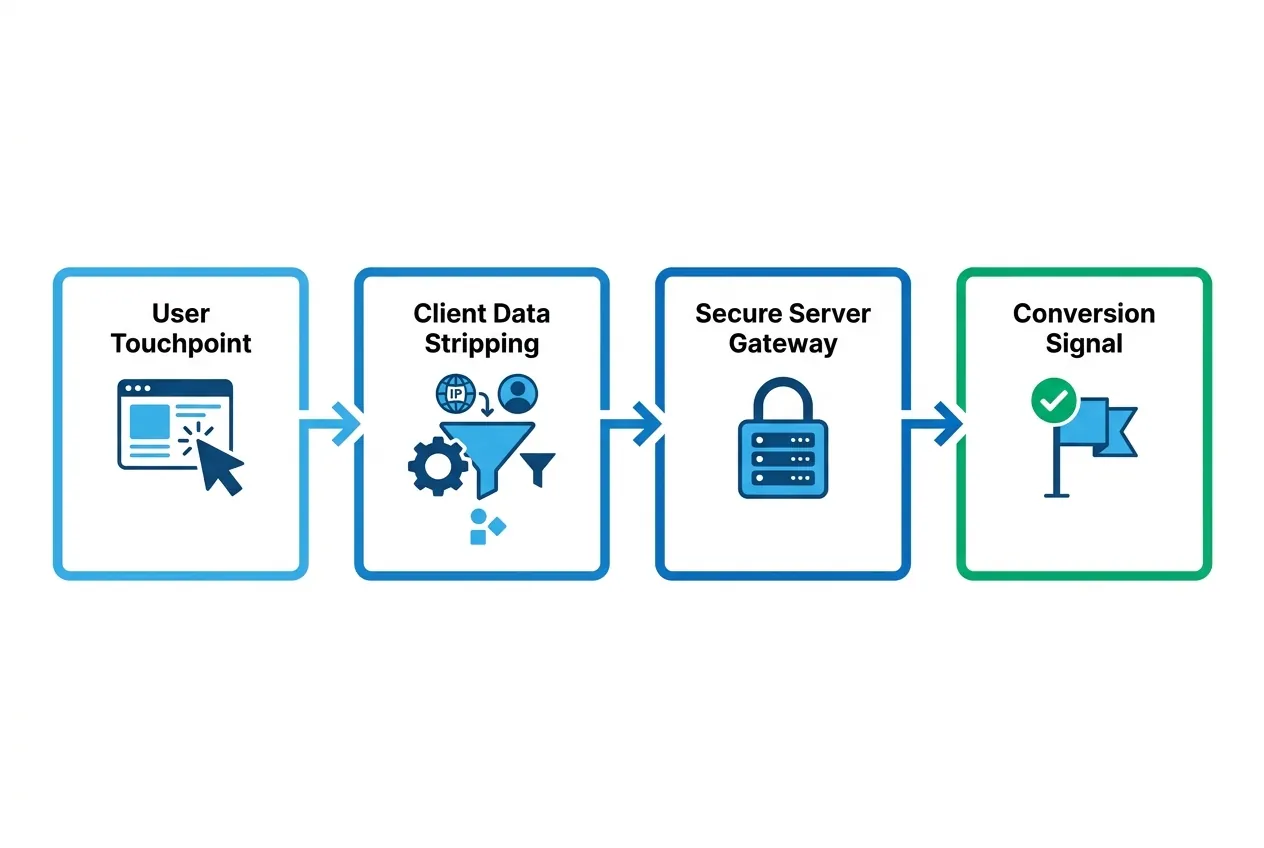
- Client-Side Data Stripping: Removing IP addresses, query strings, and personal health context before events hit downstream analytics tools.
- Encrypted Identifiers: Utilizing transient, randomly generated session keys to stitch multi-touch paths without storing identifiable patient records in marketing databases.
- Server-Side Gateways: Running proxy servers that inspect and sanitize outbound conversion pings, ensuring ad networks receive only the mathematical signal needed for bid optimization.
Understanding what data points can be tracked without compromising patient privacy is detailed further in Call tracking: how it works and what to measure beyond call volume.
How Marketing Attribution Management Changes Media Allocation
Systematic marketing attribution management alters how marketing executives deploy capital. When organizations rely on blended cost-per-lead (CPL) reporting, they tend to over-index on generic search terms and broad social campaigns that look inexpensive on paper.
When offline conversion imports and call attribution are activated, the economics often flip. A search campaign with a $180 cost-per-lead may appear inefficient next to an $85 display campaign. However, closed-loop tracking reveals that the $180 search campaign yields an 18 percent intake rate with high lifetime value, while the $85 campaign produces disconnected numbers, out-of-network inquiries, and zero verified admissions.
Attribution management transforms the optimization target from raw inquiry volume to verified unit economics:
- Optimization Target. Unmanaged Platform Reporting: Form submissions and raw clicks. Closed-Loop Attribution Management: Admitted patients, closed deals, and revenue.
- Bidding Strategy. Unmanaged Platform Reporting: Maximize Conversions (volume-driven). Closed-Loop Attribution Management: Target CPA / Target ROAS on verified milestones.
- Call Visibility. Unmanaged Platform Reporting: Total call count and duration. Closed-Loop Attribution Management: Keyword-level call routing tied to CRM intake status.
- Channel Credit. Unmanaged Platform Reporting: Overlapping, duplicative platform claims. Closed-Loop Attribution Management: Deduplicated, cross-channel interaction models.
- Compliance Posture. Unmanaged Platform Reporting: Third-party pixels exposed to PHI/PII. Closed-Loop Attribution Management: Server-side data isolation with zero data leakage.
With deduplicated data flowing into your CRM, marketing leadership can confidently cut underperforming ad groups, reallocate budget to high-yield geographic territories, and defend media spending in board-level financial reviews.
Vetting a Partner: Infrastructure, Contracts, and Technical Due Diligence
Retaining an attribution agency requires deeper technical due diligence than hiring a traditional creative or media-buying shop. A vendor can register a business entity, form an attribution-focused enterprise, and resell off-the-shelf software without understanding server infrastructure or platform privacy guidelines.
Use this operational checklist when vetting a potential measurement partner:
- Data Ownership and Pipeline Portability: Does the agency build tracking containers inside your corporate Google Tag Manager, AWS, or Google Cloud accounts, or do they force your data through their proprietary, locked dashboard? Your organization must own its historical conversion logs and server configurations.
- Technical Architecture and Server Routing: Can the firm demonstrate how they configure server-side containers and offline conversion uploads? Ask them to diagram how they handle ad click identifiers without passing unhashed personal data to advertising platforms.
- Regulatory Literacy: If you operate in healthcare or a regulated market, does the agency demonstrate working knowledge of HHS tracking guidance, LegitScript requirements, and platform sensitive-category ad policies? Can they explain how they track conversions when retargeting is prohibited?
- Intake and CRM Integration Depth: Attribution fails if tracking stops at the marketing database. Does the partner have direct experience writing scripts, webhooks, and API connections for your specific intake CRM (such as Salesforce, HubSpot, or industry-specific intake platforms)?
- Operator Experience: Has the partner managed large-scale paid media budgets in restrictive verticals? A firm with practical operational depth understands how bidding algorithms react when you switch optimization signals from raw form submissions to qualified offline conversions.

Email Us
Prefer to send the context directly?
Data and Analytics Architecture at Marketing Powered
Marketing Powered approaches attribution from an operator-led perspective. Our leadership includes a former healthcare CMO who ran marketing operations for a treatment network that expanded from 3 to 24 locations, managing $1.5 to $2M per month in Google Ads across 11+ behavioral and mental health accounts. We also bring the analytical rigor of a court-certified expert witness in advertising strategy.
Being AI-native since 2022, we engineer attribution systems specifically for complex, regulated environments. Our implementations are built for Google's sensitive healthcare vertical, where retargeting is not permitted and measurement must remain LegitScript-aware and HIPAA-aware. We deploy owned, local AI infrastructure for privacy-aware inference, ensuring your proprietary operational data is never exposed to public machine learning models.
We do not track superficial web actions and call it success. Our data and analytics architecture integrates server-side tagging, dynamic call tracking, and automated offline conversion feeds to measure marketing performance through to verified admission or signed customer. To see how we configure these pipelines for multi-location healthcare systems, hospitals, and specialized professional services, review our approach to data and analytics architecture: attribution, call tracking and first-party data.
Questions, Answered.
Attribution software is an application that records website touches and models paths to conversion. A marketing attribution company is a team of data engineers and media strategists who configure your tracking infrastructure, integrate your CRM, sanitize tracking data for regulatory compliance, and align platform bidding strategies with verified sales data. Software alone cannot fix broken intake logging, incomplete webhook handshakes, or non-compliant pixel deployments.
Yes. Compliance requires moving away from browser-based third-party tracking scripts and implementing server-side data routing. By capturing click parameters through a first-party proxy, filtering out protected health information and IP addresses, and executing Business Associate Agreements with measurement vendors, organizations can track offline conversions safely. This feeds optimization data to ad platforms without exposing confidential client actions.
A standard implementation typically takes between four and eight weeks, depending on the complexity of your intake process and CRM architecture. Phase one establishes server-side tagging and dynamic call tracking pools. Phase two maps CRM lifecycle stages and builds webhook feeds. Phase three initiates offline conversion imports into ad accounts to transition bidding algorithms toward qualified business milestones.
Ad networks operate in silos. If a buyer interacts with a paid search ad, views a display retargeting banner, and later clicks an email link, each ad network may register a conversion within its individual dashboard. Furthermore, ad platforms count top-of-funnel actions (such as duplicate form submissions or misdialed calls) as successful conversions. An attribution agency deduplicates these events, reconciles cross-channel interactions, and matches events against verified records in your database. Request an acquisition audit
Ready to see where your marketing can improve?
Request a free audit of your paid media, landing pages, attribution, and measurement setup. You'll get a straight assessment of where the opportunities are.
or email us at info@marketingpowered.ai