Capabilities
AI Agents for Marketing Agency Selection and Deployment
Enterprise growth leaders are shifting away from standalone software copilots toward deterministic, multi-agent architectures that connect directly to core acquisition systems. Choosing the right partner to deploy ai agents for marketing agency operations requires inspecting data ownership, model governance, and closed-loop attribution rather than accepting surface-level generative wrappers. High-performing organizations use these systems to lower customer acquisition costs while maintaining strict control over proprietary business data.

Beyond the Surface: What Agency Marketing Looks Like Today
To understand the impact of autonomous systems, executives must first examine what agency marketing has traditionally entailed. For decades, agency engagements centered on selling human billable hours. Media planners manually pulled spreadsheet reports, copywriters drafted variant headlines individually, and account managers spent days reconciling campaign performance across disconnected dashboards. That labor-heavy posture incentivized agencies to expand headcount rather than build operational efficiency, passing the cost of repetitive administrative overhead onto the client.
In an agentic model, that dynamic reverses. Instead of relying on teams of coordinators to adjust bid targets or assemble weekly reporting decks, an agency deploys specialized software agents that run continuous verification loops. In a live production environment, human strategists establish campaign boundaries, compliance rules, and conversion definitions, while autonomous agents execute the underlying data collection, anomaly detection, and creative staging.
This transition fundamentally shifts the agency relationship from renting junior staff time to licensing managed operational infrastructure. Human oversight remains mandatory, but human effort concentrates on creative differentiation, offer engineering, and unit economics. Routine technical executions operate continuously in the background, governed by explicit protocol constraints.

Core Architectures: How AI Agents for Marketing Automation Work
Deploying ai agents for marketing automation involves far more than connecting single prompts to consumer chat interfaces. A basic automation runs a linear sequence, such as sending a notification when a web form is submitted. In contrast, an agentic system is stateful and autonomous: it maintains contextual memory, evaluates the quality of its own intermediate steps, and selects specific tools to accomplish complex goals.
A robust multi-agent architecture splits marketing execution into discrete, specialized roles:
- Ingestion and Analytics Agents: Connect directly to ad network application programming interfaces (APIs), call tracking platforms, and customer relationship management systems. These agents audit live search queries, calculate cost per acquisition anomalies, and flag creative fatigue before human analysts notice the shift.
- Context Retrieval Agents: Use vector databases and private enterprise knowledge repositories to ground marketing assets in accurate product specifications, brand guidelines, and regulatory requirements.
- Drafting and Assembly Agents: Generate structured campaign variations based on live performance signals, producing ad copy, email sequences, or landing page adjustments tailored to distinct buyer segments.
- Validation and Compliance Agents: Screen every generated asset against strict policy rules before any human review. In regulated sectors, these agents verify regulatory disclosures, ban prohibited terms, and confirm platform policy compliance.
This multi-agent division of labor prevents hallucinations. When each agent has an isolated task and access to deterministic validation tools, the system operates as a dependable production pipeline rather than an unpredictable chat prompt.
Operational Velocity: Deploying AI Agents for Marketing Teams
Integrating ai agents for marketing teams does not replace internal marketing leadership. Instead, it eliminates the operational friction that stalls strategic execution. In mid-market and enterprise organizations, internal marketing departments spend hundreds of hours each quarter managing repetitive manual updates across search engines, content management systems, and paid social platforms.
A specialized partner integrates autonomous agents directly into existing marketing team workflows. For instance, in technical search engine optimization, an agent system can continuously monitor indexation health, verify structured data schema across thousands of dynamic location pages, and draft precise metadata updates whenever platform guidelines change. Rather than burdening internal developers with administrative site audits, technical marketers receive pre-validated pull requests ready for approval.
In paid advertising, agent systems perform exhaustive negative keyword mining and search term categorization across multi-location accounts. Instead of a media buyer spending hours filtering out non-converting traffic, specialized agents evaluate query intent against historical conversion records, automatically staging negative keywords that prevent wasted ad spend. Internal teams retain full governance through review dashboards, shifting their daily focus from manual data entry to strategic resource allocation.
Free Audit
Want a straight read on where your budget is leaking?
Commercial Alignment: AI Agents for Marketing and Sales Pipelines
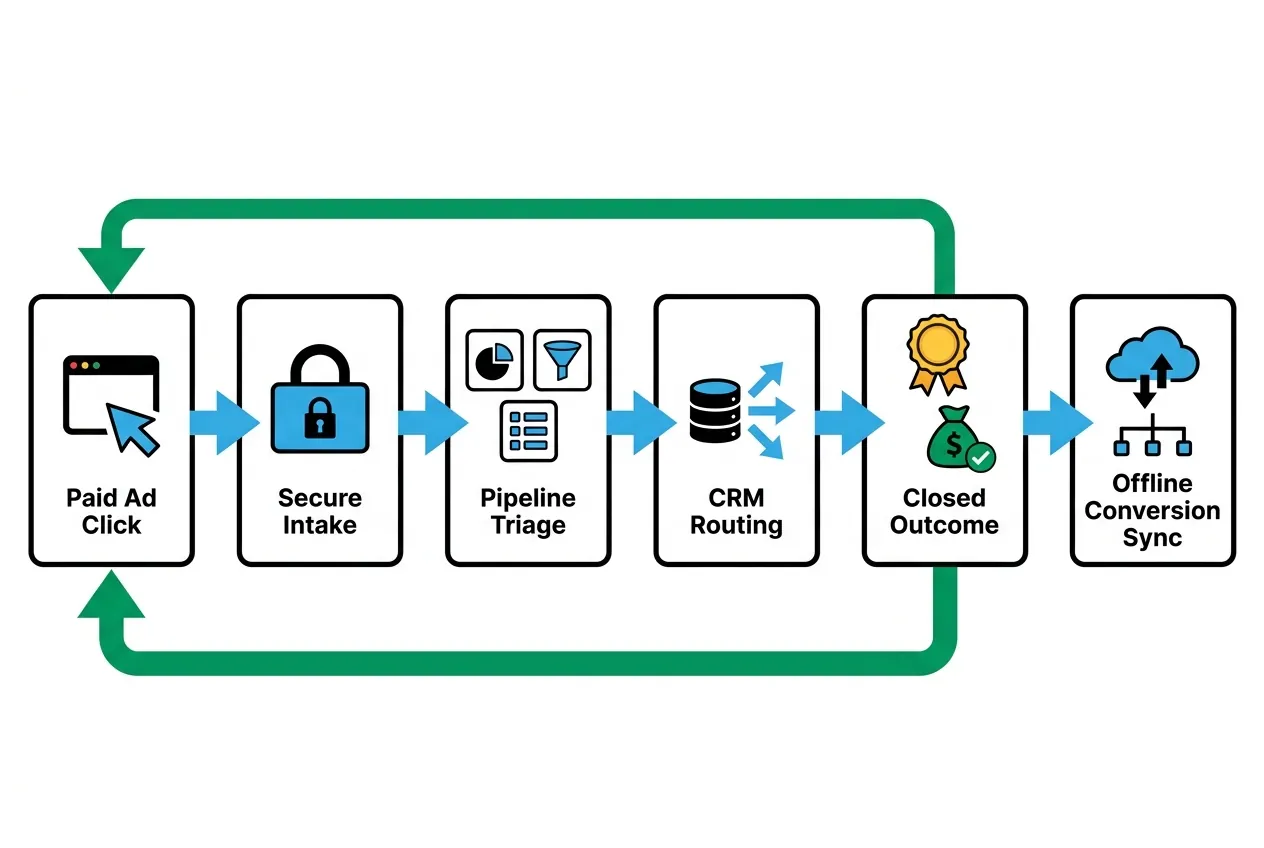
Marketing systems fail when they optimize for surface-level engagement instead of realized revenue. Standard agency automations often flood internal intake desks with low-intent contact form submissions that drive down apparent cost per lead while increasing the workload on sales personnel. Implementing ai agents for marketing and sales ensures acquisition campaigns optimize for closed transactions, signed contracts, or verified patient admissions.
Connecting marketing agents to commercial pipeline data requires rigorous data integration.
This alignment becomes critical in regulated sectors. In healthcare marketing, the United States Department of Health and Human Services enforces strict standards under its guidance on online tracking technologies, restricting the transmission of protected health information to commercial ad trackers. Simultaneously, advertising platforms enforce strict category restrictions; for instance, the Google Ads personalized advertising policy prohibits retargeting based on personal health conditions.
Specialized agents resolve this tension by operating on the organization's private infrastructure. An intake agent verifies form submissions, qualifies intent, and records offline conversions within the internal database. The system then passes privacy-compliant, anonymized conversion signals back to ad platforms through server-side APIs, allowing bidding algorithms to optimize for actual customer value without exposing sensitive user information.
Platform Limits: When AI Agents Automate Workflows with Copilot Tools
Many enterprise organizations attempt to build agent capabilities entirely inside general-purpose workplace platforms. While using ai agents for marketing automate workflows with copilot extensions can assist with internal document drafting or meeting summaries, enterprise copilots exhibit significant limitations when tasked with running high-stakes marketing infrastructure.
General-purpose office copilots are broad generalists designed for individual desktop productivity. They lack native connectors to ad auction APIs, cannot perform deterministic multi-touch attribution calculations, and do not execute multi-step optimization loops across third-party marketing tools. Furthermore, running specialized marketing tasks through generic cloud copilots exposes organizations to escalating per-seat licensing fees and token consumption costs that scale poorly across high-volume data operations.
Most critically, public cloud copilots process enterprise context within multi-tenant commercial cloud environments. For businesses in healthcare, financial services, or legal markets, routing sensitive customer intake records, pricing strategies, or proprietary campaign analytics through multi-tenant tools introduces compliance exposure. Specialist partners bypass these constraints by engineering purpose-built agent stacks that run on private infrastructure, separating everyday workplace productivity software from core revenue-generating marketing operations.
Controlled Execution: How Marketing Powered Deploys Specialized Systems
Marketing Powered engineers and manages AI-native marketing systems designed for accountable commercial outcomes. Founded by a former healthcare chief marketing officer who ran marketing for a treatment network that grew from 3 to 24 locations, the firm approaches automation from direct operational experience rather than theoretical software reselling. That background includes managing $1.5 to $2M per month in Google Ads across 11+ behavioral and mental health accounts, operating under high scrutiny where advertising failure directly impacts business survival.
The agency has operated as AI-native since 2022. Because our background was forged in Google's sensitive healthcare vertical, where retargeting is not permitted and marketing operations must remain LegitScript-aware and HIPAA-aware, our technical architecture is built around data sovereignty. Marketing Powered utilizes owned, local AI infrastructure for HIPAA-aware inference, processing sensitive data within controlled environments rather than routing private records through third-party cloud wrappers.
Every agent system we deploy connects front-end demand creation directly to back-end pipeline realities. Attribution is tracked to admission or signed contract, not just lead creation. By combining custom agent orchestration with deep media-buying discipline, our founder, who is also a court-certified expert witness in advertising strategy, ensures that automation protects brand equity, preserves compliance boundaries, and drives verified commercial growth.

Email Us
Prefer to send the context directly?
Evaluating AI Agents for Marketing Agency Operations
Selecting an external partner to architect and manage marketing agents requires rigorous technical due diligence. Enterprise buyers should look past polished user interfaces and evaluate candidates against four structural criteria:
- Data Sovereignty and Infrastructure Location: Ask the agency where client data resides during model inference. If their agents pass raw customer intake forms, patient inquiries, or proprietary campaign data through public software interfaces, the organization inherits unmanaged regulatory risk. A competent partner demonstrates clear boundary controls, zero-retention data pipelines, or local model deployment for sensitive workloads.
- Closed-Loop Attribution Methods: Inquire how agent workflows connect to actual sales or clinical admissions. If the partner measures success solely through platform-reported metrics like impressions, clicks, or unvalidated form fills, their agents will optimize for cheap volume rather than enterprise revenue. Demand proof of server-side, offline conversion synchronization.
- Deterministic Validation Layers: Require the agency to demonstrate their error-handling and validation mechanisms. Ask what prevents a generative copy agent from publishing unapproved claims or violating advertising platform guidelines. Reliable architectures feature deterministic code layers, policy-checking agents, and human approval gates that inspect all assets before release.
- Domain Experience in Regulated Sectors: Inquire about the partner's historical experience managing complex compliance mandates. Operating marketing systems in heavily regulated verticals, such as healthcare, hospital networks, or financial services, requires deep familiarity with platform restrictions, certification frameworks, and data handling protocols.
For organizations evaluating overall strategy, our analysis of AI marketing: what it changes for strategy, teams and budgets provides a broader executive roadmap. Similarly, reviewing our guides on an AI marketing agency: how to evaluate one beyond the label and selecting a Generative engine optimization agency: what a specialist partner delivers and how to vet one will help teams assess technical readiness across channels.
Questions, Answered.
Agency marketing in an AI-native model replaces manual hourly billing with managed software systems, proprietary agent workflows, and expert human strategy. Instead of paying junior agency staff to execute repetitive administrative tasks, the client pays for an engineered growth system where specialized agents handle data aggregation, campaign auditing, and creative assembly under the direction of senior marketing operators.
Standard automations follow rigid, linear rules: if a specific trigger occurs, execute an invariant action. AI agents maintain state, analyze context, and select from multiple tools based on intermediate results. An agent can read an incoming lead, verify data validity against an external database, analyze the visitor's intent, draft a tailored communication, and adjust ad spend allocation dynamically without requiring human intervention for every branch of logic.
No agency can promise fixed conversion numbers or revenue figures, as ad auction dynamics, market demand, and internal sales execution directly influence performance. However, deploying agentic marketing infrastructure establishes clear attribution tracking, eliminates manual production errors, and ensures campaign budgets optimize dynamically toward high-intent sales or admissions rather than hollow engagement metrics.
Off-the-shelf copilots function well for desktop word processing and spreadsheet tasks, but they lack the platform-specific APIs, deterministic safety controls, and real-time bid optimization capabilities required to manage scalable acquisition media. Custom agent systems connect directly to private business databases, maintain strict data boundaries, and integrate with sales pipelines to produce measurable financial returns. Talk with Marketing Powered about owning your marketing AI stack
Ready to see where your marketing can improve?
Request a free audit of your paid media, landing pages, attribution, and measurement setup. You'll get a straight assessment of where the opportunities are.
or email us at info@marketingpowered.ai