Resources
Is Google Analytics HIPAA Compliant? | Use Cases
Google Analytics is not HIPAA compliant on its own because Google will not sign a Business Associate Agreement for the service. When standard tracking tags collect IP addresses, device identifiers, and clinical URL parameters from healthcare websites, that data transmission creates direct regulatory exposure under federal privacy rules. Healthcare organizations can still measure marketing performance effectively, but only by establishing a compliant proxy architecture that sanitizes data before it reaches Google servers.
By Mike Hulick, Founder, Marketing Powered

What Constitutes PHI in Web Analytics: Lessons from HHS OCR Guidance
The Core Legal Conflict: Why Google Will Not Sign a BAA for Analytics
The fundamental compliance breakdown between healthcare entities and Google Analytics is contractual. Under the Health Insurance Portability and Accountability Act (HIPAA) Privacy Rule, any vendor that creates, receives, maintains, or transmits Protected Health Information (PHI) on behalf of a covered entity is classified as a business associate. A covered entity cannot legally share identifiable health data with a vendor without an executed Business Associate Agreement (BAA).
Google explicitly details its business associate coverage across enterprise services. As outlined in the Google Cloud HIPAA Compliance guidelines, Google will sign a BAA for specific Google Cloud Platform services and Google Workspace applications. However, Google Analytics is deliberately excluded from that eligible services list. Google has maintained this boundary across both Universal Analytics and Google Analytics 4 (GA4).
Because Google refuses to accept legal status as a business associate for Google Analytics, the platform must be treated as an untrusted third-party endpoint. Account settings, administrative toggles, or data retention limits inside the GA4 interface cannot cure this contractual absence. If any web request sent to GA4 contains information that meets the statutory definition of PHI, a regulatory violation occurs at the moment of transmission.
Organizations evaluating their analytics infrastructure must distinguish between vendor capabilities and contractual commitments. Software cannot be deemed compliant simply because it features encryption at rest or access control permissions. Without a signed BAA, the legal responsibility for any protected data landing on Google servers rests entirely on the healthcare provider. For marketing and operations leaders, this reality requires re-evaluating every page where standard tags are deployed, as detailed in our guide on HIPAA compliant analytics.
To determine analytics risk, marketing teams must examine the specific data payloads transmitted by default tracking scripts. When a user visits a webpage equipped with standard GA4 code, the script automatically gathers the visitor's IP address, browser user-agent string, unique client identifier (stored in the _ga first-party cookie), page URL, and page title.
The Department of Health and Human Services (HHS) Office for Civil Rights (OCR) highlighted the privacy implications of these automated payloads in its published bulletin. As explained in the HHS OCR Tracking Guidance, tracking technologies deployed on covered entities' websites collect digital identifiers that often qualify as Individually Identifiable Health Information (IIHI).
Under HIPAA, health information is identifiable if it identifies an individual or if there is a reasonable basis to believe the information can be used to identify an individual. Standard digital identifiers, including static or dynamic IP addresses and persistent cookie values, meet this identification threshold when connected to health contexts.
Consider an unauthenticated web user searching for specialty medical care. If that individual visits a page with the URL path /conditions/bipolar-disorder-treatment or /addiction-medicine/inpatient-detox, the request payload connects the user's IP address and device identifier with a specific clinical condition and treatment intent. When that payload transmits to a vendor without a BAA, the interaction constitutes an impermissible disclosure.
The issue becomes more severe when internal site search terms, form metadata, or click events pass query parameters containing patient names, email addresses, or appointment requests directly to third-party endpoints. Reviewing these vulnerabilities is critical to managing HIPAA digital marketing risk across digital properties.

The AHA v. Becerra Decision: What Changed for Public Pages
In response to enforcement actions, healthcare providers challenged the administrative reach of federal tracking guidance. On June 20, 2024, the legal landscape shifted through a major federal court decision that clarified tracking boundaries on public websites.
In the case of American Hospital Association v. Becerra, the U.S. District Court for the Northern District of Texas vacated the specific portion of the OCR tracking guidance that classified an unauthenticated public webpage visit paired with an IP address as automatic PHI. As documented in the AHA v. Becerra District Court Decision, the court ruled that the OCR exceeded its statutory authority by assuming that a visitor's subjective, unexpressed intent could transform ordinary metadata into protected health data. The court held that an IP address connected to a general, public web page visit does not inherently reveal an individual's past, present, or future health condition.
This decision established essential legal distinctions that marketing leaders must understand:
- Public Informational Content: Browsing general health education, physician directories, or hospital facility locations on unauthenticated public pages does not automatically trigger PHI status merely because an IP address is captured.
- Authenticated Portals Remain Fully Protected: The court ruling did not alter protections for authenticated areas. Patient portals, electronic health record (EHR) logins, and billing systems remain strictly governed by HIPAA. Direct analytics scripts deployed inside authenticated environments violate federal privacy rules.
- Interactive Intake Pages Carry Ongoing Risk: Webforms, symptom checkers, direct appointment scheduling interfaces, and consultation request pages involve explicit disclosures of individual condition or intent. These interactive touchpoints fall outside the protective scope of the AHA ruling.
While the ruling gives healthcare organizations greater leeway on general marketing pages, it does not provide blanket immunity for unchecked analytics implementations. Transmitting identifiable user entries, form values, or unique patient records to non-BAA vendors remains a significant regulatory liability.
High-Risk Use Cases: Where Standard GA4 Implementations Fail
Standard analytics setups fail most frequently where marketing conversion funnels intersect with clinical workflows. Healthcare organizations running paid acquisition campaigns across regulated service lines often create high-risk data exposures without realizing it.
Patient Portals and Authenticated Systems
Deploying GA4 within patient portals, patient management platforms, or telehealth waiting rooms represents the most direct privacy violation. In these spaces, every user session is tied to an active, identifiable patient record. Passing session paths, button clicks, or document downloads to a non-covered vendor breaches HIPAA security and privacy rules.
Behavioral Health and Substance Use Disorder Funnels
In behavioral and mental health marketing, statutory exposure extends beyond HIPAA. Confidentiality protections under Title 42 of the Code of Federal Regulations, Part 2, impose strict disclosure limits on substance use disorder patient records, as detailed in the SAMHSA 42 CFR Part 2 Revised Rule.
Marketing campaigns targeting acute behavioral treatment often use landing pages featuring deep clinical detail, such as medical detox protocols or psychiatric admission forms. Transmitting page interactions and form drop-offs from these specialized pathways to standard analytics tools exposes sensitive clinical records that carry elevated federal penalties.
Online Appointment Scheduling and Pre-Screening Forms
Many healthcare websites embed third-party scheduling widgets or digital pre-screening questionnaires. When a user enters contact information alongside clinical symptoms or medical history, native browser tags can automatically capture those form inputs via URL query parameters, page triggers, or DOM scraping. If GA4 collects these parameters alongside device IDs, the organization transmits identifiable health records to an unauthorized downstream system.
Dynamic Call Tracking and Lead Capture
Running paid media campaigns requires tracking phone inquiries and web submissions. Standard call tracking scripts that mirror visitor data into GA4 events can inadvertently push caller phone numbers, recorded call durations, and call transcription keywords into analytics event payloads. Without strict data isolation, these operational metrics contaminate analytics property reporting with protected information.
Free Audit
Want a straight read on where your budget is leaking?
Server-Side Tagging and Data Cleansing Architecture
To reconcile the need for campaign measurement with strict privacy regulations, healthcare organizations must abandon client-side tracking in favor of an isolated, HIPAA-governed proxy architecture. In this framework, tracking code on the user's browser never communicates directly with Google Analytics.
This privacy-first pipeline operates across four technical stages:
- First-Party Data Collection: The visitor's browser sends tracking events exclusively to a custom subdomain owned and operated by the healthcare provider (such as data.organization.org). Because this endpoint is treated as first-party communication, it avoids third-party browser restrictions and remains within the provider's direct perimeter.
- The BAA-Covered Processing Layer: The server endpoint runs on infrastructure backed by a fully executed Business Associate Agreement, such as Google Cloud Platform or private server instances. This proxy server receives the incoming web request, holding the data safely within a compliant operational boundary.
- Algorithmic Data Cleansing: Before forwarding any session data downstream, the server-side application processes the payload. It permanently strips raw IP addresses, parses URL paths to remove sensitive clinical keywords or query strings, removes personally identifiable form inputs, and transforms persistent user IDs into non-reversible, synthetic tokens.
- Sanitized Outbound Transmission: Only after the payload is stripped of all eighteen HIPAA identifiers does the proxy dispatch an event call to the GA4 Measurement Protocol API. Google Analytics receives clean, aggregated behavioral metrics without ever ingesting or storing protected health information.
This architecture satisfies both compliance officers and marketing teams. The organization preserves visibility into channel performance, traffic volume, and page conversions while ensuring that unauthorized vendors never gain access to patient identifiers.
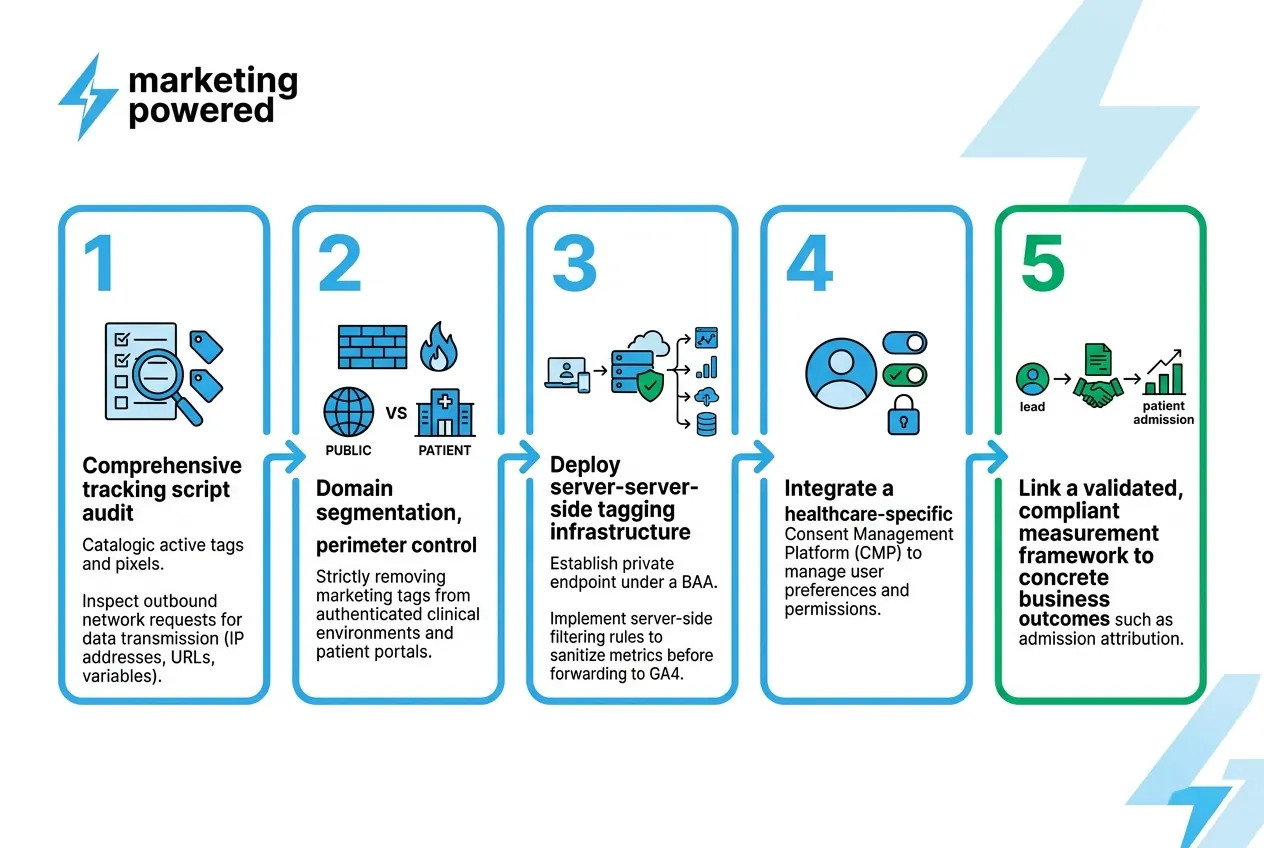
Implementation Guide: Step-by-Step Compliance Governance
Transitioning an organization from client-side vulnerability to a resilient measurement framework requires coordination between marketing leadership, IT engineering, and legal counsel. The following roadmap outlines the operational phases for secure implementation.
Phase 1: Comprehensive Tracking Script Audit
Begin by cataloging every tag, pixel, and script active across digital properties. Use developer tools or specialized tag scanners to inspect outbound network requests on public pages, intake pages, and scheduling confirmation paths. Document what data each script transmits, paying specific attention to IP addresses, URL query parameters, and custom event variables.
Phase 2: Domain Segmentation and Perimeter Control
Segregate public marketing pages from authenticated clinical environments. Remove all marketing analytics tags from patient portals, telehealth access points, and clinical assessment systems. Establish strict firewall boundaries preventing client-side tags from loading within any URL path associated with patient records or post-intake interactions.
Phase 3: Deploy Server-Side Tagging Under a BAA
Procure and configure server-side infrastructure on a cloud provider that signs a BAA. Point website tag managers to this private endpoint. Implement routing rules within the server container that automatically intercept, sanitize, and validate every outgoing request before forwarding metrics to GA4.
Phase 4: Configure Consent Management Platforms
Integrate a healthcare-aware Consent Management Platform (CMP). Configure consent banners to block non-essential tracking technologies until the user provides active authorization, adhering to state privacy regulations and regional consumer protection statutes. Ensure that consent records are maintained systematically for auditing purposes.
Phase 5: Establish Attribution to Admission
Rather than relying on third-party ad networks to track sensitive conversions, build an internal attribution mechanism. Our operational approach uses first-party data capture to track attribution through to verified admission, rather than stopping at the raw lead or webform submission. By processing sensitive clinical admissions within HIPAA-aware, owned infrastructure, marketing leaders can accurately measure return on ad spend without exposing patient records to ad platforms or analytics tools.
The Operational Reality: What Analytics Data Cannot Prove
When deploying privacy-safe analytics, marketing and clinical operations teams must understand the technical limits of the resulting data. Data sanitization protects patient rights, but it changes reporting dynamics in specific ways.
Stripping client identifiers and truncating IP addresses breaks long-term user stitching across separate sessions. A user who researches treatment on a mobile device and later completes an intake questionnaire on a home desktop will appear as two separate, anonymous sessions in GA4. Server-side proxying deliberately destroys cross-device tracking to maintain individual privacy.
Furthermore, compliance rules prevent the use of Google Analytics native audience-building features for healthcare remarketing. In Google's sensitive healthcare vertical, behavioral retargeting based on medical conditions or treatment history is strictly prohibited by platform policy. Marketers cannot pass health-related event data to GA4 to create custom remarketing lists or seed lookalike audiences.
Understanding these constraints prevents misallocated resources. The purpose of Google Analytics in a regulated healthcare environment is to evaluate aggregate channel efficiency, measure landing page engagement, and understand high-level traffic patterns. Patient intake validation, admission reporting, and revenue attribution must remain safely housed inside secure, BAA-backed systems of record.
Questions, Answered.
No. Google will not sign a BAA for Google Analytics 4 under either standard or 360 enterprise accounts. While Google signs BAAs for Google Cloud Platform and Google Workspace, Google Analytics remains excluded from HIPAA-eligible services.
No. In GA4, IP anonymization is active by default, but it does not make the tag compliant on its own. Outbound web requests still expose the user's raw IP address to Google servers during the connection handshake. Furthermore, GA4 still collects unique pseudo-anonymous cookie IDs, page URLs, and device attributes that can constitute PHI when associated with clinical content.
Following the June 2024 AHA v. Becerra ruling, tracking an unauthenticated user's visit to a general homepage alongside an IP address does not automatically constitute a HIPAA violation. However, if that homepage contains interactive scheduling widgets, symptom assessments, or forms that capture health-seeking intent, unmanaged tracking tags remain a major legal risk.
The HHS Office for Civil Rights enforces civil monetary penalties for HIPAA violations that range from statutory minimums to annual statutory maximum caps exceeding one million dollars, depending on the tier of negligence. Organizations also face significant liability from state attorney general investigations and private class-action litigation under federal and state privacy statutes.
Healthcare organizations can maintain attribution by combining server-side data cleansing with first-party data architecture. Server-side tracking strips identifiers before metrics reach external analytics platforms. Downstream lead validation and admission tracking are then measured securely inside BAA-backed databases or CRM environments, linking marketing spend directly to admissions without sharing PHI with external ad platforms. Request an acquisition audit
Ready to see where your marketing can improve?
Request a free audit of your paid media, landing pages, attribution, and measurement setup. You'll get a straight assessment of where the opportunities are.
or email us at info@marketingpowered.ai