Resources
HIPAA-Aware Analytics for Healthcare Websites
No analytics tool is "HIPAA compliant" on its own. Whether your setup is appropriate depends on what data you collect, who receives it, and the specific agreements governing that exchange. Hipaa compliant analytics is a documented decision process about data flow, not a product purchase or a certification label from a vendor.
By Mike Hulick, Founder, Marketing Powered

The core compliance question
Teams often search for a list of "HIPAA compliant" tools. That approach misses the regulatory reality: HHS does not certify analytics products. Instead, you must determine if your specific configuration creates a risk of disclosing protected health information (PHI). A recognized platform can be configured unsafely, while a basic tool can be set up defensively.
The central question is not "which brand should we buy?" It is "what data leaves the site, to whom, and under what authority?" If you cannot answer that, you do not have analytics; you have an unmanaged disclosure risk. This guide focuses on behavioral health, mental health, and hospital organizations where the stakes are highest because a page visit can itself reveal sensitive intent.
Understanding your covered entity status
Before configuring any tag, confirm your organization's legal standing. Treatment providers and health systems that conduct certain electronic transactions are typically "covered entities" under the HIPAA Privacy Rule HHS: Who Must Comply. Marketing sites sit in a gray area for many organizations because they may not transmit PHI directly, but they can still expose it through page context.
A site that only publishes general information is different from one that lets visitors verify insurance benefits or request appointments. The latter creates a higher risk profile. Your privacy officer should confirm your status and the scope of the Privacy Rule for your specific website architecture. Do not assume marketing pages are exempt because they are "public." In behavioral health, a URL path like /services/medication-assisted-treatment combined with an IP address can be enough to identify a person’s intent to seek care.
The data-flow decision record
The most useful artifact in this process is a documented decision record. We call it the Page-by-Page Tracking Decision Worksheet. It replaces vague assurances like "we removed the pixel" with an auditable trail of who allowed what, and why.
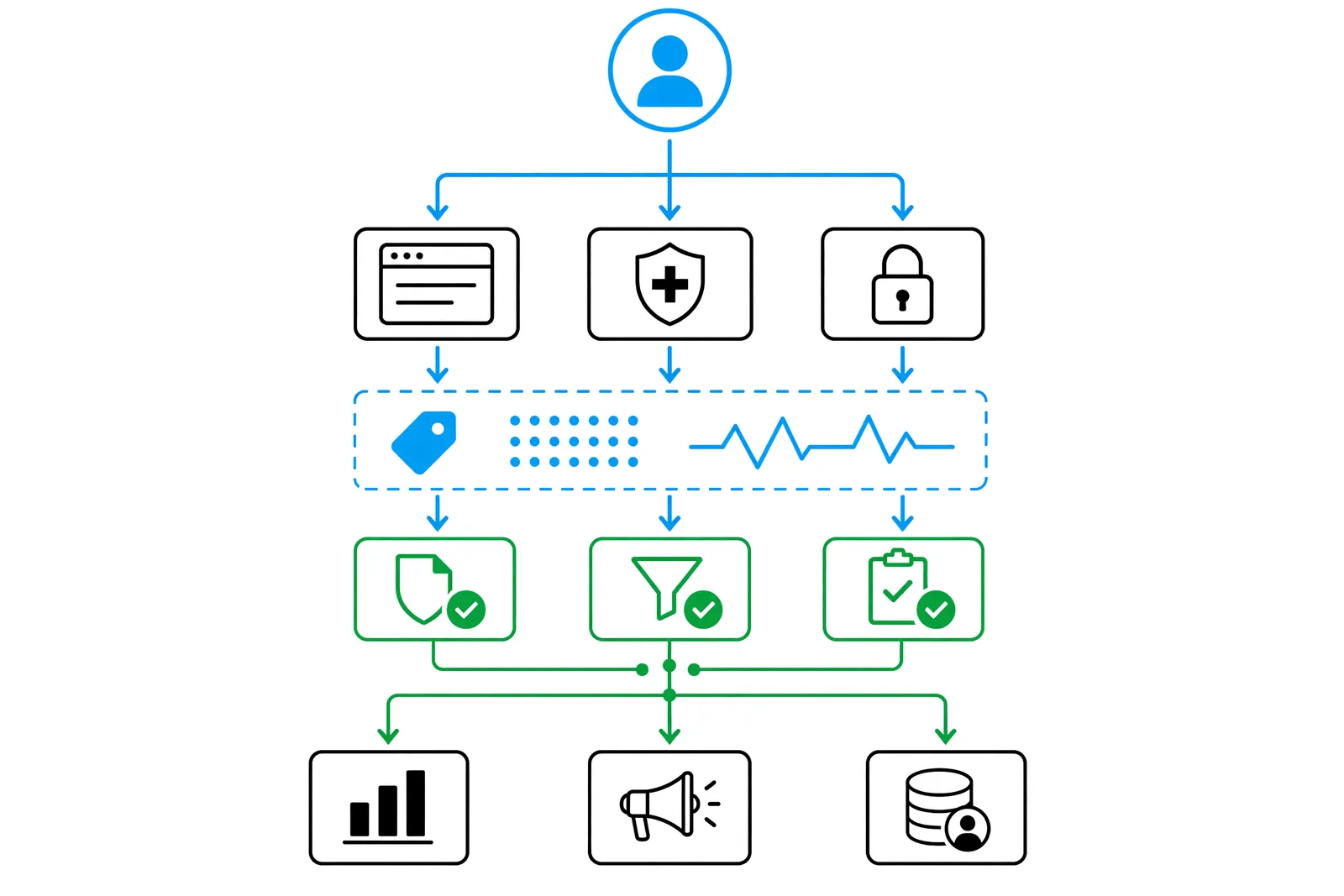
Start by classifying your pages into four risk tiers:
- General Information: Home, about, careers. Lower risk.
- Service & Condition: Program descriptions, condition-specific pages. Elevated risk.
- Intake Entry Points: Contact forms, benefits verification, scheduling. High risk.
- Authenticated: Patient portals, account-linked forms. Highest risk.
For each tier, you must record the permitted events, the recipients (vendors), the business purpose, and the named owner who approved the setup. This worksheet becomes your defense if an audit occurs or a breach investigation begins. It forces marketing, IT, and compliance to align on what is actually happening in the browser.
Free Audit
Want a straight read on where your budget is leaking?
Implementing privacy-safe tracking
Once you have classified your pages, implement controls that match each tier’s risk level. The goal is to keep as much data local as possible while still capturing enough signal to make budget decisions.
Aggregate site analytics: On lower-risk pages, use first-party or self-hosted tools to track session counts and traffic sources. Avoid persistent identifiers like cookies where possible. This tells you which channels drive volume without storing individual user histories.
Call source capture: In healthcare, the call is often the conversion. A reviewed call tracking arrangement can assign a source to each inbound number without relying on page-level tags that might leak context. Ensure your vendor agreement covers this specific service and that recordings are handled according to your retention policy HHS: Business Associates.
Offline reconciliation: Move the definition of "qualified" out of marketing and into intake leadership. Code outcomes in your CRM (e.g., qualified, verified, admitted) and join that data to source attribution at an aggregate level inside your own environment. This creates a defensible view of cost-per-qualified-call without sending identifiable patient outcomes back to ad platforms.
Common mistakes and constraints
Even with good intentions, teams make predictable errors. Here is where the process usually breaks down:
- Treating the tool as the decision. Buying a product because its marketing copy says "privacy-focused" and skipping the data inventory. The configuration matters more than the brand.
- Assuming a BAA settles everything. A Business Associate Agreement covers a specific service relationship. It does not automatically cover every sub-processor or new feature your vendor launches. Review scope annually HHS: BAAs.
- Forgetting embedded vendors. Chat widgets, scheduling embeds, and form builders often load their own scripts that bypass your tag manager. These are unreviewed recipients until you check them.
- Relying on cookie banners. Consent tooling helps with transparency, but it does not resolve the underlying disclosure risk if the data is sensitive by context. In healthcare, consent is not a substitute for minimizing collection.
- Stripping everything without a replacement. Some teams disable all tracking to be safe. The result is a blind spot where budget decisions are made on intuition. You need a measured baseline, even if it is aggregate.

Measuring qualified calls and admissions
Reducing tracking does not mean giving up accountability. It means moving the measurement of outcomes off the website and into systems you control. Where authorized data supports it, this allows you to link acquisition to admissions without sending identifiable information to third-party marketing platforms HHS: De-identification.
Think in four layers of measurement:
- Aggregate site analytics: Count sessions and traffic sources on general pages. This tells you which channels bring visitors.
- Call source capture: Assign a source to each inbound call via reviewed tracking numbers. This is your primary conversion event for many healthcare funnels.
- Qualified definition: Intake leadership defines what "qualified" means (fit, geography, payer). Marketing does not get to define this alone.
- Offline reconciliation: Join CRM outcomes to source data internally. Calculate cost-per-qualified-call and verified-to-admission rates within your own environment.
Be cautious with ad platform conversion imports. Sending an admission event back to a platform can be a disclosure of its own, especially in sensitive health categories. If your reviewers approve it, ensure the event is non-identifying and document that approval in your worksheet.
Email Us
Prefer to send the context directly?
Google Analytics and alternatives
Questions about specific tools like Google Analytics often arise in this context. Our separate guide covers Is Google Analytics HIPAA compliant? with a deep dive into its terms and configuration limits. This page stays tool-neutral because vendor policies change, and a claim about one product must be tied to its current documentation.
If you are researching alternatives, evaluate by category rather than brand:
- Vendors that offer a BAA: Ask which specific service the agreement covers and what data types it permits.
- Self-hosted analytics: Collection stays under your control, but hosting location, access logs, and retention still need review.
- Aggregate or cookieless tools: These reduce identifiers, but confirm exactly what they log before treating them as low risk.
For any option, ask: What data does it receive? Where is it stored? Who can access it? If a vendor cannot answer in writing, treat that silence as a red flag. Your answers go into the decision worksheet, not just the contract drawer.

Take the worksheet into an acquisition audit
If your team has completed the inventory and wants help connecting the compliant parts of your measurement to qualified calls and admissions, request an acquisition audit. We review how paid media, call handling, intake, and reporting connect to identify where measurement is currently blind or exposed. Your compliance team keeps final authority over every regulated decision. For broader context on our approach, see HIPAA-conscious marketing.
Questions, Answered.
A documented combination of a data inventory, a recipient map, agreements that fit each specific use case, verified configuration, and a recorded risk analysis with a named reviewer. The tool brand is one input, not the answer.
HHS does not certify analytics products. You should be skeptical of any vendor claiming certification. Instead, look for vendors that allow you to execute a Business Associate Agreement and configure data handling to meet your privacy needs HHS: Who Must Comply.
It depends on whether the vendor creates, receives, maintains, or transmits protected health information on your behalf. If they do, a BAA is generally required HHS: Business Associates. Your privacy officer should make this determination for each recipient in your stack.
Capture source at the call level, define "qualified" with intake leadership, code outcomes in your CRM, and reconcile to source data at an aggregate level inside your own environment. Avoid sending identifiable outcomes to advertising platforms unless your reviewers have explicitly approved a specific non-identifying event.
If your organization operates a substance use disorder program subject to 42 CFR Part 2, it has its own rules for records and disclosures HHS: 42 CFR Part 2. Whether these rules apply to your marketing analytics is a question for counsel, but the stricter standard should inform your risk assessment.
Ready to see where your marketing can improve?
Request a free audit of your paid media, landing pages, attribution, and measurement setup. You'll get a straight assessment of where the opportunities are.
or email us at info@marketingpowered.ai