Resources
Psychiatry Marketing: An Operator's Guide to Local Search
Psychiatry marketing fails when managed as generic healthcare lead generation instead of a precise clinical routing system. This guide demonstrates how to build an acquisition infrastructure that synchronizes local search intent directly with prescriber availability, protecting intake staff from burnout while systematically filling clinical calendars.
By Mike Hulick, Founder, Marketing Powered

The Financial Cost of Misaligned Acquisition
Search terms in the psychiatric sector carry steep media costs due to high clinical lifetime value and dense local competition. November 2026 Semrush benchmark data identifies cost-per-click values reaching $24.68 for the exact match term "psychiatry marketing," with a monthly search volume of 140 and a keyword difficulty of 7. The variant "psychiatrist marketing" commands an even higher premium at $28.20 per click with a volume of 210 and a difficulty of 14, while "psychiatric marketing" registers 70 monthly searches with a difficulty of 12. When private groups deploy broad paid campaigns against these expensive keyword clusters without a clinical filtering mechanism, the financial drain compounds rapidly.
The immediate casualty of a misaligned campaign is the front desk. Clinic intake coordinators spend a massive percentage of their operational hours disqualifying out-of-network inquiries, redirecting patients seeking weekly psychotherapy rather than medication management, or fielding crisis calls that require acute stabilization rather than outpatient scheduling. Picture a busy intake coordinator toggling between a ringing phone system, an electronic medical record scheduling screen, and an insurance verification portal. When marketing delivers raw, unfiltered lead volume, that coordinator becomes a highly paid triage operator for the wrong patients.
Customer acquisition cost calculations based strictly on top-funnel cost per lead mask catastrophic post-lead drop-offs prior to the initial diagnostic appointment. For psychiatric practices, generating one hundred unqualified phone calls consumes thousands of dollars in front-desk triage labor. Generating twenty pre-screened, insurance-matched inquiries aligned to open prescriber slots yields a profitable, resilient clinic. Marketing success in this vertical must be engineered backward from prescriber panel capacity and downstream appointment attendance.

Navigating Search Advertising Constraints
The behavioral health sector operates under strict advertising regulations that eliminate the most common digital marketing tactics used by e-commerce and general professional services. Most notably, the Google Ads Policies on Personalized Advertising explicitly prohibit targeting users based on personal hardships, which includes mental health conditions, psychiatric diagnoses, and addiction. This policy means that retargeting is not permitted. A psychiatric clinic cannot use tracking pixels to follow a website visitor around the internet with display ads after they read an article about anxiety medication or depression treatments.
Operating successfully within these constraints requires an evidence-first approach to search intent. Managing $1.5 to $2M per month in Google Ads across 11+ behavioral and mental health accounts requires building campaigns entirely around the first-click conversion. Because the practice only gets one opportunity to capture the patient's attention when they actively search for a provider, the landing page must immediately communicate insurance acceptance, geographic location, prescriber availability, and clinical scope.
Furthermore, practices prescribing controlled substances or operating interventional telemedicine models must navigate rigorous third-party verification. Complying with LegitScript Certification Standards is non-negotiable for platforms seeking to run paid search ads for specific pharmaceutical interventions. Building campaigns for Google's sensitive healthcare vertical requires deep familiarity with these compliance frameworks, ensuring that ad copy, landing page claims, and keyword targeting never trigger automated policy suspensions that can freeze a practice's patient pipeline for weeks.
Structuring Dual-Entity Local Search
Patient acquisition in private practice relies heavily on proximity and local search visibility. However, psychiatric groups face a complex structural problem: how to optimize search assets for the primary clinic entity alongside the individual profiles of its medical staff. Generalist agencies frequently create duplicate, competing listings that cannibalize local search authority, leaving both the clinic and the physician buried on the second page of map results.
Effective psychiatrist SEO requires a deliberate dual-entity local search architecture. The strategy begins with claiming and optimizing a primary Google Business Profile for the clinic itself. This primary listing houses the overarching brand, the comprehensive list of accepted commercial insurance networks, the primary intake phone number, and the facility photographs.
Separate, distinct practitioner profiles using individual National Provider Identifiers must then be nested correctly or managed in parallel without triggering Google's duplicate listing penalties. A patient searching for a specific board-certified psychiatrist by name has a different search intent than a patient searching for a local psychiatric clinic. Practitioner profiles should highlight specific sub-specialties, individual board certifications, and direct booking links for that specific prescriber's calendar. By managing these entities as a synchronized network rather than competing assets, a practice dominates local search results, capturing both brand-level intent and provider-specific referrals.
Free Audit
Want a straight read on where your budget is leaking?
Mapping Campaigns to Clinical Service Lines
A psychiatric group is rarely a single monolithic business model. Outpatient clinics typically operate distinct clinical service lines, each requiring an entirely different patient acquisition funnel. Treating all psychiatric marketing as a single campaign inevitably leads to imbalanced prescriber panels and misallocated media budgets.
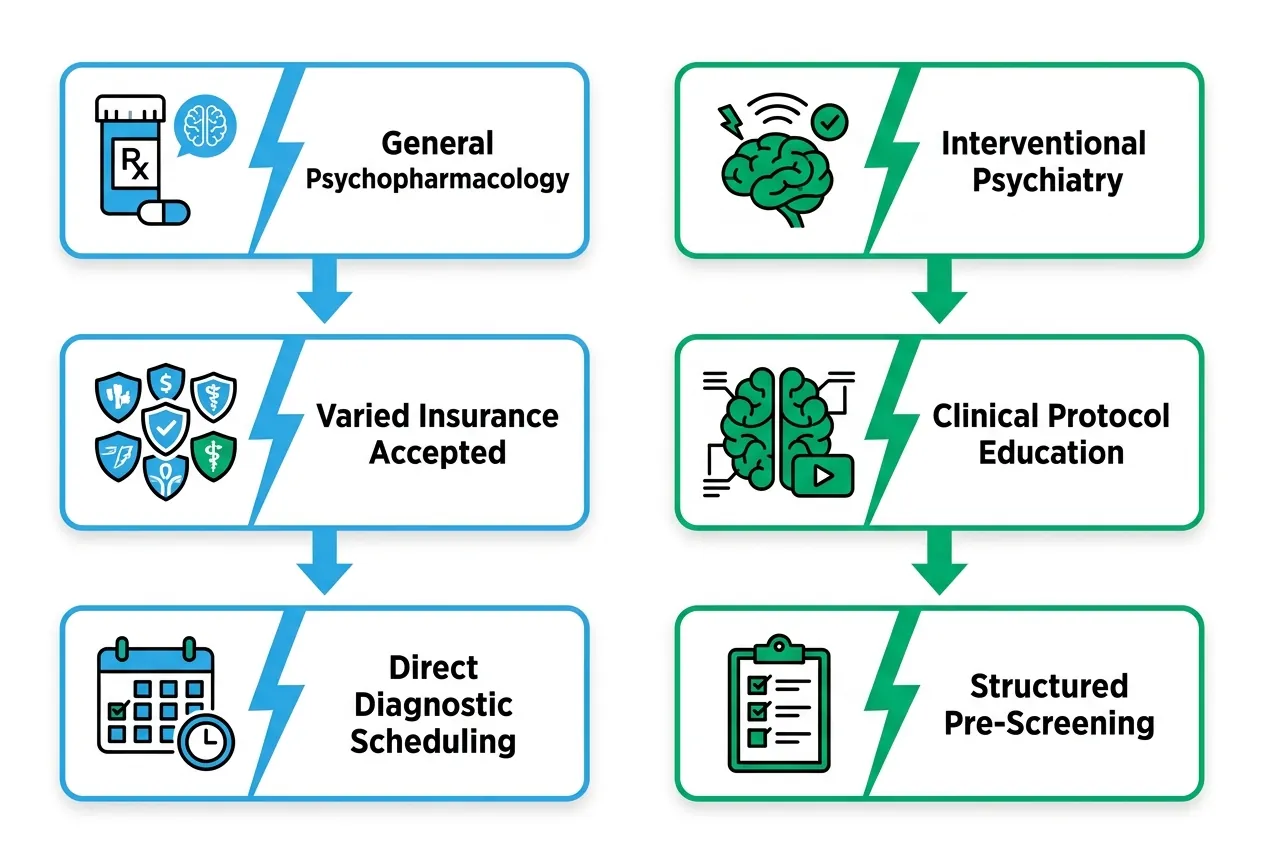
Consider the contrast between general adult psychopharmacology and interventional psychiatry. A general medication management patient journey often involves a high volume of local search queries driven by immediate friction: a primary care doctor referral, a recent lapse in a prescription, or a newly approved commercial insurance plan. The marketing objective here is friction reduction. The landing page must clearly display accepted insurance logos, offer rapid intake scheduling, and set expectations for the initial diagnostic evaluation.
Conversely, the patient journey for high-reimbursement interventional procedures like Transcranial Magnetic Stimulation or esketamine therapy looks entirely different. These treatments represent a significant clinical escalation, often requiring documented treatment-resistant depression and extensive prior authorizations. The search intent is highly investigative. Patients compare efficacy rates, side effect profiles, and facility environments. The marketing collateral must shift from urgent scheduling to profound clinical authority, providing detailed educational videos, transparent out-of-pocket cost breakdowns, and structured consultation workflows. Aligning the campaign architecture directly to these specific service lines prevents high-ticket interventional demand from being buried under general medication management inquiries.
Managing Reviews Within Federal Guidelines
Online reputation directly dictates patient conversion rates in local healthcare markets, yet medical practices face strict regulatory boundaries regarding how they can solicit and manage patient feedback. Practices that attempt to manipulate their online reputation expose themselves to significant legal and platform risks.
The FTC Consumer Reviews and Testimonials Guidance strictly prohibits deceptive review practices. Clinics cannot mandate positive reviews, suppress negative feedback through selective gating software, or offer financial incentives for patient testimonials. In the psychiatric sector, these general rules are compounded by clinical ethics and patient privacy standards. A front desk coordinator cannot pressure a patient experiencing a mental health crisis to leave a public review on an iPad in the waiting room.
A defensible review acquisition strategy relies on operational integration rather than coercion. Practices must train staff to recognize moments of natural clinical resolution, such as a successful discharge from an intensive outpatient program or a positive milestone in a long-term medication management plan, and offer the opportunity to provide neutral feedback. Providing automated, HIPAA-aware post-appointment surveys that include optional, un-gated links to public review platforms ensures a steady stream of authentic local signals without violating federal guidelines or patient trust.
Measuring Yield by Attended Appointments
The ultimate failure point of standard digital marketing in healthcare is the reliance on top-funnel vanity metrics. When an agency reports success based on a low cost per lead or a high volume of form submissions, they shift the burden of qualification entirely onto the clinic. A qualified lead in behavioral health is not merely someone who submitted a form; it is a clinical match whose insurance is accepted, whose acuity matches the facility's licensing, and who actually attends their first appointment.
Accountable marketing infrastructure requires attribution tracked to admission, not just lead. This standard demands integrating the marketing data warehouse directly with the practice management software or electronic medical record system. By tracking the exact digital journey from an initial local search click through to an attended initial psychiatric evaluation billed under CPT codes 99204 or 99205, clinic leadership can calculate the true customer acquisition cost.
This level of operational visibility transforms business decisions. As a former healthcare CMO who ran marketing for a treatment network that grew from 3 to 24 locations, the defining metric for expansion was always the cost per attended intake, matched to clinical capacity. If a specific paid search campaign generates fifty inquiries but zero attended appointments due to network mismatch, that campaign is a liability, regardless of its low cost per click. A dashboard that visualizes this complete pipeline allows medical directors to turn media spend on and off based precisely on which prescribers have open panel slots in specific geographic locations.

Email Us
Prefer to send the context directly?
Securing Data with Local Infrastructure
The transition from basic lead generation to advanced, attribution-driven healthcare marketing requires processing sensitive operational data. In the era of artificial intelligence, uploading clinical intake schedules, patient disposition reports, and raw conversion data to public cloud-based language models presents unacceptable privacy and security risks.
Marketing Powered operates as an organization that has been AI-native since 2022, solving this exact data sovereignty challenge. Processing healthcare marketing data requires strict boundary controls. Rather than passing sensitive performance metrics through third-party APIs where data retention policies are opaque, advanced marketing operations require owned, local AI infrastructure for HIPAA-aware inference.
By running proprietary analytics models on physically owned hardware, a marketing team can analyze call disposition logs, intake bottlenecks, and geographic conversion patterns without ever exposing that data to external commercial networks. This infrastructure allows psychiatric practices to leverage state-of-the-art predictive analytics for panel capacity planning and campaign optimization while maintaining total custodial control over their operational intelligence. When the system is LegitScript-aware and HIPAA-aware by design, practice owners gain the competitive advantage of advanced machine learning without compromising their ethical or regulatory obligations to their patients.
Questions, Answered.
Acquiring the right patients requires shifting the marketing objective from volume to clinical routing. Instead of running broad campaigns for general terms, campaigns must be segmented by specific clinical service lines and matched to real-time prescriber availability. When a psychiatric nurse practitioner's panel is full for commercial adult ADHD management but open for geriatric psychiatry, the ad spend and local search assets must dynamically shift to capture geriatric search intent. This prevents overbooking in saturated schedules while filling critical clinical gaps, ensuring that the intake team only processes inquiries for services the clinic can actually accommodate.
Marketing performance in a medical practice must never be measured by raw form submissions or total phone calls. The primary key performance indicator must be the cost per attended diagnostic evaluation. To achieve this, the practice must implement a closed-loop attribution system that connects the initial marketing touchpoint to the final status in the electronic medical record. By measuring the drop-off rate between initial inquiry, clinical qualification, scheduled appointment, and actual attendance, operations teams can identify exactly where the pipeline is failing. If a campaign produces a high volume of qualified calls but a low admission rate, the failure often lies in intake scripting, speed to lead, or scheduling friction, allowing leadership to fix the operational bottleneck rather than blindly increasing ad spend. Request an acquisition audit
Ready to see where your marketing can improve?
Request a free audit of your paid media, landing pages, attribution, and measurement setup. You'll get a straight assessment of where the opportunities are.
or email us at info@marketingpowered.ai