Capabilities
Psychiatrist SEO for Growing Medical Practices
Securing qualified patient demand for outpatient clinics requires an organic search architecture tailored to clinical mental health services. Standard digital marketing approaches often attract general therapy inquiries rather than patients seeking medical evaluations, diagnostic assessments, or ongoing medication management. Dedicated psychiatrist seo establishes provider-level authority, captures commercial-intent patient queries, and routes inquiries directly to confirmed clinical appointments.

Structural Differences Between Therapy SEO and Psychiatrist SEO
General mental health campaigns frequently fail psychiatric clinics by blurring the line between psychotherapy and medical psychiatry. When a digital strategy targets broad phrases like "counseling near me" or "therapist for anxiety," the clinic front desk spends valuable administrative hours fielding inquiries for sliding-scale talk therapy, life coaching, or crisis intervention services the practice does not provide. Clinical psychopharmacology and psychiatric evaluations represent distinct clinical scopes, and search engines evaluate them as separate medical entities.
Prospective psychiatric patients use precise search queries reflecting diagnostic needs and prescriptive authority. Searches focus on adult ADHD testing, medication management, bipolar disorder treatment, or specialized interventional care such as transcranial magnetic stimulation (TMS) and esketamine. To convert this intent, landing pages must speak directly to diagnostic rigor, accepted insurance panels, and clinical staff credentials. Rather than competing against high-volume wellness directories, clinics benefit from aligning organic content with clinical specialties, separating medical psychiatry from allied therapy services as detailed in our broader mental health SEO framework.

Clinic and Practitioner Google Business Profile Optimization
Local search engines evaluate psychiatric clinics through both facility-level and practitioner-level entities. Multi-provider practices often suffer from fragmented local visibility when individual prescribers create disconnected profiles or compete directly against the main office address. Establishing clear local visibility requires configuring your Google Business Profile infrastructure in accordance with the Google Business Profile Guidelines for Healthcare and Multi-Practitioner Businesses.
Under these standards, a clinic must maintain a primary facility listing categorized under "Psychiatric clinic" or "Mental health clinic," alongside verified practitioner profiles for individual psychiatrists (MDs and DOs) and psychiatric mental health nurse practitioners (PMHNPs). Each practitioner profile must clearly link to their individual provider biography on the clinic website, list their exact clinical department, and utilize distinct direct scheduling links where possible. Structuring listings in this manner prevents Google from filtering duplicate practitioner records, protects the clinic's local map pack rankings, and captures branded searches for specific physicians across every geographic territory the practice serves.
Clinical Architecture for Psychiatric Conditions and Modalities
A high-converting psychiatric website requires an information architecture that reflects clinical taxonomy rather than thin marketing copy. Generic service pages that group every condition onto a single overview page fail to build topical authority. Search engines reward depth, requiring dedicated pages for distinct clinical conditions, diagnostic procedures, and treatment modalities.
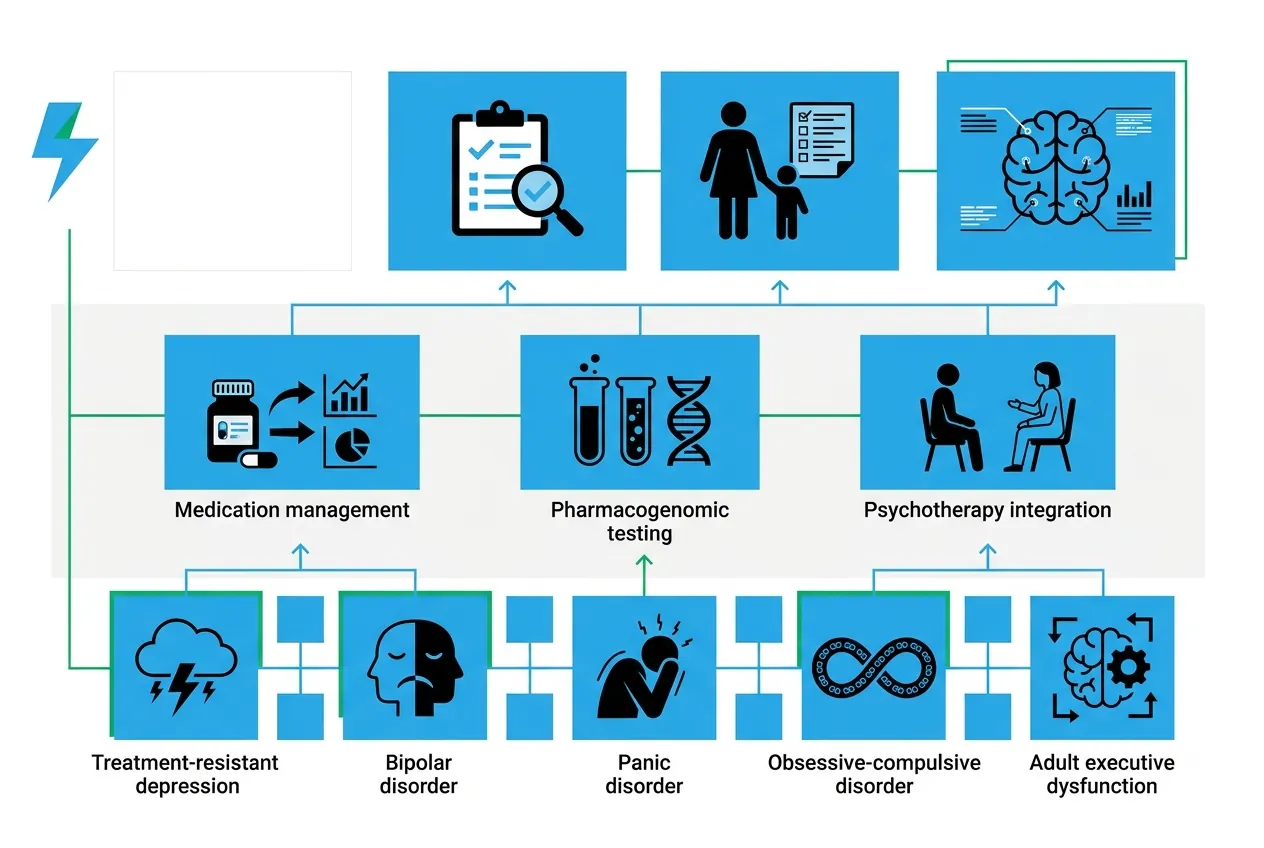
Effective site architecture separates content into three structured tiers:
- Diagnostic and Evaluation Pages: Dedicated landing pages for comprehensive psychiatric evaluations, second-opinion diagnostic assessments, pediatric psychiatric evaluations, and neuropsychiatric screenings.
- Treatment Modalities: Structured service pages detailing psychiatric medication management, pharmacogenomic testing, psychotherapy integration, and specialized interventional treatments.
- Condition-Specific Pages: Authoritative resources explaining clinical protocols for treatment-resistant depression, bipolar I and II disorders, panic disorder, obsessive-compulsive disorder, and adult executive dysfunction.
Connecting these pages through internal links guides prospective patients from initial condition research to scheduling an intake evaluation. This architectural approach underpins our focused work with psychiatric practices, ensuring organic traffic reaches the specific clinician qualified to treat the presenting condition.
Free Audit
Want a straight read on where your budget is leaking?
Intake Infrastructure: Measuring Inquiries to Completed Appointments
Organic search rankings provide zero balance-sheet value if incoming search volume does not translate into completed clinical appointments. In traditional marketing reporting, agencies highlight vanity metrics like raw form fills or phone call counts. For a psychiatric clinic, high call volume often masks low clinical conversion if callers are out of network, seeking unprovided services, or dropping out during complex intake paperwork.
Measuring the commercial return of search visibility requires integrating website intake pathways directly with clinic scheduling or electronic health record (EHR) workflows. Attribution must connect initial organic search pathways to scheduled psychiatric evaluations, verified insurance benefits, and completed first appointments. Our methodology reflects the operational discipline of a former healthcare CMO who ran marketing for a treatment network that grew from 3 to 24 locations, managing $1.5 to $2M per month in Google Ads across 11+ behavioral and mental health accounts. By tracking attribution to admission and completed intake rather than stopping at raw inquiries, clinic leadership maintains clear insight into patient acquisition costs and provider capacity utilization.
Governance, Patient Privacy, and Healthcare Platform Compliance
Digital marketing for medical psychiatry operates under strict legal and regulatory boundaries. Because psychiatric care involves sensitive health conditions, clinics cannot rely on tracking technologies that transmit personal data or unshielded protected health information to commercial advertising networks. Furthermore, Google explicitly restricts remarketing for healthcare services under the Google Ads Personalized Advertising Policy, prohibiting campaigns that target users based on sensitive health or mental health conditions.
This regulatory environment makes owned organic search channels essential for sustainable patient acquisition. Additionally, reputation management and patient review acquisition must comply with federal consumer protection standards. The FTC Consumer Review Rule prohibits deceptive review practices, review gating, or incentivized patient testimonials. Maintaining compliance requires automated, neutral review workflows that protect patient confidentiality while consistently building authentic public feedback. Marketing Powered is LegitScript-aware and HIPAA-aware, deploying owned, local AI infrastructure for HIPAA-aware inference that ensures clinic data handling remains secure, private, and fully compliant.
Questions, Answered.
Psychiatrist local SEO focuses on medical search intent, prescriptive authority, insurance panel participation, and psychiatric diagnoses such as bipolar disorder, ADHD, and clinical depression. Therapy SEO primarily captures general counseling and talk therapy queries. Search engines treat psychiatrists as medical physicians, requiring provider-level schema, medical entity verification, and distinct Google Business Profile categories separate from allied mental health practices.
Rather than measuring success by website visits or raw contact submissions, clinics should track organic search conversions through to scheduled clinical evaluations and completed first appointments. Connecting web conversion paths to practice management or scheduling systems allows operators to measure qualified patient acquisition, clinical show rates, and capacity utilization by individual prescriber.
A multi-provider clinic should maintain a primary Google Business Profile for the practice location categorized as a psychiatric clinic, along with verified practitioner profiles for individual psychiatrists and nurse practitioners. Each provider listing must include specific appointment links, direct phone numbers where appropriate, and links to provider-specific biographical pages on the main clinic website.
Paid advertising platforms enforce strict limitations on sensitive medical categories, including total prohibitions on retargeting users who have visited mental health web pages. Organic search visibility provides a resilient, privacy-compliant channel that captures prospective patients at the precise moment they actively seek clinical evaluation, without violating platform privacy policies or transmitting sensitive health data. Request an acquisition audit
Ready to see where your marketing can improve?
Request a free audit of your paid media, landing pages, attribution, and measurement setup. You'll get a straight assessment of where the opportunities are.
or email us at info@marketingpowered.ai