Capabilities
Hospital SEO and Service-Line Visibility
Enterprise health systems require digital discovery models that translate regional clinical capacity into scheduled patient appointments. Generic wellness content and disconnected directory listings dilute organic search visibility across primary markets. Marketing Powered builds hospital SEO systems that structure clinical service lines, align provider and facility data, and establish search authority tied directly to patient admissions.

Clinical Entity Architecture: Beyond Generic Medical Content
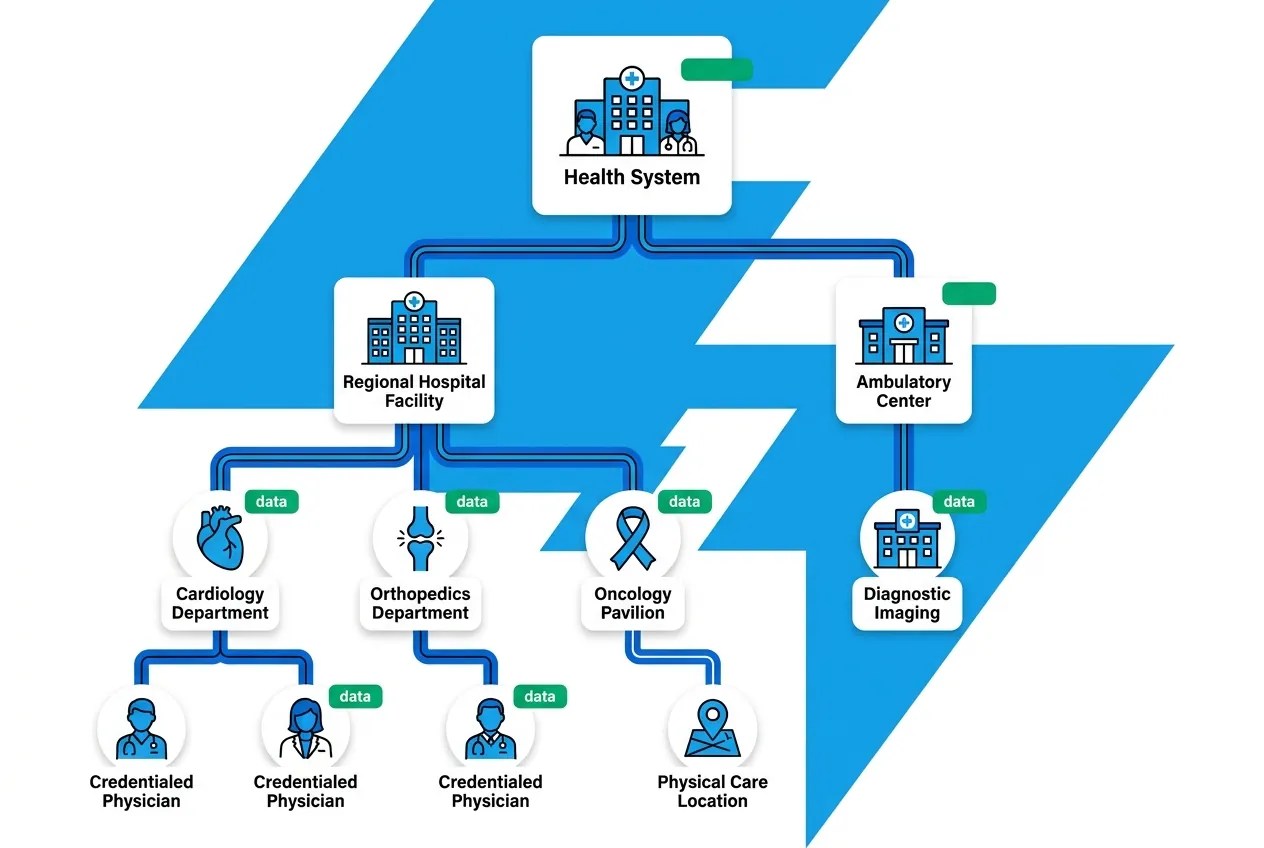
Search engines evaluate hospital networks through medical entity graphs rather than keyword density on informational blog posts. When a health system treats search as a publishing volume problem, internal teams produce hundreds of general health wellness articles that compete against consumer health portals without capturing regional appointment intent. A clinical entity model organizes web infrastructure around licensed facilities, clinical departments, credentialed medical staff, and specialized procedures.
In this structure, schema markup connects each service line to its physical care delivery location and practicing specialists using structured data types like Hospital, MedicalOrganization, MedicalSpecialty, and Physician. Search engines recognize the exact clinical scope of an ambulatory surgery center, a regional cardiac pavilion, or an outpatient oncology clinic. Structuring these real-world clinical relationships ensures that organic search systems present the right specialized facility when a patient searches for diagnostic imaging, joint replacement, or infusion therapy within your regional market.
Structuring Hospital Service Lines for High-Intent Organic Demand
High-acuity specialty service lines such as orthopedics, cardiology, oncology, and surgical neurology represent the financial foundation of health system operations. Capturing this market requires an information architecture that distinguishes between broad condition research and procedural booking intent. A prospective patient researching early symptoms of degenerative disc disease requires a different digital path than someone searching for minimally invasive lumbar spine decompression in an adjacent suburb.
To prevent organic cannibalization across sister facilities in multi-hospital networks, service-line architecture must reflect clear clinical hierarchies. Parent service-line hubs establish comprehensive clinical authority, while localized procedure pages capture geographically constrained appointment searches. We help healthcare marketing leaders build these operational pathways through our work for hospitals and health systems, ensuring digital capacity matches actual operating room schedules and clinical intake availability.
Hospital Local SEO and Physician Directory Governance
Local pack rankings on Google Maps drive significant outpatient appointment volume across ambulatory networks and primary care clinics. However, health systems frequently suffer from severe data conflicts across Google Business Profiles. Duplicate listings, outdated suite numbers, conflicting clinical hours, and unmanaged provider departures undermine visibility across competitive service areas.
Effective hospital local SEO requires strict, three-tiered entity governance:
- Primary Facility Listings: Main hospital campuses and acute care facilities with explicit physical addresses, emergency department designations, and trauma center credentials.
- Department Profiles: Distinct, nested Google Business Profiles for specialized units operating within the hospital campus, such as ambulatory surgery, pediatric urgent care, women's health, or imaging centers.
- Employed Provider Profiles: Individual practitioner profiles coordinated with National Provider Identifier (NPI) registry records and medical staff credentialing rosters.
Centralizing this data eliminates conflicting location signals between Google Maps, Apple Maps, state licensing boards, and local healthcare citations, expanding geographic visibility across regional service boundaries.
Free Audit
Want a straight read on where your budget is leaking?
Technical Crawl Quality Across Complex Health System Networks
Decades of regional acquisitions, facility mergers, and electronic health record migrations leave enterprise health systems with fragmented web ecosystems. A typical health network website contains thousands of orphaned pages, abandoned doctor profiles, legacy subdomains, and competing intake forms. Search engine spiders waste crawl budget navigating pagination errors and duplicate service descriptions rather than indexing core clinical pages.
Resolving technical crawl quality demands enterprise-level auditing and hygiene:
- Consolidating Subdomains: Migrating standalone hospital microsites, foundation portals, and specialty institute domains into a unified root directory structure.
- Eliminating Duplicate Content: Resolving overlapping service-line copy produced across multiple regional facilities by implementing precise canonicalization and distinct localized clinical details.
- Optimizing Faceted Physician Directories: Managing search crawler parameters on find-a-doctor directories to ensure indexed provider pages provide unique, crawlable clinical focus areas without generating infinite filter URLs.
- Accelerating Core Web Vitals: Removing bloated script libraries and unoptimized media assets to meet mobile rendering benchmarks for emergency and urgent care searches.
A clean technical infrastructure allows search engines to evaluate and rank newly expanded clinical services without indexation delays.

Privacy-Conscious Healthcare SEO Measurement and Attribution
Measuring hospital SEO through vanity metrics like total website sessions or keyword position averages obscures true commercial performance. Digital health leaders require acquisition attribution that tracks the patient journey from an initial search engine query to a completed phone inquiry, an online scheduling intake, and a confirmed admission.
Tracking patient acquisition in healthcare requires strict compliance with federal regulatory frameworks. The Department of Health and Human Services provides strict parameters regarding third-party tracking pixels on patient-facing web properties in its guidance on online tracking technologies. Similarly, advertising platforms operate strict restrictions; for example, the Google Ads personalized advertising policy prohibits retargeting based on sensitive health conditions or personal medical interests.
Our background is shaped by direct operational experience: a former healthcare CMO who led marketing for a treatment network expanding from 3 to 24 locations, managing $1.5 to $2M per month in Google Ads across 11+ behavioral and mental health accounts, combined with court-certified expert witness credentials in advertising strategy. We implement privacy-first analytics and call tracking that operate without third-party data leakage, tracking patient volume directly to service-line capacity. For a broader view of integrated healthcare growth frameworks, read our hospital marketing guide.

Clinical Review Workflows and Content Governance
Search algorithms place stringent content quality demands on healthcare topics under Your Money or Your Life (YMYL) evaluation criteria. Health systems cannot publish automated or unverified medical copy without risking search demotions across their primary domain. Every page presenting clinical guidance, treatment indications, or surgical overviews must demonstrate clear medical expertise and institutional trust.
Our delivery model implements clinical governance workflows that integrate with your medical staff leadership:
- Physician Attribution: Every clinical service page displays explicit author and medical reviewer credentials, board certifications, and direct links to active provider profiles.
- Structured Editorial Oversight: Content undergoes formal review gates to verify accuracy against current clinical practice guidelines before indexing.
- Routine Clinical Auditing: Regular editorial review cadences ensure procedural descriptions, pharmaceutical references, and diagnostic protocols reflect changes in clinical operations.
This disciplined governance protects the health system from regulatory risk, reinforces patient trust, and signals medical authority to search engines.
Questions, Answered.
Ranking for specialist care requires establishing a direct structural connection between clinical procedure pages, physical department locations, and employed provider profiles. Rather than relying on generic articles about medical conditions, health systems must publish procedure-specific pages containing structured schema markup, physician credentials, accepted insurance information, and direct scheduling integration. Aligning these elements with optimized Google Business Profiles for both the department and the specialist enables search engines to display the clinic for high-intent regional searches.
Hospital search performance should be evaluated through downstream clinical milestones rather than raw organic traffic. This requires connecting web analytics to call center intake tracking, online scheduling software, and customer relationship management systems. By using privacy-safe tracking architecture that protects patient health information, marketing teams can measure how organic discovery translates into verified phone consultations, completed appointment requests, and clinical admissions by facility and specialty.
Healthcare SEO is a broad discipline that encompasses national medical publishers, health technology vendors, pharmaceutical brands, and clinical practices. Hospital local SEO focuses specifically on regional market capture for physical acute care facilities, outpatient clinics, and employed medical groups. It prioritizes geographic proximity, Google Maps visibility, localized service-line queries, and directory consistency to capture patient demand within specific service areas. Request an acquisition audit
Ready to see where your marketing can improve?
Request a free audit of your paid media, landing pages, attribution, and measurement setup. You'll get a straight assessment of where the opportunities are.
or email us at info@marketingpowered.ai