Resources
Hospital Marketing Guide: Service Lines and Demand
A campaign can generate interest that scheduling, intake or inconsistent location information never turns into patients. That is the most common failure in hospital marketing, and it rarely shows up in a platform report. This guide treats demand planning, channel selection and reporting as one system with named owners, starting from service-line capacity rather than media budgets.
By Mike Hulick, Founder, Marketing Powered

Who this guide is for
This guide is written for hospital and health-system CMOs, VPs of marketing and service-line leaders who own a line such as orthopedics, cardiology, women's health, oncology or behavioral health. It is also useful for access center leaders, digital leads, and the compliance and privacy reviewers who decide what can be measured and published.
It is not a vendor comparison and it does not include benchmark tables. We have excluded third-party statistics because we could not tie them to a stored, dated source in this production cycle, and an unsourced benchmark is more dangerous in a budget meeting than no benchmark at all. Where a number matters, the guide tells you how to produce it from your own systems.
If you want tactical depth for individual service lines, the hospital service-line marketing resource covers that level of detail. This page outlines the planning framework that sits above those tactics.

What hospital marketing is and is not
Most guides open with channels: search, social, video, email, billboards. That framing makes hospital marketing look like a media-buying problem. It is closer to an operations problem with a media component. In practice, hospital marketing has five parts that have to work together:
- Demand planning. Which service lines and locations should grow, by how much, and by when.
- Definition of qualified. What a good inquiry looks like for each line.
- Acquisition. Paid media, local and technical SEO, content, referral support and reputation work.
- Conversion and intake. Landing pages, forms, call handling, scheduling and follow-up.
- Measurement. Reporting that connects spend to qualified demand and, where authorized data supports it, to completed patients.
What it is not: brand awareness for its own sake, a website redesign, or a monthly report of impressions. Awareness and a good website both matter, but neither is a plan. Hospital marketing differs from single-location practice marketing in three ways. Capacity is lumpy and varies by service line, site and sometimes day of week. Many stakeholders influence the outcome, including clinical leaders, access teams, compliance and IT. And the data that would prove results is often the most restricted data you have.
Step 1: Start with service-line capacity
The first input to a hospital marketing plan is not budget. It is the answer to a question marketing teams often cannot answer without help from operations: where can we actually take more patients? Before selecting channels, collect these inputs per service line and location.
- Open capacity. Question to answer: What appointment, procedure or admission capacity is available in the planning window?. Likely source owner: Service-line leader, operations.
- Constraints. Question to answer: What limits intake: clinician availability, imaging, beds, authorizations, payer mix?. Likely source owner: Service-line leader, revenue cycle.
- Priority. Question to answer: Is growth wanted here, tolerated, or not wanted?. Likely source owner: Executive team, service-line leader.
- Seasonality. Question to answer: When does demand and capacity shift?. Likely source owner: Operations, marketing analytics.
- Access speed. Question to answer: How long between inquiry and first available visit?. Likely source owner: Access center.
- Geography. Question to answer: Which communities can realistically reach this location?. Likely source owner: Marketing, operations.
Some of this data will be incomplete. That is fine. A rough, agreed capacity picture beats a precise one nobody has seen. The goal is to prevent two predictable errors: generating demand for a line or site that cannot absorb it, and ignoring a line where capacity sits unused. Capacity-first planning changes decisions in concrete ways. A service line with a long wait for a first visit may need less acquisition spend and more attention to access speed. A site with open capacity but weak local visibility may be the best place for location-specific campaigns. A line leadership wants to hold steady should not be in a growth campaign at all.
Free Audit
Want a straight read on where your budget is leaking?
Step 2: Define "qualified" per service line
Marketing and service-line leaders often argue over lead quality because they have never written down what quality means. One side counts any form fill or call. The other side counts only patients who arrive, sometimes with specific coverage or referral status. Both views are reasonable. The problem is that they are unstated. Define qualified per service line, in writing, before choosing channels. A usable definition has four parts:
- Eligibility. Is the person within the service area, age range, and clinical scope? Marketing can screen on some of this. Clinical screening belongs to clinical staff.
- Intent. Is the person seeking an appointment, a referral, information, or something the service does not offer (job applications, billing questions)?
- Fit with access. Can the inquiry be served within the line's access targets at an available location?
- Stage reached. Qualified at inquiry, qualified at scheduling, or qualified at completed visit. These are different measurements.
Examples of how definitions differ by service line
These are structural examples, not benchmarks. For orthopedics, qualified may mean a person with a musculoskeletal complaint in the service area who wants an evaluation, with a referral pathway that the practice accepts. Calls about physical therapy at a different organization are not qualified. For cardiology, qualified may mean an inquiry matching screening or evaluation services, routed to the right clinic. Emergency symptoms must be directed to emergency care in all messaging and call scripts; that is a safety requirement, not a marketing preference.
For women's health, definitions differ between obstetrics, gynecology and imaging, each with different scheduling rules. For oncology, qualified inquiries are often dominated by referral and navigation pathways, making paid media a smaller part of the picture and referral tracking more important. The value of this exercise is the disagreement it surfaces. If the service-line leader and the marketing lead define qualified differently, the dashboard will never satisfy both. Settle it before launch.
Step 3: Choose channels after definitions
Once capacity and definitions are set, the channel plan has criteria to meet. This is where hospital digital marketing comes in. Below is a compact view of how each channel fits. For tactical depth by line, use the service-line resource linked above.
Paid search
Paid search captures existing intent: people already looking for a service, a location or a provider. It suits lines with open capacity and a clear conversion path. It performs poorly when the landing page does not match the query, when location information is inconsistent, or when intake cannot answer quickly.
Local and technical SEO
For multi-location systems, local SEO is the foundation under every other channel. Accurate, consistent location pages, hours, service listings and provider information reduce the friction that turns interest into a missed visit. Technical issues such as duplicate location pages, thin service pages and unclear canonical paths can suppress visibility for the lines you most want to grow.
Paid social and content
Paid social creates or nudges demand for services where people do not search in advance, such as screenings or wellness programs. It requires careful targeting and messaging for health topics. Platform rules for health and sensitive categories change frequently; confirm the current policy source before each campaign launch to ensure compliance with specific audience and tracking restrictions. Content and service pages should answer what the service is, who it is for, where it is offered, how to start, and what to expect on first contact. They should do this in plain language and with accurate clinical review.
Referral and reputation
In many lines, referral volume outweighs direct-to-consumer demand. Marketing's role here is to make referral easy: clear pathways, current information for referring offices, and tracking that reveals which relationships generate completed patients. Ratings and reviews influence which location a person chooses. A systematic, compliant review process for each location is part of acquisition. Review responses must follow privacy rules, since a public reply can disclose that someone is a patient.
How to choose
Rank channels against three questions per service line and location: Does this channel reach people with qualifying intent? Can intake absorb the volume it will generate? Can we measure it to the stage we need? A channel that scores well on reach but poorly on intake capacity or measurement should be limited until the weak link is fixed.
Step 4: Fix where interest dies
The gap between a click or call and a scheduled visit is where many hospital campaigns lose most of their value. Marketing can influence this stage heavily without owning it. Review these points with the access center and web team:
- Landing page match. Does the page continue the promise of the ad or search result, in the same language, for the same service, with a clear next step?
- Location accuracy. Do address, phone, hours and provider information match across the website, local listings, ads and call routing?
- Phone handling. Are calls routed to staff who can schedule that service? What happens to missed calls?
- Form follow-up. Who responds to web inquiries, how fast, and through which channel?
- Scheduling friction. Is online scheduling available for the line, and does it show real availability?
Call tracking and intake automation sit in this layer. They make the difference between knowing "we got 200 calls" and knowing which calls were qualified for which line at which location. Whether you can capture and use that data depends on your privacy review, covered in the compliance section below.
Email Us
Prefer to send the context directly?
Step 5: Build location-specific campaigns without fragmenting reporting
Health systems face a recurring tension. Leadership wants to compare performance across sites. Local teams need campaigns that reflect their own communities, providers and capacity. Forcing every site into one campaign makes comparison easy and results poor. Letting every site run its own program makes results local but comparison impossible. The workable approach is shared standards with local variation:
- Shared: naming conventions, definitions of qualified per line, tracking parameters, reporting calendar, dashboard structure, brand and compliance rules.
- Local: service mix, provider spotlights, community targeting, budgets scaled to capacity, messaging that reflects local access (hours, parking, languages).
With a consistent structure, centralized multi-site reporting becomes possible without uniform campaigns. Every location reports the same measures against the same definitions, even if the tactics differ. A shared taxonomy must be set up before campaigns launch; retrofitting naming and tracking across dozens of campaigns is slow and error-prone. Comparing sites without accounting for capacity differences invites bad decisions. A site with fewer qualified inquiries but a higher completion rate may be performing better than a busier site that cannot schedule what it receives.
Step 6: Build the measurement ladder
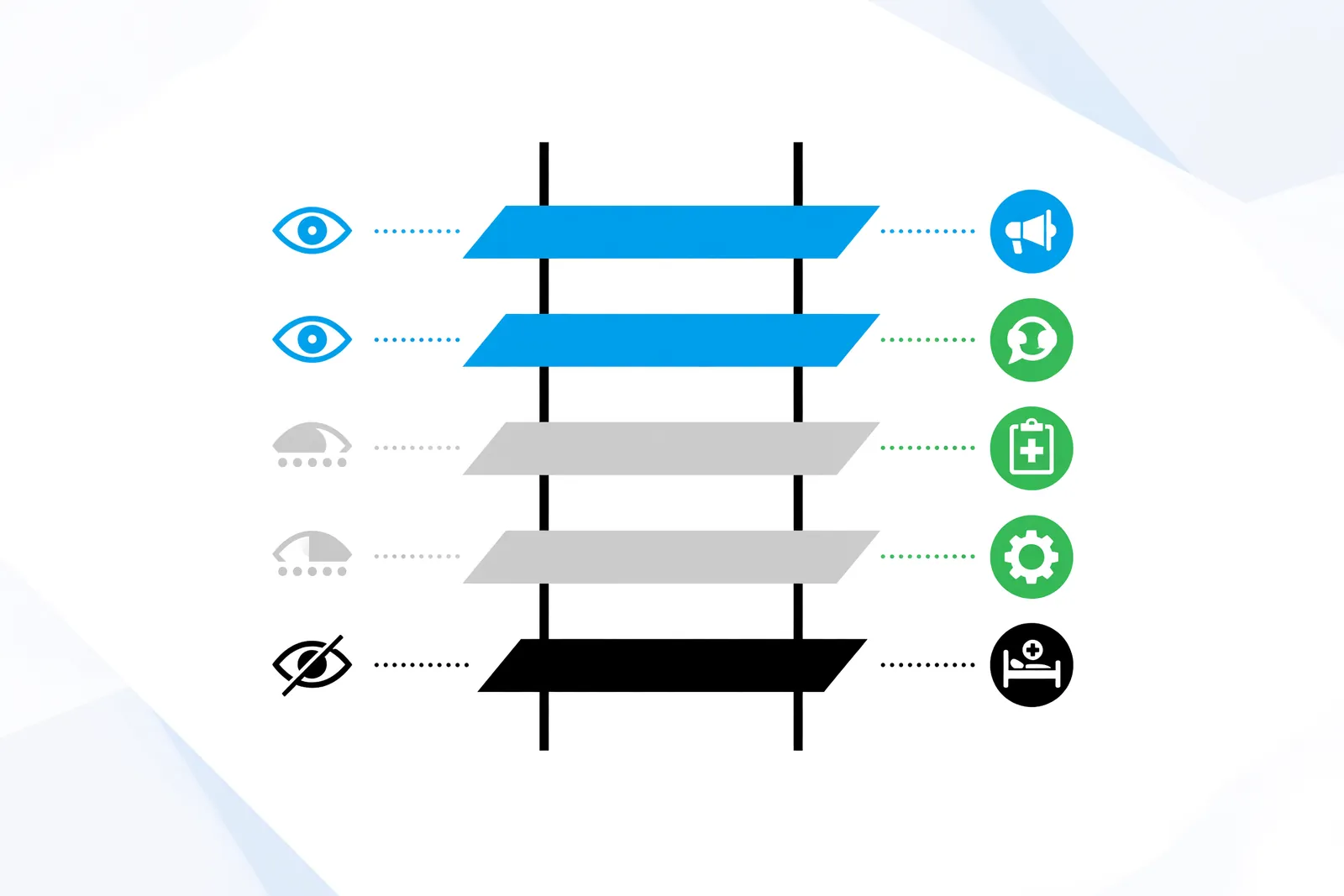
Hospital reporting often stops at the stage where data is easiest to collect. A ladder makes the gaps visible. List each stage from impression to completed patient, and for each one record whether you can see it today. Most organizations discover that the first three rows are visible and the last four are not. That explains why marketing and service-line leaders cannot agree; they are looking at different rungs.
- Exposure. What to measure: Impressions, reach, local visibility. Typical owner: Marketing.
- Engagement. What to measure: Clicks, site visits, page engagement. Typical owner: Digital lead.
- Inquiry. What to measure: Calls, forms, chats, scheduling starts. Typical owner: Digital lead, access center.
- Qualified inquiry. What to measure: Inquiries meeting the service-line definition. Typical owner: Access center, service-line leader.
- Scheduled. What to measure: Appointments booked from the inquiry. Typical owner: Access center.
- Completed visit. What to measure: Patient attended. Typical owner: Operations, analytics.
Fill in your visibility status honestly. Connecting the lower rungs requires first-party data, an intake process that records outcomes consistently, and a privacy review that decides what can move between systems and in what form. We work within the reviews your organization requires, with responsibilities defined before implementation. The aim is to link acquisition to patient outcomes where authorized data supports it, and to be explicit where it does not.
Measuring against qualified calls or admissions
How should hospital marketing be measured against qualified calls or admissions? Pick the highest rung you can see reliably, and report it per service line and location. Then show the rungs below it as diagnostics. Where you can see completed visits through authorized data, use those as the primary outcome. Where you can see only scheduled appointments, use scheduled-qualified inquiries and state the limitation. Where you can see only calls, require call coding for qualified or not qualified, and audit a sample of calls against that coding regularly. Do not blend rungs into one headline number. A report mixing form fills, unanswered calls and scheduled visits cannot support a budget decision.
What the data cannot prove
Hospital marketing data has real limits. Naming them in the report protects credibility and keeps decisions honest. Platform conversions are not patients; they record an event the platform can see, not whether the person was eligible or arrived. Attribution is partial because patients often search later, call a different number, or ask a physician. Correlation with admissions is not causation; volume rising after a campaign could reflect seasonality or a provider joining.
Privacy limits create blind spots where tracking and data sharing are restricted. That does not mean the marketing had no effect; it means the effect cannot be assigned precisely. Call coding is a human judgment that varies by person unless it is trained and audited. Small volumes mislead, as a location with few inquiries can swing wildly month to month. A good report states what is measured, what is estimated, and what is unknown. We distinguish measured facts from estimates in every plan we write, and a hospital report should do the same.
Strategy
Want to start with a quick message?
Compliance, privacy and platform constraints
Regulated environments shape what you can track and say. Teams often discover this after a campaign is built. Bring compliance, privacy and legal reviewers in at the planning stage. Topics to put on the agenda include tracking technologies, consent and data minimization, and platform sensitive-category rules. Ad platforms restrict some health-related targeting and measurement; since these rules change, confirm the current policy source before each launch. Some treatment advertisers face third-party certification requirements on certain platforms; confirm which current requirements apply to your specific advertiser type before referencing programs like LegitScript.
Clinical content review is mandatory for service pages, ad copy and landing pages. Messaging should not promise outcomes or imply diagnosis. A clinical review workflow with named reviewers keeps campaigns from stalling. Data handling belongs in the planning discussion because it determines which information can move between systems. Marketing Powered owns and operates computing hardware for supported workloads, but hardware ownership is separate from data ownership. Your organization's data remains yours, and where and how it is processed is a scope decision made with your review team, not a default.
When this applies to behavioral health programs
Hospitals often run behavioral health or inpatient psychiatric programs, and the framework applies, with added constraints. Capacity first, definition of qualified, channel selection, intake review and measurement all carry over. What changes includes level of care; qualified depends on whether the program is inpatient, partial hospitalization, intensive outpatient or outpatient. Admissions screening is clinical; marketing can route and inform, but clinical staff determine appropriateness.
Intake speed is more sensitive because people searching for behavioral health help are often in distress. Language must be accurate and non-stigmatizing, avoiding implied treatment efficacy. Platform rules are stricter for treatment services, so confirm current policies before building a plan. Privacy exposure is higher; tracking a visitor to a behavioral health page can reveal sensitive information. Many teams choose to limit tracking and measure through intake coding instead. This is a decision for privacy and legal review. Our founder's operator experience informs this work; he previously served as CMO at a treatment network that grew from 3 to 24 locations and managed $1.5 to $2M per month in Google Ads across 11+ behavioral and mental health accounts. Behavioral health is a specialty we know well, but it is one service line within a broader hospital program, not the whole of it.
Who owns what
Hospital marketing fails at the seams between teams. Name an owner for each step, and name a separate reviewer for anything that gets approved. The person who produced a piece of work should not be the only person approving it for release. Separate the maker from the reviewer, and record who approved which version. For example, the service-line leader owns the capacity picture with contributions from operations and finance. The marketing lead (CMO or VP) owns the channel plan and budget with contributions from the digital lead. The access center leader owns intake and call handling with contributions from marketing and IT. The analytics or IT lead owns tracking and data handling with contributions from privacy and marketing. This structure ensures that capacity, definitions, channels, conversion and reporting all have clear accountability without siloing the work.
Free Audit
Want a straight read on where your budget is leaking?
Step-by-step implementation
This sequence assumes one to three priority service lines to start. Do not try to fix every line at once. In Phase 1 (weeks 1-4), pick priority lines based on strategic importance and real capacity, complete the worksheet below, write the definition of qualified with sign-off, fill in the measurement ladder, and convene a compliance review. In Phase 2 (weeks 3-8), audit location data, landing pages, and intake coding; establish the naming taxonomy and clinical review workflow.
In Phase 3 (weeks 6-12), launch campaigns for lines with confirmed capacity and working intake paths. Start with a narrower scope than the budget allows and expand after intake proves it can respond. Audit a sample of calls regularly against the qualified definition. In Phase 4 (ongoing), report on the measurement ladder per line and location, noting what is measured, estimated and unknown. Revisit capacity with operations each period. Move spend toward lines where qualified demand converts and capacity exists; reduce it where intake or capacity is the constraint. These time ranges are planning guides, not benchmarks.
Worksheet: The Capacity-to-Demand Calculation
Use this per service line and location, updating it each planning period. It is a planning tool, not a forecast. Step A is open capacity (C), the number of new-patient visits or admissions the line can add after committed demand. Step B is the share of C you are willing to fill with marketing-generated demand (F). Step C is your inquiry-to-scheduled rate (S) based on your own intake data. Step D is your scheduled-to-completed rate (K).
Calculate qualified inquiries needed (Q) using this formula: Q = (C × F) ÷ (S × K). Compare Q with the qualified inquiries you currently receive. If current inquiries exceed Q, the constraint is probably capacity or access; spend more on speed and less on acquisition. If current inquiries fall well below Q and S and K are healthy, the line needs more qualified demand. If S or K is low, fix intake and scheduling before adding spend, because additional demand will leak through the same gaps. S and K vary by channel and season, so use ranges where volume is small to avoid misinterpretation.
Common mistakes
Planning by channel sends money to whatever is easiest to report on, not to where capacity exists. Letting "lead" mean everything means no dashboard can show quality if a lead can be a form fill, a billing call or a wrong number. Marketing generating demand for a line that cannot absorb it results in long waits and frustrated staff. Ignoring location data, such as wrong hours or duplicate listings, quietly cancels campaign spend. Treating intake as someone else's problem ignores where most conversion happens. Over-reading platform numbers treats inputs to a judgment as the final judgment.
Discovering compliance constraints late wastes time; involve privacy and legal reviewers before building tracking and creative. Forcing one campaign across all sites hides local differences. Reporting a single month is risky because small volumes are noisy; show trends and ranges. Skipping the review loop means last quarter's capacity picture drives this quarter's spend, which is rarely accurate for dynamic hospital environments.
Email Us
Prefer to send the context directly?
Checklist: Hospital Marketing Planning
Copy this into your planning document. Under Capacity, ensure open capacity is documented per priority line, constraints are named, growth priority is confirmed by leadership, and seasonality is noted. Under Definitions, have a written definition of qualified signed off by the service-line leader, emergency messaging reviewed where relevant, and non-qualifying inquiry types listed.
Under Acquisition, rank channels against reach, intake capacity and measurability; retrieve and date platform policies for each channel in use; ensure location data is consistent across website, listings, ads and call routing. Under Conversion and Intake, verify landing pages match the query or ad promise, calls are routed to staff able to schedule, web inquiry response owner and timing are defined, and intake codes source and outcome.
Under Measurement, complete the measurement ladder with visibility marked per rung; apply a shared naming and tracking taxonomy across sites; ensure reports separate measured, estimated and unknown data; audit call coding on a sample. Under Governance, conduct privacy and legal review of tracking and data flows; establish a clinical review workflow with named reviewers; name an owner and separate reviewer for each step; schedule the re-planning meeting with operations.

Next step: request an acquisition audit
If your teams cannot agree on what a qualified inquiry is, or you cannot tell which locations are turning marketing into scheduled patients, an acquisition audit is a practical place to start. We review how demand moves from spend to message to landing page to intake to reporting for your priority service lines and locations, and we identify the first constraint to fix based on your specific operational reality and data availability.
Questions, Answered.
Hospital marketing is the planning, acquisition, conversion and measurement of patient demand for a hospital's service lines and locations. It includes paid media, search, web content, intake processes, referral support, reputation and reporting. The strongest programs plan demand from capacity and measure qualified demand by line and location rather than just traffic or raw lead volume.
Start by documenting open capacity per line and location, and which constraints limit it. Agree with service-line leaders on where growth is wanted. Then define what a qualified inquiry is for each line, estimate the qualified inquiries needed using your own conversion rates, and choose channels that can reach those people and be absorbed by intake. Review capacity each period and adjust spend accordingly to prevent demand mismatch.
Use the highest rung of the measurement ladder you can see reliably, reported per service line and location. Where authorized data shows completed visits or admissions, use those as the primary metric. Where it does not, use scheduled qualified inquiries or coded qualified calls, and state the limitation clearly. Show lower rungs as diagnostics and do not blend them into a single number to avoid misleading leadership.
Hospital digital marketing is the online portion of hospital marketing: paid search and social, local and technical SEO, service pages, landing pages, call and form tracking, reviews and analytics. It is most effective when connected to intake and capacity planning, not run as a separate traffic program that ignores operational constraints like scheduling availability or location data accuracy.
There is no single best strategy because it depends on which lines have capacity and what qualified means for each. Strategies that tend to hold up include capacity-first planning, per-line definitions of qualified, accurate location data, fast intake, shared reporting standards across sites with local campaign variation, and honest statements of what the data can and cannot show in a regulated environment.
Yes, with added constraints around level of care, clinical admissions screening, intake speed, language, platform rules and privacy. The core framework of capacity-first planning and qualified definitions remains the same, but the sensitivity of the audience and strictness of compliance requirements demand tighter controls on tracking and messaging compared to general elective services.
Sometimes. It depends on what data your organization authorizes to be shared, how it is protected and how your privacy and legal teams approve the flow. Where it is not possible due to regulatory restrictions or technical limitations, report the highest visible rung of the measurement ladder and state the limit explicitly so stakeholders understand the scope of the attribution model being used.
Ready to see where your marketing can improve?
Request a free audit of your paid media, landing pages, attribution, and measurement setup. You'll get a straight assessment of where the opportunities are.
or email us at info@marketingpowered.ai