Resources
Admissions Marketing Scorecard for Treatment Centers
Admissions marketing is the operational discipline of connecting paid and organic patient acquisition channels directly to clinical verification, pre-assessment, and verified bed placement. When treatment center leadership manages acquisition solely through raw form fills and phone rings, marketing spend flows toward low-intent inquiries that overwhelm intake teams without filling beds. A structured marketing-to-admissions scorecard unifies media data with downstream clinical milestones, establishing true visibility over your acquisition economics.
By Mike Hulick, Founder, Marketing Powered

What Admissions Marketing Means in Behavioral Healthcare
Admissions marketing separates patient acquisition from traditional digital lead generation. In standard commercial lead generation, an agency or internal media team optimizes campaigns to produce the highest possible volume of inquiries at the lowest immediate cost per lead. In behavioral and mental healthcare, that metric is fundamentally disconnected from facility census and clinical reality.
A digital campaign can generate hundreds of phone calls at a low cost per inquiry while producing zero census growth. When digital media algorithms seek out low-friction form submissions or brief phone calls, they routinely capture callers with non-viable coverage, individuals seeking services outside your licensed scope of care, or out-of-area inquiries with no practical way to travel to your facility. For an admissions department, an unmanaged surge in unqualified phone traffic creates operational gridlock. Intake coordinators spend critical minutes fielding inquiries that cannot convert, while clinically appropriate patients seeking immediate residential or outpatient placement encounter hold times or delayed callbacks.
Admissions marketing shifts the operational objective from raw inquiry generation to intake progression. Rather than judging campaign health by clicks or preliminary contacts, admissions marketing evaluates acquisition against clinical intake stages: contact rate, clinical pre-screen completion, insurance verification, clinical clearance, admission scheduling, and physical facility arrival.
How should admissions marketing be measured against qualified calls or admissions? It should be measured by mapping upstream campaign identifiers directly to downstream intake milestones within the patient management workflow. This requires tracking marketing performance against qualified calls and verified admissions rather than raw inquiry volume. Measuring performance by qualified calls isolates media efficiency, while measuring against completed admissions reveals the true commercial cost of acquiring a patient. The metric that governs the entire growth model is cost per admission (CPA). Leadership can examine the foundational mechanics of this calculation in our guide to cost per admission for rehab.
Operating an admissions marketing model requires distinct infrastructure. Marketing Powered was founded by a former healthcare CMO who ran marketing for a treatment network that grew from 3 to 24 locations and managed $1.5 to $2M per month in Google Ads across 11+ behavioral and mental health accounts. Scaling multi-location operations across residential, partial hospitalization, and intensive outpatient programs revealed that treating marketing and intake as separate silos inflates acquisition costs. When marketing teams report only on ad impressions and intake directors report only on bed occupancy, leadership lacks the diagnostic connective tissue to identify whether an empty facility stems from poor media targeting, mismatched commercial insurance profiles, or intake friction.

Core Conversion Milestones: From First Ring to Bed Placement
An admissions scorecard requires standardized operational stages recognized by both marketing and admissions personnel. When departments use subjective language to describe pipeline health, data integrity breaks down. Admissions marketing relies on six sequential conversion milestones that map the exact transition from an anonymous click to a physical bed placement.
1. Inbound Inquiries
An inbound inquiry represents any raw contact captured by your acquisition infrastructure. This includes inbound phone calls directed to tracking numbers, submitted web forms, and real-time chat interactions. At this initial milestone, the inquiry contains no clinical validation. It is simply an event record containing an upstream source, timestamp, campaign identifier, and initial contact point.
2. Qualified Inquiries and Call Quality
A raw contact becomes a qualified inquiry when it satisfies foundational operational thresholds. In phone acquisition, this is evaluated through call quality standards. A qualified call must connect to a live intake coordinator, maintain an active duration exceeding 90 to 120 seconds, and originate from a geographic market within the organization's licensed footprint or accessible travel perimeter.
During this initial exchange, the intake coordinator confirms that the caller or family member is seeking an active level of care that the facility provides, such as medical detox, residential addiction treatment, adolescent psychiatric care, or dual-diagnosis programming. Calls that terminate under 60 seconds, misdials, vendor outreach, and callers seeking services completely distinct from the facility's clinical scope are categorized as unqualified and isolated from acquisition conversion totals.
3. Verification of Benefits (VOB) Initiated and Completed
The Verification of Benefits milestone occurs when the prospective patient or family provides policy details to verify commercial coverage or self-pay viability. This is an essential inflection point in the admissions marketing model. An inquiry that cannot clear financial verification cannot progress to clinical pre-screening in a private commercial facility.
Tracking VOB volume back to specific campaigns, ad groups, and search queries exposes structural performance differences in media channels. Two distinct campaigns may each produce 50 inbound calls, but if one yields 18 completed VOBs while the other yields only two, the campaigns possess vastly different economic values regardless of front-end cost per call.
4. Clinical Pre-Screen and Clinical Clearance
Once coverage or payment capability is established, the admissions coordinator or intake nurse conducts a formal pre-admission clinical assessment. This evaluation reviews current substance use or psychiatric acuity, medical history, concurrent physical health conditions, and potential behavioral risks.
The outcome of this stage is clinical acceptance by the medical director or clinical intake team. Many inquiries with verified insurance fail this milestone due to clinical incompatibility, such as unmanaged acute medical conditions, specific psychiatric diagnoses exceeding the facility's license, or medical needs requiring hospital-based acute stabilization.
Tracking pre-screen outcomes to acquisition sources helps marketing refine ad messaging, negative keyword lists, and landing page content to discourage inquiries requiring levels of care the facility cannot support.
5. Admission Scheduled and Travel Arranged
Following clinical clearance, the family or prospective patient commits to a specific intake date and time. For residential and inpatient programs drawing regional or national patient populations, this step involves flight booking, train reservations, or family transit scheduling.
At this stage, the inquiry represents an active operational reservation. The admissions team coordinates with facility nursing, operations, and case management to prepare room assignments, specialized dietary plans, and medical intake protocols.
6. Verified Physical Admission
The final conversion milestone occurs when the patient arrives at the physical facility, completes initial intake documentation, surrenders personal effects, and is formally logged into the Electronic Health Record (EHR) as an active census unit.
Admissions marketing considers no digital conversion complete until this physical milestone is verified. Attribution systems must ingest this verified event to establish actual media returns and calculate verified cost per admission.
- 1. Inbound Inquiry. Operational Definition: Raw inbound phone call, form fill, or web chat. Primary Data Source: Call tracking software / Web server. Core Diagnostic Function: Measures gross acquisition reach and creative engagement.
- 2. Qualified Call. Operational Definition: Live interaction over 90 seconds meeting geographic and basic care parameters. Primary Data Source: Dynamic call tracking / IVR logs. Core Diagnostic Function: Filters out misdials, spam, and non-viable service inquiries.
- 3. VOB Completed. Operational Definition: Commercial insurance verified or self-pay capacity established. Primary Data Source: Intake CRM / Billing clearinghouse. Core Diagnostic Function: Identifies payer alignment across digital campaigns.
- 4. Clinical Clearance. Operational Definition: Clinical pre-screen approved by medical/clinical leadership. Primary Data Source: EHR / Clinical assessment software. Core Diagnostic Function: Validates clinical targeting accuracy and patient acuity fit.
- 5. Admission Scheduled. Operational Definition: Confirmed arrival date with travel or transit documentation. Primary Data Source: Admissions scheduling queue. Core Diagnostic Function: Measures patient commitment and intake closing effectiveness.
- 6. Verified Admission. Operational Definition: Patient physically arrives, signs intake paperwork, and enters census. Primary Data Source: Electronic Health Record (EHR). Core Diagnostic Function: Establishes definitive acquisition attribution and true CPA.
The Weekly Marketing-to-Admissions Scorecard: Shared KPIs for Leadership
Marketing and admissions cannot operate with divergent reporting dashboards. When marketing presents reports focused on impressions and low click costs while admissions presents reports on bed vacancy, executive leadership cannot pinpoint the causes of operational shortfalls. Weekly growth meetings must focus on a single cross-functional scorecard that tracks both departments through unified performance ratios.
What weekly admissions KPIs should marketing and intake share? Marketing and admissions teams should monitor seven core operational metrics on a weekly cadence:
- Inbound Call Volume and Answer Rate: The total number of inbound media-generated calls paired directly with the intake answer rate. An answer rate falling below 85% signals severe operational capacity constraints that waste media dollars, regardless of how effectively digital campaigns perform.
- Contact and Qualification Rate: The percentage of total inquiries that meet the qualified inquiry definition (duration, geography, and level of care). A dropping qualification rate indicates targeting issues in upstream campaigns.
- VOB Completion Rate: The percentage of qualified inquiries that progress to a completed insurance verification. This metric monitors payer compatibility within the incoming traffic.
- VOB-to-Clearance Rate: The percentage of verified policies that pass clinical review. Drops in this metric highlight a disconnect between campaign positioning and the facility's clinical admission criteria.
- Clearance-to-Scheduled Rate: The percentage of clinically approved patients who commit to a confirmed admission date. This reflects intake counseling competency, financial navigation, and family engagement.
- Show Rate (Scheduled to Admitted): The percentage of scheduled patients who physically arrive at the facility. Significant slippage at this stage indicates friction in travel coordination, unaddressed family hesitation, or delayed intake scheduling.
- Cost Per Qualified Inquiry vs. Cost Per Admission (CPA): The complete marketing investment divided by qualified inquiries, compared against total marketing investment divided by verified admissions.
Accountability across this pipeline must be clearly defined between departments:
- Marketing Department Ownership: Marketing holds primary accountability for inbound inquiry volume, campaign answer monitoring, qualification rate, and cost per qualified inquiry. If total qualified calls drop or the cost per qualified inquiry rises, the media team must adjust targeting, keyword match structures, negative lists, and ad creative.
- Admissions Department Ownership: Admissions holds primary accountability for speed-to-lead, call answer rate, conversion of qualified calls to completed VOBs, clinical pre-screen velocity, and the arrival show rate. If answer rates fall below 85% or speed-to-lead on digital forms exceeds five minutes, the breakdown sits within admissions operations.
- Shared Executive Ownership: Both departments co-own the verified cost per admission and total census volume. When CPA rises, executive leadership uses the scorecard to diagnose whether the increase stems from media cost inflation, declining call quality, or intake operational bottlenecks.
Free Audit
Want a straight read on where your budget is leaking?
Data Architecture: Connecting Ad Platforms to CRM Without Compliance Exposure
Connecting digital advertising platforms to internal intake management systems requires specialized data engineering, particularly within regulated healthcare environments. Many behavioral healthcare networks either maintain completely detached systems that eliminate marketing attribution, or implement client-side tracking scripts that transmit protected health information (PHI) to third-party ad networks, creating significant regulatory exposure.
Attribution tracking must comply with major platform policies and healthcare privacy standards. In behavioral healthcare and addiction services, standard retargeting is strictly prohibited. The Google Ads Personalized Advertising Policy bars advertisers from using remarketing lists, interest-based targeting, or audience lists built on personal hardships, including physical or mental health conditions, addiction services, and clinical treatments.
Furthermore, addiction treatment facilities advertising within the United States must comply with the Google Ads Healthcare and Medicines Policy, which requires third-party certification through LegitScript and explicit platform authorization before running paid search ads.
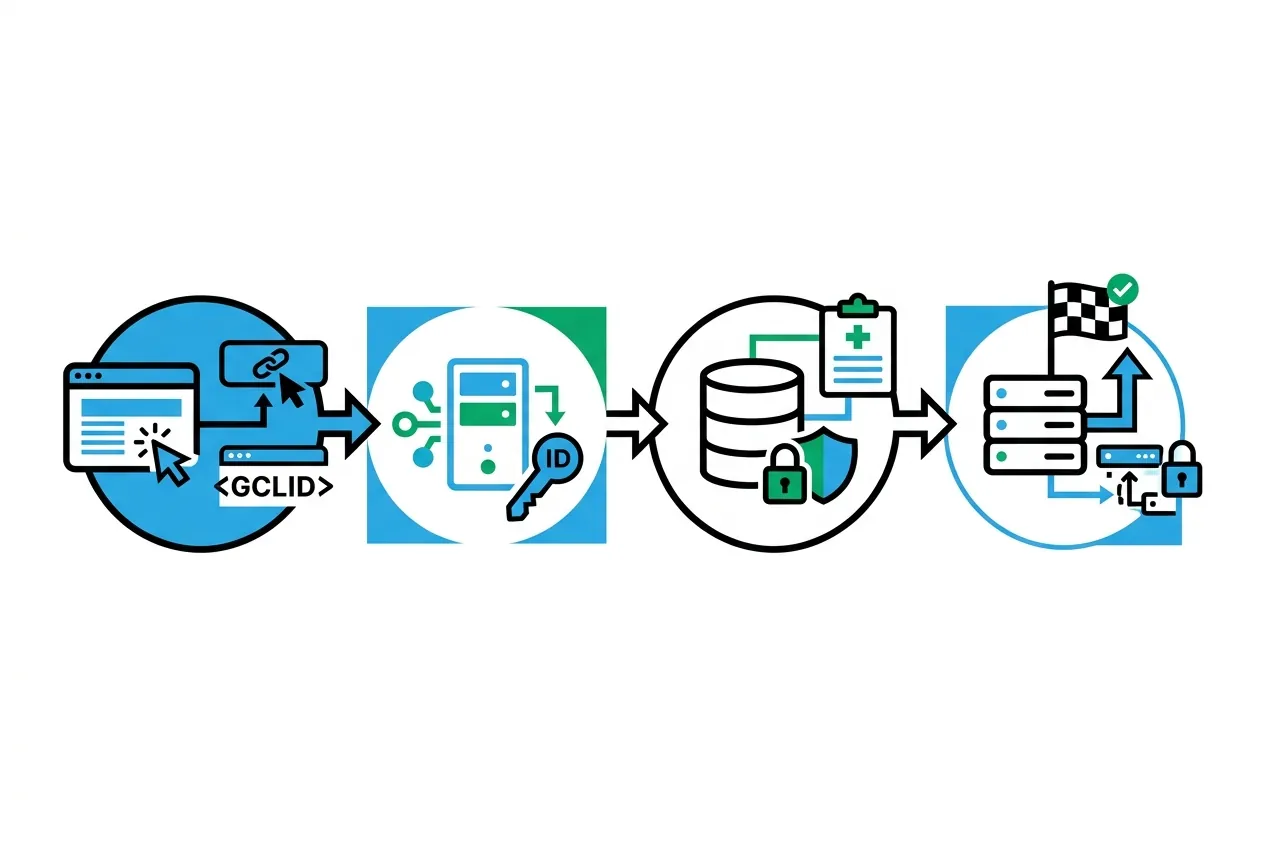
To track admissions marketing performance under these regulatory constraints, organizations must implement a privacy-aware, server-side data architecture. This framework bridges media touchpoints and clinical records without sending sensitive clinical information or PHI back to advertising platforms.
This tracking framework begins when a user navigates to your web property. Dynamic Number Insertion (DNI) presents a unique phone number linked to the visitor's web session, capturing click-level attributes such as the Google Click Identifier (GCLID), source, medium, campaign, and keyword set. When the visitor dials the number, the call tracking platform matches the incoming phone call to the digital session token without associating it with medical history or clinical declarations.
Once the call routes to your admissions center, the session token passes into an isolated, non-clinical field inside your intake customer relationship management (CRM) software. The admissions coordinator documents operational milestones within the CRM: Qualified Call, VOB Completed, Clinical Clearance, and Verified Admission.
To close the measurement loop, a server-side ingestion script queries the CRM for verified milestones at regular intervals. When an admission is confirmed, the script extracts the original marketing session token, removes all patient names, dates of birth, clinical notes, and diagnostic codes, and sends a hashed, privacy-safe conversion event back to the advertising platform API.
This offline conversion import allows media bidding algorithms to optimize for actual admissions milestones rather than raw website clicks, all while maintaining compliance with privacy standards and platform policies. Organizations seeking to implement this infrastructure can review our technical models for analytics and attribution services.
Root Causes of Funnel Breakdowns and High Acquisition Costs
When treatment center leadership analyzes an underperforming admissions scorecard, high cost per admission can usually be traced back to distinct operational or analytical failures. Identifying these common failure modes allows organizations to correct acquisition problems before exhausting operational budgets.
1. Inbound Call Abandonment and Staffing Misalignment
The most common point of marketing failure in behavioral health is intake call abandonment. Media spend often generates high call volumes during evenings and weekends when family members or prospective patients seek help outside work hours. However, treatment facilities frequently concentrate experienced intake coordinators during standard weekday business hours.
When call volume spikes during understaffed shifts, calls route to voicemail, encounter extended hold times, or transfer to general nursing staff unprepared to conduct motivational intake counseling. An unanswered call in behavioral health rarely leaves a voicemail; the prospective patient dials the next facility listed in the search results. An answer rate falling below 85% quickly wastes marketing investments.
2. Payer and Acuity Disconnects in Search Targeting
Paid search campaigns often generate high call volumes with low qualification rates due to overly broad keyword strategies and poor negative keyword hygiene. When marketing teams bid on broad match terms such as "rehab near me" or "mental health facility" without aggressive geographic exclusions and negative keywords, campaigns capture significant search traffic for state Medicaid, Medicare, or juvenile services that a private commercial facility cannot accept.
While these calls register as successful leads on marketing agency dashboards, they cannot clear the VOB stage. Campaign keyword sets and ad copy must clearly reflect accepted commercial insurance networks, private-pay parameters, and clinical scope to qualify search intent before the click occurs.
3. Delays in Verification of Benefits Processing
Friction during the VOB review process creates significant drop-off between the initial call and clinical pre-screen. When an intake coordinator collects insurance details and submits them to an off-site billing vendor or internal department that takes three to six hours to return policy parameters, the critical window of patient engagement closes.
Behavioral health inquiries are crisis-driven events. If a facility takes several hours to confirm coverage, the caller often contacts a competing facility that executes real-time digital benefit verifications. Every hour of delay between inquiry and benefit confirmation reduces admission show rates.
4. Over-Reliance on Vanity Conversion Signals
When digital marketing agencies lack server-side integration into the admissions CRM, they configure ad campaigns to optimize for micro-conversions, such as thirty-second phone calls, contact page visits, or automated form completions.
Ad platform machine-learning algorithms will automatically seek out the users most likely to trigger those front-end conversion actions. The algorithm does not know whether a caller holds verified commercial insurance or possesses a phone number from an out-of-service region; it only registers that a call occurred.
Over time, the media platform systematically directs ad spend toward low-intent, unqualified callers who readily dial phone numbers but never admit. Shifting platform optimization from raw calls to offline, verified conversion milestones reverses this programmatic waste.

The Treatment Center Admissions Marketing Audit and Scorecard Template
To establish visibility over your acquisition pipeline, implement this standard weekly scorecard audit. By evaluating performance across media channels, call quality, and intake conversion, leadership can quickly pinpoint where capital and operational capacity are being lost.
How to Interpret Scorecard Variances
- High Inbound Volume with Low Qualification Rate (Line 10 Below 50%):
- Diagnostic: Paid campaigns are reaching low-intent audiences or bidding on mismatched keywords. Review negative keyword lists for state-funded insurance programs, juvenile care, or unrelated medical services. Confirm geographic filters match your licensed service territory.
- High Qualified Call Volume with Low VOB Rate (Line 13 Below 40%):
- Diagnostic: Prospective callers match clinical requirements but lack compatible commercial insurance or private financial resources. Adjust digital messaging to set clearer expectations regarding accepted insurance networks before users contact intake.
- High VOB Clearance with Low Clinical Approval (Line 18 Below 80%):
- Diagnostic: Ad messaging and landing page content may be targeting clinical conditions or acuity levels that your medical team does not support, such as severe medical detox needs or complex dual diagnoses requiring hospital-based care.
- High Clinical Approvals with Low Arrival Show Rate (Line 21 Below 75%):
- Diagnostic: Bottlenecks sit within travel booking, financial navigation, or follow-up communications. Delays between clinical clearance and scheduled arrival allow prospective patients to reconsider, experience intervention fatigue, or choose a competing provider.
Questions, Answered.
Standard digital lead generation measures campaign success by front-end inquiry actions, such as raw clicks, ad impressions, web form completions, and phone rings. Admissions marketing tracks acquisition across the full clinical intake workflow: call quality, insurance verification, clinical clearance, scheduled travel, and physical bed placement. This approach allows leadership to evaluate marketing investments against true cost per admission (CPA) rather than superficial cost per lead (CPL).
A behavioral healthcare intake department should maintain a live answer rate of at least 85%, with a target of 90% or higher during peak inquiry hours. Callers seeking addiction or mental health services are frequently navigating personal crises. If an inbound call routes to voicemail or remains on hold for more than twenty seconds, callers routinely abandon the interaction and reach out to alternative treatment providers.
Google Ads enforces strict privacy rules that prohibit remarketing and personalized ad targeting within sensitive healthcare categories. Under the Google Ads Personalized Advertising Policy, advertisers are prohibited from deploying retargeting pixels or constructing audience lists based on personal hardships, including addiction treatment, mental health conditions, and clinical therapies. Treatment centers must optimize acquisition through compliant search targeting, dynamic landing pages, and privacy-safe offline conversion imports rather than direct remarketing campaigns.
The primary drivers of drop-off between clinical clearance and arrival are intake friction, slow travel coordination, and unaddressed family hesitation. If more than twenty-four to forty-eight hours elapse between clinical acceptance and scheduled arrival, patient motivation often wanes, or family dynamics shift. Facilities must establish dedicated intake support to coordinate transportation, manage travel logistics, and maintain continuous contact with the patient and family until arrival.
Most clinical EHR systems are engineered for medical charting, clinical compliance, and billing administration; they are not designed to capture click identifiers, session logs, and dynamic call tracking data. Effective admissions marketing requires a dedicated, HIPAA-aware intake CRM or data pipeline that captures marketing attribution data, maps it to clinical milestones using anonymous identifiers, and uploads de-identified conversion signals back to media platforms via secure server-side connections. Download the admissions scorecard
Ready to see where your marketing can improve?
Request a free audit of your paid media, landing pages, attribution, and measurement setup. You'll get a straight assessment of where the opportunities are.
or email us at info@marketingpowered.ai