Resources
Cost per Admission for Rehabs: Financial Model and Operational Benchmarks
Cost per admission rehab calculations establish the true commercial investment required to place a qualified patient into an active treatment bed. While digital marketing teams frequently celebrate low costs per raw inquiry, sustainable behavioral healthcare operations depend entirely on mid-funnel conversion velocity, insurance verification pass rates, and clinical suitability. Evaluating acquisition economics through admissions rather than lead volume reveals the operational disconnects that quietly drain facility margins.
By Mike Hulick, Founder, Marketing Powered

The Financial Model: Direct Media Versus Fully Loaded CPA
In behavioral healthcare, calculating patient acquisition costs using media spend alone creates an inaccurate picture of operational health. A marketing dashboard may report an acquisition figure of $2,800 based solely on digital ad spend divided by admitted patients. Meanwhile, the general ledger shows that when accounting for intake staffing, third-party verification technology, medical record review, and agency retainers, the actual operational cost to admit that same patient exceeds $7,500.
Treatment center executives must separate acquisition economics into two core models: Direct Media CPA and Fully Loaded CPA. Both metrics serve distinct management functions, but conflating them leads to misallocated capital and distorted financial forecasting.
Direct Media CPA measures front-end advertising efficiency. The formula divides total paid advertising investment across search, social, and aggregator platforms by the total count of verified admissions originating from those specific paid campaigns over a set evaluation period:
Direct Media CPA = (Total Paid Ad Spend) ÷ (Admissions Attributed to Paid Media)
Direct Media CPA shows how paid channels deploy capital relative to physical admissions. It highlights keyword efficiency, landing page message resonance, and geographic yield. However, it completely ignores the organizational friction required to transform a distressed phone call into a physical intake.
Fully Loaded CPA calculates the aggregate commercial cost required to fill a licensed bed. This figure includes every variable and fixed operational cost incurred from initial brand discovery to clinical intake:
Fully Loaded CPA = (Ad Spend + Intake Personnel Overhead + Verification Tech + Agency Fees + Logistics) ÷ (Total Completed Physical Admissions)
Intake personnel overhead includes the salaries, payroll taxes, benefits, and shift differentials for admissions coordinators, intake nurses, and after-hours coverage. Verification technology encompasses software subscriptions for real-time verification of benefits (VOB) engines, customer relationship management (CRM) licenses, electronic health record (EHR) inquiry integrations, and call routing infrastructure. Marketing platform infrastructure accounts for call tracking licenses, search engine marketing management fees, and mandatory regulatory verifications such as LegitScript certification. Transportation logistics capture facility-funded airfare, secure ground transit, or peer recovery travel support provided prior to clinical admission.
When financial officers track only direct media spend, intake inefficiency remains hidden. An intake team that takes 45 minutes to process an insurance verification or drops 70% of qualified clinical inquiries during shift handoffs can inflate the true cost of acquisition without altering the marketing team's front-end reports.
To diagnose where capital is being lost, operators must break down the acquisition path into its composite mathematical drivers:
CPA = Cost Per Lead (CPL) ÷ (Clinical Qualification Rate × Payer Fit Rate × Intake Close Rate)
This relationship demonstrates why chasing a lower cost per lead often raises the final cost per admission. If an agency lowers CPL from $250 to $80 by bidding on broad behavioral health queries, but the clinical qualification rate drops from 40% to 8% and the payer fit rate falls from 50% to 12%, the resulting cost to seat a patient multiplies dramatically. Lower-funnel conversion mechanics always override top-of-funnel inquiry discounts.
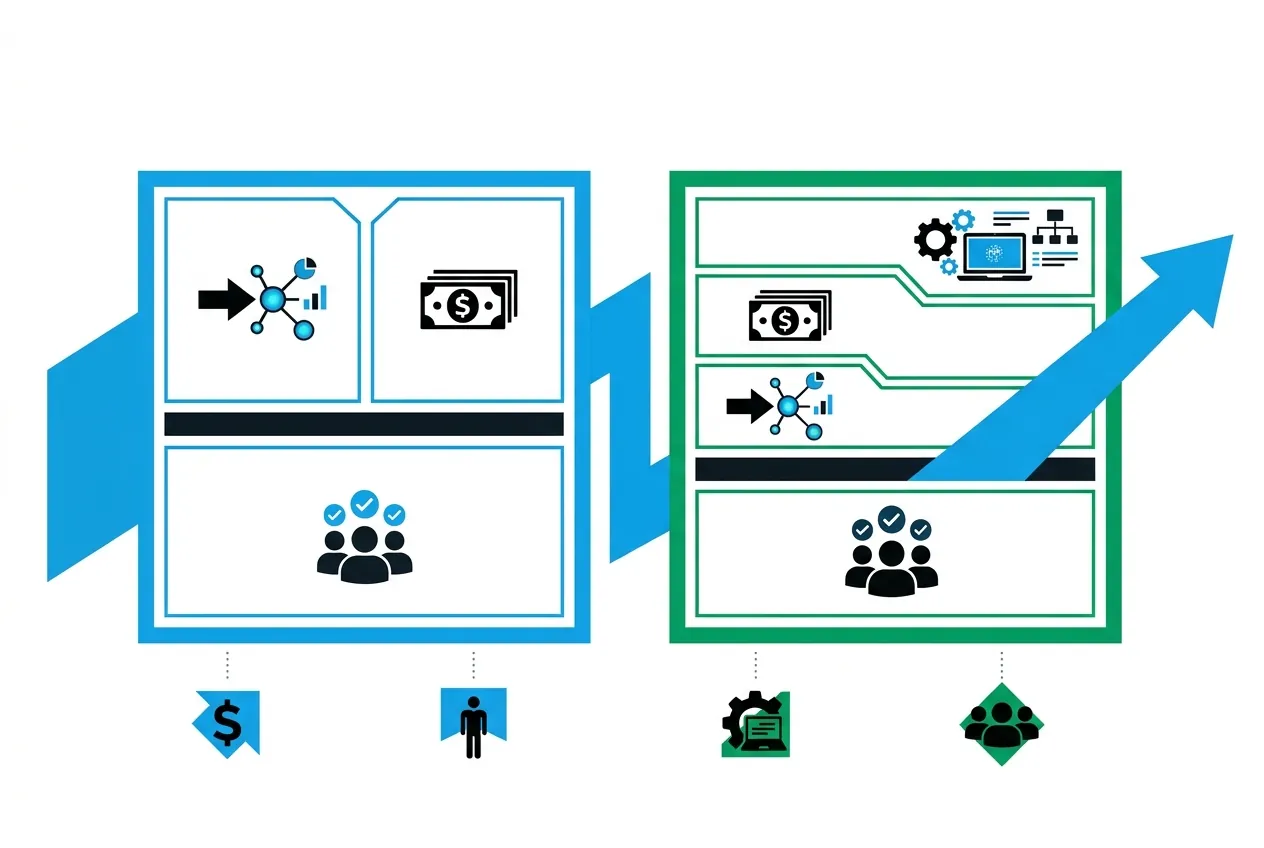
Behavioral Health Benchmarks by Level of Care and Payer Mix
Cost per admission rehab metrics cannot be evaluated as a single universal number. Acquisition benchmarks vary sharply based on level of care, clinical acuity, payer relationships, and facility licensing. Comparing the CPA of an in-network intensive outpatient program with that of an out-of-network medical detox facility creates false performance targets that mislead executive planning.
In-Network (INN) Residential Treatment
In-network residential facilities operate under negotiated per-diem contracts with commercial payers such as Blue Cross Blue Shield, Aetna, Cigna, or UnitedHealthcare. Because in-network status eliminates the massive out-of-pocket deductible hurdles common in private healthcare, the addressable patient pool is broader and insurance verification approval rates are substantially higher.
- Direct Media CPA Target: $2,500 to $4,500
- Fully Loaded CPA Target: $4,500 to $7,500
- Average Length of Stay (ALOS): 14 to 28 days
- Commercial Payer Verification Pass Rate: 45% to 65%
- Dominant Acquisition Friction: Local market bed availability and clinical exclusion criteria (such as severe co-occurring medical conditions or active psychosis).
For in-network providers, the primary financial constraint is margin management. Because contracted reimbursement rates are fixed and lower than historical out-of-network charges, allowable CPA margins are tighter. An in-network facility generating $650 per diem across a 21-day length of stay produces $13,650 in gross commercial revenue per admission. A fully loaded CPA of $6,800 consumes nearly 50% of the patient episode's gross margin. Operating profitably in an in-network environment requires strict adherence to efficient local targeting, high conversion velocity, and low administrative intake waste.
Out-of-Network (OON) Residential and Dual Diagnosis
Out-of-network residential facilities rely on private insurance policies with out-of-network behavioral health benefits. While reimbursement per admitted patient day is substantially higher than in-network contracts, the path from initial phone call to bed placement contains severe financial friction points.
- Direct Media CPA Target: $6,500 to $12,000
- Fully Loaded CPA Target: $10,000 to $18,000+
- Average Length of Stay (ALOS): 21 to 45 days
- Commercial Payer Verification Pass Rate: 12% to 25%
- Dominant Acquisition Friction: High individual deductibles ($5,000 to $15,000), restrictive policy exclusions, and utilization review management by third-party administrators.
Out-of-network providers operate in an entirely different financial dynamic. With gross episodic reimbursements often ranging from $35,000 to $65,000, leadership can sustain a $12,000 fully loaded CPA and still maintain healthy margins. However, out-of-network acquisition models face extreme cash-flow volatility. Because only one in six commercial inquiries typically holds an active, qualifying out-of-network policy with manageable deductibles, the marketing engine must process higher raw inquiry volumes to yield a single admission.
Partial Hospitalization (PHP) and Intensive Outpatient (IOP)
Day treatment and outpatient programs rely primarily on local community patient populations. Without 24-hour room and board coverage, patients rarely travel across state lines for outpatient programming alone, making hyper-local visibility essential.
- Direct Media CPA Target: $1,200 to $2,800
- Fully Loaded CPA Target: $2,200 to $4,200
- Average Length of Stay (ALOS): 6 to 12 weeks
- Commercial Payer Verification Pass Rate: 50% to 70%
- Dominant Acquisition Friction: Daily attendance adherence, local transportation, and competition from community mental health centers.
Outpatient programs feature lower total lifetime revenue per clinical episode, typically generating between $5,000 and $12,000 depending on step-down duration. High CPA expenditures quickly destroy the profitability of an outpatient clinic. Success in this vertical relies on localized search rankings, strong regional professional networks, and step-down transitions from inpatient detox programs.
- Medical Detox / Inpatient. Payer Relationship: In-Network (INN). Typical Direct Media CPA: $2,000 - $3,800. Typical Fully Loaded CPA: $3,800 - $6,200. Average Inbound VOB Pass Rate: 50% - 65%. Intake Close Rate Range: 15% - 22%.
- Medical Detox / Inpatient. Payer Relationship: Out-of-Network (OON). Typical Direct Media CPA: $6,000 - $11,000. Typical Fully Loaded CPA: $9,500 - $16,000. Average Inbound VOB Pass Rate: 15% - 28%. Intake Close Rate Range: 6% - 11%.
- Residential Dual Diagnosis. Payer Relationship: In-Network (INN). Typical Direct Media CPA: $2,800 - $4,800. Typical Fully Loaded CPA: $4,800 - $7,800. Average Inbound VOB Pass Rate: 45% - 60%. Intake Close Rate Range: 12% - 18%.
- Residential Dual Diagnosis. Payer Relationship: Out-of-Network (OON). Typical Direct Media CPA: $7,500 - $13,500. Typical Fully Loaded CPA: $11,000 - $19,500. Average Inbound VOB Pass Rate: 12% - 22%. Intake Close Rate Range: 5% - 9%.
- PHP / IOP Day Treatment. Payer Relationship: In-Network (INN). Typical Direct Media CPA: $1,200 - $2,400. Typical Fully Loaded CPA: $2,200 - $3,800. Average Inbound VOB Pass Rate: 55% - 70%. Intake Close Rate Range: 18% - 26%.
- PHP / IOP Day Treatment. Payer Relationship: Out-of-Network (OON). Typical Direct Media CPA: $2,500 - $4,500. Typical Fully Loaded CPA: $4,200 - $6,800. Average Inbound VOB Pass Rate: 20% - 35%. Intake Close Rate Range: 8% - 14%.
Blending these figures across distinct facilities creates blind spots. An operator running both an in-network outpatient center in Ohio and an out-of-network luxury residential retreat in California will see a blended CPA that obscures both the marketing waste in the outpatient program and the intake conversion breakdowns at the residential facility. Every program requires its own distinct acquisition ledger.
The Intake Drop-Off Waterfall: Where Qualified Inquiries Disappear
Digital marketing agencies often disclaim responsibility for business revenue by stating their role ends when the phone rings. Simultaneously, admissions departments defend declining census numbers by claiming that inbound calls are low quality. The reality sits directly within the mid-funnel conversion pipeline: the intake drop-off waterfall.
To pinpoint where capital is lost, facilities must map inquiry data across five distinct stages. When an inquiry fails to convert, documenting the exact failure point is the only way to determine whether the breakdown stems from campaign messaging, payer verification speed, or admissions team handling.
Stage 1: Inbound Contact to Clinical Qualification
The funnel begins the moment a prospective patient, family member, interventionist, or employer contacts the treatment center.
Major failure mechanisms:
- Inquiry timing: Calls arriving outside normal business hours routed to unmonitored voicemail or third-party answering services with no clinical knowledge.
- Acuity mismatch: Prospective patients presenting with acute medical issues (e.g., severe delirium tremens, active suicidality, severe eating disorders) that exceed the facility's licensed capabilities.
- Age and demographic restrictions: Calls seeking adolescent care contacting an adult-only residential facility due to broad digital campaign targeting.
Operational metric to enforce: Speed-to-lead. If an online form submission or missed call is not engaged by a live admissions coordinator within 3 minutes, the likelihood of completing a clinical assessment falls precipitously. Individuals seeking behavioral healthcare are often experiencing acute distress; a delay of 20 minutes frequently results in the caller reaching out to a competing facility or abandoning the search altogether.
Stage 2: Clinical Qualification to Financial Verification (VOB)
Once a coordinator determines the prospective patient meets the facility's clinical scope, the financial vetting process begins. The intake coordinator collects health insurance policy numbers, group IDs, subscriber dates of birth, and employer information to run a verification of benefits.
Major failure mechanisms:
- Payer incompatibility: The caller holds Medicaid, Medicare, or an HMO policy, while the facility only accepts commercial PPO plans.
- Prohibitive cost-sharing: The patient has an active policy, but their remaining individual deductible is $8,500 with 40% co-insurance, and the family lacks liquid funds to cover the out-of-pocket obligation.
- Sluggish verification turnaround: The intake team relies on manual phone calls to insurance clearinghouses that take four to six hours. By the time benefits are verified, the prospective patient has entered withdrawal, disconnected their phone, or accepted placement elsewhere.
Operational metric to enforce: VOB turnaround velocity. In-network benefits should be verified via automated clearinghouse connections within 15 minutes of initial contact. Complex out-of-network verifications should never exceed 45 minutes.
Stage 3: Verification of Benefits to Bed Offer and Scheduling
With benefits verified and out-of-pocket costs reviewed, the admissions department presents the financial agreement to the patient or family and reviews the case with the clinical director or attending physician for final bed approval.
Major failure mechanisms:
- Financial sticker shock: Unclear communication of out-of-pocket expectations early in the call, causing family members to balk when presented with initial deductible payments.
- Physician review bottlenecks: Clinical leadership taking hours to review medications and history, allowing the crisis window to close.
- Lack of real-time inventory management: Admissions coordinators offering beds that were filled an hour earlier by a different coordinator, resulting in delayed scheduling.
Operational metric to enforce: Offer acceptance rate. A properly aligned intake team should convert at least 50% of fully verified, clinically qualified opportunities into scheduled admissions.
Stage 4: Scheduled Intake to Physical Bed Arrival
Scheduling an intake date does not equal an admitted patient. In residential behavioral healthcare, the gap between scheduling and physical check-in represents a critical drop-off point.
Major failure mechanisms:
- Travel anxiety and ambivalence: Patients experiencing hesitation while waiting for their scheduled flight or drive.
- Lack of travel coordination: Facilities expecting patients in active withdrawal to navigate commercial airline travel without support.
- Toxic home environments: Leaving the patient in an unstable environment for 48 to 72 hours before intake occurs, during which relapse or intervention collapse frequently happens.
Operational metric to enforce: Show rate (Intakes completed / Intakes scheduled). High-performing facilities maintain a show rate above 85% by providing direct travel logistics, continuous touchpoints by peer recovery staff every four hours, and immediate next-day admissions.
When analyzing the entire funnel, an intake close rate of 8% to 15% across all inbound calls is typical for well-run in-network facilities. Out-of-network residential facilities generally operate between 3% and 8% because of stricter payer criteria. When total conversion dips below these ranges, leadership must systematically review the waterfall data to resolve the specific operational breakdown before allocating additional capital to top-of-funnel advertising.
Free Audit
Want a straight read on where your budget is leaking?
Regulatory and Platform Constraints That Reshape Acquisition Economics
Marketers entering behavioral healthcare from traditional enterprise software or consumer e-commerce often rely on playbooks that violate federal healthcare regulations or major platform advertising rules. Lowering your cost per admission rehab requires operating within a narrow, highly scrutinized regulatory environment.
LegitScript Certification Mandates
Before an addiction treatment provider can spend a single dollar on Google Ads or Meta platforms, the facility must secure and maintain active LegitScript certification.
LegitScript evaluates applicants across multiple operational standards:
- Valid, unencumbered state facility licensure for every level of care advertised.
- Verification that physical facilities exist and match corporate filings.
- Review of clinical staffing credentials, medical oversight policies, and background checks.
- Review of website disclosures, domain ownership, and physical address transparency.
- Strict scrutiny of billing practices, laboratory testing arrangements, and incentive programs to verify compliance with the federal Eliminating Kickbacks in Recovery Act (EKRA).
LegitScript certification requires significant upfront application fees, extensive background documentation, and annual renewal audits. If a facility allows its certification to lapse, ad platforms will immediately suspend all active search and social campaigns. Reinstatement can take weeks, during which census levels drop while fixed facility overhead costs remain constant.
The Complete Prohibition of Health-Related Retargeting
In standard digital marketing, retargeting website visitors who failed to convert on their initial visit is a standard method for reducing overall acquisition costs. If a user visits a pricing page and leaves, an ad tracker serves display ads across the web over the following 30 days to encourage a return visit.
Under the Google Ads Personalized advertising policy, personalized advertising and retargeting are strictly prohibited for health in personalized advertising queries. Platforms explicitly ban building audience lists based on health conditions, substance use disorders, mental health treatments, or clinical facility visits.
Google considers any attempt to serve targeted ads based on past interaction with an addiction treatment domain a policy violation that risks immediate account termination. Marketers cannot deploy remarketing lists for search ads (RLSA), display retargeting banners, or build Meta custom audiences from website visitors seeking addiction care.
This platform constraint completely changes digital economics. Every website visitor represents a one-time opportunity. If your landing page features confusing messaging, conceals insurance acceptance details, or forces a user in crisis to fill out a 15-field contact form, that visitor leaves and will not be re-engaged through ad networks. Front-end messaging must qualify the visitor, establish trust, and provide direct phone access immediately.
HIPAA Enforcement and First-Party Tracking Boundaries
The Office for Civil Rights (OCR) at the U.S. Department of Health and Human Services (HHS) has established clear guidance regarding the use of online tracking technologies by HIPAA-covered entities. The transmission of protected health information (PHI)—including an individual's IP address combined with visits to specific health treatment pages—to non-HIPAA-compliant third-party advertising platforms without valid authorization violates federal privacy law.
Standard tracking implementations that send unhashed lead data or tracking pixels directly to ad platforms create massive legal and financial liabilities. Treatment centers cannot rely on third-party tracking pixels to train ad algorithms on which users converted into patients.
Instead, sophisticated operators build HIPAA-aware, server-side data architectures. Conversion events sent back to ad engines must be completely stripped of personal identifiers, utilizing randomized click identifiers (such as Google GCLIDs) and offline conversion tracking protocols. This architecture lets ad platforms optimize bidding toward qualified admissions without exposing sensitive patient health details to public platform databases.
Compliance-Driven Bidding Environments
Because of these regulatory boundaries, the competitive landscape in behavioral health search is heavily compressed. Standard marketing strategies such as broad-brush behavioral targeting, programmatic display networks, and third-party lookalike audiences are unavailable.
Consequently, high-intent Google search auctions represent the primary digital channel where patients and families actively seek immediate placement. This dynamic drives cost-per-click (CPC) rates for terms like "dual diagnosis residential treatment" or "medical detox near me" to levels between $40 and $120 per click. Under the Google Ads Healthcare and medicines policy, advertisers must be verified and certified, creating a high barrier to entry where only operators with disciplined conversion funnels can bid profitably.
When every click requires a substantial financial investment and users cannot be retargeted, marketing waste must be minimized. Directing paid traffic to broad, unsegmented landing pages or deploying general call center staff to answer high-intent medical inquiries quickly inflates costs and damages campaign performance.
Capacity-Aware Demand Modeling and Rehab Marketing Budget Sizing
A frequent mistake in behavioral healthcare leadership is managing marketing as a static, disconnected line item. A chief financial officer sets an annual rehab marketing budget of $60,000 per month, distributes it evenly across 12 calendar months, and expects the admissions team to maintain an 85% average census.
This static approach ignores the operational reality of facility operations: licensed bed capacity fluctuates constantly based on clinical discharges, staffing ratios, and gender-specific room configurations.
Managing acquisition spend without real-time capacity modeling leads to two persistent points of failure:
- Over-spending during high-census periods: The facility is running at 94% occupancy with only two open beds, but the marketing team continues spending $2,000 per day on paid search. Inbound calls are turned away or referred out, effectively burning acquisition capital.
- Under-spending during impending census cliffs: The facility is currently full, but discharge planning schedules show that 12 patients will complete their residential programming over the next seven days. Because the static marketing budget was not adjusted ahead of time, the facility hits an occupancy cliff, dropping to 55% census before new leads can be generated and processed through the intake waterfall.
Dynamic, capacity-aware demand modeling ties marketing spend directly to real-time bed inventory and predictable clinical discharge schedules.
To implement dynamic budget sizing, leadership must calculate its monthly capital allocation using empirical admissions math rather than arbitrary financial targets.
The Budget Sizing Formula
To determine the precise marketing budget required to achieve census targets, operators apply the reverse admissions formula:
Required Inbound Inquiries = (Required Admissions Target) ÷ (Intake Close Rate)
Required Monthly Ad Budget = Required Inbound Inquiries × Average Cost Per Qualified Inquiry
Consider a 36-bed in-network residential treatment center. The facility maintains an average length of stay of 24 days. To maintain an optimal 88% occupancy rate, the facility must maintain an average daily census of 32 patients.
At an ALOS of 24 days, each bed turns over approximately 1.25 times per month. Maintaining 32 active beds requires roughly 40 completed admissions every month.
If alumni referrals, professional community outreach, and organic search generate 16 admissions per month, the paid acquisition engine must reliably produce the remaining 24 admissions.
Using historical conversion data:
- In-Network Intake Close Rate (Inquiries to Admissions): 12%
- Average Cost Per Qualified Inbound Inquiry: $185
Required Monthly Paid Inquiries = (24 Admissions) ÷ (0.12 Close Rate) = 200 Qualified Inquiries

Required Monthly Ad Budget = 200 Inquiries × $185 = $37,000
Under this capacity-aware model, the targeted Direct Media CPA is:
Email Us
Prefer to send the context directly?
Target Direct Media CPA = ($37,000) ÷ (24 Admissions) = $1,541.67
If census drops unexpectedly to 22 beds due to early departures against medical advice (AMA), the marketing engine must increase inquiry volume. Because paid search campaigns cannot be scaled infinitely without experiencing diminishing returns and higher cost-per-click rates, the model must account for the marginal CPA curve. Expanding targeting into broader geographic regions or secondary search terms naturally reduces the overall intake close rate, meaning CPA increases as campaign scale expands.
To learn more about structuring regional and program allocations, review our detailed guide on rehab marketing budget architecture.
Upgrading the Intake Close Rate Across Critical Conversion Milestones
Improving your cost per admission rehab does not require doubling your marketing budget. The fastest, most cost-effective way to reduce CPA is to identify and fix operational friction inside your intake and admissions department.
Small improvements across intermediate conversion milestones produce substantial gains in total admissions. If a treatment center improves its clinical qualification rate by 15%, its verification pass rate by 10%, and its scheduling close rate by 10%, the facility increases total admitted patients by nearly 40% without spending an extra dollar on digital advertising.
To capture these gains, admissions directors must deploy structured operational protocols across the intake lifecycle.
Milestone 1: Contact Friction and the Three-Minute Rule
Data across emergency and acute behavioral health services consistently shows that inquiry responsiveness governs conversion success. A prospective patient reaching out for help is often at a critical decision point.
Operational protocols to deploy:
- Automated call routing: Direct high-intent inbound search calls straight to an active admissions coordinator, bypassing multi-tiered interactive voice response (IVR) phone trees. Forcing a caller in crisis to "press 4 for admissions" leads to abandoned calls.
- Omnichannel notification: When a web form or digital inquiry is submitted, configure instant text and voice delivery to the on-duty admissions team.
- After-hours clinical coverage: Shift from passive third-party answering services that take messages to licensed or trained coordinators working dedicated evening and weekend shifts. The majority of crisis calls occur between 6:00 PM and 2:00 AM; routing these inquiries to an untrained overnight answering service wastes valuable lead opportunities.
Milestone 2: Empathetic Discovery Versus Clinical Interrogation
Intake coordinators often default to viewing incoming calls as clinical checklists. They immediately demand insurance IDs, medical histories, and sobriety dates before establishing rapport or acknowledging the caller's distress. This approach creates emotional resistance and causes prospective patients to disengage.
Operational protocols to deploy:
- The 70/30 conversational balance: Coordinators should spend the first three minutes listening actively, validating family distress, and establishing clinical safety before requesting insurance policy numbers.
- Peer-led connection: Utilize coordinators who have personal recovery experience or formal behavioral health training. Prospective patients and families respond to empathy, clear authority, and genuine guidance during moments of crisis.
- Clear reassurance: Normalize the fear of entering treatment. Address practical barriers immediately, including job protection rights under the Family and Medical Leave Act (FMLA), pet boarding accommodations, and medical detox safety protocols.
Milestone 3: Real-Time Insurance Verification and Payer Navigation
The delay between receiving insurance policy details and delivering a financial explanation of benefits is a primary driver of mid-funnel drop-offs. If a coordinator says, "Let me run this through billing and call you back in three or four hours," the chance of losing that patient increases substantially.
Operational protocols to deploy:
- Electronic clearinghouse integration: Deploy verification technology that interfaces directly with major clearinghouses to confirm active coverage, copays, deductibles, and authorization requirements while the prospective patient remains on the phone.
- Transparent financial presentation: Break down the financial commitment clearly. Explain deductible obligations, coinsurance, and available payment options with empathy. Ambiguous statements such as "insurance should take care of most of it" inevitably cause deals to collapse later when billing documents arrive.
- Payer navigation for out-of-network facilities: If a patient holds an out-of-network policy with an unaffordable single-case deductible, establish documented warm-handoff agreements with trusted in-network community partners rather than simply rejecting the caller. Assisting an unqualified caller in finding appropriate care builds community goodwill and professional referral equity.
To evaluate how your acquisition team can systematize these operational workflows, explore our specialized programs for rehab lead generation.

Building an Attribution Architecture Down to Bed Placement
Lowering your cost per admission rehab over time requires closing the data loop between your marketing platform and your electronic health record.
Most marketing agencies optimize campaigns around shallow conversion events: total clicks, form submissions, or raw phone calls lasting longer than 60 seconds. However, ad platform algorithms do not understand your clinical licensing or insurance contracts. If an algorithm notices that bidding on low-cost keywords generates an influx of Medicaid calls to a facility that only accepts commercial PPO insurance, it will allocate more budget to those low-cost terms.
The agency will report that call volume is up and cost per call has dropped by 40%. Meanwhile, the admissions team is overwhelmed with unqualified inquiries, zero new patients are admitted, and the facility's fully loaded CPA climbs.
Solving this problem requires an attribution system that measures outcomes all the way down to physical bed placement.
Step 1: Capture Source Attribution Data Securely
When a user engages with your digital properties, their ad click ID (such as a Google GCLID or campaign identifier) must be captured dynamically by your web session infrastructure. If the user calls your intake line, your call tracking system must dynamically display a unique tracking number mapped to that specific web session.
This call tracking platform must operate under a signed Business Associate Agreement (BAA) and capture the source campaign, keyword cluster, and session data without recording or transmitting protected health information (PHI) back into unauthorized platform tools.
Step 2: Route Attribution Identifiers into the Admissions CRM
When the call or web form reaches your intake team, the unique click and campaign identifiers must flow directly into the CRM inquiry record alongside the caller's operational notes.
The CRM must document the patient's progression through distinct intake statuses:
- Inbound Call Received
- Clinically Qualified
- Insurance Run (VOB Complete)
- Insurance Approved (Financial Match)
- Intake Scheduled
- Admitted (Physical Bed Placement)
- Lost / Disqualified (with structured disposition reasons: e.g., Wrong Payer, Out of Service Area, Clinical Mismatch, Chose Competitor)
Step 3: Offline Conversion Feedback Loops
Once a patient physically arrives at the facility and completes the clinical intake intake process, your billing or EHR system registers a completed admission.
Using a secure server connection, your marketing data infrastructure queries the CRM for verified admissions, extracts the associated ad click identifiers (such as the GCLID), and sends an offline conversion event back into the ad platform. This conversion payload contains only deterministic transaction data: the transaction ID, the timestamp, an assigned conversion value, and the original ad click ID. No patient names, diagnoses, clinical notes, or medical identifiers are ever shared.
Step 4: Activating Value-Based Smart Bidding
With offline conversion data flowing back into the ad platform, you can adjust your advertising strategies. Instead of configuring campaigns to maximize raw conversions (calls), you switch the bidding engine to Value-Based Bidding (Target ROAS or Maximize Conversion Value).
Under this model:
- A raw inbound call that fails verification is assigned a conversion value of $0.
- A clinically qualified call with verified insurance is assigned a conversion value of $500.
- A completed, physical admission is assigned a conversion value of $5,000.
The ad platform's machine learning algorithms will automatically adjust bidding strategies. The engine stops pursuing broad, low-intent search terms that generate unqualified calls and focuses spend on specific search queries, audiences, and dayparts that reliably yield admitted patients. Closed-loop attribution aligns your marketing spend directly with facility census requirements.
Questions, Answered.
To calculate cost per admission by program, segment all direct advertising spend, dedicated intake personnel hours, and technology overhead by clinical level of care rather than combining them into a single facility-wide average. Divide the total capital allocated to each specific program by the verified physical admissions completed for that service line over that time frame: Program CPA = (Direct Program Ad Spend + Allocated Intake Labor + Program Clinical Vetting Costs) ÷ Completed Physical Admissions to That Specific Program. For example, an intensive outpatient program (IOP) that spends $12,000 on localized search ads, incurs $4,000 in dedicated intake staffing costs, and admits 8 patients produces an IOP CPA of $2,000. Evaluating programs separately prevents high-margin residential services from masking operational inefficiencies in outpatient divisions.
Cost per admission must always be evaluated alongside intermediate conversion milestones rather than measured in isolation. Front-end marketing efficiency should be tracked via Cost Per Qualified Call (inquiries that meet basic clinical criteria and hold viable insurance coverage). Operational intake efficiency is measured by the Lead-to-Admission conversion percentage. If your Cost Per Qualified Call is low but your overall CPA is unsustainably high, the operational failure lies inside the admissions department (slow verification speed, poor sales technique, or delayed physician reviews). Conversely, if the intake team converts 25% of qualified calls but the CPA remains inflated, the breakdown stems from front-end marketing targeting issues that drive too few qualified opportunities.
For in-network residential treatment centers, a healthy intake close rate typically ranges from 10% to 18% of total raw inbound inquiries, and 35% to 50% of clinically qualified, insurance-verified contacts. For out-of-network private facilities, an intake close rate of 3% to 8% of raw inquiries is typical because of higher deductible barriers, stricter medical necessity criteria, and narrower policy coverage.
Health-related retargeting is strictly prohibited under federal privacy regulations and major platform policies, including Google Ads Personalized Advertising policies. Behavioral health conditions, substance use disorders, and mental healthcare are classified as sensitive personal health categories. Serving targeted advertisements to users based on their prior visits to an addiction treatment website creates severe patient privacy risks and violates platform policies. Violating these rules can result in immediate, permanent ad account suspensions.
A treatment center can lower its CPA without increasing marketing spend by optimizing three operational conversion points: Decrease speed-to-lead response times on missed calls and digital form submissions to under three minutes. Automate electronic verification of benefits (VOB) to return insurance coverage details to prospective patients within 15 minutes of initial contact. Deploy closed-loop, HIPAA-aware offline conversion tracking to feed verified bed admissions back into ad platform bidding engines, training algorithms to eliminate spend on search terms that generate unqualified calls. Request an admissions economics audit
Ready to see where your marketing can improve?
Request a free audit of your paid media, landing pages, attribution, and measurement setup. You'll get a straight assessment of where the opportunities are.
or email us at info@marketingpowered.ai