Resources
Hospital Marketing Agency RFP and Evaluation Matrix
A hospital marketing agency rfp must evaluate technical infrastructure, operational intake handoffs, and regulatory compliance rather than creative pitch decks. When health systems procure an external marketing partner, selecting an agency based on subjective brand presentations often produces unverified leads, tracking compliance violations, and misallocated budgets. This procurement framework and evaluation matrix enables healthcare leadership to audit agency capabilities against clinical capacity, privacy mandates, and verifiable patient encounters.
By Mike Hulick, Founder, Marketing Powered

The Structural Flaw in Traditional Hospital Agency RFPs
Procurement committees at regional hospitals and academic medical centers often manage agency procurement using general enterprise purchasing templates. A review team composed of the chief marketing officer, supply chain specialists, and clinical department chairs sits in a conference room reviewing twenty-page submissions filled with award show laurels, broadcast video reels, and aesthetic redesigns. While brand identity carries value, selecting an agency through creative showmanship introduces severe downstream operational friction. Health systems do not suffer from an absence of creative storytelling. They suffer from disconnected data pipelines, unaddressed scheduling bottlenecks, and marketing spend directed into clinical departments that have sixty-day appointment backlogs.
When an RFP focuses on creative philosophies, agencies respond with broad assertions regarding awareness and community engagement. These proposals routinely gloss over how media buyers manage platform policies or connect ad spend to electronic health record encounters. In consumer retail, a digital agency can deploy standard tracking pixels across an e-commerce catalog, measure cart checkouts via third-party web cookies, and optimize campaigns using native machine learning algorithms. In healthcare, this standard operational playbook is both ineffective and legally hazardous.
Health system marketing operates under strict structural constraints. Clinical service lines have fixed physical capacities, variable physician schedules, and localized coverage areas. Digital advertising platforms enforce rigorous sensitive-category limitations. For instance, the Google Ads Personalized Advertising Policy strictly prohibits using remarketing lists, audience targeting, or historical user data to target individuals based on health conditions, treatments, or clinical procedures. A generic agency that promises to retarget website visitors who browsed cardiology or oncology pages displays a fundamental ignorance of platform rules that can lead to account suspension.
Furthermore, traditional RFPs rarely evaluate intake mechanics. If an agency drives five hundred patient inquiries for joint replacement surgery, but the hospital call center experiences a thirty-five percent abandonment rate or scheduling desks lack template availability for eight weeks, the marketing expenditure produces zero net clinical value. An operator-grade RFP treats marketing as an end-to-end operational system. It assesses the agency as an engineering and acquisition partner capable of synchronizing paid media, privacy-compliant tracking architecture, and hospital access workflows.

Mandatory RFP Architecture: Core Technical and Operational Requirements
To filter out agencies that lack deep healthcare competencies, your procurement specification must ask targeted, technically explicit questions. Avoid open-ended queries such as "Describe your reporting philosophy." Instead, require prospective vendors to document exact data flows, server configurations, and intake integration protocols.
Every enterprise hospital marketing RFP must incorporate five non-negotiable requirement modules:
1. Privacy-Governed Measurement and Technical Data Architecture
Prospective agencies must outline their exact tracking infrastructure. Health systems cannot allow third-party client-side scripts to run unmonitored on patient-facing domains. The proposal must mandate:
- Detailed network topology showing how patient interaction data is collected, filtered, and transmitted.
- Specification of server-side tracking environments, including reverse-proxy implementations and customer-owned cloud endpoints.
- Protocols for executing Business Associate Agreements across the entire software stack, including analytics pipelines, call tracking engines, and cloud hosting vendors.
- A clear strategy for first-party conversion measurement that does not expose protected health information or user IP addresses to advertising networks.
2. Service-Line Demand Orchestration and Capacity Balancing
Healthcare organizations cannot afford uniform media pacing across all departments. The RFP must require vendors to demonstrate dynamic budget reallocation:
- Operational mechanisms for pausing or reducing ad spend when specific service lines reach maximum appointment capacity.
- Systems for prioritizing high-contribution margin clinical programs such as orthopedics, neurology, bariatric surgery, and cardiovascular interventions.
- Methodology for coordinating localized campaigns for specialized programs, integrating with hospital service-line marketing strategies to prevent internal competition between affiliated community clinics and flagship facilities.
3. Intake Integration and Call Center Synchronization
A patient lead is not an acquisition. The RFP must evaluate how the agency interfaces with hospital access operations:
- Integration capabilities with patient scheduling platforms, centralized access centers, and practice management software.
- Verification of dynamic number insertion (DNI) architectures that route phone calls to specialized clinical queues while preserving privacy-safe campaign attribution.
- Protocols for auditing call quality, hold times, and scheduling disposition without capturing or storing sensitive patient communications on unauthorized third-party servers.
4. Search and Local Directory Governance
Hospitals rely heavily on organic local discovery for primary care and urgent care facilities. The vendor must provide:
- Multi-location management protocols for Google Business Profiles, National Provider Identifier (NPI) directory synchronization, and local listing consistency across hundreds of providers.
- Technical strategies for addressing provider turnover, clinic relocations, and duplicate map markers.
- Search engine optimization frameworks designed to capture high-intent local queries while competing effectively against non-profit aggregators and commercial directory sites.
5. Media Buying Accountability and Vertical Verification
Paid advertising in healthcare requires specialized knowledge of regulatory controls and certification programs:
- Experience with platform-specific certification processes, including the Google Ads Healthcare Policy, which mandates strict validation for clinical trials, pharmacy services, and treatment facilities.
- LegitScript certification management protocols for behavioral health, addiction medicine, and specialized psychiatric units operated within the health system.
- Direct media management proof. Heath systems must determine whether the agency manages accounts in-house or white-labels media execution to offshore brokers or third-party holding companies.
Auditing Data Privacy, Server-Side Tracking, and HHS Ad-Tech Compliance
Data privacy represents the most critical legal vulnerability in modern healthcare marketing. In December 2022, and with subsequent operational updates, the Department of Health and Human Services Office for Civil Rights issued explicit regulatory guidance regarding digital marketing technologies. The HHS Bulletin on Online Tracking Technologies confirmed that deploying unmanaged third-party tracking pixels on hospital websites can constitute an impermissible disclosure of protected health information under the Health Insurance Portability and Accountability Act.
When a patient visits a hospital website to research an oncology diagnosis, locate a specialist, or book an appointment, client-side trackers provided by platforms such as Meta, Google, or TikTok routinely capture the user's IP address, device identifiers, and specific URL strings. If an unauthenticated website page contains condition-specific metadata, transmitting that information alongside an IP address to a commercial advertising vendor without a valid HIPAA Business Associate Agreement violates federal privacy standards.
An RFP must expose an agency's technical compliance posture immediately. If an agency recommends pasting standard JavaScript tags directly into Google Tag Manager or claims that website visitors on public pages have no privacy protections under HIPAA, the evaluation committee must eliminate that agency from consideration.
Health systems must require prospective agency partners to answer the following architectural questions:
First, does the agency implement customer-managed, server-side tagging hosted within a private cloud environment? A server-side container acts as a protective data airlock. Instead of allowing external ad platform pixels to scrape browser data directly, browser events pass exclusively to an internal server owned and controlled by the healthcare provider. That server strips IP addresses, removes personally identifiable URL strings, scrubs medical condition parameters, and forwards only privacy-safe, anonymized conversion events to external advertising platforms.
Second, does the agency demand that vendors execute a Business Associate Agreement for every software component touching patient conversion pipelines? Many popular analytics tools, call-tracking vendors, and customer relationship management platforms refuse to sign BAAs, expressly stating in their terms of service that their software must not be used to process or transmit protected health information. The RFP must require agencies to submit an exhaustive vendor audit list verifying that every tool in their recommended technology stack signs a BAA and maintains active administrative, physical, and technical safeguards.
Third, how does the agency address the commercial realities of platform restrictions? Major platforms explicitly prohibit retargeting based on medical status. Under the Google Ads Personalized Advertising Policy, an advertiser cannot create audiences based on clinical procedures, pharmaceutical treatments, or health-related conditions. An agency that pitches lookalike audiences or retargeting pools built from hospital website visitors displays a lack of technical and regulatory competence. The RFP must force agencies to demonstrate how they generate qualified new patient acquisition via privacy-first search, contextual display, and compliant local inventory without relying on prohibited remarketing tactics.
Free Audit
Want a straight read on where your budget is leaking?
Capacity-Driven Service-Line Demand and Intake Alignment
A sophisticated marketing campaign is a clinical failure if it drives patient demand directly into an operational bottleneck. Health system marketing executives frequently encounter scenarios where an agency claims exceptional campaign performance based on low cost-per-click rates and thousands of raw form submissions. However, an inspection of hospital access data reveals that the targeted orthopedic clinic has an eight-week backlog for new patient consultations, while the surgical center's newly opened outpatient facility sits underutilized.
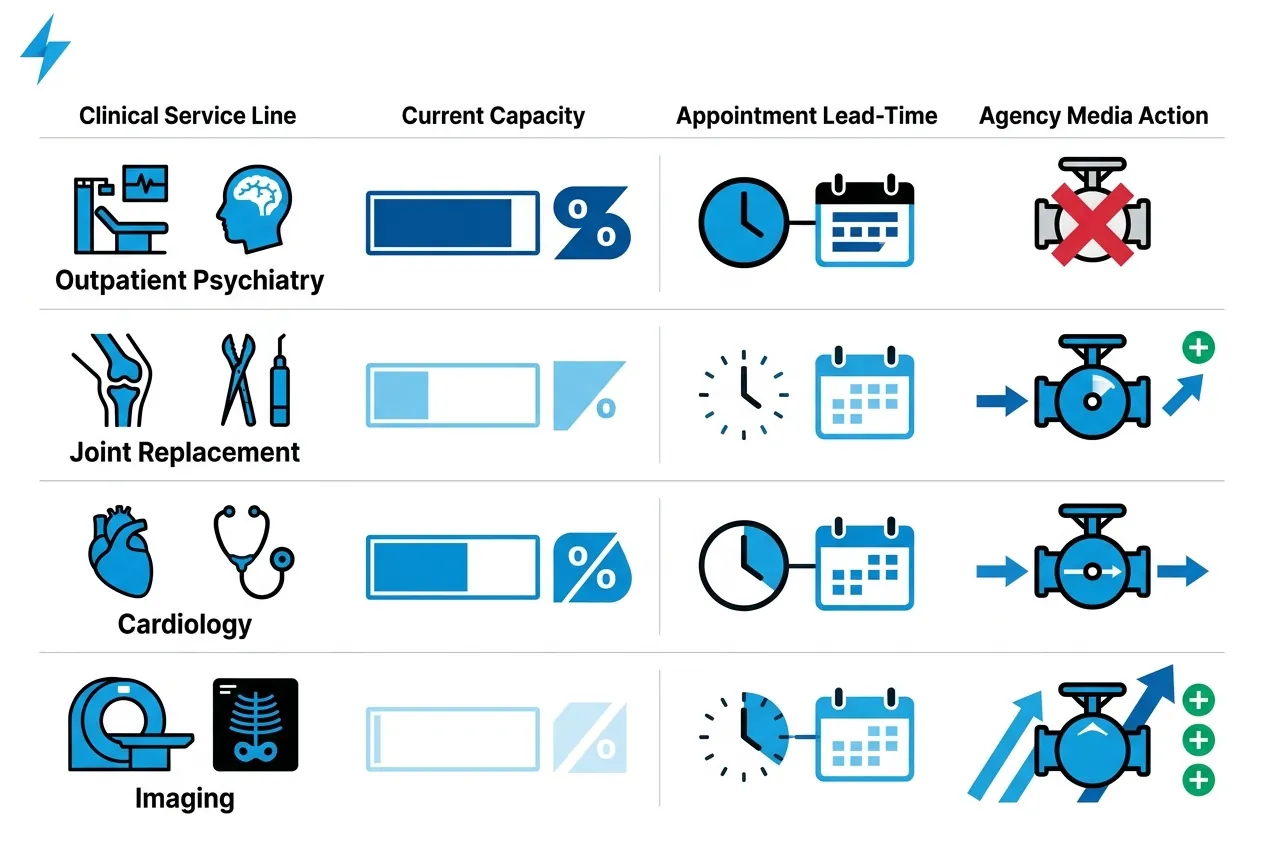
An operator-grade hospital marketing agency RFP requires prospective partners to demonstrate how their media management integrates with physical clinical capacity. Demand generation must function as a controllable valve, not an uncontrolled firehose.
In a functional multi-hospital network, the media planning process begins inside the hospital access center and clinical scheduling system. Marketing leaders sit with service-line directors, clinical operations managers, and clinic practice administrators to review template utilization. An evaluation matrix must assess an agency's ability to ingest clinical capacity reports and translate operational realities into paid search and programmatic media allocation:
- Adult Outpatient Psychiatry; Current Capacity Status: 98% Booked (Saturated); Lead Time for Appointments: 12 Weeks; Agency Media Action Mandated: Suspend paid acquisition immediately; shift spend to acute inpatient crisis stabilization or adolescent psychiatric programs.
- Total Joint Replacement; Current Capacity Status: 62% Booked (High Availability); Lead Time for Appointments: 4 Days; Agency Media Action Mandated: Escalate local search bid caps; launch high-intent search coverage across primary service areas; activate provider-specific booking campaigns.
- Cardiology (Electrophysiology); Current Capacity Status: 88% Booked (Moderate Availability); Lead Time for Appointments: 3 Weeks; Agency Media Action Mandated: Maintain brand discovery and organic search footprint; suppress aggressive direct-booking search ads; focus on physician referral outreach.
- Outpatient Imaging and MRI; Current Capacity Status: 45% Booked (Underutilized); Lead Time for Appointments: Same Day / Next Day; Agency Media Action Mandated: Maximize search coverage across extended driving radiuses; deploy fast-access landing pages; bid aggressively against commercial imaging chains.
When structuring your RFP, ask prospective agencies to present an operational scenario: If our cardiology department loses three key procedural specialists and clinic capacity drops by forty percent overnight, what is your team's exact operating procedure for reallocating capital across unaffected sub-specialties within twenty-four hours?
Agencies that rely on automated, set-and-forget media buying scripts cannot answer this question coherently. A capable agency partner operates with daily or weekly optimization cadences, maintaining direct communication lines with hospital operations to ensure paid budgets support institutional margins rather than generating patient dissatisfaction through unfillable demand.
Furthermore, the RFP must require agencies to measure attribution past the initial point of contact. Generating an inbound phone call or web inquiry provides no economic return if the caller is out of network, seeking an unsupported clinical sub-specialty, or abandons the call due to extended queue times. Our operational standards are informed by deep healthcare experience: our founder previously served as a healthcare CMO directing marketing for a treatment network that scaled from 3 to 24 locations, managing $1.5M to $2M per month in Google Ads across 11+ behavioral and mental health accounts. Managing high-stakes acquisition media across multi-location healthcare environments requires tracking attribution down to the verified clinical encounter or admission, rather than stopping at the raw lead.
The agency proposal must explain how call disposition data, canceled appointments, and attended patient visits are reconciled against ad spend without violating patient privacy. Health systems requiring multi-department growth can review our dedicated approach for hospitals and health systems to understand how operational alignment protects clinical resources.
Multi-Location Governance and Provider Directory Infrastructure
For health systems operating multiple acute care hospitals, regional medical centers, ambulatory surgery units, and sprawling outpatient physician networks, digital discovery occurs primarily at the local level. When a patient requires immediate medical care or a consultation with a specialist, their search journey begins with localized mobile queries: "pediatric urgent care near me," "orthopedic surgeon in [city]," or "mammogram center open Saturday."
Health system marketing teams frequently face extreme fragmentation across their digital presence. A single healthcare network may encompass thousands of employed physicians, dozens of urgent care locations, and multiple specialty centers. If prospective patients encounter conflicting phone numbers, obsolete suite addresses, or duplicate Google Business Profiles, patient trust erodes, local search rankings decline, and appointment volume drops.
The RFP must audit prospective agencies across three core areas of multi-location infrastructure:
Local Search Ecosystem Governance
The agency must demonstrate a centralized process for managing Google Business Profiles, Apple Business Connect, and Bing Places across the entire health system enterprise:
- What automated systems and manual verification protocols does the agency utilize to manage provider credential changes, clinic rebrandings, and facility relocations?
- How does the agency handle the critical distinction between facility profiles (such as an emergency department or regional hospital campus) and individual practitioner profiles (employed physicians practicing within that hospital)?
- What is the vendor's strategy for maintaining accurate operating hours, emergency department twenty-four-hour designations, and holiday closures to prevent patient arrival at closed facilities?
Physician Directory Architecture and Schema Markup
Organic visibility for hospital service lines depends heavily on search engines understanding the clinical relationships between providers, locations, and specialties. The proposal must evaluate:
- The agency's technical approach to structured schema markup (including MedicalOrganization, Physician, Hospital, and MedicalSpecialty schema types) deployed across provider biography pages and location portals.
- Experience integrating website provider directories with internal credentialing systems and National Provider Identifier (NPI) registry databases to maintain absolute data integrity across digital directories.
- Strategies for optimizing provider biography pages to convert organic discovery traffic into scheduled appointments through direct EHR integration.
Reputation Management and Patient Sentiment Integration
Online patient reviews heavily influence clinical provider selection. The RFP must determine:
- How the agency deploys compliant review generation workflows that encourage satisfied patients to leave public feedback on Google Business Profiles without compromising patient privacy or running afoul of platform anti-gating policies.
- The agency's protocols for monitoring and flagging negative clinical reviews, patient grievances, or potential HIPAA breaches occurring within public review responses.
- Methods for analyzing review sentiment across individual clinic locations to identify operational bottlenecks, front-desk customer service friction, or provider communication deficits.
The Hospital Marketing Agency Evaluation Matrix and Scoring Model
Evaluating hospital marketing agency proposals requires a quantifiable, defensible scoring methodology. Healthcare procurement committees often evaluate vendor responses using vague, ten-point scales that allow subjective personal impressions to override technical evaluation.
The evaluation matrix below provides a weighted scoring model tailored specifically to healthcare realities. The framework assigns 100 total possible points across five strategic pillars, prioritizing technical data architecture, privacy compliance, and intake integration over aesthetic design portfolios.
When reviewing vendor proposals, the cross-functional procurement team (including the CMO, digital marketing director, chief information security officer, and clinical operations lead) should score each agency against the detailed criteria in the evaluation matrix below:
- Privacy Architecture & HIPAA Ad Tech; Weight: 25%; Specific Audit Criteria: Demonstrates customer-owned server-side conversion architecture; provides signed BAAs for all analytics and call-tracking tools; shows clear protocols to strip IP and URL parameters before transmission to ad platforms; displays zero reliance on prohibited retargeting tags.; Disqualification Triggers (Automatic Zero): Proposes deploying standard client-side Meta or TikTok pixels on clinical pages; refuses to sign a BAA; recommends retargeting users based on medical conditions; lacks understanding of HHS OCR tracking guidance.
- Capacity-Driven Media & Performance Economics; Weight: 25%; Specific Audit Criteria: Documents dynamic budget reallocation mechanisms tied to clinical capacity; tracks performance down to attended encounters or admissions; manages platform sensitive-category policies seamlessly; optimizes against contribution margin rather than cost-per-click.; Disqualification Triggers (Automatic Zero): Reports solely on vanity metrics (impressions, clicks, raw form fills); treats all service lines with uniform monthly budgets regardless of clinic wait times; displays zero knowledge of platform healthcare policies.
- Intake Integration & Technical Operations; Weight: 20%; Specific Audit Criteria: Demonstrates deep integration with healthcare access centers, centralized scheduling, and EHR platforms; provides HIPAA-compliant dynamic number insertion (DNI); audits call abandonment rates and scheduling conversion rates.; Disqualification Triggers (Automatic Zero): Treats the contact form or phone call as the final point of attribution; relies on consumer-grade tracking software that stores unencrypted patient call recordings on third-party servers.
- Multi-Location & Directory Governance; Weight: 15%; Specific Audit Criteria: Robust strategy for managing thousands of Google Business Profiles; clear distinction between facility and practitioner entities; advanced deployment of MedicalOrganization schema markup; automated directory synchronization.; Disqualification Triggers (Automatic Zero): Proposes manual, ad-hoc listing updates; lacks structured data expertise; cannot present a scalable solution for updating provider directory departures or clinic relocations.
- Team Experience & Regulated Expertise; Weight: 15%; Specific Audit Criteria: Senior media buyers with direct healthcare operations experience; court-certified or industry-recognized authority in advertising standards; proven execution across high-stakes, regulated medical environments.; Disqualification Triggers (Automatic Zero): Media execution outsourced to offshore white-label entities; agency account leads possess only consumer retail or packaged goods experience; team displays poor clinical literacy.
Conducting Agency Pitch Shortlist Due Diligence
Once scores are compiled and the agency list is narrowed to two or three finalists, the procurement committee must move beyond written proposals and subject the finalists to an operational stress test during oral presentations.
Require finalist agency teams to answer these three live technical prompts without advance preparation:
- Open Google Tag Assistant on an existing client site you manage in healthcare and walk us through every single third-party request generated on a clinical appointment page. (Exposes whether client-side advertising pixels are actively leaking user data).
- Review this anonymized clinic capacity report showing three overbooked specialties and two severely underutilized clinics. You have twenty minutes to present a revised thirty-day media spend allocation model. (Exposes whether the agency understands healthcare capacity economics or relies on rigid retainer retainers).
- Detail your exact legal and technical protocol when an advertising network erroneously flags a critical cardiovascular or mental health ad for policy violations. (Exposes whether the agency understands healthcare platform appeals or relies on generic support chat tickets).

Email Us
Prefer to send the context directly?
Mistakes, Regulatory Constraints, and Contractual Safeguards
Selecting an agency partner through an RFP process is an exercise in risk mitigation. Healthcare organizations operate under immense public scrutiny and legal oversight. A single operational oversight by an agency can result in widespread brand damage, regulatory investigations, and financial penalties.
Health systems frequently encounter several critical procurement errors during the contracting stage:
1. Failing to Own Agency Ad Accounts and Cloud Infrastructure
Health systems must never permit an agency to run paid media campaigns out of an agency-owned Google Ads, Meta Business Manager, or cloud hosting account. If the agency relationship dissolves, the health system loses years of historical conversion data, campaign architecture, and account reputation.
- Contract Safeguard: The master services agreement must state that all ad accounts, server containers, analytics properties, and domain assets remain the exclusive, non-transferable property of the health system. The agency must operate strictly via delegated administrative access.
2. Ambiguous Intellectual Property and Data Sovereignty Clauses
Modern marketing workflows increasingly utilize specialized machine learning models and automated data ingestion scripts. Health systems must maintain strict boundaries around how their organizational data is handled.
- Contract Safeguard: The contract must explicitly forbid the agency from feeding proprietary hospital operational data, patient demographic metrics, or scheduling volumes into public, multi-tenant commercial AI models. Any technical infrastructure or inference workflows deployed must preserve institutional data sovereignty. Marketing Powered maintains owned, local infrastructure specifically designed to provide privacy-aware data inference without leaking operational intelligence into third-party commercial systems.
3. Vague Performance Metrics and Retainer Complacency
Traditional agency contracts establish a fixed monthly retainer for an undefined level of service, leaving the agency incentivized to minimize hours allocated to the health system while focusing resources on winning new business.
- Contract Safeguard: Base agency evaluation and contract renewal terms on verified operational outcomes: booked appointment accuracy, cost per completed clinical encounter, access center call-answer velocity, and capacity-balanced delivery. Require the agency to submit monthly performance audits that cross-reference ad spend directly with intake operational data.
4. Overlooking Search and Advertising Verification Deadlines
Navigating advertising policies requires proactive administration. If an agency delays submitting health system verification credentials or fails to maintain LegitScript certification for applicable behavioral health or substance use disorder service lines, ad platforms will suspend campaigns instantly.
- Contract Safeguard: Mandate that the agency maintains designated compliance managers responsible for tracking platform policy updates, securing LegitScript documentation where applicable, and managing advertising regulatory appeals within defined service-level agreements.
Questions, Answered.
A health system must require an agency partner to provide: Proof of a privacy-governed data architecture that utilizes server-side tracking, executes Business Associate Agreements across all vendors, and adheres strictly to HHS OCR tracking guidance. Capacity-driven media management that dynamically adjusts paid media budgets based on real-time clinic scheduling capacity and physician availability. Measurement systems capable of attributing media spend past the initial form fill down to scheduled appointments, verified intake encounters, or clinical admissions. Comprehensive multi-location local search governance across Google Business Profiles, physician directory databases, and healthcare schema markup. In-house media buying managed by experienced healthcare operators who understand platform sensitive-category advertising constraints.
A hospital marketing agency RFP should measure qualified encounters by establishing an integrated tracking bridge between digital campaigns and hospital intake systems without exposing protected health information. The RFP must mandate that the agency utilize HIPAA-compliant dynamic number insertion (DNI) and server-side conversion APIs. Inbound calls must be evaluated based on duration, clinical department routing, and intake disposition (such as booked appointment, out of network, or existing patient inquiry). Furthermore, the agency must provide a protocol for regularly reconciling media click IDs and hashed conversion identifiers against de-identified appointment completion logs or admission records. This ensures media budgets are optimized to reduce the cost per verified patient encounter rather than inflating vanity lead counts.
A thorough hospital marketing agency procurement cycle typically takes between eight and fourteen weeks from initial document release to final contract execution. The standard timeline includes two weeks for RFP drafting and requirement definition, three weeks for agency proposal preparation, two weeks for internal committee scoring, two weeks for finalist presentations and technical stress tests, and two to three weeks for legal review, BAA execution, and master services agreement finalization. Accelerating this timeline often leads to inadequate technical vetting, exposing the health system to compliance liabilities.
In almost all clinical scenarios, health systems cannot run personalized retargeting campaigns for specific medical conditions. Under the Google Ads Personalized Advertising Policy, advertising that targets users based on health conditions, clinical treatments, or physical ailments is strictly prohibited. Furthermore, deploying third-party tracking pixels to identify visitors who browse specific medical condition pages and serving them targeted ads across the web violates the HHS Bulletin on Online Tracking Technologies unless explicit HIPAA authorization is obtained. Compliant agencies focus on capturing high-intent search demand, local map visibility, and contextual outreach rather than illegal remarketing lists.
Behavioral health marketing within a hospital network carries elevated regulatory and operational requirements. Advertising platforms enforce stringent verification standards for mental health and addiction treatment services. For instance, Google Ads requires specialized LegitScript certification for advertisers promoting substance use treatment services. Additionally, patient privacy regulations surrounding behavioral health and substance use disorders, such as 42 CFR Part 2, enforce confidentiality standards that are even more restrictive than standard HIPAA rules. An RFP must evaluate an agency's specific experience managing sensitive mental health campaigns, credentialing approvals, and specialized intake routing. Request an acquisition audit
Ready to see where your marketing can improve?
Request a free audit of your paid media, landing pages, attribution, and measurement setup. You'll get a straight assessment of where the opportunities are.
or email us at info@marketingpowered.ai