Resources
How to Build Useful Service Area Pages for Multi-Territory Businesses
Multi-territory service businesses frequently struggle to expand their organic search footprint beyond their immediate municipal boundary. Creating useful service area pages allows your company to capture high-intent local demand across adjacent markets without resorting to spam tactics. When built around genuine proof of delivery, transparent dispatch logistics, and proper structured data, these pages earn durable organic rankings and generate qualified inbound inquiries.
By Mike Hulick, Founder, Marketing Powered

The Doorway Trap: Why Programmatic City Templates Fail
The standard agency playbook for regional expansion relies on automated volume. An agency takes a core landing page, creates a spreadsheet of fifty surrounding zip codes or township names, and programmatically generates hundreds of thin city landing pages. Each page features the exact same generic sales copy, the same bullet points, and the same stock imagery, altering only the municipal name in the main header and meta tags.
This approach creates severe organic search risk. According to the Google Search Central Spam Policies, Google explicitly classifies pages created solely to funnel users to another destination, or multiple pages with content that leads to essentially the same destination, as doorway spam. Doorway pages provide zero distinct utility to searchers. When search engine crawlers detect an array of uniform URLs with near-identical text footprints targeting different geographic terms, the algorithm can devalue or remove those pages from the index entirely. In severe instances, an algorithmic or manual doorway action suppresses the visibility of the primary root domain itself.
Beyond algorithmic penalties, programmatic templates fail the commercial test. Modern buyers recognize programmatic templates immediately. When a commercial property manager in an adjacent suburb lands on a page that claims to be located down the street, yet lists no local address, displays generic regional stock photography, and cannot name specific neighborhoods or local municipal codes, trust evaporates.
The buyer bounces back to the search results to find a local competitor who demonstrates an authentic operational footprint. To rank well and convert visitors, a service landing page must justify its existence independently of its keyword target. It must reflect how your business actually operates on the ground.

Storefront Locations vs. Service Areas: Google's Critical Boundary
A persistent misconception among multi-location operators is that every target city requires a physical address to compete in local search. This misconception has fueled a cottage industry of fraudulent local tactics, including renting virtual offices, staffing executive suites with mailboxes, or using employee home addresses to generate fake Google Business Profiles.
Google maintains a strict operational distinction between storefront businesses and service-area businesses (SABs). As detailed in the Google Business Profile Help, businesses that serve customers at their own facilities must maintain permanent signage, display posted operating hours, and have staff present during those hours. Service-area businesses, by contrast, travel directly to customers to deliver their work. If an organization does not have an in-person, walk-in customer facility, it must hide its physical street address on its Google Business Profile and designate specific service boundaries by city, county, or postal code.
Attempting to manufacture storefront presence through virtual addresses creates catastrophic profile suspension risk. Once Google suspends a Business Profile for deceptive address representation, reinstating it requires rigorous video verification, utility bills, business licenses, and lease documentation.
For multi-facility healthcare providers, ambulatory clinics, or retail medical practices where patients receive treatment on-site, physical location pages are mandatory. That architecture requires specialized compliance, provider scheduling integrations, and facility-level local optimization, as outlined in our guide to healthcare location page SEO.
For commercial trade contractors, mobile service fleets, regional engineering consultants, and field service providers, the operational reality is different. Your value is mobile dispatch, not walk-in foot traffic. You do not need a physical lease in every target municipality to earn organic search traffic. You need dedicated, compliant service area pages designed specifically for organic search results rather than artificial map pack manipulation.
The Local Utility Standard: Required Data for Real Service Pages
If you remove the city name from your service page and the remaining content could apply to any town in the country, that page is a doorway page. To earn rank and build immediate commercial credibility, every municipal page on your website must meet the local utility standard.
A compliant, high-performing service area page must provide concrete, verifiable operational details specific to that territory:
- Clear Dispatch Origins and Transit Windows: State where your service vehicles, technicians, or mobile teams deploy from, along with realistic response times. If you dispatch from a central depot twenty miles away, state that clearly. Buyers value an honest forty-five-minute emergency response window over an improbable five-minute promise from an unverified address.
- Municipal Licensing, Codes, and Permits: Different jurisdictions enforce distinct municipal requirements. A commercial HVAC contractor serving two adjacent counties often operates under separate regional licensing bodies, differing environmental regulations, or distinct permitting processes. Detailing these jurisdictional nuances proves your technical competence and authentic local presence.
- Specific Sub-Markets, Corridors, and Landmarks: Name the commercial districts, industrial parks, subdivisions, or transport corridors your team actively traverses. Rather than repeating the municipal name twenty times, reference known local infrastructure: major highway bypasses, distinct business districts, or neighborhood clusters.
- Verified Local Project Histories: Include brief summaries of real projects completed within that municipality. Describe the technical problem, the operational solution, the general neighborhood where the work occurred, and the outcome. Verifiable case summaries create a moat of original content that programmatic scrapers cannot replicate.
- Direct Operations Routing: Provide clear intake pathways, including direct phone lines to the operational dispatch desk responsible for that specific zone, clear service territory boundaries, and straightforward booking tools built into your web development framework.
Free Audit
Want a straight read on where your budget is leaking?
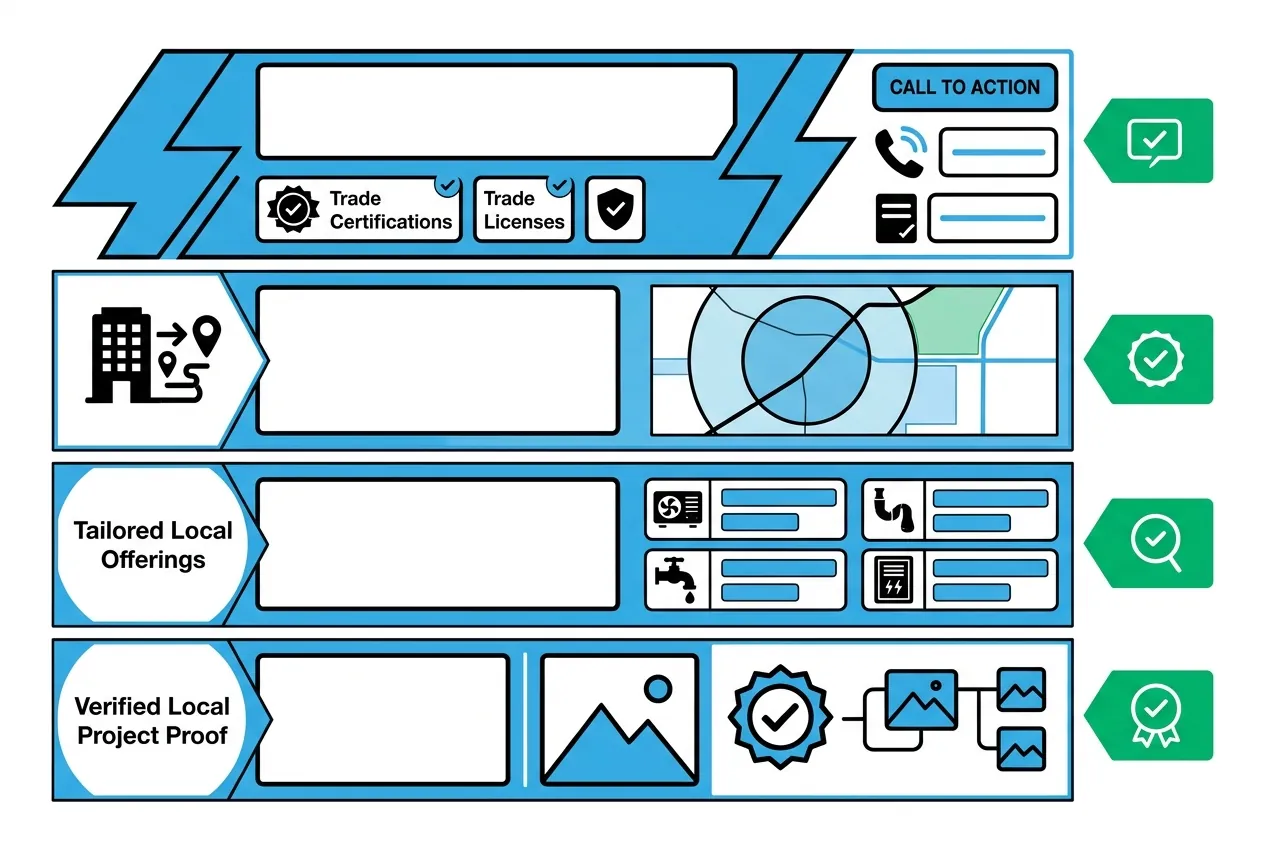
Annotated Architecture: Anatomy of a High-Converting City Page
To convert cold search traffic into booked service appointments or qualified RFP submissions, your layout must eliminate geographic doubt the moment a searcher lands on the page.
Below is an annotated architectural framework for a defensible, conversion-focused service area page:
Section 1: Above-the-Fold Territory Confirmation
- Headline Structure: [Core Commercial Service] in [Target Municipality, State Abbreviation]
- Operational Sub-Headline: Rapid dispatch from our [Hub Location] serving [Target Municipality] and surrounding [Specific County/Sub-Market] facilities.
- Immediate Proof Elements: Verified state contractor license numbers, active municipal registration numbers, average dispatch response times, and primary commercial trade certifications.
- Primary Conversion Mechanism: A dedicated intake form paired with a direct phone number to the regional dispatch desk. Avoid generic corporate routing numbers whenever possible.
Section 2: Operational Dispatch and Service Perimeter
- Regional Logistics: A concise description of your physical deployment mechanics. For example: "Our field service units deploy daily from our central logistics hub in North District, providing scheduled maintenance and 2-hour emergency site coverage across the entire Metro Industrial Corridor."
- Service Perimeter Boundaries: Explicitly define the boundaries of your service territory. List adjacent municipalities, key commercial arterial roads, and the outer radius where your team accepts standard service calls without supplemental mobilization surcharges.
Section 3: Specialized Service Applications for the Local Market
- Tailored Core Offerings: Rather than listing twenty generic services, focus on the three to five service capabilities most relevant to that target territory's infrastructure.
- Market-Specific Context: If the target municipality contains heavy manufacturing zones, highlight industrial preventive maintenance and high-voltage electrical services. If the area consists primarily of modern mid-rise office developments, emphasize commercial building automation and energy efficiency retrofits.
Section 4: Verified Local Project Profiles
- Case Summary 1: Brief documentation of a completed project within the target municipality. Outline the commercial sector, the specific scope of work, the municipal permitting involved, and the delivered business outcome.
- Case Summary 2: Documentation of an ongoing maintenance agreement or emergency repair delivered to a recognized facility type in the region. Real, operational job documentation provides undeniable evidence of physical presence.
Section 5: Regional Compliance, Permitting, and Local Standards
- Jurisdictional Expertise: Detail how your team handles local permitting offices, utility coordination, and regional inspection standards. Explaining municipal compliance steps reassures commercial decision-makers that your team understands the regulatory friction of operating within their city limits.
Section 6: Direct Dispatch and Territory Intake
- Actionable Next Steps: A structured booking form that asks for property type, square footage, urgency level, and physical project address.
- Transparency Notice: A clear statement confirming availability: "Our regional dispatch team confirms all service inquiries within 30 minutes during standard operating hours."
Structured Data Blueprint: Schema for Service-Area Businesses
Search engines rely on structured data to parse entity relationships, service categories, and operational boundaries. However, many service businesses execute local schema incorrectly by declaring a physical storefront address on pages targeting cities where they have no legal physical presence.
Using the LocalBusiness schema with a full address property on a service area page where no physical office exists creates a direct conflict with Google's entity guidelines. If your company operates from a central office in City A and builds a service area page for City B, you must not publish a schema markup claiming your street address is in City B.
Instead, implement structured data using the Service and Organization types, leveraging the areaServed property as defined by the Schema.org areaServed specifications. This approach communicates your physical origin while establishing your operational delivery radius.
A compliant schema implementation for a service area page uses structured JSON-LD data to define relationships clearly. That markup clearly declares that the service is delivered by an organization based at an authenticated physical hub, while systematically registering the target municipality through the areaServed property. It establishes geographic relevance without misrepresenting your physical assets. Implementing this markup as part of technical local SEO ensures search engines understand your true coverage area.

Operational Territory Routing: Dispatch, Intake, and Attribution
A high-performing service area page does not exist in isolation. Its success depends entirely on how effectively it connects inbound search demand to real-world operational capacity. If your marketing creates demand in an area where your dispatch teams cannot deliver within an acceptable time frame, you waste marketing budget and damage your reputation.
Territory Alignment and Capacity Auditing
Before drafting or launching a service area page, audit your field operations. Establish hard geographic perimeters:
- What is the absolute maximum drive time technicians can travel before mobilization costs destroy job profitability?
- Does your operational team have licensed personnel qualified to pull permits in that specific municipality?
- Can your fleet realistically maintain your advertised emergency response times during peak transit hours?
If your operations team cannot service a municipality reliably, do not build a page for it. Focus organic resources exclusively on high-priority territories where your business can actively accept and fulfill new accounts.
Dynamic Call Routing and Dispatch Segmentation
Connecting a regional landing page to a generic corporate phone tree creates intake friction. When a commercial prospect calls from a dedicated city page, their call should route immediately to a dispatch desk or representative familiar with that territory.
Using dynamic call tracking numbers tied to specific service areas allows intake personnel to answer with territory-aware context. The intake coordinator can immediately confirm: "Apex Dispatch, we have units operating in the West Valley corridor today. What type of facility are you calling from?"
This operational alignment immediately reassures the prospect that they are dealing with an active, nearby provider, driving substantial conversion improvements over generic corporate call centers.
True Full-Funnel Attribution
Measuring the success of service area pages requires tracking beyond simple form fills or incoming phone calls. High lead counts mean nothing if incoming inquiries fall outside your travel radius or fail to meet your minimum service criteria.
Attribute your marketing down to signed work orders, completed service calls, and collected revenue. By tying specific municipal landing pages directly to closed customer accounts in your CRM, you can identify which territories generate high-margin recurring work and which ones produce low-margin or unserviceable calls.
This level of attribution clarity allows you to refine your content, adjust your operational perimeters, and allocate media investment toward your most profitable geographic territories.
Questions, Answered.
A service business should only build as many service area pages as it can support with verifiable work history, operational dispatch capacity, and distinct, high-utility content. For most regional service businesses, starting with 10 to 25 primary municipalities or commercial corridors yields superior search visibility and conversion rates compared to publishing hundreds of thin, automated city pages.
Google does not penalize websites simply for having multiple city landing pages. It penalizes pages that function as doorways: URLs created solely to capture search traffic that offer substantially identical content, lack unique utility, and funnel searchers to a single generic destination. As long as each page contains genuine operational details, verified project histories, accurate regional schema, and transparent dispatch parameters, your site complies fully with Google search quality guidelines.
No. Using virtual offices, PO boxes, co-working memberships, or fake addresses to verify a Google Business Profile violates Google's official business representation policies. Doing so exposes your listing to algorithmic suspension or permanent removal. Focus instead on ranking your service area pages organically while properly configuring your primary Google Business Profile as a legitimate service-area business with designated coverage zones.
A physical location page represents a storefront, clinic, or customer-facing office. It must include on-site parking instructions, walk-in hours, physical street addresses, interior facility photography, and direct check-in procedures. A service area page represents mobile delivery, focusing on fleet dispatch logistics, response radiuses, travel windows, municipal licensing, and verified on-site work completed at client properties.
Do not declare an address on a LocalBusiness schema for a municipality where your business does not maintain an actual physical facility. Instead, define your parent entity as an Organization with its real legal headquarters address, and link it to a Service schema that utilizes the areaServed property pointing directly to the target municipality or administrative territory. Request a Local Visibility Review
Ready to see where your marketing can improve?
Request a free audit of your paid media, landing pages, attribution, and measurement setup. You'll get a straight assessment of where the opportunities are.
or email us at info@marketingpowered.ai