Resources
Palm Beach County Local Visibility Audit: Structural Findings
Establishing reliable organic discovery across South Florida requires structural precision rather than automated ranking reports. This palm beach county local visibility audit documents observable search engine results, profile configurations, and technical architecture across regional service businesses and agencies. The findings provide a measurable operational baseline for operators evaluating their local customer acquisition systems.
By Mike Hulick, Founder, Marketing Powered

1. Audit Scope, Methodology, and Sample Limits
Local search performance is governed by strict proximity parameters, category taxonomy, and structured technical data. Between November 15 and November 18, 2026, an operator-led audit examined the public local search ecosystem across Palm Beach County. The sample cohort comprised 25 commercial service domains and regional agency websites operating within West Palm Beach, Boca Raton, Delray Beach, Palm Beach Gardens, and Jupiter. The audited sectors included specialized healthcare practices, commercial facilities services, professional advisory firms, and established digital marketing agencies.
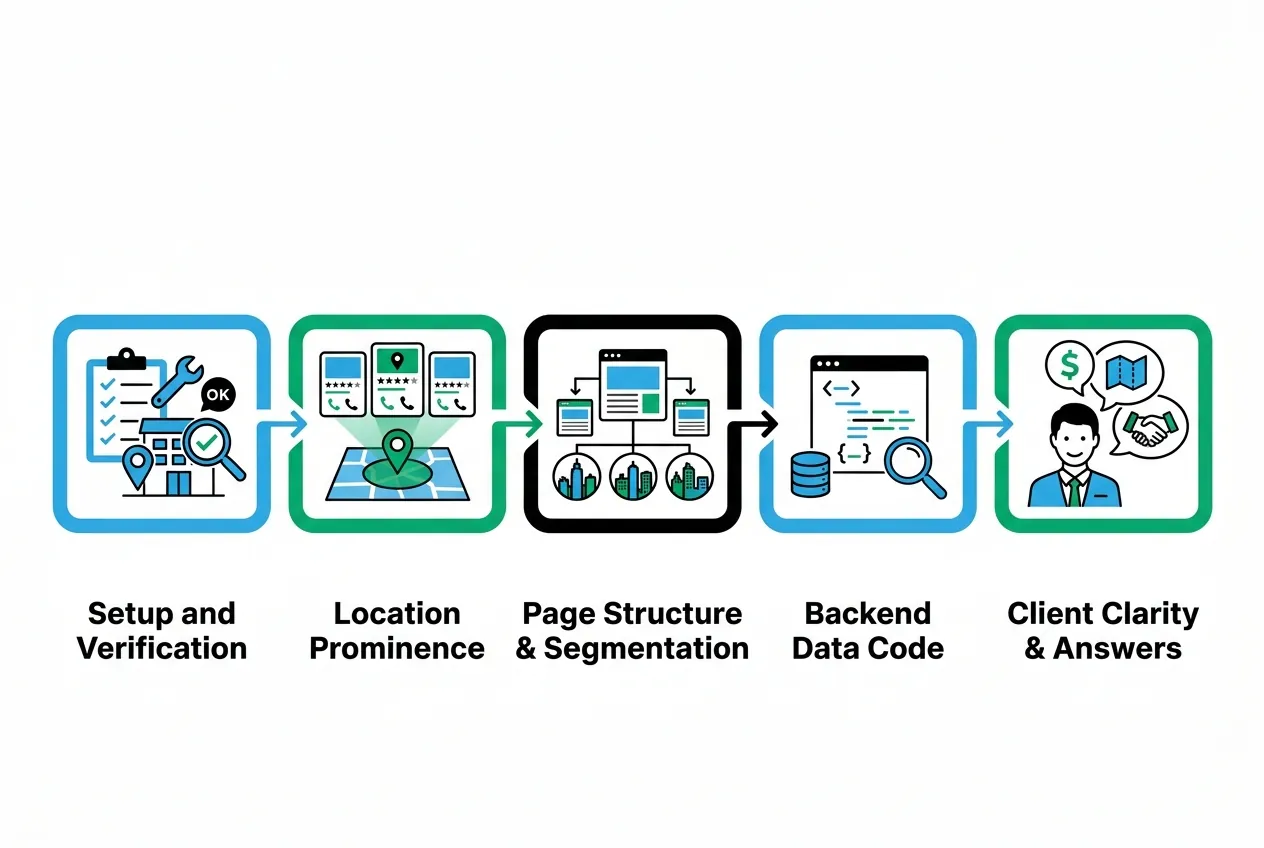
Data collection was executed using localized IP coordinates corresponding to municipal centers within Palm Beach County. Queries were run across clean browser instances with cleared caches and neutral user histories to prevent personalized bias in desktop and mobile Search Engine Result Pages (SERPs). The data recorded for each subject encompassed five primary dimensions:
- Google Business Profile configuration, verified category mapping, and naming compliance.
- Map Pack presence across localized commercial intent queries.
- Municipal landing page architecture, content differentiation, and crawl depth.
- On-page schema implementation, specifically LocalBusiness and MedicalBusiness structured data.
- Directness of answers to critical buyer questions regarding pricing, service boundaries, and engagement models.
This audit reports observable public website architecture and snapshot search engine presentation at the stated observation dates. Public search engine placements are dynamic snapshots influenced by physical searcher location, temporal query demand, and real-time algorithmic shifts. These observations do not represent permanent ranking guarantees or private internal Search Console performance data.
2. Google Business Profile Integrity and Map Pack Alignment
The Google Business Profile (GBP) functions as the primary data anchor for local commercial visibility. Across the audited Palm Beach County cohort, performance in the local 3-pack revealed a stark divide between organizations maintaining disciplined profile hygiene and those attempting superficial optimization tactics.
The most prominent vulnerability identified was title manipulation. Multiple commercial service operators in Boca Raton and West Palm Beach appended geographic qualifiers and generic service keywords to their registered business names. While this tactic may produce transient visibility, it creates severe administrative risk under the Google Business Profile representation guidelines. Google requires that a business profile title reflect the exact real-world name used on storefront signage, state corporate filings, and official tax documentation. Keyword-stuffed titles invite algorithmic filtering, community edits, and administrative suspension.
Primary category selection proved to be the single most impactful lever governing local pack placement. High-performing healthcare clinics and commercial firms selected precise primary classifications (such as "Urgent care clinic" or "Commercial real estate agency") rather than broad umbrella terms. Secondary categories were frequently mismanaged across the sample. Audited sites often neglected secondary categories entirely or added conflicting categories that diluted topical authority.
Physical verification status also dictated local reach. Businesses operating out of shared co-working spaces or executive suites in downtown West Palm Beach consistently struggled with profile stability compared to operators with dedicated physical facilities, prominent exterior signage, and permanent staffing. Google's location algorithms verify physical permanence; profiles that lack dedicated leases or recognizable physical entrances face heightened suspension triggers during reverification sweeps.
3. The Municipal Challenge: Navigating Palm Beach County Geography
Palm Beach County encompasses an elongated geographic footprint spanning more than 45 miles from Boca Raton in the south to Jupiter and Tequesta in the north. This geographic layout creates distinct commercial zones separated by substantial drive-time barriers. A central operational failure observed in the audit was geographic dilution: businesses attempting to capture the entire county through a single generic contact page or an unfocused homepage.
A search conducted in Jupiter for commercial services rarely returns a provider based physically in Boca Raton unless municipal landing pages demonstrate clear localized relevance. To build legitimate search engine authority across these distinct municipalities, multi-location operators and regional providers must implement structured municipal page hierarchies:
- Dedicated Municipal Architecture: URL structures should logically group municipal service areas beneath a clean directory structure (such as /locations/boca-raton/ or /service-areas/jupiter/).
- Localized Entity Markers: Each municipal page must integrate specific geographic reference points, including neighborhood districts, major arterial intersections (such as Interstate 95 and Florida's Turnpike exits), and municipal service zones.
- Distinct Operational Details: Pages must feature unique local phone numbers, localized team assignments, dedicated driving directions, and localized client intake procedures.
- Prevention of Doorway Pages: The most frequent technical penalty risk observed was mass-generated city pages where only the city name was dynamically swapped. Search engines categorize boilerplate city pages with identical text blocks as low-value doorway pages, which suppresses indexing across the entire domain.
When properly deployed, municipal content provides search engines with verifiable proof of physical and operational capacity within that specific municipality, avoiding the dilution that plagues single-page regional sites.
Free Audit
Want a straight read on where your budget is leaking?
4. Content Architecture: Benchmarking Regional Agency and Provider Pages
A local website must do more than achieve an impression; it must resolve the specific evaluation criteria of prospective buyers. The audit benchmarked prominent regional agency domains alongside top-performing regional healthcare providers to evaluate how effectively their public content answers core buyer questions.
Established regional marketing agencies demonstrate strong aesthetic execution, but their public content often avoids operational transparency. When auditing agency sites for buyer decision factors, significant information gaps emerged:
- Engagement Scope and Timelines: Regional agency pages often describe broad capability categories (such as brand development or performance marketing) without outlining the actual phases of onboarding, technical implementation, or reporting frequency.
- Pricing Context and Investment Parameters: Public pages routinely obscure pricing models, forcing prospects into lengthy sales discovery calls before establishing whether minimum engagement tiers align with buyer budgets.
- Attribution and Measurement Frameworks: Public agency pages rarely detail how conversion data is captured, reconciled, or connected to bottom-line business outcomes.
Conversely, the top-performing private medical practices and commercial contractors in Palm Beach County structured their content directly around transaction-critical queries. Leading medical specialty providers in Jupiter and Delray Beach maintained comprehensive procedural guides, clear insurance participation tables, upfront self-pay pricing schedules, and explicit practitioner credentialing profiles.
Transitioning from vague marketing claims to concrete operational answers improves conversion quality. High-intent local searchers do not seek marketing rhetoric; they search to confirm whether a provider accepts their insurance, serves their exact municipality, possesses verifiable credentials, and can solve their specific commercial problem within a defined timeline.

5. Technical Infrastructure and Local Schema Implementation
A robust local search footprint requires structured technical execution beneath the presentation layer. The public audit evaluated mobile performance metrics and structured data implementation across the sample cohort, identifying structural deficiencies in technical crawlability and entity mapping.
Local schema markup acts as a direct translation layer between website text and search engine knowledge graphs. Across the 25 audited domains, fewer than 35 percent implemented fully validated JSON-LD schema containing localized entity data. Most relied on basic WebSite or Organization tags generated automatically by content management systems.
Beyond structured markup, mobile infrastructure issues were prevalent. Several audited sites exhibited cumulative layout shifts caused by unoptimized hero video elements and third-party tracking scripts. In a local search environment where mobile queries drive immediate call volume, technical latency degrades both user retention and algorithmic ranking confidence.
6. Citation Hygiene, Aggregators, and Review Compliance
A business cannot establish local prominence if its off-page citation signals conflict with its on-page data. The audit reviewed citation consistency across core data aggregators (including Data Axle and Neustar Localeze), major search engines, and vertical-specific business directories.
Inconsistent Name, Address, and Phone (NAP) records were widespread among businesses that had relocated within Palm Beach County over the previous three years. Legacy addresses in commercial business parks in Boca Raton or downtown Delray Beach persisted across secondary directories, creating duplicate profile conflicts and splitting citation authority. Maintaining pristine aggregator data requires systematically verifying primary business listings, claiming duplicate profiles, and suppressing legacy records.
Review acquisition systems formed another critical axis of the audit. While review volume and velocity directly influence consumer choice, operators must adhere strictly to federal advertising standards. The FTC Consumer Reviews and Testimonials Rule establishes strict civil liability for deceptive review practices. Prohibited tactics include:
- Review gating, where customers indicating negative sentiment are routed away from public platforms while positive customers are directed to Google.
- Incentivized reviews, including offering discounts, gift cards, or service credits in exchange for consumer testimonials.
- Employee-generated reviews or conditioned customer feedback.
Compliant reputation management requires systematic, non-incentivized post-service review requests sent equally to all verified clients. Businesses that implement transparent review collection build resilient, long-term review profiles that withstand platform audits and regulatory scrutiny.
Managing complex multi-location search systems requires practical operational leadership. The founder of Marketing Powered previously served as a healthcare CMO, directing the marketing infrastructure for a treatment network that expanded from 3 to 24 locations. Operating in Google's sensitive healthcare vertical, where retargeting is strictly prohibited and regulatory compliance is paramount, the founder managed $1.5 to $2M per month in Google Ads across 11+ behavioral and mental health accounts.
That operational background, combined with court-certified expert witness credentials in advertising strategy, informs Marketing Powered's approach to local search. Visibility cannot be treated as a vanity exercise measured by automated software scores; attribution must track through to verified admissions, signed retainers, and deposited revenue.

Email Us
Prefer to send the context directly?
7. Frequently Asked Questions About Local Search Visibility
Why does our business appear in Map Packs in West Palm Beach but vanish in Delray Beach?
Google's local algorithm calculates searcher proximity as an uncompromising primary factor. Unless a business possesses a physical office with verified signage in Delray Beach, its visibility will naturally decline as the physical distance from the searcher increases. To expand geographic reach across Palm Beach County, organizations must build dedicated municipal landing pages with localized content, acquire local citations, and cultivate reviews from clients throughout those southern municipalities.
Can we use a co-working space or virtual mailbox to establish a local presence in Boca Raton?
Using virtual mailboxes, PO boxes, or unstaffed co-working desks directly violates Google Business Profile quality guidelines. Google actively suspends profiles registered at shared virtual offices unless the business leases dedicated, permanently branded physical office space, staffs the location during stated business hours, and can provide lease documentation and video verification upon request.
What is the primary operational risk of keyword stuffing a Google Business Profile title?
While adding city names or generic service keywords to a business profile title can produce a brief spike in local pack ranking, it leaves the profile exposed to manual suspensions, algorithmic demotion, and competitor redressal complaints. A suspended profile completely disappears from Google Maps and search results, instantly halting local inbound discovery until formal corporate documentation is reviewed and approved by Google's support team.
How should multi-location healthcare providers manage local search attribution?
Healthcare organizations must decouple lead generation metrics from verified operational outcomes. Tracking clicks, calls, or form submissions alone fails to show commercial efficacy. Multi-location systems must connect localized call tracking and web intake events directly to electronic health record systems or CRM admissions, measuring cost-per-admission and verified patient starts by location while maintaining strict patient privacy boundaries.
Ready to see where your marketing can improve?
Request a free audit of your paid media, landing pages, attribution, and measurement setup. You'll get a straight assessment of where the opportunities are.
or email us at info@marketingpowered.ai