Resources
Healthcare Location Page SEO: Architecture and Conversion
The operating rule for healthcare location page seo is simple: give each facility a distinct, crawlable page, and assign someone to keep it accurate. Include verified services, levels of care, insurance handling, arrival details and a clear contact path. Then measure qualified inquiries by facility, not rankings alone.
By Mike Hulick, Founder, Marketing Powered

What location page SEO covers
Treat the page as a maintained operating record, not a city-name template. Before rewriting copy, establish who confirms the facts, where inquiries go and how admissions reports their quality.
A healthcare location page answers a specific decision: “Can this facility help, and how do I contact the right team?”
Its job is narrower than the broader work of healthcare local SEO. This article focuses on the facility page, its position in the website and its connection to intake.
Our recommended standard is operational: every important statement should have an accountable owner, and every contact path should identify the intended facility. That is a management framework, not a measured ranking formula.
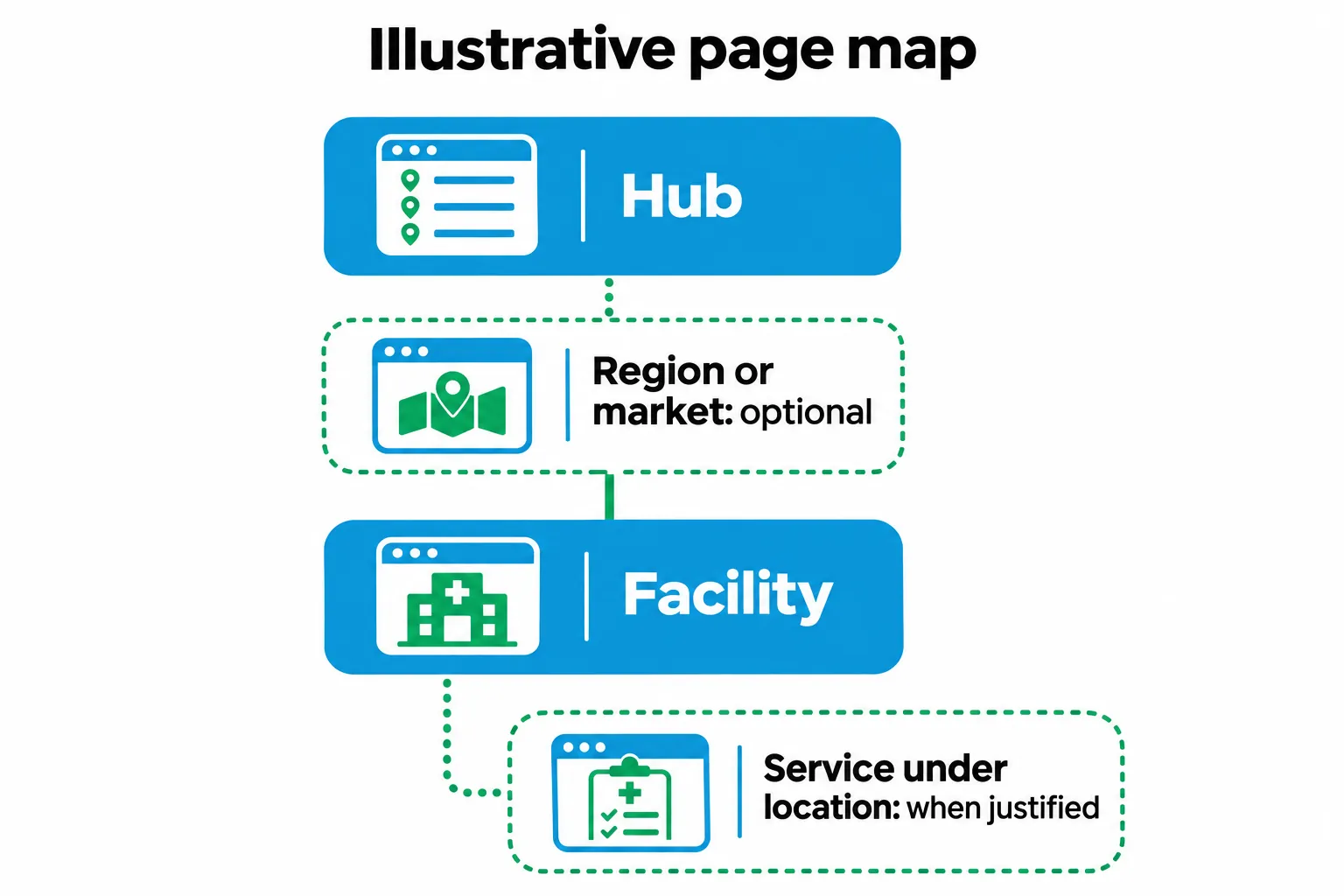
Build location page architecture around real decisions
Use only the levels visitors need:
- Location hub; Purpose: Compare facilities; When to use it: An organization has multiple sites
- Region or market; Purpose: Explain meaningful local choices; When to use it: Several facilities serve one market
- Facility; Purpose: Describe one operating location; When to use it: A distinct site needs its own record
- Facility service; Purpose: Explain a specific offering at that site; When to use it: Substantial facility-specific details justify it
A service-under-location page should earn its place. Create one when the service operates there, visitors need distinct intake or eligibility information, and an owner can maintain it. Otherwise, use a section on the facility page.
Google identifies city-targeted pages that funnel visitors elsewhere, and substantially similar intermediate pages, as examples of doorway abuse. Repeated wording alone is not the full definition. Google Search spam policies
Link the hub to facilities, facilities back to the hub, and relevant service explanations to the locations delivering them. Do not create a regional layer merely to target another keyword.
For network-wide planning, connect this work to multi-location healthcare SEO, rather than treating each facility as an isolated publishing project.
What belongs on every healthcare location page
Build the page from verified operating information:
- Identity: Facility name, address, direct contact route and applicable hours. Distinguish facility hours from telephone intake hours.
- Services: What this site delivers today, including levels of care where relevant. Do not present the network’s entire service list as locally available.
- Intake: Who answers, whether appointments or referrals are needed, and what happens next.
- Insurance and payment: Approved wording about participation and benefits verification. Separate accepting a plan from confirming an individual’s coverage.
- Arrival: Entrance, parking, transit, accessibility information and appointment instructions, confirmed by operations.
- People and credibility: Approved staff information and current credentials, checked before publication.
- Contact: Prominent click-to-call and form options that preserve the intended facility through routing.
For Business Profiles, Google requires a phone number connecting to the individual location or a website representing that location. Numbers must remain under the business’s direct control; Google recommends local numbers where possible. Document how tracking preserves those requirements. Google Business Profile guidelines
Keep the template consistent, but make the facts specific. Unique parking instructions are more useful than another paragraph praising the city.
Free Audit
Want a straight read on where your budget is leaking?
Assign owners before drafting
Make one person accountable for the complete facility record. Other teams supply and approve their parts.
- Address, arrival details and hours; Recommended owner: Facility operations; Review trigger: Operating change
- Services and care levels; Recommended owner: Clinical or program leadership; Review trigger: Program change
- Intake and routing; Recommended owner: Admissions or scheduling; Review trigger: Workflow change
- Insurance wording; Recommended owner: Revenue cycle and compliance; Review trigger: Payer change
- Clinical claims and privacy; Recommended owner: Designated clinical and privacy reviewers; Review trigger: Before publication
- Template, crawl and markup; Recommended owner: Web or SEO lead; Review trigger: Site release
- Attribution and reporting; Recommended owner: Marketing analytics and admissions; Review trigger: Tracking change
Use a scheduled quarterly confirmation as a management practice, not a substitute for immediate updates. A discontinued service should not remain listed until the next audit.
Implement in six steps
1. Inventory facilities and competing URLs
Have marketing and operations reconcile the facility roster against location pages, regional pages, service pages and older listings. Flag missing facilities, closed sites and multiple pages claiming the same purpose.
Assign each facility one intended primary URL.
2. Establish the technical baseline
Have the web lead record response status, crawl access, indexability, canonical destination, rendered content and internal links. Check titles, the H1 and mobile usability.
Treat canonical tags as signals, not commands. Google describes redirects and canonical annotations as strong canonicalization signals, while sitemap inclusion is weaker. Google canonicalization guidance
Do not point distinct facility pages to a corporate page merely because they share a template.
3. Build the facility record
Operations confirms the facts; admissions confirms the handoff. Store an owner, approval date and change trigger for each field.
For an illustrative outpatient clinic, separate appointment hours from call-answering hours. Describe a centralized intake team accurately rather than implying callers reach an on-site clinician. This is a proposed operating example, not a reported result.
4. Draft and review
Write from the record. Put service fit, location and the next action ahead of generic brand copy.
Complete clinical, privacy and claims review before release. Test whether a mobile visitor can identify the site and contact route without searching through navigation.
5. Validate structured data and tracking
Google recommends the most specific applicable LocalBusiness subtype. Choose markup based on the actual entity, not the search appearance you want. Google LocalBusiness documentation
Keep structured data consistent with visible content. Google’s guidelines prohibit marking up information readers cannot see. Google structured-data guidelines
Test calls and forms end to end without real patient information. Verify facility assignment, after-hours routing and reporting.
6. Release with a measurement record
Record the publication date, changed URLs and concurrent marketing or intake changes. Map each facility URL in Search Console, then schedule an initial 28-day comparison and subsequent reviews. Treat that window as a reporting cadence, not an SEO deadline.
Measure qualified demand by facility
Use a measurement chain with explicit boundaries:
Search visibility → contact → qualified inquiry → assessment or appointment → admission, where authorized
Search Console reports impressions and clicks and supports filtering by page URL and date. Use it for search performance, not as evidence of patient acquisition. Search Console performance guidance
Create one scorecard row per facility:
- Search impressions and clicks; Decision it supports: Whether the intended page is gaining visibility
- Calls and forms; Decision it supports: Whether visitors initiate contact
- Qualified inquiries; Decision it supports: Whether inquiries fit the facility
- Scheduled assessments or appointments; Decision it supports: Whether intake progresses
- Admissions, where authorized; Decision it supports: Whether acquisition connects to the operating outcome
Admissions should define qualification before reporting begins. Consider service fit, geography and payment pathway; distinguish unique inquiries from repeat calls, spam and administrative contacts.
Keep website-originated calls separate from calls placed directly through a Business Profile. A facility assignment alone does not establish the acquisition source.
Google prohibits sensitive user information in Analytics and states that HIPAA-regulated entities must not expose PHI through the service. Google Analytics privacy guidance
Design reporting around authorized systems and aggregate outcomes. Do not send clinical notes, form narratives or patient identifiers into general marketing analytics.

Email Us
Prefer to send the context directly?
Behavioral and mental healthcare considerations
Use non-stigmatizing language and describe intake without implying diagnosis or treatment outcomes. Ask clinical leadership to distinguish assessment from admission and confirm what each location actually provides.
Keep paid advertising requirements separate from organic publishing. For U.S. recovery-oriented drug and alcohol addiction advertising, Google requires LegitScript certification and Google certification. That is an advertising requirement, not an organic ranking recommendation. Google healthcare advertising policy
For hospitals and other healthcare organizations, apply the same ownership model while replacing admissions milestones with the appropriate scheduling, referral or service-line workflow.
Mistakes and what the data cannot prove
Avoid city swaps without facility substance, unmaintained insurance language, untested contact routing and reporting that blends every location together.
Shared templates are not the operational problem. Unverified facts and indistinguishable page purposes are.
A before-and-after comparison cannot isolate the effect of a rewrite. Record potential confounders such as paid campaigns, staffing, availability, seasonality and Business Profile edits. Describe a change as an observed association unless stronger evidence supports causation.
For search and AI discovery, use the same discipline: document what appeared, for which query and when. Do not convert an isolated appearance into a claim about admissions impact.
Printable location page checklist
Copy this checklist into a facility worksheet, or use your browser’s print function to save it as a PDF. Mark each item yes, no or unknown, then assign an owner and due date to unresolved items.
- One intended primary page represents the facility.
- Operations has confirmed identity, hours and arrival details.
- Clinical leadership has confirmed services and care levels.
- Admissions has approved intake wording and routing.
- Insurance language has an accountable reviewer.
- Mobile calls and forms have passed testing.
- Crawl, indexability and canonical checks are recorded.
- Structured data matches the visible page.
- Internal links connect the facility to relevant navigation.
- Qualified-inquiry criteria are documented.
- Privacy review covers forms, tags and reporting.
- Publication date, baseline and follow-up review are recorded.
Start with the unknowns. Do not rewrite around missing operating facts.

Strategy
Want to start with a quick message?
Request an acquisition audit
Start with the connection between the facility record, search landing page and intake handoff.
Request an acquisition audit to assess location page architecture, qualified-demand measurement and the gaps preventing facility-level accountability.
Questions, Answered.
Verified identity, locally available services, intake instructions, insurance handling, arrival details and a tested contact path. Assign an owner to each element.
Report search visibility by URL and inquiries by facility. Apply an admissions-approved qualification definition, then extend measurement to admissions only through authorized data.
No. Create a separate page only when facility-specific service details support a distinct visitor decision and someone can maintain them.
Include one when it resolves real questions about that facility. Write it for visitors, not as a promised search enhancement.
Ready to see where your marketing can improve?
Request a free audit of your paid media, landing pages, attribution, and measurement setup. You'll get a straight assessment of where the opportunities are.
or email us at info@marketingpowered.ai