Resources
Google Maps vs Organic Rankings: Why Your Positions Differ
A business can hold top positions in standard search results while remaining invisible on map listings just two miles down the road. When evaluating google maps vs organic rankings, local business operators and healthcare marketing directors must recognize that Google evaluates these environments using two distinct architectures. Understanding this structural divide enables operational teams to diagnose lost patient or client demand, evaluate true market visibility, and build a local acquisition engine that translates search intent into verified appointments.
By Mike Hulick, Founder, Marketing Powered

Two Search Engines in One Interface: Web Index vs. Google Maps
When a user types a query like "outpatient physical therapy" or "commercial litigation attorney" into Google, the search engine does not query a single database. Instead, it queries two separate engines and merges the results on a single screen. Traditional website rankings stem from Google's core web crawler, which processes HTML documents, internal link structures, domain-level backlink equity, and indexable text across millions of public domains.
Google Maps rankings operate on a completely different infrastructure: the Google Places database. This spatial directory organizes entities around verified physical coordinates, user proximity, category classifications, and operational attributes.
On mobile devices, this structural split creates a distinct user experience. A prospective patient searching for immediate care from their vehicle or smartphone sees the local pack first. This interface feature, often referred to as the 3-Pack, displays an interactive map interface, three physical business locations, star ratings, operating hours, and click-to-call buttons. The traditional organic web results are pushed well below the fold.
Because mobile screens prioritize immediate physical actions such as driving directions and direct phone calls, a company that ranks at position one in standard web results but sits outside the local pack loses the vast majority of local transactional demand. To capture local volume, operators must optimize for the distinct mechanics that power each indexing system.

Why Organic Domain Authority Fails to Lift Map Pack Visibility
A common misconception among marketing leaders is that aggressive content publishing and traditional backlink acquisition will automatically push their Google Business Profile into the local 3-pack. While a strong website supports local visibility, organic domain authority cannot overcome geographic limits or poor profile optimization.
Traditional website rankings evaluate authority on a macro level. A well-optimized guide to orthopedic surgical recovery or corporate tax restructuring can achieve high positions across an entire metropolitan area, a state, or even nationwide. The web crawler prioritizes depth of content, technical performance, and external backlink profiles. Physical distance between the searcher and the business server is immaterial to the organic engine.
Google Maps reverses this priority. The spatial algorithm cares primarily about physical location and immediate utility. Even if a business holds a domain rating in the top tier of its industry, its Google Business Profile can easily fall outside the local 3-pack for an individual standing three miles from the facility. The spatial index is designed to answer a different question: which verified physical location can best serve this specific individual at their exact geographic coordinates right now?
Relying on traditional SEO metrics to assess local market capture creates a false sense of security. Marketing teams celebrate top-three organic rankings for core commercial terms while remaining unaware that local competitors with weaker websites capture the calls simply because their physical storefront sits closer to the cluster of search queries.
The Three Local Ranking Pillars: Relevance, Distance, and Prominence
Google defines how its local algorithms evaluate business profiles. According to Google Business Profile Help, local results are determined by three foundational criteria: relevance, distance, and prominence.
Relevance
Relevance measures how well a local business profile matches the specific intent of a search query. Google determines relevance primarily through:
- The primary category selected within the Google Business Profile
- Secondary category selections
- The business title and operational descriptions
- Verified service listings and product catalogs
- The contextual relevance of the landing page linked to the profile
Choosing an imprecise primary category remains one of the most frequent errors in local marketing. For example, selecting "Mental Health Clinic" when the facility primarily provides "Addiction Treatment Center" services creates a relevance mismatch that prevents the listing from appearing for high-intent addiction recovery queries.
Distance
Distance calculates how far the searcher's physical location (or explicit geographic modifier) is from the business's verified physical address.
If a user does not include a location name in their search query, Google calculates distance based on known location signals: mobile GPS coordinates, Wi-Fi network location, or IP address data. Distance acts as a natural dampener on visibility. As the physical distance between the searcher and the facility increases, visibility decays rapidly, regardless of how authoritative the company is.
Prominence
Prominence reflects how well-known and reputable a business is within its market. Prominence incorporates signals from both the online and offline world:
- Review volume, review velocity, and overall star ratings
- Citations and business mentions across major web directories
- Articles, local news coverage, and backlink authority pointing to the business website
- Historical engagement data within Google Maps, such as direction requests and calls
Review management requires strict operational integrity. Under Google Business Profile policies, businesses are prohibited from offering incentives for reviews, gating negative feedback, or fabricating customer testimonials. Building prominence requires systematic, authentic request workflows rather than artificial review schemes.
Free Audit
Want a straight read on where your budget is leaking?
Measuring Local Reach: Static Rank Tracking vs. Geocoded Grid Tracking
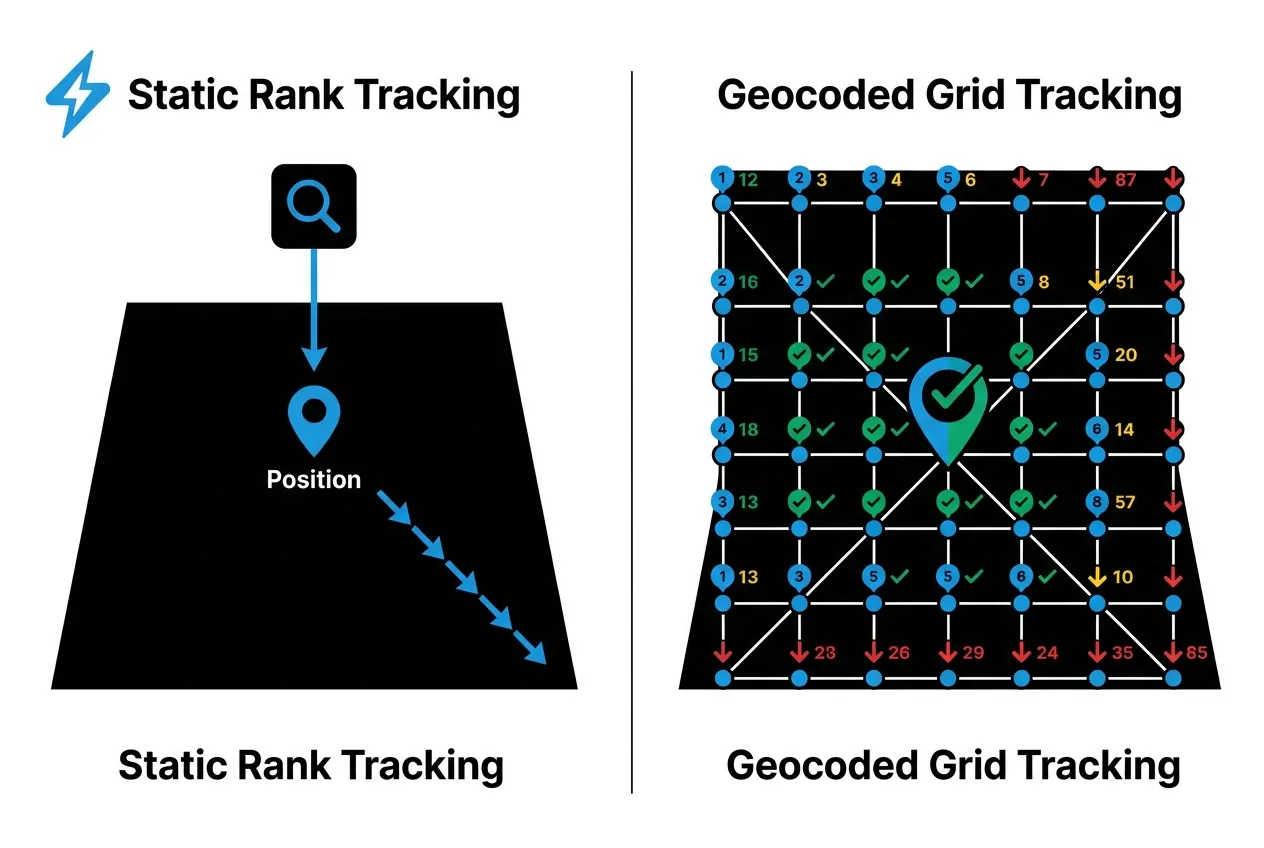
Evaluating local visibility using legacy rank-tracking software produces misleading reports. Traditional rank trackers operate by pinging Google from a single static IP address or data center, often checking queries from an arbitrary geographic center point such as a city hall or central post office.
If a rank tracker reports that your business is "Rank #2 in Tampa" for a key service phrase, that figure represents a single point in space. It tells you nothing about your performance two miles north, four miles east, or within the affluent suburbs where your target clientele resides. For Google Maps, a single organic rank number is mathematically incomplete.
Modern local measurement requires geocoded grid tracking. A geo-grid tool plots a multi-node matrix (such as a 7x7 or 13x13 grid) across a defined radius surrounding the facility, ranging from one to fifteen miles. The tool queries Google Maps from the exact geographic coordinates of each individual node.
The resulting visual report reveals the shape of your local visibility footprint:
- The Proximity Centroid: A green cluster of top-three positions immediately adjacent to the physical address.
- Distance Decay Boundaries: The exact perimeter where rankings fall from position three to position eight or twelve.
- Competitor Interception Zones: Geographic corridors where a competitor's profile consistently outperforms your listing due to their physical placement or superior review prominence.
Utilizing geocoded grid tracking transforms local reporting from speculative averages into actionable spatial intelligence. Operators can see precisely where their acquisition funnel breaks down across their physical service area.
Diagnostic Matrix for Local Search Discrepancies
When local service businesses and healthcare providers experience gaps between website traffic and inbound calls, comparing organic indicators against map positions identifies the root cause. Use this diagnostic matrix to assess visibility issues:
- Symptom 1; Primary Engine Status: Top-3 Organic Ranking across city; Secondary Engine Status: Position 10+ in Local 3-Pack; Probable Operational Cause: Primary GBP category mismatch; low review count; unoptimized landing page link; Corrective Action: Align GBP primary category; implement automated review collection; link profile to local landing page
- Symptom 2; Primary Engine Status: Position 1 to 3 within 0.5 miles; Secondary Engine Status: Drops to Position 15+ at 2 miles; Probable Operational Cause: Extreme proximity bias; dense urban competitors; weak brand prominence signals; Corrective Action: Build local citations; earn regional backlinks; increase authentic review velocity across service territory
- Symptom 3; Primary Engine Status: High impressions in Search Console; Secondary Engine Status: Low organic clicks; flat inbound phone call volume; Probable Operational Cause: SERP dominated by paid Local Services Ads and Local Pack; informational query intent; Corrective Action: Reallocate budget toward local pack dominance; adjust landing page copy to target transactional intent
- Symptom 4; Primary Engine Status: High Local Pack rank across grid; Secondary Engine Status: Low organic rankings for website pages; Probable Operational Cause: Weak technical site health; thin website content; deficient external backlink profile; Corrective Action: Conduct technical site audit; expand service page content; build location-specific domain authority
Diagnosing these discrepancies prevents wasted capital. If a clinic's visibility decay is driven by a category error or a lack of review prominence, continuing to publish generic blog content on the website will not solve the underlying acquisition problem.

Aligning Location Pages and Business Profiles for Local Growth
To maximize discovery, local service businesses must coordinate their website infrastructure with their Google Business Profiles. Rather than treating these assets as disconnected channels, operators should configure their location landing pages to serve as direct authority engines for their map listings.
Dedicated Location Pages vs. Homepages
Multi-location organizations frequently make the mistake of linking every Google Business Profile to their website homepage. While the homepage typically carries the highest domain authority, it dilutes geographic relevance.
Each profile should link directly to a dedicated, high-converting location page. For a healthcare group or legal firm with multiple offices, this page must include:
- Exact Name, Address, and Phone (NAP) details matching the profile letter for letter
- Specific operating hours and emergency contact instructions
- Verified practitioner bios and direct scheduling forms
- Detailed descriptions of the specific clinical or professional services delivered at that address
- An embedded Google Map corresponding to the verified location pin
Structured Data and Schema Markup
Search engine bots require unambiguous confirmation that a web page represents a specific physical entity. Embedding structured JSON-LD schema markup bridges the gap between web index data and the Places database.
Implement LocalBusiness, MedicalBusiness, or relevant professional schema on each dedicated location landing page. The structured data should explicitly declare:
- @type: The specific sub-type (e.g., Physician, Dentist, LegalService)
- name: The exact legal entity name
- address: The postal address matching Google Business Profile records
- geo: Precise latitude and longitude coordinates
- telephone: The local tracking number displayed on the profile
- hasOfferCatalog: Specific services performed at this location
When Google's web crawler encounters clean, unambiguous schema corresponding directly to a verified Google Business Profile, the search engine connects the assets. Domain authority from the website flows directly into the local prominence calculations for the Google Maps listing. Operators looking to systematically coordinate these assets across multiple clinics or offices can explore structured implementation through local search optimization.
Questions, Answered.
No. To appear in Google Maps and earn local 3-pack placement, a business must have a verified physical location. Google allows businesses that serve customers at their homes or job sites to operate as Service Area Businesses (SABs), hiding their street address on the public profile. However, an actual physical address must still be verified via postcard, video, or documentation during setup. Furthermore, profiles with publicly visible storefront addresses consistently demonstrate wider ranking radii than hidden-address service profiles in competitive commercial markets.
This drop is caused by proximity decay and competitor density. Google Maps prioritizes convenience for the searcher. In suburban or urban environments with high business density, multiple competing businesses occupy the physical space between the user and your facility. Unless your profile possesses overwhelmingly superior prominence metrics (such as ten times the review volume, higher ratings, and extensive local link equity), Google's algorithm naturally defaults to the closer verified competitor.
Dynamic Number Insertion (DNI) and call tracking do not harm local rankings if implemented correctly. In the past, marketers feared that using call-tracking numbers would violate Name, Address, and Phone (NAP) consistency rules. Google accommodates call tracking: place your call-tracking number in the primary phone field of your Google Business Profile to capture phone attribution, and place your standard local landline in the secondary phone field. This configuration maintains entity verification across historical web citations while delivering precise acquisition data.
While adding geographic or service keywords to a business name has historically influenced relevance signals in Google Maps, doing so artificially violates Google's guidelines. Google requires the name on your profile to match your real-world, legal business name as used on signage, tax documents, and official branding. Adding artificial keywords risks profile suspension, review loss, and removal from the local index. Sustainable prominence should be built through categories, review content, and on-page location optimization rather than title manipulation.
While changes to a Google Business Profile (such as updating categories) can influence relevance within days, structural website updates take longer. When you optimize location pages, implement JSON-LD schema, or build local backlinks, Google's web crawlers must first index the pages, recompute domain authority, and pass that prominence equity into the local places database. In competitive verticals, measurable expansion of your geo-grid ranking radius typically takes between four and twelve weeks of consistent optimization and review acquisition. Request a Local Visibility Review
Ready to see where your marketing can improve?
Request a free audit of your paid media, landing pages, attribution, and measurement setup. You'll get a straight assessment of where the opportunities are.
or email us at info@marketingpowered.ai