Resources
42 CFR Part 2 and Treatment Center Marketing Data
Executing 42 cfr part 2 marketing requires an operational discipline that balances patient confidentiality with commercial acquisition requirements. Behavioral health providers navigate stricter privacy boundaries than standard healthcare operators because federal law protects substance use disorder records from unconsented commercial disclosure. Treatment centers can achieve full-funnel attribution down to admissions while maintaining strict isolation between front-end ad tech and clinical records.
By Mike Hulick, Founder, Marketing Powered

The Core Conflict in 42 CFR Part 2 Marketing
Every addiction treatment center depends on consistent patient inquiries to sustain operational capacity, yet standard digital marketing pipelines frequently create direct legal vulnerability. In typical commercial marketing, web teams install client-side pixels, tag managers, and session recorders across every digital asset. In substance use disorder (SUD) treatment, those default implementations violate federal privacy statutes.
Federal protections under SAMHSA 42 CFR Part 2 Regulations govern any information that would identify a patient as having or having had a substance use disorder. Unlike standard medical practices covered solely by the Health Insurance Portability and Accountability Act (HIPAA), Part 2 programs cannot disclose patient identifying information without specific written consent, a qualifying court order, or an established regulatory exception. A standard business associate agreement does not authorize an organization to transmit SUD patient identifiers to third-party ad platforms.
When an individual visits a treatment center website and views pages detailing medical detox, residential inpatient programming, or medication-assisted treatment, their user journey is clinically descriptive. Traditional ad pixels from platforms such as Meta, Google, and TikTok routinely collect the visitor's IP address, device identifiers, and specific page URLs. The HHS Tracking Technologies Guidance issued by the Office for Civil Rights makes it clear that disclosing protected health information to third-party tracking vendors without individual authorization violates federal standards. Within SUD treatment, this data transmission also breaches Part 2 confidentiality mandates.

Why Substance Use Disorder Data Demands Elevated Legal Protection
Congress enacted 42 CFR Part 2 to address a specific societal barrier: individuals avoided seeking treatment for substance use disorders out of fear that their medical records would be weaponized against them in criminal prosecutions, custody disputes, employment decisions, or civil proceedings. The regulation creates a protective perimeter around the patient record, establishing criminal penalties for unauthorized disclosures.
The HHS 42 CFR Part 2 Final Rule aligned certain Part 2 provisions more closely with HIPAA regulations under the CARES Act, particularly regarding care coordination and single consent models for treatment, payment, and healthcare operations. However, this regulatory alignment did not create an open channel for marketing technology. Commercial exploitation, automated audience profiling, and advertising disclosures remain prohibited without explicit, granular patient authorization.
Top-of-funnel web traffic presents an inherent compliance challenge. An individual researching inpatient rehabilitation at midnight has not signed an intake disclosure or a Part 2 consent form. If the treatment provider captures that user's visit using tracking scripts that feed programmatic advertising networks, the provider effectively exposes the individual's treatment-seeking status to commercial surveillance. Protecting addiction treatment marketing data privacy requires treating all front-end digital touchpoints with the same confidentiality standards applied within admissions call centers.
Five Dangerous Data Practices in Addiction Treatment Marketing
Many healthcare digital agencies rely on playbooks designed for e-commerce or general consumer services. When applied to behavioral healthcare, these standard methods generate severe regulatory exposure.
- Unshielded Client-Side Pixels on Clinical Intake Pages: Deploying raw JavaScript tags from Google, Meta, or LinkedIn directly inside a container on assessment or admissions pages transmits user interaction events and referral URLs directly to advertising networks.
- Pushing Unhashed or Hashed CRM Lists to Advertising Platforms: Exporting contact records from an admissions intake CRM and uploading them to create lookalike or custom audiences violates Part 2 consent mandates. Even if the data is cryptographically hashed, sending lists of individuals who contacted a treatment center constitutes an unauthorized disclosure of SUD-identifying information.
- Unmanaged Call Tracking and Audio Transcription: Deploying third-party call-tracking phone numbers without a signed Qualified Service Organization Agreement (QSOA) or Business Associate Agreement (BAA) exposes confidential intake conversations. If that tracking platform automatically transcribes call recordings containing clinical histories and pushes the text to unvetted third-party software, compliance is compromised.
- Attempting Retargeting in Sensitive Categories: Retargeting users who visited addiction treatment pages directly conflicts with platform policies. The Google Ads Personalized Advertising Policy strictly prohibits personalized advertising and remarketing lists based on sensitive health conditions, including substance abuse treatment.
- Relying on General Healthcare Agency Assurances: Standard agencies often assume a general platform BAA provides total legal protection. Ad platforms explicitly state that their standard agreements do not cover the transmission of protected health information through client-side advertising pixels. Providers should review our healthcare marketing compliance checklist to evaluate their exposure across their active martech stack.
Compliant Technical Architecture for Addiction Treatment Marketing Data Privacy
Achieving regulatory compliance does not mean operating in the dark. Treatment providers can maintain detailed campaign measurement by implementing an engineered separation between public acquisition systems and clinical admissions data.
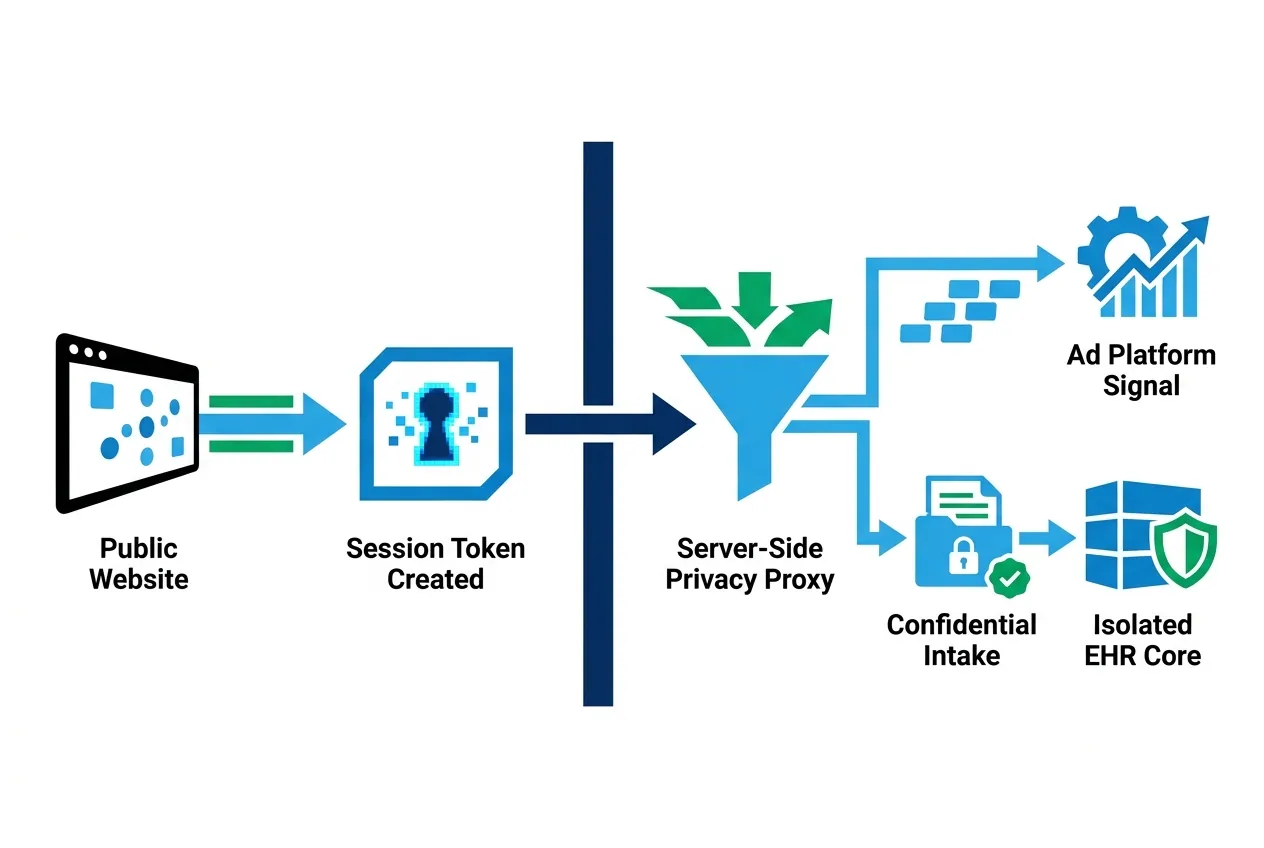
The primary requirement of this architecture is isolating front-end engagement metrics from electronic health records (EHR) and customer relationship management (CRM) software. The client browser must never run native third-party advertising scripts on sensitive pages. Instead, marketing teams utilize a server-side proxy container that intercepts event data before it leaves the provider's controlled infrastructure.
In this model, server-side endpoints strip away IP addresses, unique device fingerprints, and identifiable form parameters. Ad platforms receive anonymized conversion events (such as a generic form submission milestone) tied only to opaque transaction tokens. Marketing Powered operates with owned, local AI infrastructure for HIPAA-aware inference, ensuring that internal data processing, intake evaluations, and operational analyses never route confidential patient dialogues through shared public cloud models. Treatment organizations seeking technical execution can partner with our HIPAA-conscious marketing agency team to deploy these architectural boundaries.
Free Audit
Want a straight read on where your budget is leaking?
Measuring Down to Admissions Without Violating Federal Consent Rules
Treatment centers routinely waste advertising spend when optimizing campaigns solely for shallow metrics like clicks, page visits, or raw form submissions. In competitive behavioral health search auctions, a high percentage of incoming inquiries may be out of network, seeking services not offered, or commercially unqualified. Growth requires measuring campaigns against completed admissions.
Connecting an ad click to an admitted patient without violating 42 CFR Part 2 requires a privacy-preserving attribution protocol:
- Anonymous Click Tokenization: When a prospective patient lands on an acquisition page, the system assigns a unique, randomized session identifier. This identifier contains no personal details, phone numbers, email addresses, or clinical descriptors.
- Token Ingestion at Intake: When the user initiates contact via a secure form or privacy-shielded phone call, the session token transfers into the intake record alongside the prospective patient's information.
- Internal Milestone Tracking: The admissions team works through verification of benefits, clinical assessment, and travel coordination inside their protected, Part 2 compliant environment. Marketing tools have no direct access to this clinical workflow.
- Offline Conversion Feedback: Once an admission takes place, an automated internal pipeline isolates the original session token. The system sends an aggregate signal back to the ad network indicating that the token resulted in a qualified conversion.
This feedback loop transmits zero patient names, zero diagnostic data, and zero clinical notes to the advertising platform. Marketing algorithms receive the mathematical signal necessary to optimize bidding toward qualified admissions, while the patient's identity remains protected inside the facility's clinical perimeter.
Implementation Framework and Organizational Accountability
Deploying a compliant marketing operations system requires coordination across executive leadership, legal counsel, marketing directors, and technical developers. The table below outlines clear operational responsibilities to maintain ongoing adherence to federal standards.
- Tag Governance; Responsible Owner: Web Development Lead; Primary Implementation Tasks: Remove all client-side third-party pixels from intake forms; deploy server-side event routing.
- Ad Platform Compliance; Responsible Owner: Marketing Director; Primary Implementation Tasks: Secure LegitScript certification; verify keyword structures comply with Google sensitive category rules.
- Vendor Agreements. Responsible Owner: Legal Counsel / Compliance. Primary Implementation Tasks: Execute Business Associate Agreements and Qualified Service Organization Agreements with all martech vendors.
- Call Tracking Systems; Responsible Owner: Admissions Director; Primary Implementation Tasks: Implement dynamic number insertion through HIPAA-aware providers; disable unencrypted call recordings.
- Attribution Pipeline. Responsible Owner: Technical Architect. Primary Implementation Tasks: Build decoupled, token-based conversion pipelines linking admissions outcomes to marketing campaigns without PHI.
LegitScript certification represents an essential baseline for addiction treatment advertising. Under the Google Ads Healthcare and Medicines Policy, treatment providers targeting the United States must obtain certification through LegitScript prior to serving search campaigns. Marketing Powered leadership includes a former healthcare CMO who ran marketing for a treatment network that grew from 3 to 24 locations, managing $1.5 to $2M per month in Google Ads across 11+ behavioral and mental health accounts. Operating effectively at this scale requires institutionalizing compliance protocols across daily campaign adjustments.
Questions, Answered.
No. Standard Business Associate Agreements do not permit providers to transmit substance use disorder records or patient identifying information to commercial ad networks. Most major ad platforms explicitly disclaim the receipt of sensitive health information via their standard web tags. Furthermore, 42 CFR Part 2 requires specific disclosures and patient authorizations that standard platform BAAs do not accommodate.
While HIPAA regulates protected health information across the entire healthcare ecosystem, 42 CFR Part 2 applies specialized, heightened confidentiality rules specifically to federally assisted substance use disorder treatment programs. Part 2 restricts the disclosure and redisclosure of patient identifying records in civil, criminal, administrative, or legislative proceedings, and it establishes strict limits on commercial or marketing disclosures without express written consent.
Yes, but call recording must be managed under strict compliance protocols. The call-tracking vendor must sign a Business Associate Agreement and, where applicable, a Qualified Service Organization Agreement. Audio files must be encrypted both in transit and at rest, and access must be restricted to authorized admissions personnel. Pushing raw audio or unredacted call transcripts to third-party marketing tools or unvetted AI platforms violates federal privacy requirements.
No. Major advertising networks, including Google, explicitly prohibit remarketing and personalized advertising for sensitive medical conditions, including substance abuse treatment. Beyond platform rules, serving ads to individuals based on previous visits to addiction treatment web pages creates substantial legal risk under HHS tracking guidelines and Part 2 regulations.
Providers track performance by assigning opaque, randomized session tokens at the top of the funnel and passing those tokens into secure intake systems. When an admission occurs, the internal system transmits the session token back to the acquisition platform as an aggregate conversion signal. No patient names, contact details, diagnoses, or clinical notes ever leave the protected healthcare environment. Request an acquisition audit
Ready to see where your marketing can improve?
Request a free audit of your paid media, landing pages, attribution, and measurement setup. You'll get a straight assessment of where the opportunities are.
or email us at info@marketingpowered.ai