Capabilities
Rehab Lead Generation Measured to Admissions
Lead volume is easy to put on a dashboard and hard to defend when admissions do not move with it. This page is for treatment center CEOs, COOs, CMOs and admissions leaders who want rehab lead generation judged by what happens after the inquiry. Our rehab lead generation work focuses on paid media, SEO, conversion systems and attribution through to admission, where authorized data supports it.

When inquiry volume stops explaining admissions
Consider outside help when inquiries rise without admissions, lead quality is disputed, or spending decisions rely on volume alone. Start by checking measurement before deciding whether media, intake or both need to change.
The admissions director has the overnight call sheet. The person running media has a platform export. Detox is full, and outpatient still has openings. A vendor, a wrong number and a caller already in treatment can sit in the same total as a new inquiry that might fit the payer network. Until those are separated, drug rehab lead generation and broader treatment center lead generation look busier than the census.
The founder is a former healthcare CMO who ran marketing for a treatment network that grew from 3 to 24 locations, and in that role managed $1.5 to $2M per month in Google Ads across 11+ behavioral and mental health accounts. The founder is also a court-certified expert witness in advertising strategy. That history shapes the questions on this page. It is not a result of this firm, and it is not a forecast for your census.

What counts as a qualified treatment center lead
A qualified treatment center lead is a real, reachable person asking about a service the facility offers, with insurance or payment status captured or routed for verification of benefits, who reaches intake and receives a documented disposition. Unqualified inquiries stay in the report as named categories, not as a hidden remainder.
Set these five criteria with the admissions team:
- Real and reachable. Not spam, a duplicate or a test.
- Service fit. The caller wants a level of care the facility provides, in a geography or travel pattern it can serve.
- Payment fit. Insurance or payment information is captured and is plausibly compatible with the facility's network, or the call is routed to verification of benefits for confirmation.
- Right category. Existing patients, vendors, job seekers and families asking about an unrelated service are tagged and counted separately, not deleted.
- Recorded outcome. Record an intake disposition, including unanswered, pending and unknown outcomes.
A form fill is not yet a qualified healthcare lead. The working test is whether someone can say, inquiry by inquiry, why it entered or left the acquisition funnel.
Where marketing control ends
Marketing does not own the admission. Use the split below to see which side of the handoff needs review, and which facts are still missing.
<table>.
<thead>.
<tr>.
<th scope="col">Marketing controls</th>.
<th scope="col">Admissions controls</th>.
<th scope="col">Shared</th>.
</tr>.
</thead>.
<tbody>.
<tr>.
<td>Traffic and keyword quality</td>.
<td>Speed to answer</td>.
<td>Disposition definitions</td>.
</tr>.
<tr>.
<td>Message and landing experience</td>.
<td>Verification of benefits handling</td>.
<td>Insurance and level-of-care criteria</td>.
</tr>.
<tr>.
<td>Call routing and source tagging</td>.
<td>Intake assessment and admissions coordination</td>.
<td>Capacity signals by service line</td>.
</tr>.
</tbody>.
</table>.
Matched calls that do not progress warrant review of intake, capacity, clinical eligibility and data completeness. Mismatched calls warrant review of targeting, messaging and qualification criteria. Call-level evidence narrows the investigation; it does not establish causation by itself.
Free Audit
Want a straight read on where your budget is leaking?
How calls, sources and duplicates are checked
A defensible validation process checks available source tags, scores inquiries against agreed criteria, identifies duplicates where records permit, and reports spam and misdials separately. Document unresolved records and tracking gaps.
That review is a shared screen. An intake coordinator and the person responsible for media look at yesterday's calls together. One call carries a campaign parameter and matches a level of care the facility offers. A second number already exists in the customer relationship management (CRM) record from a form last week, so it is one person, not two rehab leads. A third call is a job seeker and stays in its own category. Recordings, transcripts or intake notes are used for scoring only after permitted uses, consent and access limits are set.
Source tagging is covered on the call tracking and intake attribution page.
How rehab lead generation should be measured
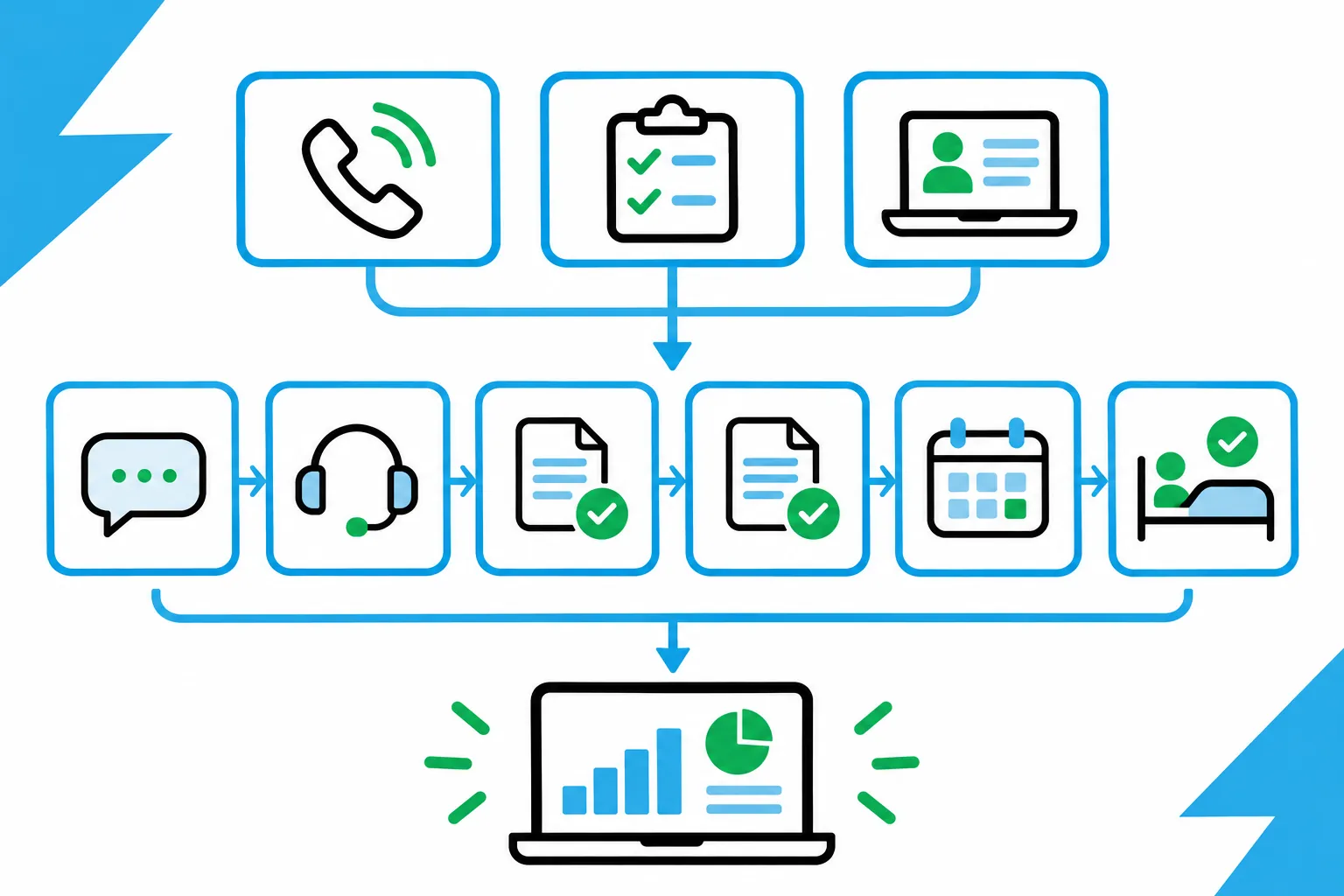
Measure rehab lead generation through a staged funnel over an agreed reporting period, not through one cost-per-lead number. Report each stage authorized data can support, name the stages it cannot, and treat the ratios as a description of that chain. The funnel does not, by itself, show that media caused an admission.
Define these stages with admissions:
- Inquiry
- Qualified call
- Verification of benefits started
- Verification of benefits completed
- Admission scheduled
- Admitted
Cost per qualified call uses tracked acquisition cost for the period as the numerator and unique qualified calls as the denominator, after the duplicate rule you adopt. Cost per admitted patient uses that same numerator and admitted patients as the denominator. That figure can inform patient acquisition ROI. It is not ROI, because reimbursement and length of stay sit outside the media export. Late admissions are assigned to the period the facility chooses and shown apart from same-period admissions, so a delayed admission is neither dropped nor counted twice. Possible duplicates that cannot be matched stay visible as unresolved.
Insurance-qualified calls are a midpoint metric only after your payer mix and network status define them. If outcomes live in an electronic health record (EHR) that this work is not authorized to use, reporting stops at the last visible stage and says so. Attribution is tracked to admission, not just the lead, where authorized data supports it. Some admissions follow several touchpoints or a long delay, and the report should show that limit.
Evaluate demand alongside available capacity by service line. Calls for a full detox unit are a different operating fact from calls for a service line with open beds.
Consent, privacy and referral boundaries
This service focuses on a facility's own advertising and acquisition measurement, not purchasing patient referrals or selling personal information. Define account ownership, access permissions and permitted data flows before implementation. Compensation is not tied to an individual admission.
Before using recordings, transcripts or intake records for attribution, establish permitted uses, applicable recording consent, access limits and retention rules. Client permission alone does not establish that a disclosure is permitted. HIPAA and Part 2 requirements may apply. Federal law provides a party-consent exception for intercepting a wire, oral or electronic communication, unless the purpose is a criminal or tortious act, and state law may require consent from more parties 18 U.S.C. § 2511.
HHS states that regulated entities may not use tracking technologies in a way that impermissibly discloses protected health information to vendors. A vendor that creates, receives, maintains or transmits that information for a covered function is a business associate, which calls for a permitted disclosure and a business associate agreement. A June 20, 2024 court order vacated the guidance to the extent it said HIPAA is triggered merely by connecting an IP address with a visit to an unauthenticated public webpage about a health condition or healthcare provider HHS online tracking guidance.
Part 2 applies to federally assisted programs that provide substance use disorder diagnosis, treatment or referral for treatment, and some requirements apply to recipients of those records. It should not be assumed for every inquiry or organization HHS Part 2 overview.
Google restricts the promotion of recovery-oriented drug and alcohol addiction services to approved advertisers in approved locations, including the United States. Its examples include clinical treatment providers and lead generators or referral agencies Addiction services policy. In the United States, advertisers must be certified by LegitScript as addiction services providers and also certified with Google. Services not eligible for LegitScript certification are not allowed to advertise those services on Google Healthcare and medicines policy.
Marketing Powered is LegitScript-aware and HIPAA-aware, and built for Google's sensitive healthcare vertical, where retargeting is not permitted. That is a description of scope, not a certification of your organization.
Email Us
Prefer to send the context directly?
What an acquisition audit focuses on
The acquisition audit focuses on source attribution, inquiry qualification, intake handoffs and gaps in admissions reporting. Its scope depends on the systems and authorized information available.
The session follows one recent inquiry with the people who touched it: the page or ad that started it, the call record, the verification of benefits note if one exists, and the disposition field, including blank, pending and unknown values. The point is to see broken source tags, one person counted as several inquiries, and qualified calls that never received a disposition. Compatibility with current call tracking or a CRM depends on the systems, available interfaces and permitted access.
Programs whose work is substance use treatment can review related constraints on the substance use disorder marketing page.
Common questions
What constitutes a qualified treatment center lead?
A real, reachable person seeking a service the facility offers, with payment status captured or routed for verification, who reaches intake and has a documented disposition, including pending and unknown outcomes. Other caller types stay in named categories.
How should rehab lead generation be measured against admissions?
Use an agreed period and a staged chain from inquiry to qualified call, verification of benefits, scheduled admission and admitted patient. State the duplicate rule and how late admissions are assigned. Cost per qualified call and cost per admitted patient describe that chain. They do not establish that marketing caused the admission.
How is this different from buying rehab leads?
The service is the facility's own advertising and acquisition measurement. It is not the purchase of patient referrals and not the sale of personal information. Account ownership, access and permitted data flows are defined before implementation.
Can current call tracking or a CRM stay in place?
Compatibility depends on the systems, available interfaces and permitted access.
Will the work set an admissions target?
No. Admissions depend on intake assessment, capacity, payer fit and clinical decisions outside marketing's control. The report shows what authorized data supports.
Ready to see where your marketing can improve?
Request a free audit of your paid media, landing pages, attribution, and measurement setup. You'll get a straight assessment of where the opportunities are.
or email us at info@marketingpowered.ai