Capabilities
Healthcare Lead Generation for Multi-Location Providers
The same campaign can fill one location and strand inquiries at another, while a dashboard that stops at cost per lead looks fine either way. Healthcare lead generation for a multi-location provider is a routing and measurement problem as much as a media problem. A lead is qualified only when it matches that site's service line, eligibility rules, and open capacity that day.

Who needs healthcare lead generation
Picture two sites on the same Tuesday morning. At the first, the admissions coordinator is still on a call and the next inquiry goes to voicemail. At the second, an assessment slot is open and the phone is quiet. Both sites share one campaign and one cost per lead. The report does not show which site could have taken the person who called.
Most providers already buy demand. The question is whether the setup can separate a fit from a miss, by location, on the day the inquiry arrives. Outside help is worth weighing when several of these are true:
- More than one location, with separate intake paths or admissions teams.
- Spend is rising, and marketing, intake, and leadership each report a different count of good inquiries.
- Call tracking ends at the call and never reaches a disposition.
- Cost per admitted patient or booked appointment is not visible by location.
- The current report is volume and cost per lead, while leadership is judged on admissions, scheduled appointments, or census.
If none of these apply, an in-house team with clean tracking may be enough. If several do, the gap is usually the handoff between media and the intake desk.
The founder previously served as a healthcare CMO and ran marketing for a treatment network that grew from 3 to 24 locations. The founder also managed $1.5 to $2M per month in Google Ads across 11+ behavioral and mental health accounts and is a court-certified expert witness in advertising strategy. That operating history is why the work starts at intake, not at the ad account.

What qualified means across locations
Organizations that evaluate lead quality across sites stop asking whether a channel produces good leads. They ask whether an inquiry matched a specific location on four variables, written down with clinical and admissions leaders before spend scales:
- Service line. Does that location offer the level of care or specialty requested?
- Eligibility. Does the inquiry meet the payer, age, geography, and screening rules the organization set?
- Capacity. Can that location admit or schedule inside a window that is useful?
- Reachability. Was the inquiry answered, followed up, and documented?
Quality is a property of the match, not of the source. A paid click and a referral call can both be qualified or unqualified depending on where they land. Marketing, intake, and leadership then report against the same definition. Qualified healthcare leads are the inquiries that survive that match, not the inquiries that merely completed a form.
Illustrative example, not a measured result. Three locations share one number. One site is near capacity. One has open capacity in a service line the ads never mention. One does not accept the payer most callers carry. Volume looks steady. Location-level dispositions would show one site turning people away, one site never offered the open service, and one site doing the admitting. The operating fix is routing, message, and budget by location. It is not a larger lead total.
How we deliver healthcare lead generation
The offer is qualified inquiries and appointment demand, intake routing, and governance, reported against admissions or scheduled appointments. It sits inside broader healthcare digital marketing services, scoped to the parts of the funnel that are actually broken.
Qualified inquiries and appointment demand
Paid media and landing pages are planned around the service lines and locations that can be served. Messaging reflects eligibility and capacity, so a page does not offer what a given site cannot deliver. Channel build and bid management are covered on the healthcare PPC page.
Intake routing and follow-up
Forms, tracked calls, and chat connect to routing rules by location, service line, and hours, then to the intake system already in use. Each inquiry receives a disposition the organization defines, such as a fit for that site, not a fit, outside the service area, or capacity not available. Where machine-assisted tagging speeds classification, a person sets the rules and reviews the outcome. Marketing Powered has been AI-native since 2022 and operates owned, local infrastructure for HIPAA-aware inference when that processing is part of the engagement. Not every campaign uses it. Owning the compute does not change who owns the data.
What stays with people
People approve creative, routing rules, and any automated step that touches an inquiry. Automation cuts re-keying. It does not replace the admissions judgment.
Free Audit
Want a straight read on where your budget is leaking?
Measuring inquiry to admission
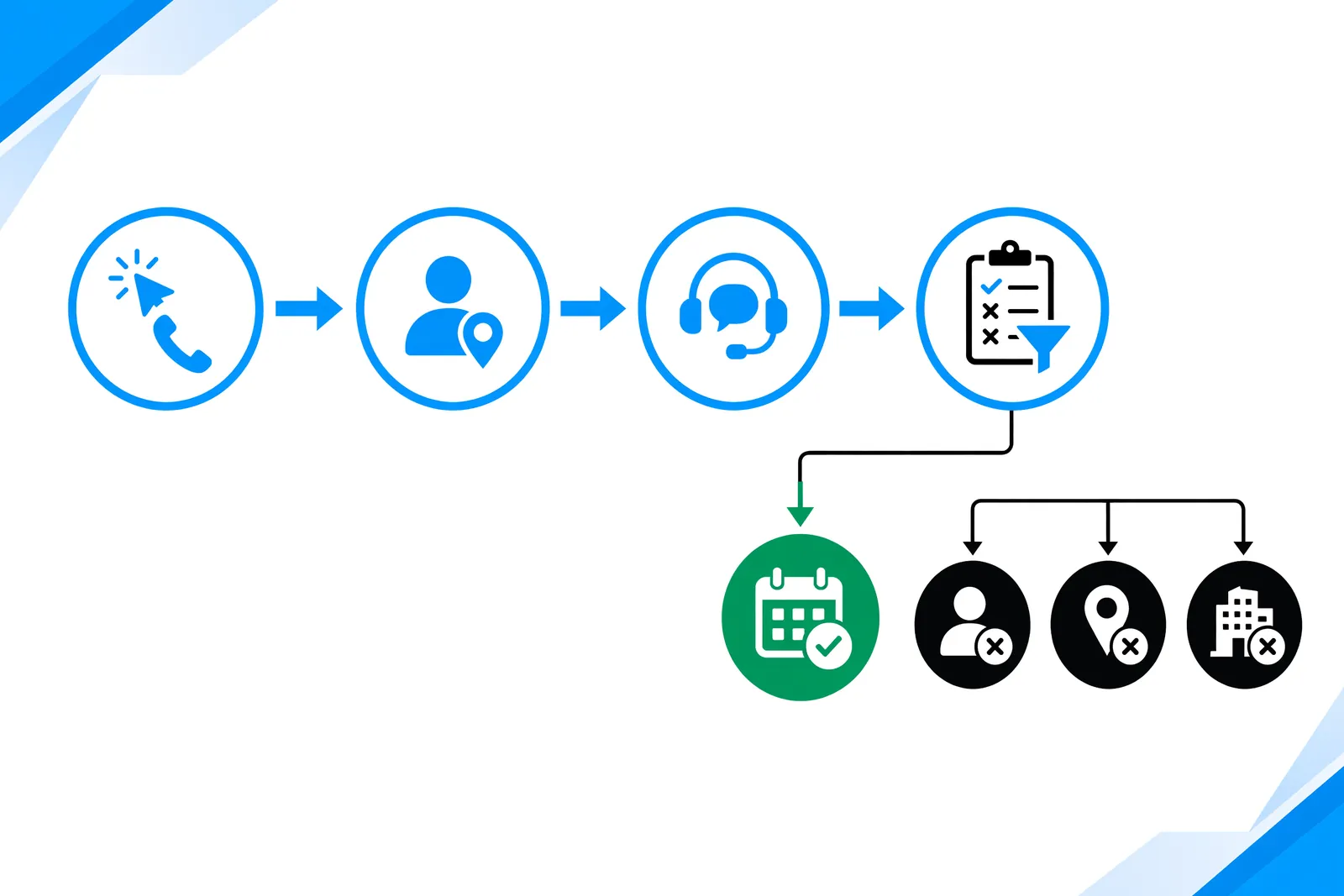
Measurement is a chain a coordinator can walk, not a single conversion tag.
- A click or call starts, with source and the location context known at that moment.
- The inquiry is captured.
- Intake makes contact, or the attempt is logged.
- A disposition is recorded against the written definition.
- An admission or appointment is scheduled, and marked completed only where the data supports it.
From that chain, reporting can show cost per qualified inquiry and cost per admitted patient or scheduled appointment, by location. Patient acquisition ROI is the same comparison stated as return: what an admission or booked appointment returned against what it cost to acquire, using only fields the organization has authorized. Where the data supports a link to a downstream outcome, the report shows it. Where it does not, the report says so. Estimates and measured facts are labeled separately.
The design does not require marketing to hold a clinical chart. The fields that move are operational: source, location, time, disposition, and whether an appointment or admission was scheduled. Which of those fields may move, and to whom, is a decision for the organization's privacy and legal reviewers. Attribution tracked to admission, rather than to the lead alone, is the reporting standard. The wider healthcare patient acquisition model is described under patient acquisition marketing.
Governance, privacy, and platform rules
Healthcare advertising carries dependencies that general lead generation does not. Platform rules change, so the current source is checked before launch, and counsel sets the boundary.
Google treats content related to health as a sensitive interest category. That includes physical or mental health conditions and counseling for issues such as depression, anxiety, and addiction. Google Ads policy For ads in a sensitive interest category, advertiser-curated audiences cannot be used. That list includes Customer Match, your data segments, audience expansion, and lookalike segments. Predefined Google audiences can still be used, because sensitive user signals are excluded from them. Google Ads policy The practice is built for that vertical: campaigns are planned without those advertiser-curated audiences.
In the United States, advertising recovery-oriented drug and alcohol addiction services on Google Ads requires certification as an addiction services provider through LegitScript, and a separate certification with Google. Not every drug and alcohol service is eligible. Services that are not eligible are not allowed to advertise those services. Google Ads policy
With limited exceptions, the HIPAA Privacy Rule requires an individual's written authorization before protected health information is used or disclosed for marketing. The Rule treats a covered entity's communications about its own health-related services, and communications for treatment or care coordination, differently from selling patient information to a third party for that party's own promotion. HHS guidance We are LegitScript-aware and HIPAA-aware. That awareness is not a certification of your program, and it does not decide what your authorization or business associate terms must say.
Working rules for the engagement:
- Data ownership is set by the agreement. Where compute runs does not transfer it.
- Data flows are documented before launch: which system holds which event, and who can see it.
- People approve creative, routing, and any automated step that touches an inquiry.
- Privacy and legal reviewers set the limits. The build follows those limits.
Hospitals, health systems, and other regulated operators face the same routing problem even when the certification list differs. Who the work is built for is outlined on who we help.

What the acquisition audit covers
The acquisition audit is a review of how an inquiry moves from the ad, to a person at intake, to an outcome. It is not a media plan, and it is not a fixed set of files or a preset timeline. Access is limited to the systems and fields your team approves.
The review focuses on four questions. Where does tracking stop, and does a call or form ever receive a disposition? How are inquiries routed across locations, and where are they answered, missed, or sent to a site that cannot take them? Do marketing, intake, and leadership share one written definition of qualified, by service line and location? What can be measured through to an admission or a scheduled appointment with data you already authorize?
The result is a prioritized view of that handoff: what to change in routing, messaging, and reporting before more spend is added. The number of locations and the access you grant determine how far the review can go. Nothing is assumed before that is known.
Ready to see where your marketing can improve?
Request a free audit of your paid media, landing pages, attribution, and measurement setup. You'll get a straight assessment of where the opportunities are.
or email us at info@marketingpowered.ai