Resources
Referral vs Digital Attribution in Treatment Centers
Evaluating referral vs digital marketing attribution for treatment centers requires connecting initial patient discovery directly to downstream clinical admissions rather than relying on subjective intake notes. When business development liaisons and digital media teams operate in disconnected silos, healthcare executives receive fragmented reporting that distorts true patient acquisition costs. Establishing deterministic tracking across the entire admissions cycle provides the operational clarity leadership needs to allocate capital effectively.
By Mike Hulick, Founder, Marketing Powered

The Core Conflict: Business Development Outreach Versus Paid Acquisition
Tension between field business development teams and digital marketing departments is common across behavioral healthcare organizations. Field liaisons spend their days traveling between hospital emergency departments, private therapy practices, collegiate wellness offices, and community events to build direct professional networks. Concurrently, digital marketing teams deploy capital across search campaigns, organic content, and local directories to capture immediate commercial search intent from individuals and families experiencing crisis.
Conflict erupts when an admission occurs and both departments submit competing claims for the census credit. An outreach liaison argues that their lunch meeting with a local physician three months prior generated the placement, while the digital media log demonstrates that the patient clicked a paid search ad and initiated a telephone conversation via a dynamic tracking number twenty minutes before the intake screening began.
In clinical reality, modern patient journeys rarely follow a single track. A family physician may suggest three reputable residential treatment centers to a patient, but the family conducts rigorous research online before contacting any facility. They review patient testimonials, investigate clinical modalities, verify insurance acceptance, and inspect facility licensing. If they dial a telephone number displayed on a paid search landing page, standard last-touch analytics tools assign total credit to paid digital advertising. Conversely, an individual who first discovers a facility through a non-branded web search may later consult their outpatient psychiatrist, who then contacts a regional outreach liaison to facilitate the intake. If the intake coordinator types "Physician Referral" into the electronic health record without checking prior web interactions, digital marketing performance is rendered invisible.
Viewing business development and digital media as rival acquisition channels creates flawed resource allocation. Treating them as complementary components within a unified conversion system prevents leadership from prematurely defunding effective paid media or overpaying for unverified field relationships.

Why Incomplete Lead Volume Distorts Clinical Intake Priorities
A persistent failure in behavioral healthcare marketing is optimizing campaigns for top-of-funnel lead volume instead of verified admissions. Measuring performance purely on raw inquiries, web forms, or cost per lead creates severe operational blind spots. Digital agencies without healthcare operating experience often celebrate lower cost-per-call numbers, unaware that the admissions department is being overwhelmed with non-viable inquiries that waste clinical labor.
The operational pipeline from initial inquiry to physical bed census involves multiple attrition points:
- Initial Contact: An inbound call or live chat connects with the intake department.
- Clinical Pre-Screening: Admissions coordinators assess medical stability, psychiatric acuity, age restrictions, and level-of-care requirements.
- Verification of Benefits (VOB): The financial clearance team reviews policy deductibles, co-pays, in-network versus out-of-network status, and pre-authorization criteria.
- Clinical Evaluation: Medical directors and nursing supervisors review psychiatric history and concurrent physical conditions to ensure safe placement.
- Logistical Scheduling and Intake: Travel arrangements, intervention coordination, family approvals, and physical arrival on site.
A campaign producing hundreds of low-cost phone inquiries might yield an abysmal admission conversion rate if callers are seeking Medicaid coverage at an exclusively commercial out-of-network facility, or if psychiatric acuity exceeds the facility's licensed capabilities. Conversely, targeted business development relationships or high-intent search queries may generate fewer total inquiries but yield an exceptional ratio of completed admissions.
Evaluating marketing effectiveness strictly by initial inquiries incentivizes teams to pursue cheap, unqualified traffic. Aligning acquisition data with downstream metrics is critical to understanding actual healthcare marketing ROI and protecting clinical capacity from administrative overload.
Technical Architecture for Marketing-to-Admissions Attribution
Constructing a reliable attribution framework requires purpose-built technical infrastructure that respects federal privacy regulations while preserving campaign parameters. In standard commercial e-commerce, tracking transactions relies on persistent user IDs, retargeting pixels, and expansive third-party data collection. In behavioral healthcare, these methods are both legally prohibited and technically unviable.
The Department of Health and Human Services (HHS) issued specific guidance regarding digital tracking tools, establishing that collecting and transmitting protected health information (PHI) via tracking technologies on public-facing and unauthenticated web pages can violate privacy rules: HHS Guidance on Tracking Technologies. Simultaneously, the Google Ads Healthcare and Medicines Policy strictly forbids remarketing and personalized audience targeting for sensitive health conditions, including substance use disorder treatment and mental health clinical services.
Operators must build marketing-to-admissions attribution using privacy-aware data architectures that operate without third-party retargeting pixels. The technical standard relies on Dynamic Number Insertion (DNI) connected directly to first-party server-side logging.
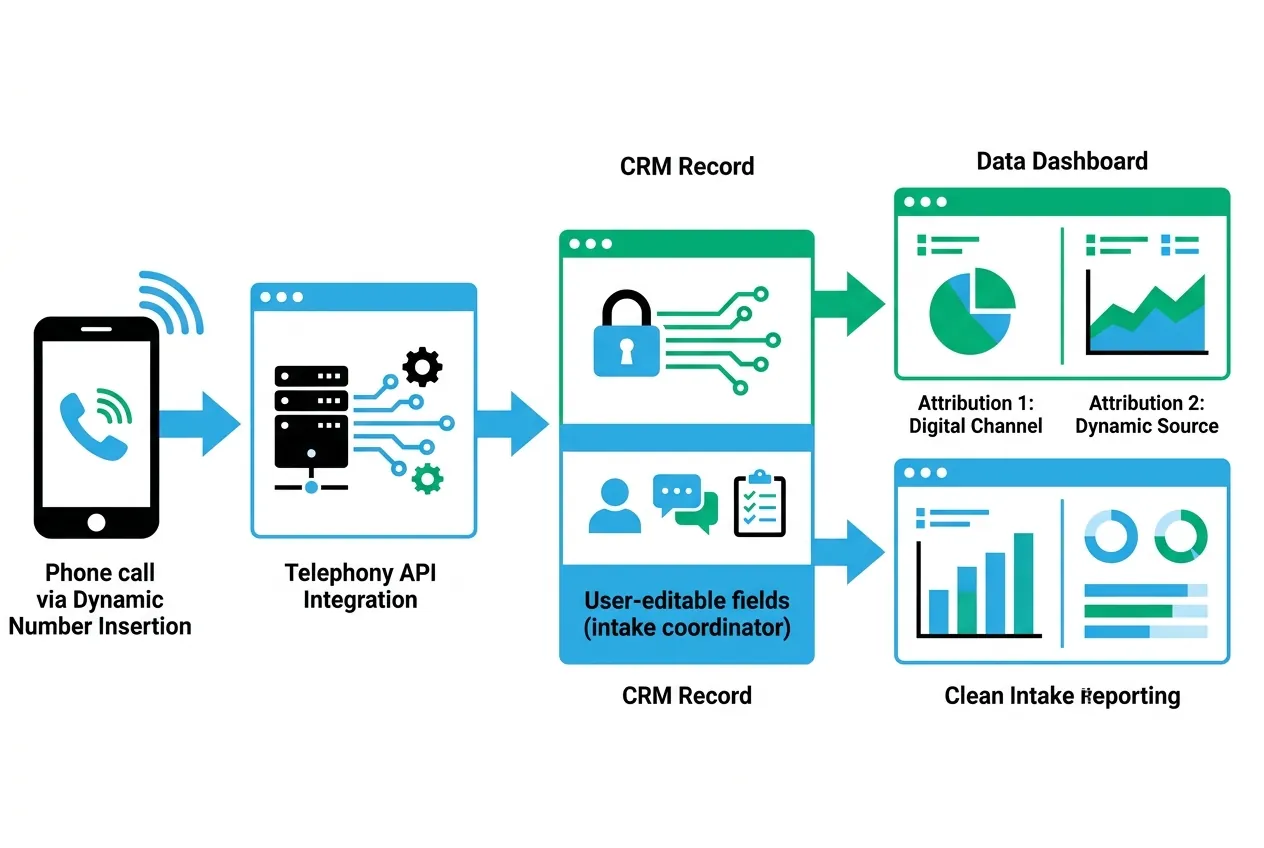
When a prospective patient lands on a website, a local session script swaps the standard phone number for a unique number assigned from an isolated tracking pool. This tracking pool maps the visitor's traffic source, campaign identifier, ad group, and landing page URL to that specific session. When the visitor dials the number, the telephony server captures the call metadata and pairs it with the session parameters before forwarding the call to the intake call center.
The telephone system must immediately transmit these campaign parameters directly into the customer relationship management (CRM) database via secure API connections. This automation captures the exact digital origin before the intake coordinator answers the call, eliminating reliance on human memory or manual data entry.
Free Audit
Want a straight read on where your budget is leaking?
CRM Source Mapping and Data Integrity at Intake
Attribution models frequently fail at the point of human data entry. Intake coordinators work under high-stress conditions, managing crises, emotional families, and urgent medical needs. Expecting an intake specialist to interrogate a distressed caller about which Google ad they clicked, or whether they found a business card at a physician's office, results in corrupted data.
When intake teams encounter manual drop-down menus in systems like Salesforce, Kipu, or Sunwave, they default to whatever choice is fastest. The most common entry becomes "Google," "Internet Search," or whatever field liaison visited the facility most recently. This human error blinds executive leadership to actual marketing performance.
Solving this structural vulnerability requires rigorous CRM source mapping where technical fields are locked against manual editing:
- Automated Lead Creation: The incoming call event creates a CRM record instantly, auto-populating fields for source, medium, campaign, keyword query, and referring URL.
- Separation of Attributions: The CRM must maintain separate, dedicated fields for "Original Digital Source" and "Professional BD Referral Source." If a patient was introduced by an outreach liaison but used paid search to locate the direct intake line, both touchpoints are recorded concurrently.
- Locked Field Permissions: Intake agents must be restricted from manually changing original acquisition fields. Their operational responsibilities should remain focused on documenting caller contact information, clinical symptoms, medical history, and insurance details.
- Stage-Gate Conversion Tracking: Dispositions within the CRM must follow defined operational milestones: Inquiry Received, Pre-Screen Completed, VOB Submitted, VOB Approved, Clinical Review Passed, Intake Scheduled, and Admitted.
Configuring these intake stages enables treatment centers to measure conversion rates between touchpoints, revealing precisely where digital traffic or liaison leads drop out of the intake funnel. Detailed implementation methodologies for these systems can be explored through specialized analytics and attribution services.
Evaluating Outreach Liaisons and Paid Search on Equal Unit Economics
Leadership teams cannot evaluate business development outreach and digital marketing using uniform financial formulas because their operational cost structures are fundamentally different. Digital search relies largely on variable media costs and agency management, whereas field business development carries heavy fixed overheads, travel expenses, and protracted lead times.
To compare these channels fairly, executive teams must calculate the fully loaded Cost Per Admitted Patient (CPAP) for each acquisition stream.
- Direct Expenditures. Field Business Development: Liaison base salary, commission bonuses, vehicle allowances, travel, dining, conference sponsorships. Paid Digital Acquisition: Google Ads media spend, platform click fees, call tracking subscriptions, search engine marketing management.
- Time to Maturity. Field Business Development: 3 to 6 months to establish local trust and build referral relationships. Paid Digital Acquisition: Immediate traffic upon campaign activation, subject to campaign optimization and quality score development.
- Lead Volume Profile. Field Business Development: Low total inquiry volume with higher clinical suitability and established intent. Paid Digital Acquisition: High inquiry volume requiring rigorous pre-screening and rapid insurance verification workflows.
- Attribution Model. Field Business Development: Direct professional relationship logged via liaison field notes and verified outreach meetings. Paid Digital Acquisition: Dynamic number tracking, CRM campaign parameter passing, and deterministic click-to-call matching.
- Economic Vulnerability. Field Business Development: High employee turnover risks losing territory relationships to competing regional facilities. Paid Digital Acquisition: Fluctuating click costs, competitive auction dynamics, and regulatory policy adjustments.
Evaluating both channels by fully loaded CPAP provides financial objectivity. A business development liaison earning a $90,000 base salary with $30,000 in travel expenses who produces three admissions a month yields an approximate acquisition cost of $3,333 per patient. A paid search campaign spending $50,000 per month that delivers ten verified admissions yields a direct media acquisition cost of $5,000 per patient, before agency management fees.
However, financial evaluation must extend beyond the initial admission event. Treatment centers must analyze Average Length of Stay (ALOS), clinical completion rates, and collected insurance reimbursements across channels. If professional provider referrals stay an average of 28 days with high clinical engagement, while unverified digital search leads average 14 days due to early administrative discharges, the true commercial return shifts dramatically. Clean marketing-to-admissions attribution connects the marketing origin directly to financial collection reports, giving operators exact unit economics.
Implementation Blueprint: Bridging Call Tracking, Dispositions, and Financial Realities
Building an accountable attribution engine across multiple treatment locations requires disciplined execution across clinical, marketing, and admissions workflows. Managing marketing operations across growing multi-location treatment networks reveals that technical platforms fail if operational handoffs are not clearly defined.
The execution process begins by establishing isolated dynamic tracking pools for each physical facility and distinct clinical service line, such as medical detox, residential inpatient, or intensive outpatient programs. Call routing must account for geographic proximity to prevent out-of-market inquiries from reaching local admissions teams unprepared to handle regional insurance plans.
Next, admissions leaders must audit their CRM dispositions. When an intake coordinator marks a record as "Unqualified," the system must require a specific sub-category reason, such as Active Psychosis, Non-Covered Insurance, Lack of Transportation, or Age Ineligible. This diagnostic data provides immediate feedback loops to the marketing team. If paid campaigns generate high call volumes that consistently fail insurance verification, digital media buyers can refine demographic criteria, search intent queries, and location parameters to stop wasting budget.
Finally, operators must establish a monthly reconciliation meeting where clinical admissions records from the electronic health record (EHR) are matched against CRM acquisition histories. This process verifies whether patients credited to field liaisons had pre-existing digital interactions, or whether digital leads were assisted by local professional networks. Aligning these data streams resolves internal disputes, establishes accountability, and ensures marketing capital is directed toward the most profitable and clinically sound channels.
Questions, Answered.
Comparing field outreach with digital search requires calculating the fully loaded Cost Per Admitted Patient (CPAP) for both pipelines. Field business development costs must include liaison base salaries, performance bonuses, auto allowances, travel expenses, client entertainment, and local conference sponsorships. Paid search costs must account for direct media expenditures, tracking infrastructure fees, and agency management retainers. Comparing these fully loaded numbers against verified days of care and collected insurance revenue eliminates internal bias and establishes financial parity.
Discrepancies typically stem from manual intake logging and last-touch reporting models. When intake staff operate under pressure during crisis calls, they often bypass detailed questioning and select whatever referral option is quickest in their software. Additionally, call tracking dashboards report total calls, including misdials, vendor outreach, and duplicate inquiries from existing patients. If the telephony system is not programmatically integrated with CRM lead stages to record unique qualified inquiries, marketing dashboards will dramatically over-report lead volume compared to the actual intake log.
Google Ads strictly prohibits retargeting, remarketing lists, and personalized audience building for sensitive healthcare verticals, including addiction treatment and psychiatric care. This means behavioral health operators cannot deploy standard cookie-based retargeting funnels to capture prospects who visit a website without calling. Attribution must be deterministic on the initial visit, capturing session parameters and mapping them to dynamic telephone numbers or secure web inquiries without relying on third-party remarketing tags.
Yes. Professional healthcare CRM configurations use two distinct, locked fields: "Digital Source Identifier" and "Professional Outreach Liaison." If an individual is referred by a physician but visits the website to verify clinical accreditation and calls through a dynamic search tracking number, the CRM captures both touchpoints. This multi-touch approach credits the field liaison for cultivating the healthcare provider relationship while acknowledging the digital campaign that facilitated the conversion. Request an acquisition audit
Ready to see where your marketing can improve?
Request a free audit of your paid media, landing pages, attribution, and measurement setup. You'll get a straight assessment of where the opportunities are.
or email us at info@marketingpowered.ai