Resources
Therapist Marketing Guide for Practice Owners
Therapist marketing requires shifting away from passive directory dependence toward an accountable, privacy-compliant patient acquisition system. Private practices, outpatient clinics, and mental health groups scale sustainably when they align high-intent search demand with rapid front-desk intake operations. This guide details the financial models, operational systems, and search architectures required to turn clinical capacity into filled clinician caseloads.
By Mike Hulick, Founder, Marketing Powered

The Economics of Practice Growth: Why Directories Are Not Enough
Most mental health private practices begin their marketing journey by purchasing listings on commercial therapist directories. A solo practitioner creates a directory profile, uploads a professional headshot, selects fifty different specialty checkboxes, and waits for inquiries to trickle into their inbox. In the early stages of a solo private practice, this approach provides a low-cost, low-effort introduction to patient acquisition. For a solo clinician needing only fifteen to twenty recurring weekly clients to reach capacity, directory listings combined with personal word-of-mouth referrals often suffice.
The commercial model breaks down entirely when a practice transitions from a solo practitioner to a multi-provider group practice or an outpatient clinic. Group practice owners quickly discover that directory platforms represent rented land. On a standard directory page, your practice profile is surrounded by direct competitors located within a five-mile radius. A prospective patient viewing your profile is one click away from dozens of competing clinicians offering similar modalities at comparable rates. You have no control over page layout, no ability to install advanced conversion mechanisms, and no control over the platform's internal ranking algorithms, which frequently rotate visibility among paying subscribers.
Relying on directories exposes group practices to severe capacity bottlenecks. Consider the unit economics of a growing group practice. When you hire an associate therapist, whether an LPC, LMFT, or LCSW, you assume fixed overhead costs or minimum payroll commitments. An unbilled clinician hour represents lost revenue that cannot be recovered. If an associate clinician has an open capacity of twenty-five client hours per week, a passive directory trickle that delivers two or three prospective inquiries per month creates a severe financial drag. The practice owner pays for the clinician's physical office space, supervision, electronic health record (EHR) seat licensing, and administrative support while the clinician's schedule sits partially filled.
To establish sustainable practice economics, clinic owners must evaluate patient acquisition through the lens of clinician chair utilization and patient lifetime value. In outpatient behavioral health, patient retention typically spans twelve to twenty weekly or bi-weekly sessions, depending on clinical modality and acuity. For a practice charging a private-pay rate of $150 per session, an individual patient relationship represents between $1,800 and $3,000 in gross revenue. For an in-network insurance practice reimbursing at an average of $100 per session, that relationship represents $1,200 to $2,000.
When your patient acquisition model relies solely on third-party directories, you cannot modulate inquiry volume to match clinician capacity. If two associate clinicians suddenly have sudden schedule openings due to simultaneous client graduations, you cannot increase directory investment to rapidly backfill those open slots. You are locked into a fixed visibility tier.
Transitioning from passive listings to an active, brand-owned acquisition infrastructure shifts the dynamic. By controlling your own organic search presence, local map visibility, and direct search advertising, you build practice brand equity rather than funding a third-party directory's search engine dominance. Brand-owned marketing allows you to direct patient inquiries specifically toward the specialties, insurance panels, or geographic clinic locations that possess open capacity.

Building the Local Organic Foundation with Therapist SEO
Mental health care remains fundamentally local. While teletherapy adoption expanded following regulatory changes, the vast majority of therapy seekers prefer working with clinicians who maintain a physical presence in their broader metropolitan community. When individuals experience distress, anxiety, or relationship conflict, their search behavior is urgent, localized, and specific. They do not search for generic mental health resources; they search for immediate local solutions.
Capturing this high-intent organic demand requires technical rigor across your digital footprint. Through specialized /services/therapist-seo, multi-clinician practices can establish dominance across local search engine results pages, ensuring their brand appears directly at the moment prospective patients initiate their search.
The cornerstone of local organic discovery is the Google Business Profile (GBP). For an outpatient group practice, your GBP listing often generates more telephone calls and website visits than your organic homepage. Managing this asset requires precise alignment with Google's physical location and categorization policies:
- Primary and Secondary Categories: Google's ranking algorithms place immense weight on the primary category selected for your profile. Group practices should designate "Mental Health Clinic" or "Counseling Center" as their primary category, reserving "Psychotherapist", "Family Counselor", or "Psychiatrist" for secondary categories. Solo practitioners operating under their individual license should align their primary category directly with their credential.
- Physical Address and Verification: Outpatient clinics must maintain a physical location with clear exterior or interior suite signage matching the legal business name. Using virtual office spaces, executive suites with shared receptionist desks, or post office boxes violates Google platform rules and risks profile suspension. If your practice operates across multiple branch offices, each physical office requires a verified GBP with a unique local phone number and distinct location landing page on your main website.
- Service Catalogs and Attributes: Populate every relevant service attribute within your profile dashboard. Detail specific offerings such as individual psychotherapy, couples counseling, cognitive behavioral therapy, dialectical behavior therapy, and adolescent counseling. Ensure attributes like "wheelchair accessible entrance" and "appointment required" are accurately documented.
Beyond the map pack, organic website architecture determines how effectively your practice ranks for non-branded condition searches. A common structural flaw in therapy practice websites is the consolidated "Services" page, where depression, anxiety, trauma, grief, and couples therapy are listed in consecutive bullet points on a single URL. This approach deprives search engines of topical depth and semantic relevance.
Search engines evaluate pages based on topical authority. An individual searching for "EMDR trauma therapy in Austin" expects a page dedicated specifically to trauma recovery, explaining the clinical mechanism of bilateral stimulation, outlining session expectations, introducing the licensed EMDR clinicians on staff, and detailing insurance or private-pay structures.
Outpatient clinics must engineer dedicated, localized service-line pages. A practice operating across three clinic locations and providing six primary clinical modalities should build an interconnected architecture:
- Core Location Page: /locations/downtown-clinic
- Specific Service Line under Location: /locations/downtown-clinic/couples-counseling
- Specific Condition Page: /services/trauma-therapy-emdr
Each clinical page must demonstrate clinical authority and adhere to Google's Search Quality Rater guidelines for "Your Money or Your Life" (YMYL) content. Therapy search queries directly affect an individual's emotional and physical well-being. Consequently, pages must feature transparent authorship, displaying the professional licenses, advanced certifications, and clinical backgrounds of the clinicians supervising or delivering care.
Internal linking structures should reinforce this clinical authority. Service pages should link directly to the biographical profiles of the specific therapists who practice those modalities, complete with their NPI numbers, state licensing board details, and accepted insurance plans. When search engine crawlers encounter this structural coherence, the practice domain establishes local authority that broad marketplace directories struggle to replicate.
High-Intent Paid Search and Compliant Therapist Advertising
While organic search engine optimization creates compounding, durable value over time, search engine optimization requires months of technical development, content generation, and citation building to reach peak rank. When an outpatient group practice opens a new clinic location or adds multiple associate clinicians to payroll, the practice cannot wait six months for organic rankings to mature. The business requires immediate, qualified patient inquiries.
This requirement makes paid search advertising an indispensable component of private practice growth. Paid search allows clinic owners to place their service lines at the very top of Google search results for exact, high-intent phrases such as "anxiety therapist accepting Blue Cross" or "child psychologist near me."
However, running paid advertising in the behavioral and mental health sector is fundamentally different from commercial retail or professional service lead generation. In commercial sectors, advertisers frequently rely on behavioral tracking, programmatic audience retargeting, and aggressive automated sales funnels. In mental health, platform policies and legal privacy statutes strictly regulate how campaigns are architected.
Google classifies healthcare, mental health conditions, and medical treatments as sensitive verticals. Under the Google Ads Policy on Personalized Advertising, advertisers are strictly prohibited from targeting users based on health conditions, medical history, or personal hardships. This policy categorically bans the use of remarketing lists for search ads (RLSA), display retargeting, and customer match lists built from patient phone numbers or email addresses. If a prospective patient visits your practice website's trauma therapy page and leaves without scheduling an appointment, you cannot deploy tracking pixels to follow that user across the internet with display ads prompting them to return.
Because retargeting is not permitted, every dollar spent on paid search must capture active, present intent and convert that visitor during their initial session. Practicing owners must master the mechanics of /resources/google-ads-for-therapists to avoid wasting marketing capital on unqualified clicks.
The primary driver of waste in therapist advertising is loose keyword match types. When unmanaged, automated bidding algorithms matching on broad keywords will display your ads for queries completely detached from clinical service delivery. A search campaign set to broad match for "depression help" will trigger clicks from individuals searching for "free depression support group online", "depression quotes", or "clinical definition of major depressive disorder." At typical market rates, where Google Ads cost-per-click metrics across core therapy terms average between $15.41 and $17.26 according to Semrush US benchmark data collected in November 2026, paying for informational or student research traffic rapidly destroys advertising budgets:
- therapist marketing: Search volume 320/mo, Keyword Difficulty 15, Average CPC $16.02
- therapy marketing: Search volume 170/mo, Keyword Difficulty 14, Average CPC $17.26
- therapist advertising: Search volume 140/mo, Keyword Difficulty 21, Average CPC $15.41
To engineer capital-efficient search advertising, campaign managers must construct exhaustive negative keyword lists before spending a single dollar. Your negative keyword library must proactively exclude:
- Academic and career queries: "jobs", "internships", "licensing requirements", "salary", "degree", "classes"
- Free and public sector resources: "free", "pro bono", "state funded", "county clinic", "hotline", "sliding scale" (unless your clinic specifically provides sliding-scale slots)
- Irrelevant clinical domains: "inpatient rehab", "psychiatric hospital", "crisis stabilization", "detox" (unless you operate those acute facilities)
Campaign structures should segment ad groups by discrete clinical service lines and payment categories. Commercial insurance campaigns must remain entirely separate from private-pay specialized modality campaigns. An ad group targeting "out-of-network trauma therapy" requires dedicated landing pages highlighting out-of-network superbill support, clinician credentials, and specialized therapeutic techniques. Conversely, an ad group targeting "in-network Aetna therapist" must route traffic to a landing page explicitly confirming in-network credentialing, copay procedures, and real-time appointment availability.
Ad copy must reflect professional restraint and clinical dignity. Clickbait headlines, hyperbolic assertions, and aggressive promotional discounts undermine professional credibility and violate medical advertising ethics. The most effective ad copy clearly communicates four variables: clinical specialty, physical location or state licensure, accepted payment methods (insurance or private fee), and the immediate next step for scheduling a confidential intake consultation.
Free Audit
Want a straight read on where your budget is leaking?
Intake Operations and Front-Desk Conversion Systems
An advertising campaign can generate hundreds of high-intent website visitors, and an optimized website can convert those visitors into inbound telephone calls and contact form submissions. However, marketing cannot generate a single dollar of clinical revenue if the practice's intake workflow fails to convert inquiries into attended clinical sessions.
In outpatient therapy and psychiatry practices, the intake transition is the primary point of commercial failure. Practice owners frequently analyze marketing dashboards, observe rising click costs, and conclude that digital marketing does not work for mental health. In reality, the breakdown occurs between the prospective patient's initial outreach and the completion of the first clinical session.
Consider the operational setting of a typical group practice. A prospective client experiencing panic attacks decides to seek professional help. Taking that step requires significant vulnerability. The client searches Google, finds your clinic website, and submits an appointment request form at 10:15 AM on a Tuesday.
If your practice operates with a traditional, asynchronous intake process, that form submission sits in an administrative email inbox. A front-desk receptionist reviews the inquiry at 3:30 PM and leaves a voicemail. The prospective client, now back at work or caring for children, cannot answer. Two days of phone tag ensue. By Thursday afternoon, the prospective client's initial surge of motivation has subsided, or they have contacted a competing practice whose intake coordinator answered the phone live and scheduled an intake evaluation on the spot.
Research in lead response dynamics demonstrates that conversion rates degrade exponentially with every passing hour. In behavioral health, where prospective clients are often in acute distress or balancing ambivalent feelings about entering therapy, speed to contact is the single most critical variable influencing intake conversion.
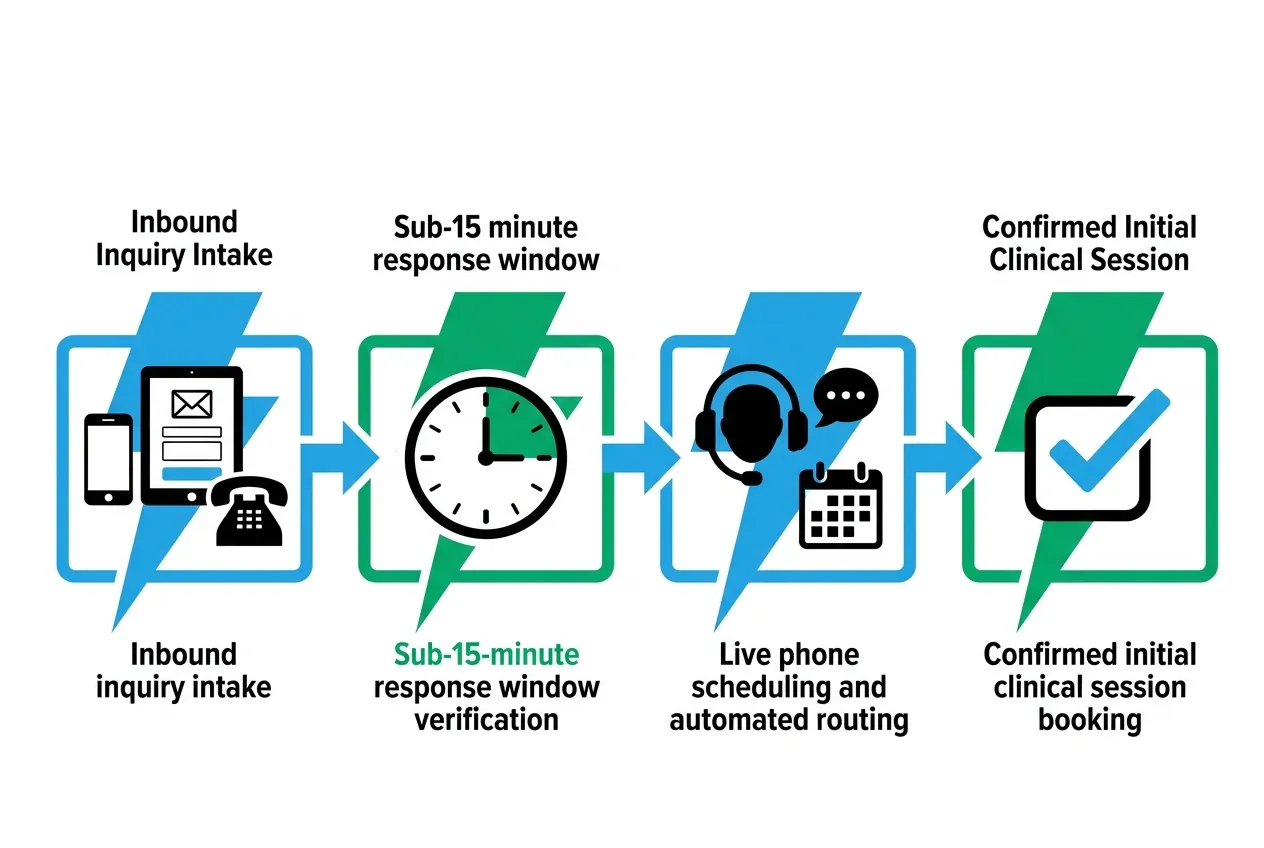
To prevent intake leakage, multi-clinician practices must implement structured, responsive intake protocols:
The intake system must maintain operational discipline across four functional areas:
- Dedicated Intake Personnel: Clinicians should rarely manage initial intake calls. Treating clinicians possess clinical training, not intake sales and logistical scheduling expertise. Clinicians returning calls between client hours sound rushed, lack immediate visibility into overall group schedule availability, and cannot systematically verify complex insurance benefits. Practices scaling beyond three clinicians require dedicated intake coordinators whose primary key performance indicator (KPI) is intake conversion speed and patient-to-clinician matching accuracy.
- Standardized Phone Scripts and Clinical Triage: Intake coordinators require structured scripts that balance emotional empathy with operational qualification. The intake team must rapidly identify the prospective patient's presenting concern, determine clinical suitability for outpatient care, verify payment capability (insurance benefits or private-pay sliding scale limits), and assess schedule compatibility.
- Automated Insurance Verification: If your clinic accepts commercial health insurance, unexpected out-of-pocket costs represent the primary driver of initial appointment cancellations. Intake workflows must integrate electronic insurance verification tools that check deductible status, copayment requirements, and coinsurance responsibilities before the patient attends the first session. Surprising a client with an unexpected $150 deductible invoice following their initial diagnostic evaluation virtually guarantees that the client will not return for session two.
- Attendance Reinforcement Protocols: The drop-off rate between scheduling an initial appointment and attending that session can reach 20% to 30% in behavioral health clinics if left unmanaged. Mitigate attendance drop-off by deploying automated, HIPAA-compliant SMS and email reminders at 48 hours and 24 hours prior to the session. Mandate that all initial intake paperwork, clinical questionnaires, and credit cards on file be submitted digitally through your EHR patient portal at least 24 hours before the appointment time. Patients who invest time completing initial intake documentation show substantially higher attendance rates.
Marketing Powered's founder, who served as a healthcare CMO running marketing for a treatment network that grew from 3 to 24 locations and managed $1.5 to $2M per month in Google Ads across 11+ behavioral and mental health accounts, observed that marketing efficiency correlates directly with operational alignment at the front desk. Media dollars cannot compensate for slow call response times, poorly trained intake staff, or fragmented administrative follow-up.
Privacy, Tracking, and Regulatory Guardrails for Mental Health Practices
Therapy marketing operates under unique regulatory constraints that do not apply to standard commercial businesses. Marketing directors and practice owners must navigate the intersection of federal patient privacy statutes, state licensing board rules, and consumer protection trade regulations. Implementing digital marketing without a rigorous compliance framework exposes a practice to severe regulatory penalties, licensing board sanctions, and reputational damage.
The most critical regulatory development affecting digital healthcare marketing is the enforcement of tracking technology guidance under the Health Insurance Portability and Accountability Act (HIPAA). In December 2022, and subsequently updated, the Department of Health and Human Services (HHS) Office for Civil Rights (OCR) issued definitive guidance regarding the use of online tracking technologies. The HHS OCR Tracking Technologies Guidance clarifies that regulated covered entities may not deploy third-party tracking technologies, such as the standard Meta Pixel, Google tag, or programmatic ad trackers, on pages where protected health information (PHI) could be transmitted to unauthorized third parties without valid patient authorization.
When an individual visits a mental health clinic website and navigates to a page addressing specific conditions (such as bipolar disorder or trauma therapy), or interacts with an appointment scheduling portal, the combination of their IP address or device identifier with the health-related URL creates an identifiable disclosure of health intent. If standard consumer tracking pixels transmit that data to advertising platforms that utilize it for their own commercial profiling or audience optimization, the practice has committed a regulatory violation.
To remain compliant, mental health practices must adjust their website tracking architecture:
- Remove unconfigured third-party advertising pixels from all appointment request forms, client portal login areas, and condition-specific service pages.
- Utilize server-side tracking environments governed by formal Business Associate Agreements (BAAs), stripping IP addresses, user identifiers, and query strings before transmitting stripped, aggregated conversion signals to analytics platforms.
- Avoid deploying consumer-grade session recording tools (such as Hotjar or FullStory) on pages that capture free-text patient inquiries or confidential medical histories.
Simultaneously, practice owners must maintain strict adherence to ethical rules governing client reviews and testimonials. In general commercial marketing, collecting public client testimonials and displaying them prominently on homepages is standard practice. In mental health, this practice is governed by strict ethical codes and consumer protection laws.
The American Psychological Association (APA) Ethics Code (Standard 5.05) explicitly states that psychologists do not solicit testimonials from current therapy clients or from other persons who because of their particular circumstances are vulnerable to undue influence. Similar prohibitions exist within the ethical codes of the National Association of Social Workers (NASW) and the American Association for Marriage and Family Therapy (AAMFT). Asking an active, vulnerable therapy client to post a public review of their mental health treatment compromises clinical boundaries, creates subtle coercion, and violates patient confidentiality if the client's identity becomes publicly linked to psychiatric care.
Furthermore, platform policies and federal trade rules strictly regulate how businesses manage their public reputation:
- Review Gating and Manipulation: The Google Maps User Contributed Content Policy strictly forbids review gating, the illicit practice of pre-screening customers with a survey and only routing positive respondents to public review sites while filtering negative feedback into internal forms. Google also prohibits incentivizing reviews through discounts, gifts, or entry into raffles.
- Federal Trade Commission Enforcement: In August 2024, the Federal Trade Commission announced its final rule banning fake reviews and testimonials. The FTC Final Rule on Consumer Reviews and Testimonials establishes formal prohibitions against creating fake consumer reviews, suppressing negative reviews through intimidation or legal threats, and buying positive ratings.
Practices must resolve the reputation puzzle by focusing review solicitation efforts ethically. Do not solicit reviews from active psychotherapy clients. Instead, practices can legitimately build local authority by encouraging reviews from professional referral sources, colleagues, alumni who have formally completed care and voluntarily wish to share feedback without solicitation, and individuals who interface with the practice through community education, workshops, or professional clinical training programs.
Operating within these parameters requires technical expertise. Marketing Powered is an AI-native firm since 2022 that operates owned, local AI infrastructure for HIPAA-aware inference. Our systems are built specifically for Google's sensitive healthcare vertical, where retargeting is not permitted, ensuring that patient acquisition campaigns expand practice revenue without compromising patient privacy or regulatory standing.

Measuring Marketing Against Attended Sessions Instead of Lead Volume
The traditional marketing agency model relies on vanity metrics: impressions, clicks, traffic volume, and raw lead form fills. An agency report might proudly highlight a $35 cost-per-lead (CPL) and claim outstanding campaign success.
For the owner of a mental health group practice, raw lead volume is a deceptive metric. A lead is not a patient. A lead is simply an unverified contact string consisting of a name, an email address, and a phone number. In behavioral health, a high percentage of raw leads never materialize into clinical revenue.
A $35 lead who has an out-of-state Medicaid plan that your clinic cannot accept is worth zero dollars. A $35 lead who requires acute inpatient hospitalization for active psychosis when your outpatient practice only treats mild-to-moderate depression is clinically unserviceable and represents zero dollars. A $35 lead who schedules an appointment but fails to show up for their initial diagnostic evaluation generates zero dollars while wasting an hour of paid clinician time.
Managing therapist marketing effectively requires abandoning cost-per-lead as your primary optimization metric. Practices must calibrate their marketing systems around downstream clinical milestones:
- Qualified Inquiries: Prospective clients who meet your clinical scope of care, reside within your state of licensure, and possess an accepted payment method (in-network commercial insurance or financial capability for private pay).
- Scheduled Intakes: Qualified inquiries that successfully complete triage and reserve a confirmed time slot on a clinician's calendar.
- Attended First Sessions (Admissions): The true baseline acquisition event. The patient attends the initial diagnostic assessment, the practice processes billing or collects the private fee, and the therapeutic relationship formally begins.
- Retained Active Clients: Patients who complete the intake session and schedule session two and beyond, advancing toward a full course of clinical care.
Attribution must be tracked to admission, not just lead. When you measure acquisition performance against attended first sessions, the economic realities of your marketing channels become apparent.
Consider a comparative scenario between two different marketing channels evaluated by a three-location outpatient group practice:
- Channel A (Broad Directory Listings & Low-Cost Paid Social Ads): Generates 100 raw inquiries at a low cost of $40 per inquiry, totaling $4,000 in spend. Because the traffic intent is unfocused, only 30 of those inquiries are clinically qualified and insured. Due to slow follow-up and weak commitment, only 12 schedule an intake, and only 8 attend their first session. The true Cost Per Attended Session is $500 ($4,000 divided by 8).
- Channel B (High-Intent Local Search & Dedicated Service-Line SEO): Generates 40 raw inquiries at a higher upfront cost of $100 per inquiry, totaling $4,000 in spend. Because these individuals actively searched for specific clinical specialties (such as "OCD exposure therapy specialist"), 32 of those inquiries are clinically qualified. With rapid intake verification, 22 schedule an intake, and 18 attend their first session. The true Cost Per Attended Session is $222 ($4,000 divided by 18).
Viewed through superficial agency reporting, Channel A appeared more successful because it produced leads at $40 versus $100. Viewed through operator economics, Channel B delivered more than double the clinical revenue at less than half the actual acquisition cost per patient.
Tracking marketing efficiency down to the attended first session requires establishing closed-loop attribution between your marketing systems and your Electronic Health Record (EHR) platform, such as SimplePractice, TherapyNotes, or AdvancedMD. While privacy regulations prevent sending protected health information back to advertising platforms, your internal reporting systems must match anonymized marketing campaign IDs with completed billing codes (such as CPT Code 90791 for psychiatric diagnostic evaluations).
By measuring marketing against completed initial sessions, clinic owners can make confident capital allocation decisions. When you know that an advertising campaign consistently acquires attended patients for an investment of $225, and your average private-pay client generates $1,800 in lifetime billings across twelve sessions, marketing ceases to be an administrative overhead expense. It becomes a predictable commercial growth engine.
Questions, Answered.
The most measurable therapist marketing channels are high-intent search channels: paid search advertising (Google Ads) and localized search engine optimization integrated with Google Business Profiles. These channels are highly measurable because they capture direct, active search intent. A prospective patient searching for "couples therapy in Denver" has a clear, immediate clinical need. By implementing privacy-compliant call tracking numbers and unique server-side form conversion endpoints, clinics can track the path of a prospective patient from their initial search query to the moment they submit a contact form or initiate a phone call. Conversely, channels such as offline networking, community sponsorships, passive directory listings, and organic social media posting are notoriously difficult to measure accurately. They operate primarily as broad awareness mechanisms, providing weak visibility into which specific marketing investments resulted in attended clinical sessions.
Therapist marketing should be measured by establishing an intake tracking pipeline that evaluates conversion progression through four distinct gates: Gate 1 (Raw Inquiries): Total volume of incoming phone calls, contact forms, and online scheduler clicks. Gate 2 (Qualified Intake Calls): Inquiries that pass clinical criteria, state licensing boundaries, and insurance or private-pay financial verification. Gate 3 (Scheduled Diagnostic Evaluations): Verified prospects who book a specific time on a clinician's schedule. Gate 4 (Attended First Sessions / Admissions): The patient attends their initial session (CPT Code 90791), completes billing, and enters ongoing care. Calculate your true marketing acquisition cost using the formula: Total Channel Marketing Spend divided by Total Attended First Sessions. If a paid search campaign spends $3,000 in a month and produces 40 phone calls, 20 scheduled intakes, and 15 attended first sessions, your Cost Per Attended Session is $200. Measuring performance at Gate 4 ensures you optimize marketing capital around actual practice revenue rather than superficial lead counts.
No. Under Google's personalized advertising policies, mental health services, psychiatric treatments, and personal health conditions are categorized as sensitive categories. Google strictly prohibits the use of retargeting, remarketing lists for search ads (RLSA), and customer match lists for health-related offerings. Additionally, deploying standard third-party tracking pixels on patient-facing clinical pages violates HHS OCR guidance regarding protected health information. Practices must design their websites and landing pages to convert prospective patients during their initial visit through clear clinical value propositions, transparent credentials, and frictionless, rapid intake pathways.
While solo practitioners can utilize paid search advertising to fill a brand-new practice, paid advertising delivers the highest return on investment for group practices employing three or more clinicians. Solo practitioners face an immediate operational constraint: once their individual caseload reaches fifteen to twenty-five recurring weekly clients, they reach maximum capacity. At that point, they must turn off advertising campaigns, forfeiting the momentum and algorithmic learning established in their ad accounts. Multi-clinician practices and outpatient clinics, however, possess recurring clinical capacity. As clinicians graduate clients or as new associate therapists join the practice, the business can maintain continuous, optimized advertising campaigns, dynamically routing new patient inquiries to whichever clinicians possess open schedule availability.
Insurance credentialing fundamentally alters your marketing messaging, landing page design, and keyword targeting strategy. For practices accepting commercial insurance panels (such as Blue Cross Blue Shield, Aetna, or UnitedHealthcare), marketing campaigns should prominently feature accepted insurance panels across ad copy, headlines, and website headers. In-network search queries (such as "in-network therapist Aetna") represent exceptionally high commercial intent; prospective clients searching these terms have already determined their payment method and are actively looking for an available provider. For private-pay and out-of-network practices, marketing strategy must pivot toward clinical specialization, advanced therapeutic modalities (such as EMDR, Somatic Experiencing, or intensive outpatient programs), and dedicated superbill reimbursement support. Private-pay marketing must clearly justify out-of-pocket fees by highlighting clinician expertise, lower caseloads, immediate appointment availability, and specialized clinical focus. Mixing these two distinct models within the same generic campaign creates intake confusion and depresses conversion efficiency. Request an acquisition audit
Ready to see where your marketing can improve?
Request a free audit of your paid media, landing pages, attribution, and measurement setup. You'll get a straight assessment of where the opportunities are.
or email us at info@marketingpowered.ai