Capabilities
SEO for Therapists and Group Practices
Organic discovery for therapy practices requires an integrated local search infrastructure that connects condition-specific searches to qualified booked appointments. Approaching seo for therapists as an operational growth engine lowers reliance on paid advertising and third-party referral marketplaces while filling clinical caseloads with financially viable patient demand. Building an owned patient acquisition asset fundamentally changes the economics of practice growth.

Why Generic Search Tactics Fail Mental Health Practices
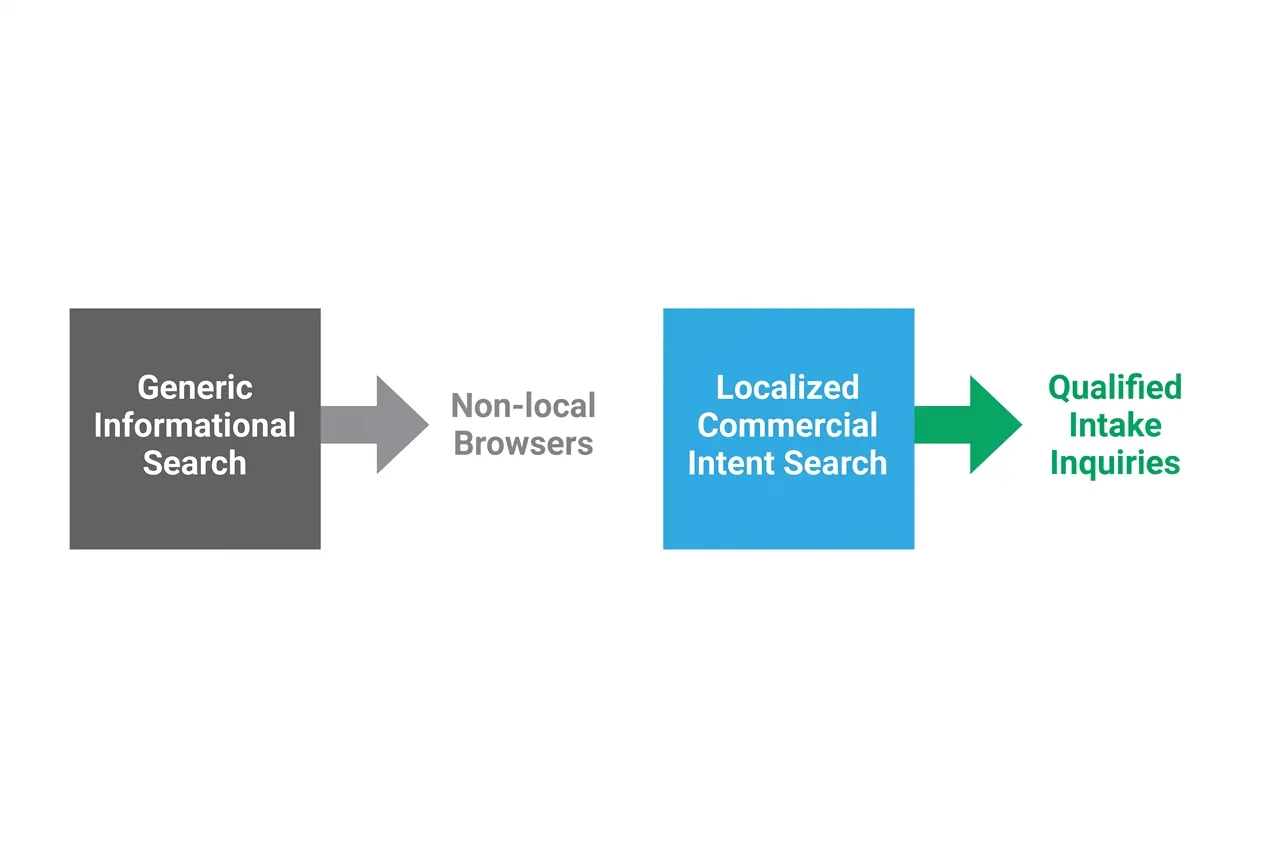
Generic marketing tactics drive irrelevant national traffic for informational symptoms rather than local, commercially viable inquiries. Marketing agencies frequently advise practice owners to publish broad blog posts about national psychological concepts. This strategy attracts high-funnel readers researching their symptoms who have no capacity to book an in-person or state-licensed telehealth appointment. True therapist seo captures high-intent local queries. In the United States, commercial search terms signal immediate readiness for care. The primary search term generates 1,600 monthly searches with a $16.12 cost per click, while localized variations carry similarly high commercial intent.
Relying exclusively on third-party referral marketplaces like Psychology Today traps practitioners in a saturated directory. Prospective clients scroll through dozens of competing therapists with identical profiles, which depresses session rates and conversion rates. Sustainable practice growth requires stepping outside the directory trap to capture a qualified local patient seeking an immediate clinical evaluation.
Local Search and Multi-Clinician Profile Architecture
Physical location signals dictate local map pack visibility, but group practices often mismanage practitioner versus practice listings. A solo practitioner expanding into a multi-clinician group frequently encounters an intake plateau because their individual online profile cannot feed multiple clinicians across distinct clinical specialties. Expanding a local footprint requires precise entity validation.
Google explicitly allows individual practitioners to have their own listing if they are public-facing, but requires specific naming conventions and category distinctions to avoid algorithmic suppression, as detailed in the Google Business Profile representation guidelines. Group practices trigger duplicate profile suspensions by creating conflicting listings at the same office address. Properly executing local seo for therapists structures the primary practice listing alongside individual practitioner listings. Search engines prioritize geographic proximity, profile completeness, and primary category relevance according to published Google local ranking guidelines.
Capturing Demand with Specialty Service Pages
High-converting patient demand searches by clinical specialty, modality, and population, not just broad geography. A person seeking specialized trauma care searches for specific modalities, while parents search specifically for adolescent behavioral health interventions. Capturing this intent requires building standalone, crawlable service pages for distinct clinical presentations such as anxiety, grief, and couples therapy.
This service page architecture maps specific modalities directly to state-licensed clinician schedules and billing codes. Connecting cognitive behavioral therapy or dialectical behavior therapy to specific clinician licensures and self-pay options meets strict search engine quality standards for health information. Implementing dedicated mental health SEO ensures that a practice aligns its technical website structure with the exact language prospective patients use when they are ready to schedule an initial evaluation.
Free Audit
Want a straight read on where your budget is leaking?
Scaling the Intake Pipeline for Group Practices
The acquisition dynamics differ wildly between a solo practitioner needing 20 recurring clients and an outpatient group practice needing 40 new clinical evaluations monthly across diverse licensures. Expanding solo practitioners transitioning to an employer model must generate enough weekly clinical intake volume to fill caseloads for their associate therapists.
Clinical directors managing multiple clinicians across physical outpatient suites require a predictable intake pipeline that balances insurance splits and clinical specializations. Comprehensive therapy group marketing connects local search visibility directly to administrative capacity. Without a highly structured search optimization strategy, group practices cannibalize their own ranking power and fail to distribute new patient inquiries effectively across their available clinicians.

Measuring Success from Inquiry to Admission
Web forms and phone calls frequently drop into unmonitored intake queues without tracking which search queries or landing pages produced an actual booked initial evaluation. Search engine optimization must be measured strictly by financial visibility and qualified opportunity. Vanity metrics like total website visitors hold zero commercial value if the practice calendar remains empty.
Attribution tracked to admission, not just lead volume, provides the operational intelligence necessary to scale a clinical practice. Marketing Powered connects marketing spend, search visibility, and landing page performance directly to scheduled clinical appointments. Utilizing an AI-native approach since 2022, the agency operates owned, local AI infrastructure for HIPAA-aware inference. This provides explicit data handling and data sovereignty, ensuring that sensitive marketing analytics and conversion metrics remain tightly controlled within a closed operating environment.
Ethical Governance and Compliance in Patient Acquisition
Generating organic patient demand intersects heavily with clinical ethics and federal regulations. A robust online reputation improves local map pack visibility, but practice owners cannot solicit reviews in exchange for incentives or selectively gate negative feedback. These deceptive practices are strictly prohibited by the Federal Trade Commission consumer reviews rule.
Furthermore, clinical ethics codes explicitly prohibit soliciting testimonials from current therapy clients due to the risk of undue influence. Administrative intake staff must navigate these review guidelines and policy dependencies to build reputation authentically without utilizing patient incentives. Marketing Powered is LegitScript-aware and HIPAA-aware, built specifically for Google's sensitive healthcare vertical where retargeting is not permitted and patient privacy is paramount.

Email Us
Prefer to send the context directly?
What an Operator-Led Acquisition Audit Includes
Marketing Powered operates on a foundation of direct commercial scale. The founder is a former healthcare CMO who ran marketing for a treatment network that grew from 3 to 24 locations. This executive background includes managing $1.5 to $2M per month in Google Ads across 11+ behavioral and mental health accounts.
As a court-certified expert witness in advertising strategy, the founder designed an acquisition audit that treats local search optimization as a critical operational asset. The audit evaluates local entity validation, multi-practitioner Google Business Profile structuring under official guidelines, niche-to-service mapping, and conversion pathways. This operator-level diagnosis identifies the specific friction points preventing a practice from scaling its initial clinical evaluations.
Questions, Answered.
Solo practitioners require localized visibility for a single primary entity to fill a limited recurring caseload. Expanding group practices require a multi-practitioner local footprint capable of generating dozens of new clinical evaluations monthly across diverse licensures. A solo practice relies on a single Google Business Profile, whereas a group practice must structure multiple distinct category listings without triggering duplicate profile suspensions.
Search optimization should never be evaluated on national blog traffic or unranked directory views. Performance must be tracked from the initial local search click to the scheduled clinical appointment. Attribution tracked to admission confirms exactly which geographic location and condition-specific landing page produced a financially viable patient, aligning marketing investment with actual clinical revenue. Request an acquisition audit
Ready to see where your marketing can improve?
Request a free audit of your paid media, landing pages, attribution, and measurement setup. You'll get a straight assessment of where the opportunities are.
or email us at info@marketingpowered.ai